A tire inflator is a portable motorized machine that pumps compressed atmospheric air directly into automotive, truck, and equipment tires to maintain proper psi levels and prevent premature tread wear. Selecting the right tire inflator at Home Depot requires matching your vehicle’s tire volume, electrical power access, and required duty cycle against the engineering specifications of available cordless, corded, and hybrid units. Understanding how these machines perform under real-world conditions ensures you invest in a tool capable of handling emergency roadside flats or routine seasonal tire pressure adjustments without overheating.
Key Facts at a Glance
- Core Function: Converts electrical energy into compressed pneumatic air via an internal motor and piston mechanism, delivering up to 160 Max PSI.
- Primary Power Sources: Available at Home Depot in 18V/20V lithium-ion cordless battery platforms, 12V DC vehicle auxiliary plugs, and dual-power hybrid configurations.
- Inflation Speed Benchmarks: Standard passenger car tires fill from flat to 35 PSI in 3 to 5 minutes, whereas heavy-duty 33-inch light truck tires require high-output 18V units running for 60 to 90 seconds per top-off.
- Pricing Spectrum: Entry-level corded 12V units retail between $30 and $60, while professional-grade cordless tool-only units range from $80 to $150.
- Critical Operational Limit: Exceeding the manufacturer’s specified duty cycle causes thermal overload, melting internal piston rings and destroying pressure sensors.
How a Home Depot Tire Inflator Works Inside
Understanding the internal mechanical architecture of a portable tire inflator helps explain why certain units handle heavy truck tires effortlessly while others burn out on small sedan top-offs. Inside the durable housing, a high-torque electric motor drives an eccentric crankshaft attached to a small connecting rod and piston cylinder.
As the piston descends, it creates a low-pressure vacuum that draws in outside ambient air through a filtered intake valve. When the piston ascends, it compresses that air chamber, forcing it past a spring-loaded check valve into a reinforced rubber or braided nylon delivery hose. The pressurized air passes through a valve chuck directly into the tire stem. A digital or analog pressure sensor continuously monitors the internal tire pressure against your pre-programmed target, sending an electrical signal to cut motor power the exact moment the threshold is reached.
Units sold at Home Depot vary widely in their internal build quality. Budget 12V models frequently utilize plastic gears and miniature brushed motors that generate significant friction heat. Professional-grade units from brands like Milwaukee and DeWalt utilize brushless motors, brass fittings, and aluminum cylinder heads that dissipate heat rapidly and withstand higher sustained operating loads.
Evaluative Breakdown of Tire Inflator Types at Home Depot
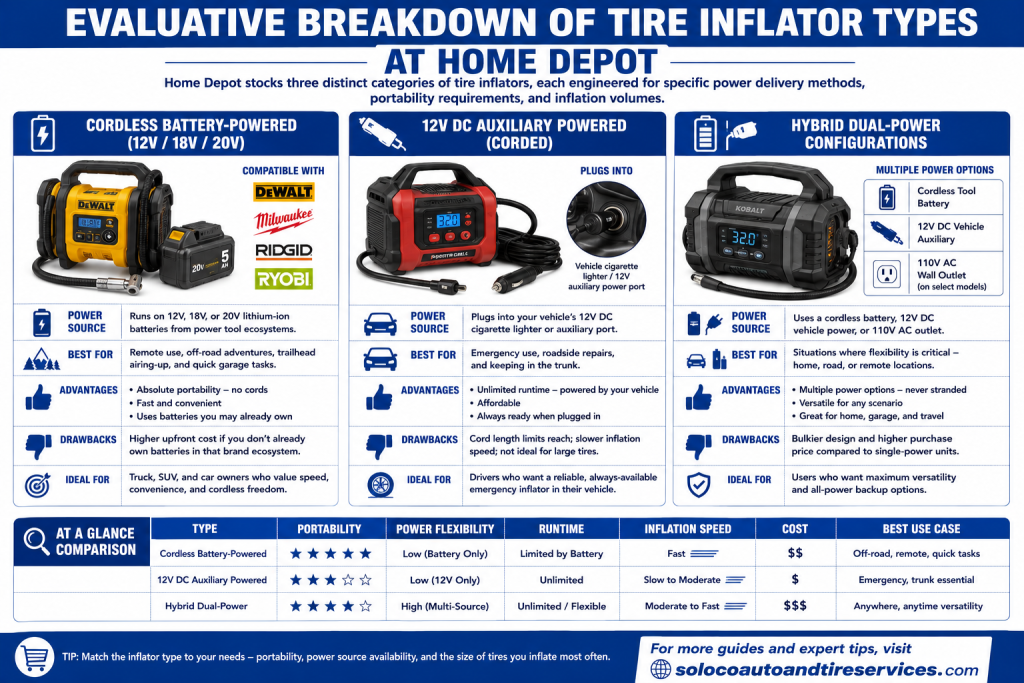
Home Depot stocks three distinct categories of tire inflators, each engineered for specific power delivery methods, portability requirements, and inflation volumes.
Cordless Battery-Powered (12V / 18V / 20V)
Cordless battery-powered inflators represent the fastest-growing segment at Home Depot due to their absolute portability and elimination of tangled power cords.
These units run on existing power tool battery ecosystems, allowing you to use the same lithium-ion pack that powers your drill or impact wrench. They excel in remote environments, trailhead tire airing-up sessions, and rapid garage maintenance. The primary drawback is the upfront cost if you do not already own batteries within that specific brand ecosystem.
12V DC Auxiliary Powered (Corded)
Traditional 12V DC corded inflators plug directly into your vehicle cigarette lighter socket or auxiliary power port, drawing electrical current straight from the car alternator or battery.
These units offer unlimited runtime because they lack battery capacity limits, making them reliable emergency trunk staples. However, their physical reach is restricted by the length of the power cord and auxiliary hose, and they typically pump air at a slower volumetric flow rate, making them poorly suited for large truck or SUV tires.
Hybrid Dual-Power Configurations
Hybrid inflators combine the best of both worlds by accepting power from both a cordless tool battery and a 12V vehicle auxiliary adapter, or in some heavy-duty models, a standard 110V AC household wall outlet. This versatility ensures you are never stranded with a dead battery pack or a blown vehicle fuse.
While they offer unmatched flexibility, their multi-source architecture results in a bulkier physical footprint and a higher standalone purchase price.
Master Performance and Ecosystem Matrix
The following matrix compares the core performance specifications, power flexibility, and target applications of the primary tire inflator lines available at Home Depot.
| Model Category | Primary Power Source | Max PSI | Typical Inflation Speed (Passenger Tire) | Duty Cycle | Approximate Price Range | Best Suited For |
| Ryobi ONE+ 18V | 18V Lithium-Ion Battery | 150 PSI | 3 Minutes (0 to 35 PSI) | 50% (5 mins on / 5 mins off) | $50 – $80 (Tool Only) | Home garage maintenance & DIYers |
| Milwaukee M18 | 18V M18 RedLithium Battery | 150 PSI | 2 Minutes (0 to 35 PSI) | 60% (Continuous under load) | $130 – $160 (Tool Only) | Heavy-duty truck owners & contractors |
| Husky 12V Multi-Purpose | 12V Vehicle Cigarette Lighter | 150 PSI | 5 to 7 Minutes (0 to 35 PSI) | 20% (10 mins max runtime) | $30 – $45 | Emergency roadside trunk storage |
| Ridgid 18V Hybrid | 18V Battery or 12V DC Adapter | 160 PSI | 2.5 Minutes (0 to 35 PSI) | 50% (5 mins on / 5 mins off) | $100 – $130 | Versatile workshop and garage use |
| DeWalt 20V Max Cordless | 20V Battery, 12V DC, or 110V AC | 160 PSI | 2 Minutes (0 to 35 PSI) | 60% (Continuous under load) | $140 – $170 | Multi-platform professional tradespeople |
Key Specifications, Inflation Speed Benchmarks, and Pricing
Evaluating a tire inflator requires looking beyond marketing claims and analyzing concrete performance metrics. Understanding how these specifications translate into real-world use prevents buyer’s remorse.
- Maximum Air Pressure Output: Most Home Depot inflators range from 100 PSI up to 160 Max PSI. While standard passenger car tires only require 32 to 36 PSI, high-pressure capability is essential for inflating bicycle tires (up to 100 PSI) or heavy-duty commercial truck trailer tires.
- Volumetric Air Delivery (CFM): Measured in cubic feet per minute, air delivery speed dictates how quickly a tire fills. Heavy-duty 18V units move more air volume per piston stroke, filling a standard passenger tire in 3 minutes compared to 6 minutes for cheap 12V cigarette lighter units.
- Light Truck Tire Benchmark (33-inch): Airing up a large 33×12.50R18 off-road truck tire from 15 PSI (trail pressure) back to 35 PSI (highway pressure) takes roughly 1 minute per tire with a high-output Milwaukee M18 unit, but can overheat and stall a basic 12V corded inflator.
- Pricing Structure: Home Depot splits pricing into “tool-only” (batteries and charger sold separately) and “kit” options. Budget corded 12V units include everything for $30 to $60, while 18V professional cordless systems require an investment of $80 to $150 for the bare tool alone.
Step-by-Step Operation Protocol for Safe Inflation
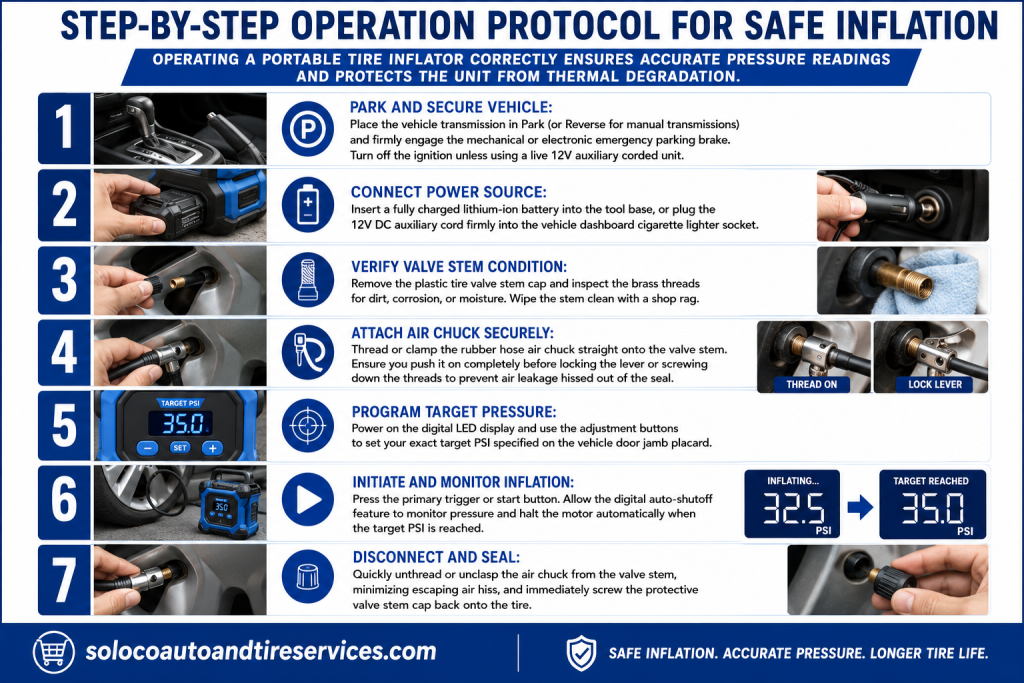
Operating a portable tire inflator correctly ensures accurate pressure readings and protects the unit from thermal degradation. Follow this precise sequence every time you inflate a tire.
- Park and Secure Vehicle: Place the vehicle transmission in Park (or Reverse for manual transmissions) and firmly engage the mechanical or electronic emergency parking brake. Turn off the ignition unless using a live 12V auxiliary corded unit.
- Connect Power Source: Insert a fully charged lithium-ion battery into the tool base, or plug the 12V DC auxiliary cord firmly into the vehicle dashboard cigarette lighter socket.
- Verify Valve Stem Condition: Remove the plastic tire valve stem cap and inspect the brass threads for dirt, corrosion, or moisture. Wipe the stem clean with a shop rag.
- Attach Air Chuck Securely: Thread or clamp the rubber hose air chuck straight onto the valve stem. Ensure you push it on completely before locking the lever or screwing down the threads to prevent air leakage hissed out of the seal.
- Program Target Pressure: Power on the digital LED display and use the adjustment buttons to set your exact target PSI specified on the vehicle door jamb placard.
- Initiate and Monitor Inflation: Press the primary trigger or start button. Allow the digital auto-shutoff feature to monitor pressure and halt the motor automatically when the target PSI is reached.
- Disconnect and Seal: Quickly unthread or unclasp the air chuck from the valve stem, minimizing escaping air hiss, and immediately screw the protective valve stem cap back onto the tire.
Common Operational Failures and Recovery
Even high-end inflators purchased at Home Depot can fail prematurely if operated outside their engineered thresholds. Recognizing common mistakes saves equipment and prevents roadside emergencies.
- Ignoring the Manufacturer Duty Cycle: Running a compact inflator continuously for more than 10 to 15 minutes causes severe heat buildup in the piston cylinder. This thermal overload melts internal plastic seals and warps check valves. Always allow the unit to rest for 10 minutes between consecutive tire inflations.
- Blowing Vehicle Fuses with 12V Units: Plugging a high-draw 12V corded inflator into an older vehicle socket while the car engine is turned off will quickly drain the car battery and blow the auxiliary circuit fuse. Always run the vehicle engine while using a corded 12V plug to ensure a steady 13.8V alternator electrical supply.
- Improper Air Chuck Engagement: Angling or cross-threading the chuck onto the tire valve stem deforms the Schrader valve pin, causing continuous pressure loss rather than inflation. Always press the chuck straight down parallel to the stem before securing.
- Kinking Delivery Hoses: Bending or folding the rubber or braided hose while the pump is actively operating creates backpressure spikes that strain internal pressure sensors and rupture hose sidewalls.
Field Troubleshooting Guide
When your Home Depot tire inflator fails to operate or displays unexpected error codes during an inflation task, use this diagnostic guide to restore function.
- Unit Fails to Power On: If an 18V cordless unit remains dead when pressing the trigger, swap out the battery pack for a known charged unit and check the battery terminal contacts for dirt or debris. If using a 12V corded unit, inspect the cylindrical 12V plug tip and unscrew the cap to replace the internal glass fuse (typically rated at 10A or 15A).
- Digital Display Flanks or Shows Error Codes: If the LED screen flashes erratically or displays an error code, disconnect the air chuck from the tire, power the unit completely off, and restart the device to reset the internal solid-state pressure transducer.
- Extremely Slow Air Delivery: If the pump runs but takes excessive time to move air, inspect the rubber hose for pinhole cracks or loose threaded fittings where air is escaping before reaching the tire valve. Allow the unit to cool down completely if it has entered a thermal throttling state.
- Inaccurate Pressure Readings: If the digital gauge reads significantly higher than a handheld manual pencil gauge, turn off the motor and let the tire air settle for 30 seconds to allow compressed heat to dissipate before taking a final static pressure reading.
Persona-Based Purchasing Matrix: Which Home Depot Inflator Should You Choose?
Selecting the ideal tire inflator depends entirely on your specific lifestyle, vehicle fleet, and existing tool ownership.
- The Metropolitan Commuter: Choose the Husky 12V DC Corded Inflator. Commuters rarely face off-road deflation emergencies and benefit from a compact, inexpensive unit that lives permanently tucked inside the vehicle trunk side-panel for unexpected seasonal temperature drops.
- The Overlanding Light Truck Owner: Choose the Milwaukee M18 Inflator. Light truck and SUV tires require high-volume air delivery and durable high-pressure capability after airing down on rocky trails. The M18 brushless motor handles heavy 33-inch tires without thermal shutdown.
- The Home DIY Garage Hobbyist: Choose the Ryobi ONE+ 18V Inflator. If you already own Ryobi drills, lawn mowers, or leaf blowers, adding the bare-tool inflator provides a cost-effective garage station for topping off family sedans, wheelbarrows, and sports equipment.
- The Multi-Platform Professional Tradesperson: Choose the DeWalt 20V Max Hybrid Inflator. Tradespeople operating on busy job sites benefit from three-way power flexibility (battery, 12V car plug, or 110V wall outlet), ensuring the unit is never sidelined by a dead power source.
- The Rural Homestead Fleet Manager: Choose the Ridgid 18V Hybrid Inflator. Homesteaders maintaining lawn tractors, utility trailers, and farm equipment require the rugged build quality, auto-shutoff precision, and dual-power reliability of the Ridgid platform.


