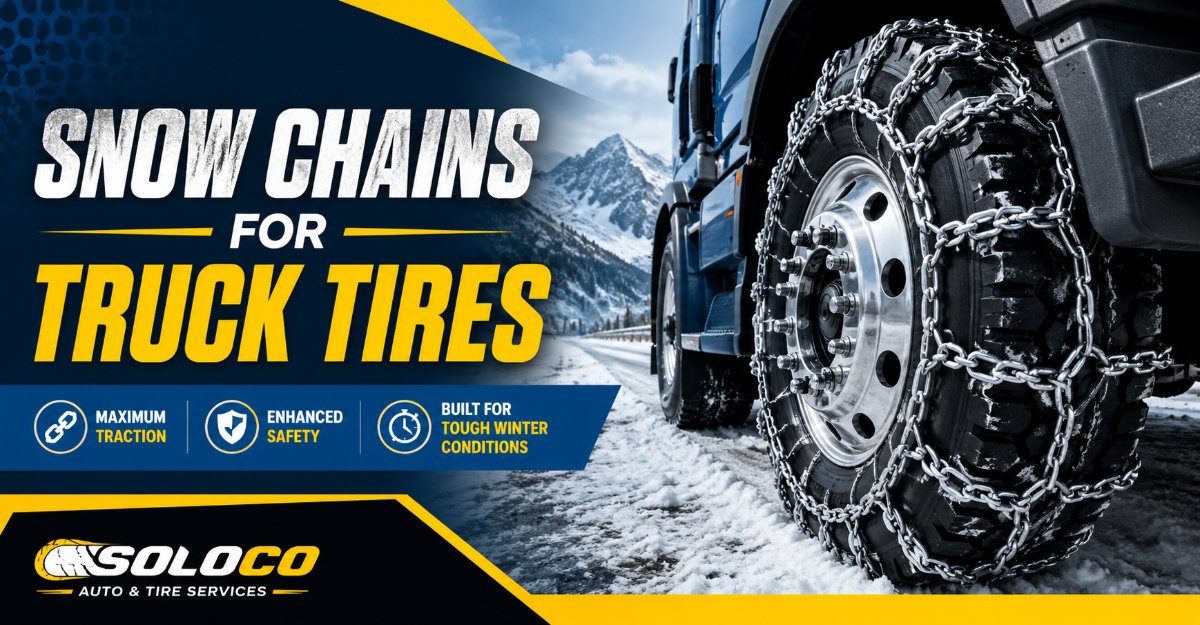
Snow chains for truck tires are heavy-duty detachable mechanical traction devices wrapped around vehicle drive wheels to provide maximum grip, friction, and lateral stability when operating through deep snow, hard-packed ice, and severe winter road conditions. Functioning by concentrating the heavy gross vehicle weight rating of a truck onto high-strength metal links or cables, these systems bite directly into frozen surfaces to prevent wheel slip, maintain steering authority, and ensure safe transit over treacherous mountain passes.
Key Facts at a Glance
- Maximum Speed Limit: 30 mph (50 km/h) to prevent centrifugal force from snapping metal links and destroying vehicle body panels.
- Typical Price Range: $60 to $200 per pair for light trucks; $150 to $500 for commercial semi-trucks; $2,000 to $3,500 for automatic axle systems.
- Installation Time: 10 to 20 minutes per axle once practiced; significantly longer in sub-zero emergency roadside conditions.
- Lifespan: 1 to 5 winter seasons, dictated entirely by the volume of miles driven on clear asphalt which rapidly wears down steel cross-links.
- Primary Requirement: Always install chains on the primary drive axle; 4WD and AWD trucks should consult owner manuals for front versus rear axle priority.
Mechanics of Truck Traction: How Snow Chains Work
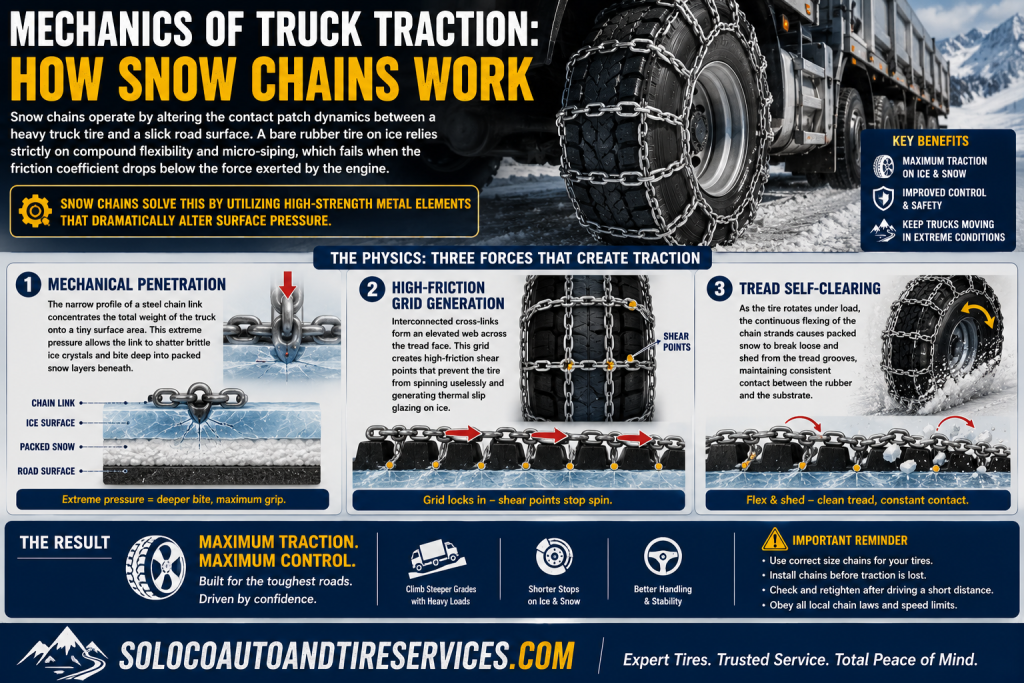
Snow chains operate by altering the contact patch dynamics between a heavy truck tire and a slick road surface. A bare rubber tire on ice relies strictly on compound flexibility and micro-siping, which fails when the friction coefficient drops below the force exerted by the engine.
Snow chains solve this by utilizing high-strength metal elements that dramatically alter surface pressure. The physics governing this mechanism involves three distinct forces:
- Mechanical Penetration: The narrow profile of a steel chain link concentrates the total weight of the truck onto a tiny surface area. This extreme pressure allows the link to shatter brittle ice crystals and bite deep into packed snow layers beneath.
- High-Friction Grid Generation: Interconnected cross-links form an elevated web across the tread face. This grid creates high-friction shear points that prevent the tire from spinning uselessly and generating thermal slip glazing on ice.
- Tread Self-Clearing: As the tire rotates under load, the continuous flexing of the chain strands causes packed snow to break loose and shed from the tread grooves, maintaining consistent contact between the rubber and the substrate.
Main Types of Truck Snow Chains
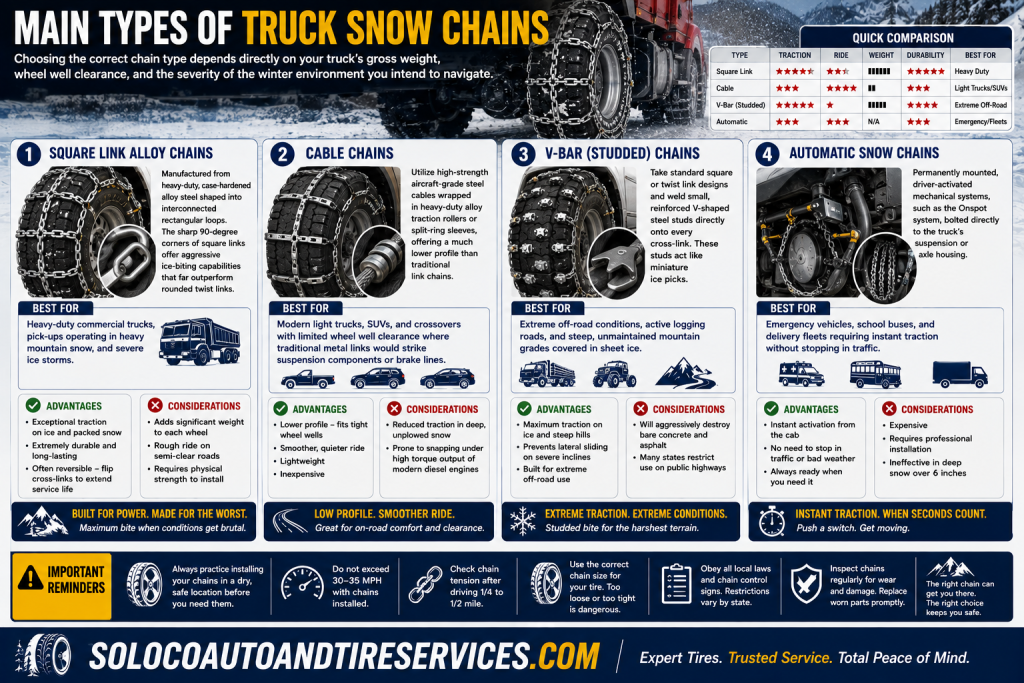
Choosing the correct chain type depends directly on your truck’s gross weight, wheel well clearance, and the severity of the winter environment you intend to navigate.
Square Link Alloy Chains
Square link chains are manufactured from heavy-duty, case-hardened alloy steel shaped into interconnected rectangular loops. The sharp 90-degree corners of square links offer aggressive ice-biting capabilities that far outperform rounded twist links.
These chains are best suited for heavy-duty commercial trucks, pick-ups operating in heavy mountain snow, and severe ice storms. They provide exceptional durability and are often reversible, allowing you to flip the cross-links to extend their service life. However, they add significant weight to each wheel, create a rough ride on semi-clear roads, and require physical strength to install properly.
Cable Chains
Cable chains utilize high-strength aircraft-grade steel cables wrapped in heavy-duty alloy traction rollers or split-ring sleeves, offering a much lower profile than traditional link chains.
They are engineered specifically for modern light trucks, SUVs, and crossovers with limited wheel well clearance where traditional metal links would strike suspension components or brake lines. Cable chains provide a smoother, quieter ride and are inexpensive. Their primary limitation is reduced overall traction in deep, unplowed snow, and they are prone to snapping under the high torque output of modern diesel engines if the tires spin against a stationary obstacle.
V-Bar (Studded) Chains
V-bar chains take standard square or twist link designs and weld small, reinforced V-shaped steel studs directly onto every cross-link. These studs act like miniature ice picks.
They are the definitive choice for extreme off-road conditions, active logging roads, and steep, unmaintained mountain grades covered in sheet ice. The studs prevent lateral sliding on severe inclines. Note that V-bar chains will aggressively destroy bare concrete and asphalt pavement within a few miles, and many state departments of transportation restrict their use on public highways to protect road infrastructure.
Automatic Snow Chains
Automatic snow chains are permanently mounted, driver-activated mechanical systems, such as the Onspot system, bolted directly to the truck’s suspension or axle housing.
When activated by a dashboard switch, an electric-over-air solenoid lowers a friction wheel into contact with the inside of the truck’s rear tire. The rotation of the tire spins the friction wheel, which centrifugalizes a series of flexible chain strands directly under the rolling tire tread. They are invaluable for emergency vehicles, school buses, and delivery fleets requiring instant traction without stopping in traffic. However, they are expensive, require professional installation, and fail to provide adequate traction in deep snow exceeding 6 inches.
Comprehensive Comparison of Chain Options
| Chain Type | Durability | Ice Bite Quality | Ride Comfort | Clearance Needed | Typical Price Range | Ideal Terrain |
| Square Link | High | Excellent | Rough | High (2 inches+) | $100 – $300 | Mountain passes, deep snow |
| Cable Chain | Moderate | Low to Moderate | Smooth | Low (under 1 inch) | $60 – $150 | Urban highways, light snow |
| V-Bar Studded | Extreme | Maximum | Very Rough | High (2 inches+) | $150 – $450 | Sheet ice, logging roads |
| Automatic | High (System) | Moderate | Smooth | Special Mount | $2,000 – $3,500 | Emergency fleets, variable ice |
Step-by-Step Installation Protocol for Manual Truck Chains
Correct installation ensures your chains stay secure, protect your vehicle body, and maximize traction. Practice this sequence in a dry driveway before facing an active winter storm.
- Park, Secure, and Inspect: Park your truck on a flat, level surface away from active traffic. Engage the parking brake, block the opposite tires, and lay the chains flat on the ground next to the drive tires to untangle any twists or overlapping links.
- Drape and Align: Carefully lift the chain assembly and drape it evenly over the top of the tire. Ensure that the smooth side of the cross-chain hooks faces inward toward the tire rubber, keeping the open hook ends facing outward to prevent sidewall punctures.
- Tuck and Position: Tuck the loose front ends slightly under the front base of the tire, leaving the main side chains accessible on the outer and inner flanks.
- Roll and Engage: Drive the truck forward slowly by 2 to 3 feet so the drive tire rolls squarely onto the main body of the chain.
- Fasten Inner and Outer Hooks: Reach behind the tire and connect the inner back-side catch hook first. Next, secure the outer front-side fastening hook, matching the link numbers on both sides to maintain equal tension.
- Tighten Integrated Cams: If your chains feature built-in cam links, insert the included cam wrench tool and turn each cam clockwise until the side chains lock firmly against the tire sidewall.
- Install Rubber Tensioners: Attach a multi-arm rubber bungee or heavy-duty spring tensioner evenly across the outer wheel face in a star pattern. This maintains constant dynamic tension, preventing centrifugal slack from developing at speed.
- Drive and Re-inspect: Drive forward approximately 1 quart of a mile at low speed, pull over into a safe zone, and inspect the fit. Manually tighten any slack that has shifted out during the initial roll-in period.
Critical Safety Parameters and Operating Limits
Operating heavy-duty truck snow chains requires strict adherence to mechanical limitations to prevent catastrophic vehicle damage.
- Speed Restrictions: Never exceed 30 mph (50 km/h) while wearing chains. Centrifugal force at higher speeds causes the flexible side chains to expand outward and whip violently against truck quarter panels, bending axle brake lines, tearing inner fender liners, and shattering suspension sensors.
- Pavement Wear Thresholds: Remove chains immediately upon reaching clear, bare asphalt. Steel links grinding against dry concrete generate high thermal friction that softens the metal links, reducing their structural integrity by up to 50% within a few dozen miles.
- Wheel Spin Hazards: Avoid spinning your tires inside the chains. Aggressive acceleration causes the cross-links to act like saw blades against the rubber tread blocks, tearing chunks out of the tire carcass and snapping cross-chain links under high torque shock loads.
Common Installation and Operational Mistakes
Avoiding common mistakes saves time, money, and prevents roadside accidents during winter travel.
- Chaining the Wrong Axle: Always install chains on the primary drive axle of the vehicle. For rear-wheel-drive trucks, chain the rear; for front-wheel-drive platforms, chain the front. For four-wheel-drive and all-wheel-drive trucks, consult your owner manual, though chaining all four wheels provides maximum steering and braking control.
- Ignoring Loose Ends and Excess Links: Failing to secure the trailing tail links of a chain allows loose steel ends to whip around at speed. Always secure excess links using zip ties, rubber retainers, or by hooking them back onto the side chain.
- Mismatched Link Counts: If your inner and outer fasteners are set to different link numbers, the chain will track crookedly across the tread face, leading to rapid side-wall wear, continuous vehicle vibration, and potential slippage off the tire shoulder.
- Driving with a Broken Link: If a cross-link snaps, pull over immediately in a safe zone. Continuing to drive with a flailing broken chain acts like a metal whip, destroying brake lines and wiring harnesses housed within the inner wheel well.
Frequently Asked Questions
Can I put snow chains on all-terrain or mud-terrain truck tires?
Yes, you can install snow chains on all-terrain and mud-terrain truck tires, but you must account for tread depth and clearance. Aggressive mud tires feature deep, wide tread voids that can swallow standard cross-links, reducing their ice-biting efficiency. Furthermore, oversized aftermarket tires frequently reduce factory wheel well clearance, requiring low-profile cable chains or specialized low-clearance diamond-pattern chains to prevent suspension interference.
How do I know what size snow chain to buy for my truck tires?
Snow chain sizing is determined strictly by your tire’s sidewall metrics, which include the tire width, aspect ratio, and rim diameter (e.g., LT275/65R20). Because tire manufacturers vary slightly in actual outer dimensions depending on tread design, always reference the manufacturer’s specific application chart rather than guessing by tire size alone. Buying an oversized chain leaves too much slack to tension safely, while an undersized chain will not stretch over the tire casing.
Are cable chains legal for mountain pass chain controls in states like California and Colorado?
Yes, standard cable chains meet the legal definition of tire traction devices under Department of Transportation regulations for R1 and R2 chain control levels in states like California and Colorado. However, when severe weather triggers R3 level restrictions—mandating that all vehicles must use chains regardless of four-wheel drive status—certain commercial mountain passes or heavy truck inspection stations may specifically require reinforced link or V-bar studded chains for heavy commercial vehicles.
What should I do if a snow chain breaks while driving on a mountain pass?
If a link snaps while driving, pull over immediately into a designated chain-up area or wide shoulder out of active traffic lanes. Remove the damaged chain completely if it cannot be repaired safely. If you carry an emergency repair kit, use a cold-shut repair link or a quick-connector tool to replace the broken cross-chain segment before continuing your journey. Never drive more than a few feet with a broken chain flapping against the vehicle body.
Do I need tensioners if my snow chains have built-in cams?
Yes, using external rubber bungees or spring tensioners alongside cam-tightened chains is strongly recommended by manufacturers. While built-in cams take up static slack during initial installation, dynamic forces, centrifugal expansion, and shifting snow pack will stretch the chain system during transit. Rubber tensioners provide continuous, active compensation that keeps the side chains locked securely against the tire flanks over miles of driving.