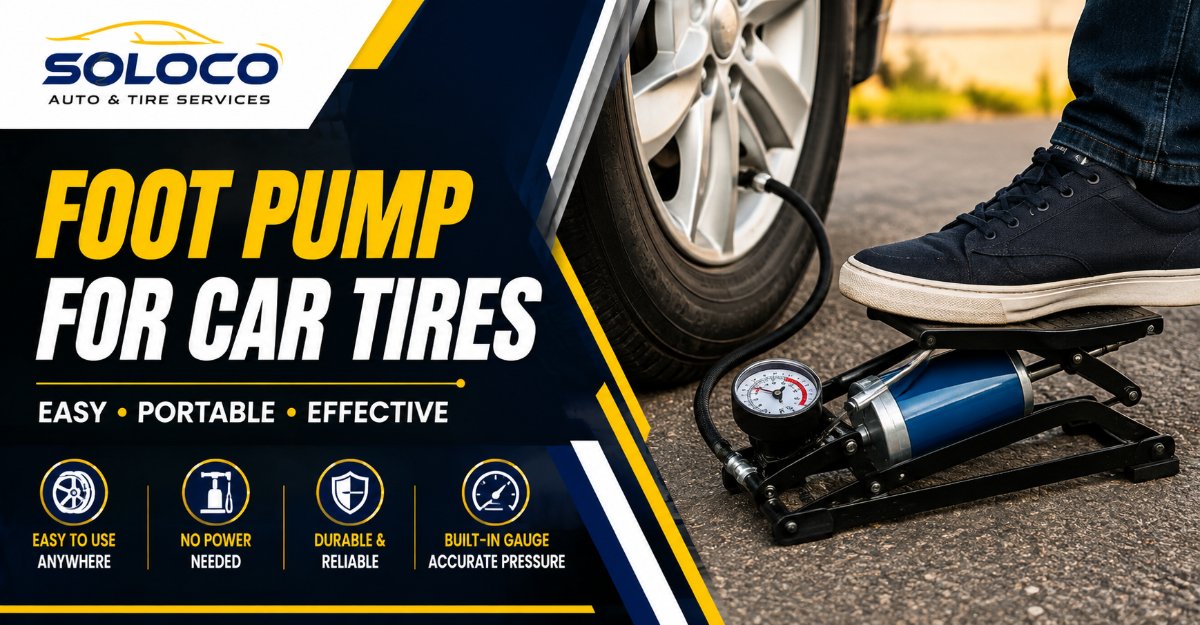
A car tire foot pump is a portable, manually operated mechanical device used to inflate automotive tires by utilizing physical leg power and a positive displacement reciprocating piston system. Operating entirely independently of electrical power sources, a foot pump serves as a reliable emergency roadside tool or garage utility for maintaining exact tire pressure without relying on motors or 12V vehicle sockets.
Key Facts At a Glance
- Average Car Tire Air Capacity: 30 to 40 liters of volume from flat to operational pressure.
- Double-Barrel Stroke Efficiency: Requires 20 to 40 strokes for a minor 3 to 5 PSI top-up.
- Full Inflation Demand: Raising a completely flat tire to 32 PSI requires 250 to 400 total continuous strokes.
- Power Independence: Operates via human mechanical energy with zero reliance on fuses, batteries, or alternators.
- Pressure Limits: Single-barrel models reach up to 100 PSI; heavy-duty double-barrel units reach 140 PSI.
How a Car Tire Foot Pump Works Mechanically
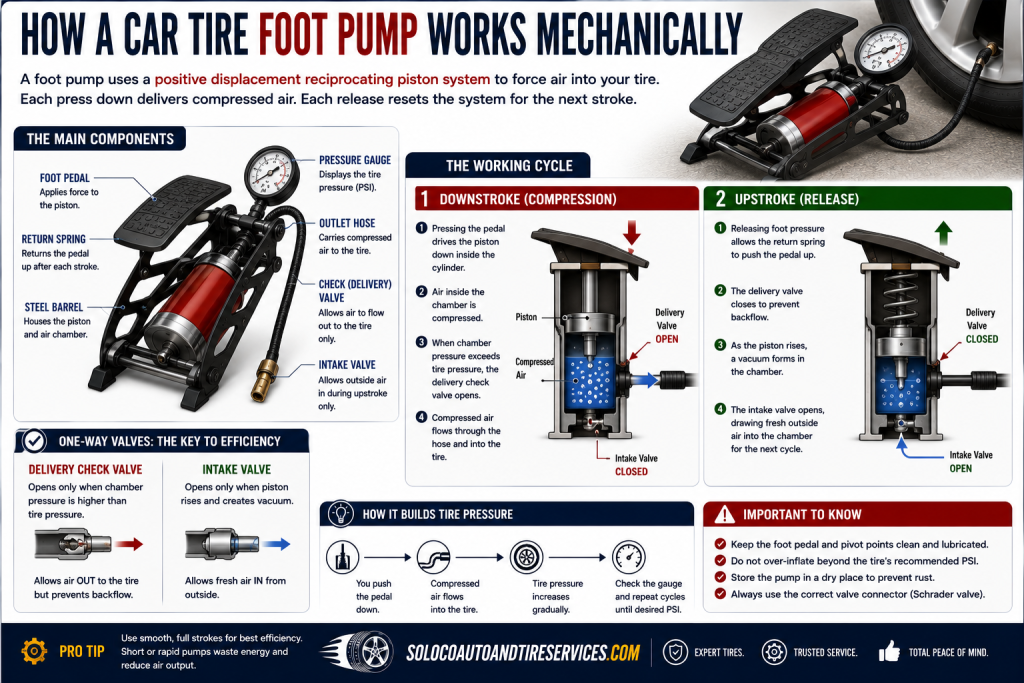
A foot pump operates through a simple positive displacement reciprocating piston system contained within a steel or alloy housing. Understanding this internal mechanism prevents operational errors that lead to premature mechanical failure.
During the downstroke, pressing the foot pedal forces the internal piston downward inside the steel barrel. This action compresses the air trapped within the cylinder chamber. Once the pressure inside the barrel exceeds the opposing pressure inside the tire, a built-in one-way check valve opens. This channels the highly compressed air directly through the rubber hose and into the tire via its Schrader valve.
During the upstroke, a heavy-duty internal return spring forces the pedal back up the moment foot pressure is released. During this upward movement, the delivery valve snaps shut to prevent any backflow or tire deflation. Concurrently, an intake valve opens to fill the cylinder chamber with fresh ambient air for the next compression cycle.
Single-Barrel Versus Double-Barrel Foot Pumps
Selecting the right mechanical configuration determines the physical effort required and the speed of inflation.
                  ┌───────────────────────────┐
                  │   Car Tire Foot Pumps     │
                  └─────────────┬─────────────┘
                                │
         ┌──────────────────────┴──────────────────────┐
         ▼                                             ▼
┌─────────────────┐                           ┌─────────────────┐
│ Single-Barrel   │                           │ Double-Barrel   │
│  (Single Cyl)   │                           │ (Twin Cylinder) │
└────────┬────────┘                           └────────┬────────┘
         │                                             │
         ├─► Analogue Gauge                            ├─► Analogue Gauge
         └─► Digital Gauge                             └─► Digital Gauge
Single-Barrel (Single Cylinder) Design
Single-barrel pumps feature one compression cylinder, delivering a lower volume of air output per pump stroke. They are typically rated up to 100 PSI and require less physical downward force per stroke. They are best suited for periodic small pressure top-ups of 1 to 3 PSI, motorcycles, and bicycles.
Double-Barrel (Twin Cylinder) Design
Double-barrel pumps employ two cylinders operating side-by-side in parallel. They deliver twice the volume of air per stroke compared to single-barrel models and are rated between 100 and 140 PSI. Because you are compressing two cylinders simultaneously, they demand higher downward stepping force. They are ideal for rapidly inflating large volume passenger car tires or handling roadside emergencies.
Gauge Variations: Analogue Versus Digital
Monitoring pressure accurately prevents under-inflation and over-inflation, both of which degrade tire tread life.
- Analogue Dials: These utilize a traditional mechanical Bourdon tube mechanism. They require no batteries or external power, but they can misread if the pump is dropped, jolted, or stored roughly in a trunk.
- Digital LCD Screens: Powered by small coin-cell batteries such as the CR2032, digital screens offer high-precision readouts to within one PSI. They feature multiple selectable display units including PSI, BAR, and kPa.
Step-by-Step Inflation Process
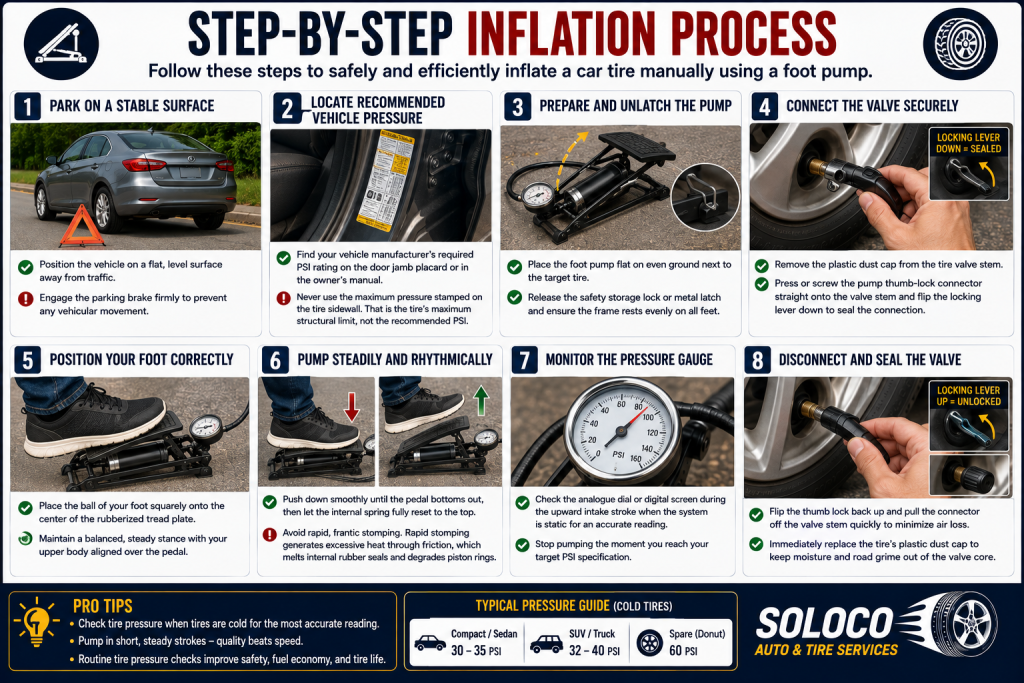
Follow these steps to safely and efficiently inflate a car tire manually using a foot pump.
Step 1: Park on a Stable Surface
Position the vehicle on a flat, level surface away from traffic. Engage the parking brake firmly to prevent any vehicular movement while working near the wheels.
Step 2: Locate Recommended Vehicle Pressure
Find your vehicle manufacturer’s required PSI rating. This specification is located on a placard affixed inside the driver-side door jamb or within the owner’s manual. Never use the maximum pressure stamped directly on the tire sidewall, as that figure represents the absolute structural limit of the tire, not the optimal operating pressure for your specific vehicle weight.
Step 3: Prepare and Unlatch the Pump
Place the foot pump flat on even ground next to the target tire. Release the safety storage lock or metal latch keeping the pedal compressed in its storage position. Ensure the frame rests evenly on all feet to prevent wobbling during operation.
Step 4: Connect the Valve Securely
Remove the plastic dust cap from the tire valve stem. Securely press or screw the pump thumb-lock connector straight onto the valve stem. Flip the locking lever down to seal the connection completely.
Step 5: Position Your Foot Correctly
Place the ball of your foot squarely onto the center of the rubberized tread plate. Maintain a balanced, steady stance with your upper body aligned over the pedal to prevent the pump frame from tilting or sliding.
Step 6: Pump Steadily and Rhythmically
Push down smoothly until the pedal bottoms out, then let the internal spring fully reset the pedal back to the top. Avoid rapid, frantic stomping. Rapid stomping generates excessive heat through friction, which melts internal rubber seals and degrades the piston rings.
Step 7: Monitor the Pressure Gauge
Check the analogue dial or digital screen during the upward intake stroke when the system is static to get an accurate pressure reading. Stop pumping the moment you reach your target PSI specification.
Step 8: Disconnect and Seal the Valve
Once you reach the target pressure, flip the thumb lock back up and pull the connector off the valve stem quickly to minimize escaping air. Immediately replace the tire’s plastic dust cap to keep moisture and road grime out of the valve core.
Financial Breakdown and Expected Time Investment
| Metric | Budget Tier | Premium Tier |
|---|---|---|
| Price Range | £10 to £15 ($13 to $20) | £25 to £45 ($32 to $60) |
| Build Quality | Stamped sheet metal, plastic thumb locks | Heavy steel frame, braided hoses |
| Gauge Type | Basic analogue dial | High-precision digital LCD |
| Minor Top-Up (2 PSI) | 45 to 60 seconds | 30 to 45 seconds |
| Low-Pressure Fix (10 PSI) | 4 to 6 minutes | 3 to 4 minutes |
| Full Inflation (0 to 32 PSI) | 12 to 15 minutes | 10 to 12 minutes |
Comparison: Foot Pump Versus 12V Electric Compressor
| Feature | Manual Foot Pump | 12V Electric Compressor |
|---|---|---|
| Power Dependency | None. Completely autonomous. | Requires a live car 12V cigarette socket or battery. |
| Speed and Effort | Slower; requires manual physical exertion. | Fast; hands-free automated compression. |
| Reliability | Exceptionally high. No motors, blown fuses, or relays to fail. | Subject to blown vehicle fuses, overheated motors, or frayed cords. |
| Noise Level | Silent mechanical operation. | Extremely loud buzzing or vibrating electric motor. |
| Storage Footprint | Folds flat; easy to tuck under a seat or in the boot. | Bulkier box shape; tethered to long power wires. |
Common Mistakes to Avoid
- Pumping with Your Toes: Placing only your toes on the edge of the pedal causes your foot to slip forward, which can bend the underlying piston rods or cause foot injury.
- Ignoring the Storage Lock Latch: Forcing the pump open without disengaging the metal retaining hook can warp, bend, or snap the structural frame.
- Over-Stretching the Short Hose: Pulling the pump too far away puts excessive stress on the rubber-to-metal connection points, leading to air leaks.
- Failing to Seat the Valve Straight: Forcing the connector onto a car valve at an angle can cross-thread the connector or damage the Schrader valve core pin.
- Storing in Damp Areas: Keeping a steel-framed pump in a wet spare wheel well leads to structural rust and degrades internal leather and rubber piston seals.
Troubleshooting Common Issues
Problem: Air escapes from the valve connector while pumping
- Likely Cause: The thumb lock lever is loose, worn out, or improperly aligned on the valve stem.
- Quick Solution: Disconnect the nozzle, check that the internal rubber washer inside the nozzle is seated straight, and firmly re-engage the locking lever. Consider upgrading to a brass screw-on adapter thread for a positive seal.
Problem: The pedal feels stuck or requires immense force to move
- Likely Cause: The tire pressure is pushing backward because the pump’s internal non-return check valve is stuck open or has failed entirely.
- Quick Solution: Detach the pump from the car entirely and press the pedal to clear the blockage. If it moves freely when disconnected, your connector pin is depressing the tire valve core without a functional pump check valve to block backpressure.
Problem: The pressure gauge reading fluctuates wildly or reads zero
- Likely Cause: The valve pin is not making direct contact to open the tire channel, or a digital gauge battery has drained completely.
- Quick Solution: Push the connector deeper onto the valve stem before locking the lever down. Replace the coin-cell battery behind the display face if using a digital unit.
Frequently Asked Questions
Can a foot pump damage my car tires if I overinflate them?
Over-inflating any tire causes excessive center tread wear, reduces braking traction, and creates a harsh ride quality. However, a foot pump itself does not inherently damage a tire unless you pump past the manufacturer’s recommended safe vehicle operating pressure limit. Always monitor the gauge during every stroke to prevent exceeding your target PSI rating.
Why does the foot pump pedal feel spongy during use?
A spongy pedal feel indicates air leakage within the compression chamber, a loose valve connector, or a worn-out piston O-ring seal that is failing to compress air efficiently. Inspect the rubber hose for micro-cracks and ensure the thumb lock is clamped tightly onto the Schrader valve stem to restore internal system pressure.
How often should I lubricate my car tire foot pump?
Lubricate the internal piston rod and cylinder walls every six months using a few drops of light machine oil or silicone spray. Avoid heavy petroleum greases, as they attract airborne dirt and brake dust, which turns into an abrasive paste that ruins the internal rubber cylinder seals over time.
Can I use a foot pump for bicycle tires and sports equipment?
Most quality foot pumps come equipped with interchangeable plastic nozzle adapters that fit Presta bicycle valves, sports balls, and air mattresses. Because foot pumps offer fine manual control over stroke volume, they prevent accidental over-inflation of low-volume inflatables compared to high-speed electric compressors.
Is a single-barrel or double-barrel pump better for SUVs?
Double-barrel pumps are significantly better for SUVs, trucks, and larger passenger vehicles. SUV tires hold substantially more air volume, meaning a single-barrel pump requires excessive time and physical exertion to raise pressure from low levels compared to the higher air displacement offered by twin cylinders.