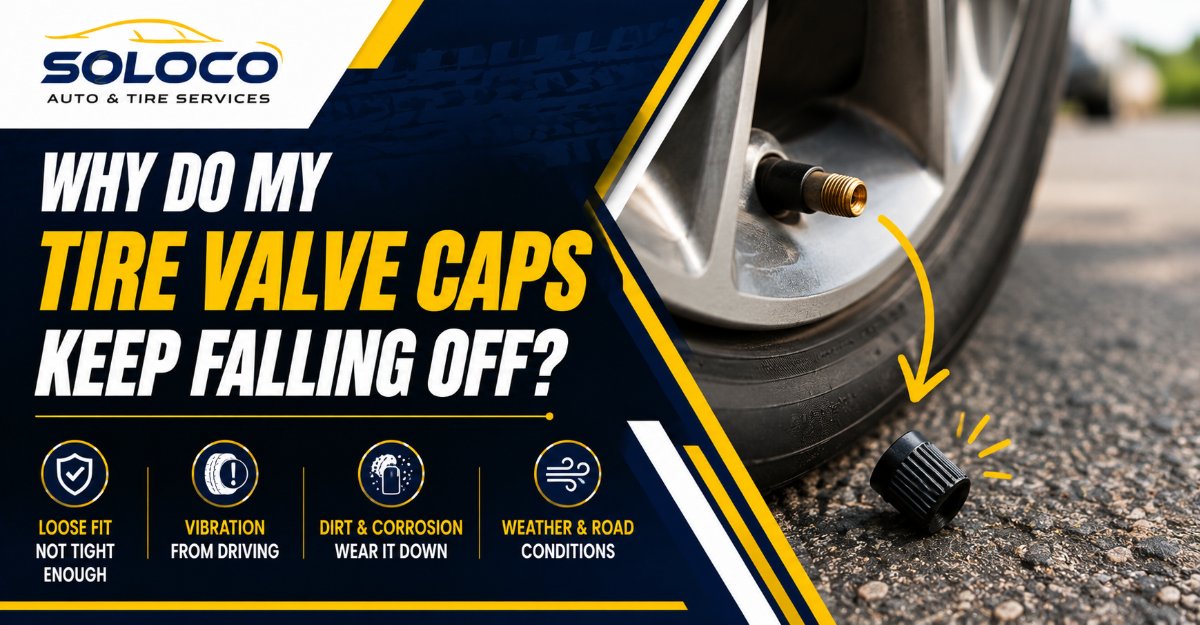
Tire valve caps fall off due to a combination of high-frequency mechanical vibration, thermal expansion differentials, improper thread tolerances, and over-tightening human error. Standard Schrader valve stems spinning at highway speeds experience intense rotational forces that back un-torqued plastic or metal caps completely off their threads over time.
At a Glance: Key Facts About Valve Cap Loss
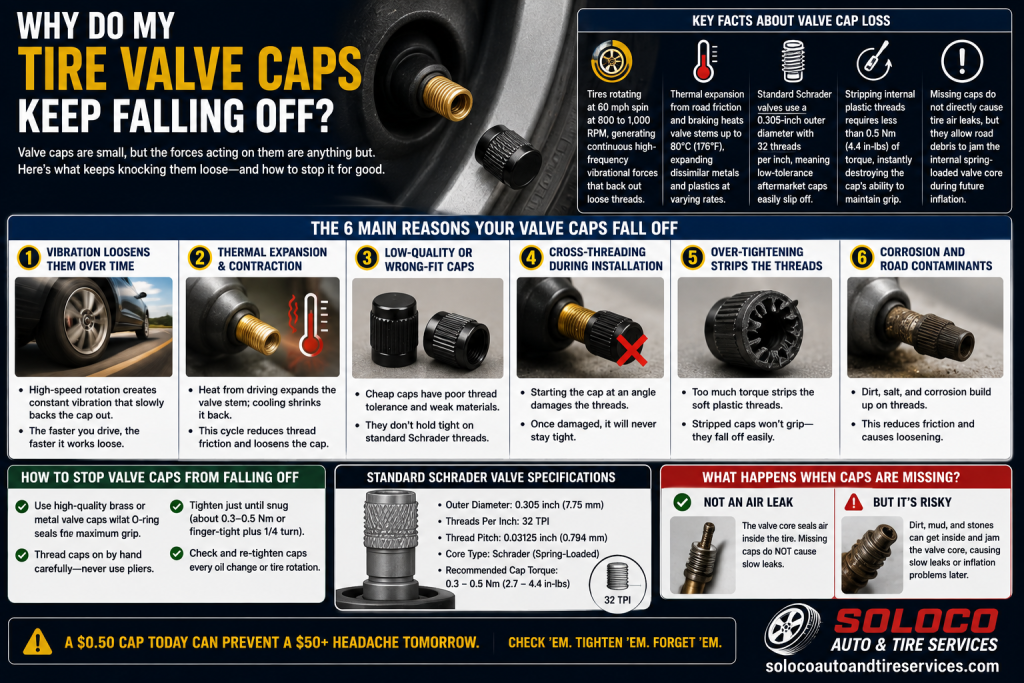
- Tires rotating at 60 mph spin at 800 to 1,000 RPM, generating continuous high-frequency vibrational forces that back out loose threads.
- Thermal expansion from road friction and braking heats valve stems up to 80°C (176°F), expanding dissimilar metals and plastics at varying rates.
- Standard Schrader valves use a 0.305-inch outer diameter with 32 threads per inch, meaning low-tolerance aftermarket caps easily slip off.
- Stripping internal plastic threads requires less than 0.5 Nm (4.4 in-lbs) of torque, instantly destroying the cap’s ability to maintain grip.
- Missing caps do not directly cause tire air leaks, but they allow road debris to jam the internal spring-loaded valve core during future inflation.
How does high-speed tire vibration unscrew a valve cap?
High-speed tire vibration unscrews valve caps by utilizing rotational inertia and harmonic feedback to overcome static friction on the threads. When a passenger vehicle travels at 60 mph (96.5 km/h), the wheel assembly spins between 800 and 1,000 RPM depending on the overall tire diameter. This rapid rotation creates a constant barrage of high-frequency micro-vibrations that travel up the rubber or metal valve stem. If a cap is installed with zero pre-load tension or lacks an internal rubber O-ring, these vibrational waves cause the female threads to chatter against the male Schrader threads. Each micro-bounce allows the cap to shift fractionally clockwise or counter-clockwise, ultimately walking itself completely off the stem over several miles of highway driving.
What role does thermal expansion play in loosening valve caps?
Thermal expansion loosens valve caps because the components are frequently manufactured from dissimilar materials that expand and contract at different rates under heat stress. During sustained highway driving, friction between the tire tread and asphalt, combined with heat transferred from the brake rotors and calipers, elevates tire valve stem temperatures up to 60°C to 80°C (140°F to 176°F). Brass valve cores, rubber stems, aluminum TPMS bodies, and plastic or chrome-plated steel caps all possess distinct thermal expansion coefficients. As the temperature rises, the inner diameter of a plastic cap expands faster and wider than the metal stem threads beneath it. This temporary dimensional mismatch widens the clearance gap between the mating surfaces, destroying the friction lock and allowing vibrational forces to spin the cap free.
How do thread mismatch and manufacturing tolerances cause cap failure?
Thread mismatch causes valve cap failure because cheap aftermarket imports frequently deviate from standard dimensional specifications by more than 0.05 mm. Standard automotive Schrader valves follow a strict international specification featuring a 0.305-inch (7.747 mm) outer diameter paired with a thread pitch of exactly 32 threads per inch (TPI). Mass-produced decorative caps purchased online often feature poorly cut or oversized internal threads that fail to engage the crests and roots of the valve stem properly. When the manufacturing tolerance is slightly too wide, the cap sits loosely on the stem even when fully screwed down. Without tight thread engagement, the physical grip relies entirely on luck rather than mechanical interference, guaranteeing that the cap will vibrate loose within a few days.
Why does over-tightening with pliers ruin valve cap threads?
Over-tightening valve caps with pliers ruins the threads because standard plastic and aluminum cap components are deliberately manufactured from soft materials designed to yield under minimal force. Stripping the delicate internal plastic threads or the external metal threads of a valve stem requires very little mechanical advantage, often less than 0.5 Nm (4.4 in-lbs) of torque. When vehicle owners use pliers or wrenches to prevent caps from falling off, the excessive clamping force crushes the plastic ridges or shears the soft brass threads flat. Once these threads are stripped or deformed, the cap loses its structural bite entirely. It will either spin continuously without tightening or sit loosely on the damaged stem, falling off at the first sign of a bump in the road.
Can aluminum valve caps fuse permanently to TPMS valve stems?
Aluminum valve caps can fuse permanently to modern aluminum Tire Pressure Monitoring System (TPMS) valve stems through a destructive electrochemical process known as galvanic corrosion. When moisture, road salt, and water infiltrate the threads of dissimilar metals—specifically an aluminum cap screwed onto an aluminum or alloy TPMS stem—a galvanic cell forms. The two metals react chemically over weeks of exposure, creating aluminum oxide build-up that welds the threads solid. Instead of falling off, these caps seize completely in place. When technicians attempt to remove them during tire pressure checks, the fragile hollow sensor stem often snaps off at the base, resulting in an expensive sensor replacement bill ranging from 100 to 200 dollars.
Why do high-end bicycle Presta valve caps fall off so easily?
High-end bicycle Presta valve caps fall off easily because they are engineered primarily for dust protection rather than mechanical retention, lacking traditional full-length thread engagement. Unlike automotive Schrader valves, Presta valves utilized on performance road and mountain bikes are narrow and feature a delicate threaded tip measuring only about 6 mm in length. The matching plastic or metal cap only screws onto this tiny upper pin rather than down the body of the stem. Due to the extremely short thread contact area and high rotational speeds of lightweight bicycle wheels, Presta caps vibrate loose and fall off at roughly twice the rate of car valve caps. Many experienced cyclists discard Presta caps entirely, relying on the internal brass locking nut to seal the core instead.
How does centrifugal force affect angled valve stems at high speeds?
Centrifugal force affects angled valve stems by generating an outward radial pull that physically distorts flexible rubber stems and stresses threaded connections. On motorcycles, scooters, and certain heavy commercial trucks equipped with 90-degree metal or rubber valve stems, centrifugal force at speeds exceeding 100 mph pulls heavily on every attached component. This outward G-force stretches the rubber base of the stem sideways and creates a slight angular deflection in the threaded tip. As the stem flexes continuously under high-speed rotation, the gap between the male and female cap threads opens up momentarily, letting centrifugal micro-vibrations back the cap off the stem until it flies off into traffic.
Why are heavy decorative metal valve caps dangerous for rubber stems?
Heavy decorative metal valve caps—such as chrome skulls, dice, or spiked designs weighing over 5 to 10 grams—are dangerous because their excess mass destabilizes standard rubber valve stems at speed. Standard plastic caps weigh less than a single gram, exerting negligible radial load on the stem. In contrast, heavy novelty caps act as miniature centrifugal pendulums when a vehicle reaches highway speeds. The G-force turns that 10-gram weight into a continuous sideways bending moment that flexes flexible rubber valve stems back and forth. This constant flexing fatigues the rubber base where it mounts to the wheel rim, eventually tearing the rubber bead seal and causing a catastrophic, sudden deflation of the tire while driving.
How can you tell if missing valve caps are caused by theft or vibration?
You can determine whether missing valve caps stem from mechanical vibration or active theft by analyzing the specific pattern of disappearance across your vehicle. If caps vanish randomly over several weeks from different wheels while you drive on rough, unpaved roads, mechanical vibration and thermal expansion are the root causes. However, if all four caps disappear overnight while the car is parked, or if unique metal, chrome, or colored caps vanish exclusively from the driver-side or street-side wheels while passenger-side caps remain intact, you are experiencing targeted petty theft. Neighborhood children and bicycle enthusiasts frequently steal decorative or metallic automotive caps as collectibles.
Should I use plastic, brass, or aluminum valve caps?
Selecting the right valve cap material depends heavily on your vehicle type, local climate, and wheel construction to prevent corrosion and structural failure.
| Valve Cap Material | Best Suited For | Key Advantages | Major Risks / Drawbacks |
|---|---|---|---|
| Virgin Plastic | Modern alloy wheels with TPMS sensors | Chemically inert; will never fuse to aluminum stems; lightweight. | Prone to thread stripping if over-tightened; degrades in intense UV light. |
| Plastic-Lined Brass | Older vehicles with rubber stems | Highly durable; handles extreme road debris and high heat effectively. | Can cause galvanic corrosion if installed on aluminum TPMS stems without anti-seize. |
| Solid Aluminum | Steel wheels with traditional brass stems | Rigid construction; excellent aesthetic finish; highly resistant to cracking. | High risk of galvanic seizure on aluminum TPMS stems; heavier mass. |
Do missing tire valve caps cause tires to lose air?
Missing tire valve caps do not directly cause tires to lose air because the primary pressure seal is maintained by the spring-loaded Schrader valve core located inside the center of the stem. The cap itself is technically classified as a secondary dust and moisture cover, not a pressure-holding device. However, driving without valve caps introduces indirect long-term risks. Without a cap, rainwater, road salt, mud, and brake dust accumulate directly inside the open barrel of the stem. During your next inflation cycle, the chuck of the air hose pushes that trapped debris straight down into the rubber seal of the valve core, jamming the internal pin open and creating a frustrating, persistent slow leak.
How tight should a tire valve cap actually be?
A tire valve cap should always be installed finger-tight only. To achieve the correct tension, screw the cap clockwise onto the valve stem using strictly your thumb and index finger until it meets firm resistance, then give it a gentle, deliberate quarter-turn to seat it against the internal rubber gasket. Never use pliers, wrenches, or mechanical tools to tighten a valve cap. Over-tightening deforms the internal sealing ring, strips the threads, and guarantees that you will need tools to remove it later—greatly increasing your chances of snapping the delicate valve stem in half.
How do you stop valve caps from loosening without using tools?
Stopping valve caps from loosening without resorting to damaging tools requires focusing on mechanical friction enhancements and correct component selection. First, ensure your caps feature an integrated internal rubber or silicone O-ring inside the top dome; this compressible gasket absorbs high-frequency vibrations and maintains outward pressure against the thread crests, preventing back-off. Second, clean the external valve stem threads with a wire brush to remove brake dust and oxidation before installation, ensuring full thread engagement. If vibrational loss persists on commercial or performance vehicles, applying a tiny drop of medium-strength threadlocker or petroleum jelly to the threads provides enough chemical resistance to keep the cap secured without cementing it permanently.
What prevents galvanic corrosion between metal caps and TPMS stems?
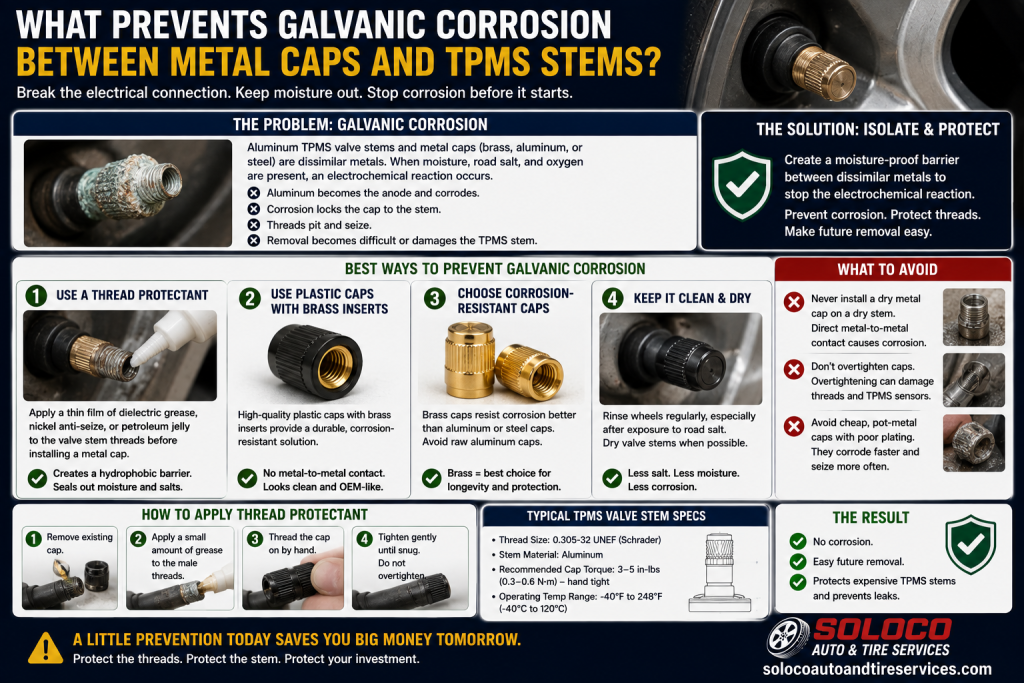
Preventing galvanic corrosion between metal valve caps and sensitive aluminum TPMS stems requires breaking the electrical circuit by isolating the dissimilar metals from moisture and direct contact. The most effective professional method is applying a microscopic film of dielectric grease, nickel anti-seize compound, or automotive-grade petroleum jelly directly onto the male threads of the valve stem before screwing on a brass or aluminum cap. The grease acts as a hydrophobic barrier that seals out ambient moisture and road de-icing salts, stopping the electrochemical reaction dead in its tracks. Alternatively, switching exclusively to high-grade plastic caps with brass inserts eliminates the risk of metal-on-metal galvanic fusion entirely while preserving a clean exterior look.
The Bottom Line
Tire valve caps fall off primarily due to high-frequency vibrational loosening at highway speeds, exacerbated by thermal expansion and poor manufacturing thread tolerances. While missing caps do not directly cause air loss, leaving stems exposed invites debris that ruins internal valve cores. Always secure replacement caps finger-tight, match plastic caps to modern aluminum TPMS sensors, and avoid heavy decorative styles to protect your tire pressure integrity.


