The marking “96V” on a tire sidewall is a standardized service description indicating the tire’s maximum load capacity and maximum safe speed capability. The number 96 denotes a maximum load capacity of 1,565 pounds per tire at maximum inflation pressure, while the letter V designates a certified maximum safe speed of 149 miles per hour.
At a Glance: Key Facts About 96V Tires
- The number 96 is a load index code representing 1,565 lbs (710 kg) per individual tire under optimal inflation.
- The letter V is a speed rating indicating safe laboratory-tested operation up to 149 mph (240 km/h).
- A complete set of four 96-rated tires supports a maximum gross vehicle weight of 6,260 lbs.
- Extra Load (XL) variants require higher inflation pressures to achieve their rated load compared to Standard Load (SL) variants.
- Downgrading speed ratings from V to H compromises high-speed stability and can void insurance coverage.
What Does 96V Mean on a Tire?
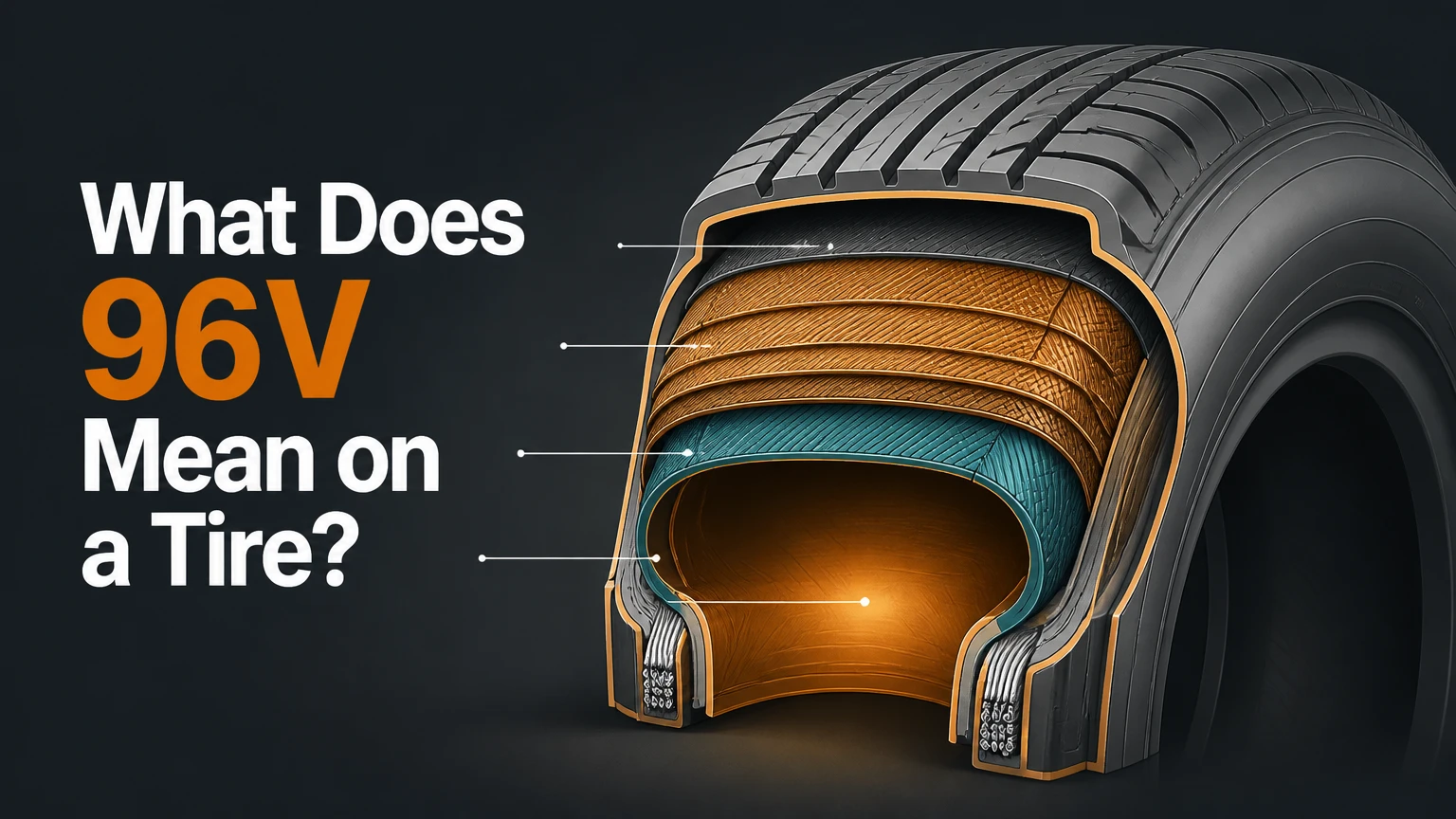
The code 96V is a combined service description stamped onto the sidewall of a passenger vehicle tire that dictates its structural limitations regarding weight and velocity. Understanding this rating prevents tire failure, blowouts, and premature tread wear. The number portion represents structural carcass strength under heavy loads, while the letter portion represents the thermal capacity of the rubber compounds to withstand friction at high velocities.
Automotive manufacturers determine the required service description based on the gross axle weight rating of the vehicle. When purchasing replacement tires, matching or exceeding these exact alphanumeric values ensures the vehicle maintains its original handling characteristics and safety margins during emergency maneuvers.
How Much Weight Can a 96 Load Index Tire Support?
A tire with a load index of 96 can safely support up to 1,565 pounds (710 kg) when inflated to its maximum allowable pressure. This numerical code is part of an international standardized rating system managed by the Tire and Rim Association and does not correspond to physical dimensions or weight measurements in pounds.
To calculate total vehicle weight limits using this index, multiply the single-tire capacity by the number of wheels on the vehicle. Two matching 96 tires on a single axle support 3,130 pounds, and a full set of four matching tires supports a maximum gross vehicle weight of 6,260 pounds. This total limit includes the combined weight of the empty vehicle, all passengers, fuel, and cargo stored in the trunk.
What Is the Maximum Speed for a V Speed Rating?
The letter V indicates that the tire is certified for maximum safe speeds up to 149 miles per hour (240 km/h). V-rated tires are engineered with specialized synthetic belt packages and heat-resistant tread compounds designed to dissipate internal friction generated during sustained high-speed highway driving.
While 149 mph far exceeds legal speed limits in most countries, this rating provides an essential performance buffer. Tires operating well below their maximum speed rating experience less thermal stress, resulting in cooler running temperatures, enhanced tread life, and superior structural integrity during sudden braking or swerving maneuvers.
What Is the Difference Between a 96V SL and a 96V XL Tire?
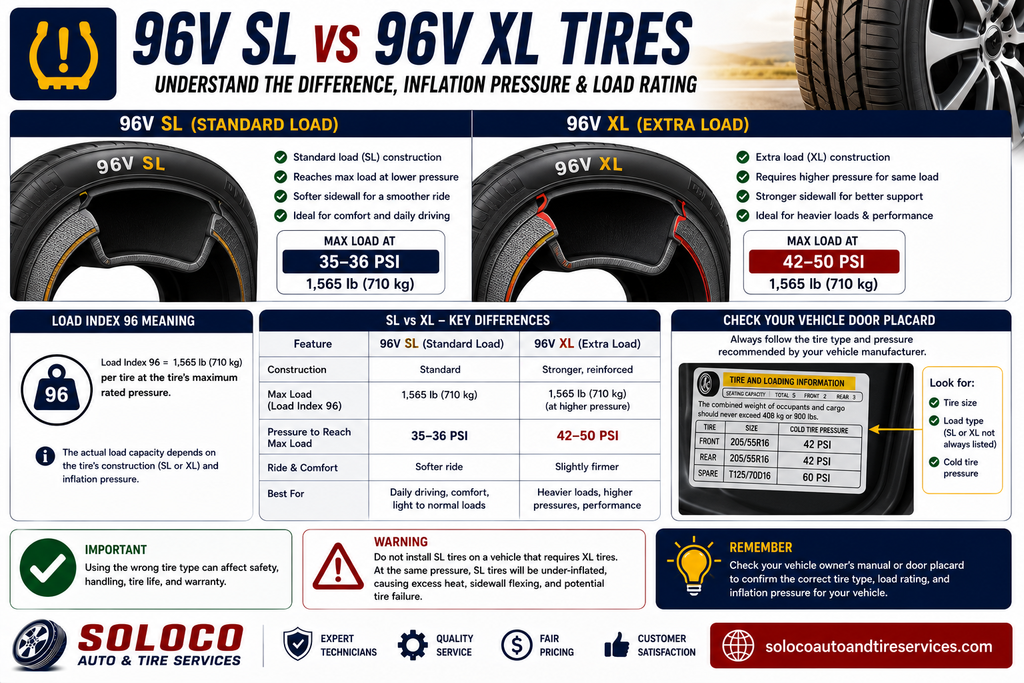
A 96V SL (Standard Load) tire and a 96V XL (Extra Load) tire share the exact same maximum load capacity of 1,565 pounds, but they achieve that capacity at different internal pressures. Standard load tires reach their maximum load rating at 35 or 36 PSI, whereas extra load tires require inflation pressures of 42 or 50 PSI to support that same weight.
Drivers must check the vehicle door placard to determine whether the manufacturer specified standard load or extra load construction. Installing an SL tire on a vehicle engineered for XL tires means the tire will run under-inflated at standard pressures, leading to excessive sidewall flexing, internal heat buildup, and a heightened risk of tread separation.
Can I Use a 96H Tire If My Car Manufacturer Specifies a 96V?
Never install a tire with a lower speed rating than the vehicle manufacturer’s original equipment specification. Dropping from a V rating (149 mph) to an H rating (130 mph) compromises high-speed structural integrity, alters emergency handling dynamics, and can void vehicle insurance policies or manufacturer warranties in the event of an accident caused by tire failure.
Tires with lower speed ratings possess softer sidewalls and less robust internal heat dissipation channels. When driven at sustained highway speeds on a heavy sedan or crossover, an H-rated tire on a vehicle requiring a V-rating will overheat, causing rubber degradation and potential structural collapse.
Can I Upgrade to a 98V or 96W Tire Instead?
Upgrading to a tire with a higher load index or a higher speed rating is completely safe and common practice among automotive enthusiasts. Installing a 98-index tire increases individual load capacity from 1,565 pounds to 1,653 pounds, while upgrading from a V rating to a W rating raises the maximum certified speed from 149 mph to 168 mph.
Higher-rated tires typically feature stiffer sidewalls and denser construction, which results in sharper steering response and improved cornering stability. The only trade-off is a slightly firmer ride quality, as the stiffer sidewalls absorb minor road imperfections with less compliance than softer standard tires.
What Happens to Tire Load Capacity When Driving Over 130 mph?
For V-rated tires, the maximum load capacity of 1,565 pounds is only guaranteed up to 130 miles per hour. When vehicle speeds exceed 130 mph and approach the 149 mph limit, centrifugal forces and extreme heat generation degrade the tire’s structural load limits.
For every incremental increase of 6 miles per hour above 130 mph up to the 149 mph maximum, the actual allowable load capacity drops by 3% to 5%. Professional track drivers and high-performance driving instructors account for this percentage drop by inflating tires to maximum track pressures or switching to higher speed ratings like W or Y when operating vehicles at extreme velocities.
What Happens If You Overload a 96V Tire Below Its Maximum PSI?
Exceeding the 1,565-pound limit of a 96V tire while maintaining standard inflation pressures causes severe carcass deflection. The tire sidewall bulges excessively near the contact patch, forcing the inner liner and steel belts to flex beyond their elastic threshold during every wheel rotation.
This continuous over-flexing generates massive internal heat, destroying the chemical bonds between the rubber and internal steel cords. Overloaded tires experience rapid tread wear across the outer shoulders, premature tire aging, and a high probability of sudden tread separation or catastrophic blowout on the highway.
Can You Mix a 96V Standard Load Tire with a 96V Extra Load Tire on the Same Axle?
Mixing standard load and extra load tires on the same axle creates dangerous handling asymmetries. Even though both tires share the 96V service description, their internal construction, ply stiffness, and pressure-to-load curves differ significantly.
During an emergency braking or cornering maneuver, the mismatched tire constructions will flex and grip the road surface at different rates. This discrepancy confuses the vehicle’s anti-lock braking system and electronic stability control, causing unpredictable vehicle swerving or loss of directional control on wet pavement.
How Does Tire Wear Affect the Actual Speed Rating and Safety Margins?
As tire tread wears down from its original depth of 10/32 or 11/32 inches to the legal minimum of 2/32 inches, the structural heat dissipation capacity of the tire changes. Worn tread blocks retain less heat-absorbing rubber mass, causing the remaining carcass to run significantly hotter at sustained highway speeds.
Furthermore, reduced tread depth diminishes water evacuation capabilities, increasing hydroplaning risks well before the mechanical limits of the V-speed rating are reached. Drivers should treat speed ratings as conditional attributes that degrade proportionally with tread wear and age-related rubber hardening.
How Do Temperature and Road Heat Degrade a V-Rated Tire During Summer?
Ambient air temperature and hot asphalt surfaces combine to elevate operating tire temperatures far above laboratory testing baselines. When asphalt temperatures reach 130 degrees Fahrenheit on a summer afternoon, a V-rated tire running at high speeds must dissipate both internal mechanical friction and external environmental heat.
If a V-rated tire is operated under-inflated in these extreme conditions, the internal rubber compounds soften beyond their engineered operating threshold. This thermal overload accelerates molecular breakdown within the belt package, leading to tread chunking, belt separation, and sudden pneumatic failure.
What Are the Dangers of the Oversized Rim and Low Profile Trap?
Installing aftermarket oversized rims often requires fitting low-profile tires with reduced sidewall heights. Many car owners inadvertently select tires that fit the physical diameter of the new rim but feature a lower load index, such as dropping from a factory 96V specification to a 92V tire.
A 92-index tire supports a maximum weight of 1,389 pounds compared to the 1,565-pound capacity of a 96-index tire, representing a dangerous 11% reduction in load-carrying capability. This reduction overburdens the suspension and tire structure, risking sidewall pinch flats and blowout failures when hitting potholes or driving over rough road expansion joints.
Why Do Winter Tires Often Feature Lower Speed Ratings Like 96H?
Winter tires frequently utilize lower speed ratings, such as dropping from a summer 96V rating to a winter 96H rating, because snow and ice conditions demand lower operating velocities. Winter tire tread compounds utilize high concentrations of natural rubber and silica designed to remain flexible in freezing temperatures, which inherently limits their high-speed heat tolerance.
Safety regulations and insurance standards in many jurisdictions legally permit dropping one speed rating category for dedicated winter tires. However, drivers utilizing H-rated winter tires must consciously restrict their maximum driving speeds to match the 130 mph limit of those specific winter compounds.
What Legal Liabilities Exist for Installing Lower Load Index Tires?
Installing replacement tires with a lower load index than the vehicle manufacturer’s minimum safety placard creates severe legal and financial liabilities. If a tire fails due to overloading resulting from an improper index choice, insurance companies can deny coverage claims for resulting property damage or personal injury accidents.
In commercial transport and rigorous state safety inspections, mismatched or downgraded tire specifications can cause vehicle registration failures. Professional tire technicians are legally obligated to refuse installation of any replacement tire that fails to meet or exceed the original equipment manufacturer’s load index and speed rating minimums.
How Does Vehicle Weight Distribution Impact the 96V Load Requirement?
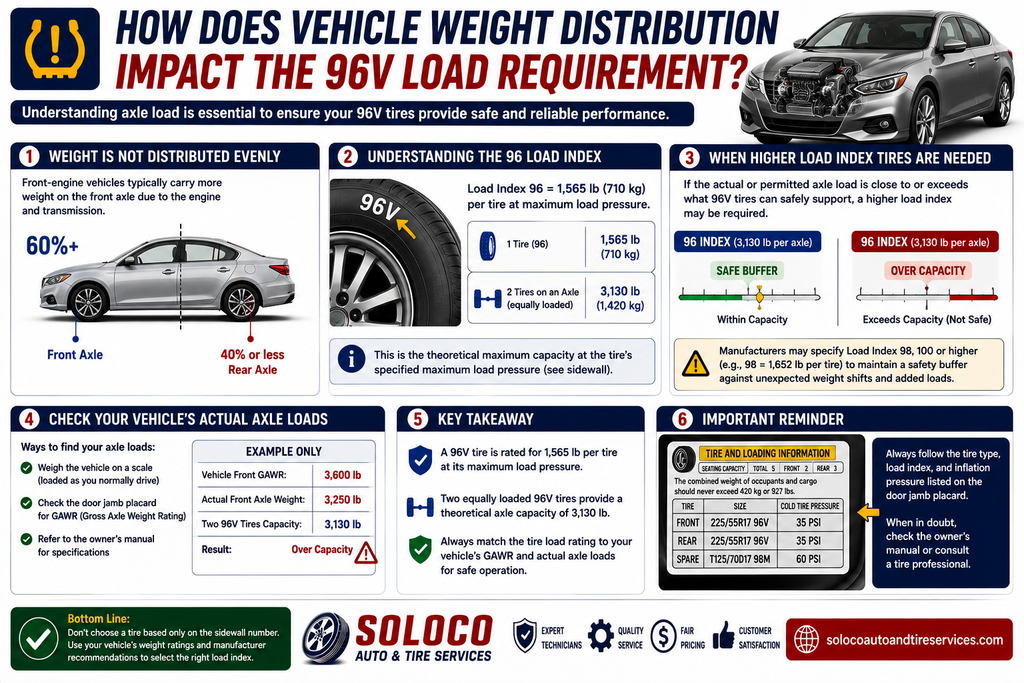
Vehicle weight is rarely distributed evenly across all four wheels, making axle load distribution analysis critical when evaluating 96V tire requirements. Front-engine vehicles often place 60% or more of their total gross weight over the front axle due to the weight of the engine and transmission assembly.
If a vehicle’s front axle weight exceeds 3,130 pounds, standard 96-index tires (rated for 3,130 lbs per axle) operate at maximum capacity even when the vehicle is only moderately loaded. In such configurations, manufacturers specify higher load indices like 98 or 100 for the front axle to maintain an essential safety buffer against unexpected weight shifts.
The Bottom Line
The 96V service description on a tire sidewall mandates a maximum individual load capacity of 1,565 pounds and a certified safe speed limit of 149 miles per hour. Maintaining proper inflation pressures, matching original equipment load and speed specifications, and accounting for extra load construction requirements ensure optimal vehicle stability and accident prevention. Never compromise safety by downgrading speed ratings or installing tires with insufficient load indices.