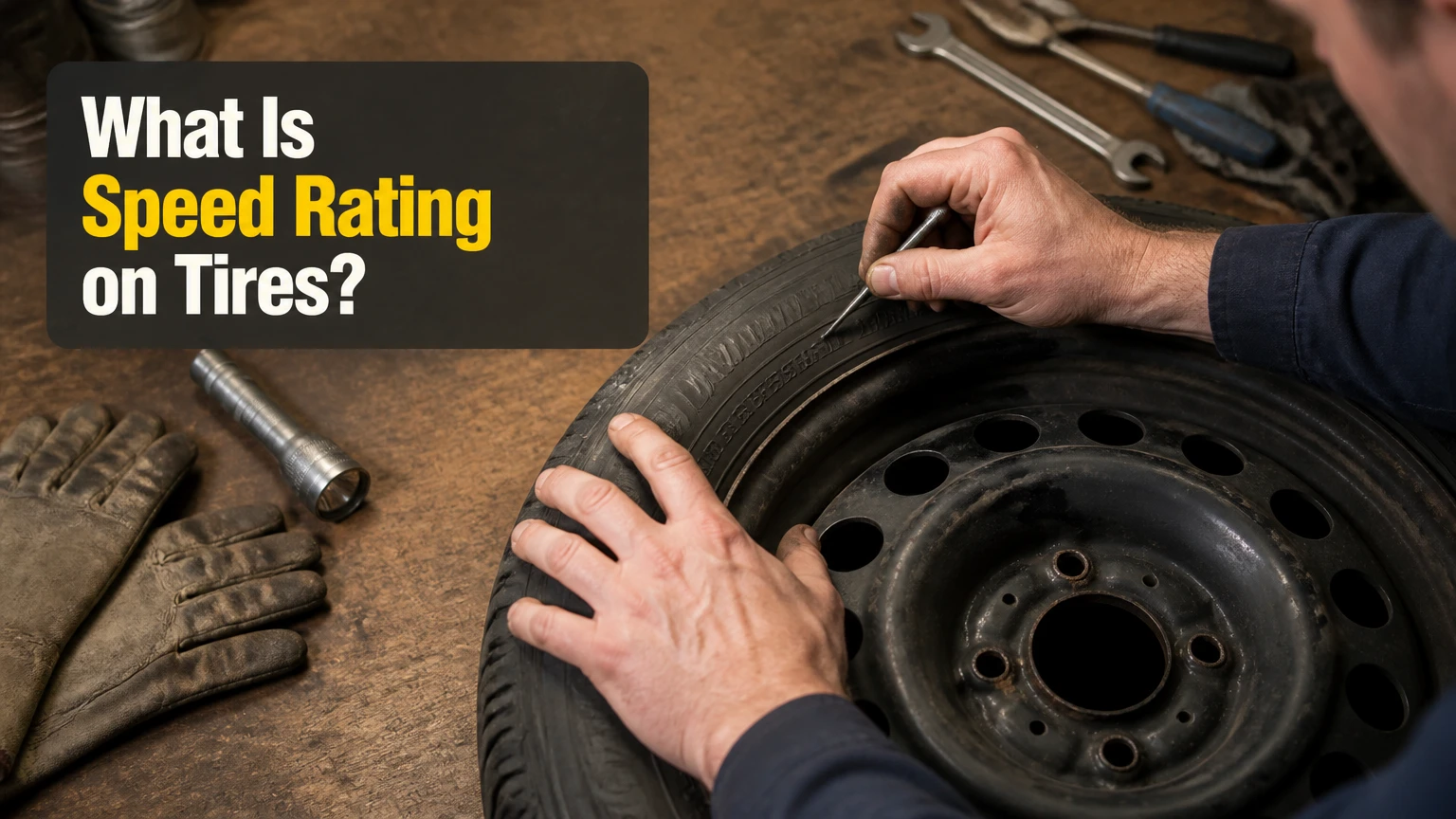
A tire speed rating indicates the maximum safe speed a tire can maintain over time under its recommended load capacity and proper inflation pressure. Regulated by standards organizations like the European Tyre and Rim Technical Organisation and the United States Department of Transportation, this letter designation represents rigorous laboratory testing limits rather than a recommended cruising velocity for public roadways.
At a Glance
- Speed ratings are represented by letters (such as S, T, H, V, W, and Y) typically located at the end of a tire size service description.
- The rating is only legally and physically valid when tires are properly inflated and not loaded beyond their maximum weight capacity.
- Mixing tires with different speed ratings limits the entire vehicle’s safe operating speed to the lowest-rated tire installed.
- Higher speed-rated tires generally utilize softer rubber compounds, which enhance cornering grip but decrease overall tread longevity.
- Standard automotive safety guidelines dictate that replacement tires should always match or exceed the original equipment manufacturer speed rating.
What is a tire speed rating?
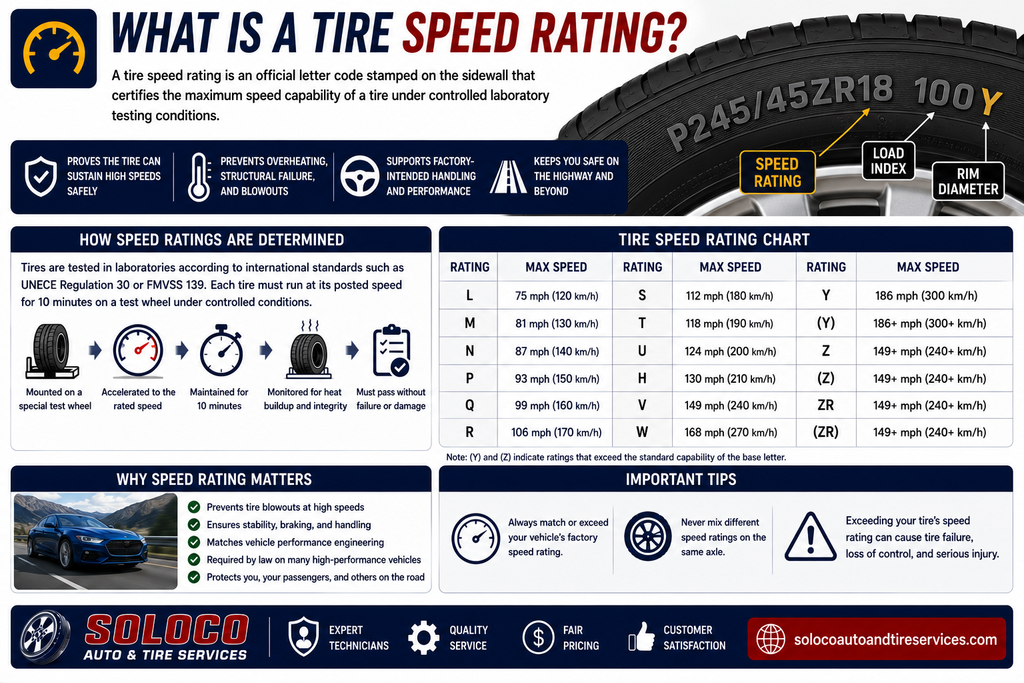
A tire speed rating is an official letter code stamped on the sidewall that certifies the maximum speed capability of a tire under controlled laboratory testing conditions.
Established through protocols such as the United Nations Economic Commission for Europe Regulation 30 or FMVSS 139, the rating proves that a tire can sustain a specific velocity for ten-minute intervals without structural failure, excessive heat buildup, or tread separation.
This metric serves as a vital bridge between vehicle dynamics, chassis engineering, and rubber chemistry. Understanding this rating prevents catastrophic tire blowouts during highway travel and ensures that your vehicle maintains factory-intended handling dynamics across various driving environments.
How do you find your vehicle’s required tire speed rating?
You can find your vehicle’s required tire speed rating on the manufacturer placard located on the driver-side door jamb, inside the glove box, or within the official owner manual.
- Open the driver-side door and locate the white and yellow tire information placard affixed to the B-pillar.
- Read the recommended tire size specification, which typically appears as a sequence of numbers and letters like 205/55R16 91V.
- Identify the final letter in the service description sequence, which in this example is the letter V, representing the required speed threshold.
- Cross-reference this letter with the vehicle owner manual to verify if the specification applies to both front and rear axles.
Never rely solely on the speed rating printed on the sidewall of the tires currently mounted on your vehicle, because previous owners or service shops may have installed incorrect or generic replacement parts.
What do the specific letters on a tire speed rating chart mean?
The tire speed rating chart uses letters from M to Y to designate maximum safe speeds ranging from 81 miles per hour up to 186 miles per hour and beyond. These designations correspond to strict velocity milestones achieved during dynamometer durability testing.
| Letter Rating | Maximum Speed (MPH) | Maximum Speed (KM/H) | Typical Vehicle Types |
|---|---|---|---|
| M | 81 mph | 130 km/h | Temporary spare tires |
| N | 87 mph | 140 km/h | Standard space-saver spares |
| P | 93 mph | 150 km/h | Uncommon modern passenger tires |
| Q | 99 mph | 160 km/h | Winter tires, oversized 4×4 tires |
| R | 106 mph | 170 km/h | Heavy-duty light truck tires |
| S | 112 mph | 180 km/h | Family sedans, base minivans |
| T | 118 mph | 190 km/h | Standard family sedans, crossovers |
| H | 130 mph | 210 km/h | Sport sedans, performance coupes |
| V | 149 mph | 240 km/h | Grand touring cars, sports cars |
| W | 168 mph | 270 km/h | High-performance exotic sports cars |
| Y | 186 mph | 300 km/h | Ultra-high-performance exotic supercars |
Each upward step in the alphabetical scale reflects increased internal belt reinforcement, advanced nylon cap plies, and specialized heat-resistant synthetic rubber compounds engineered to maintain structural integrity under extreme centrifugal forces.
What is the difference between a tire’s load index and its speed rating?
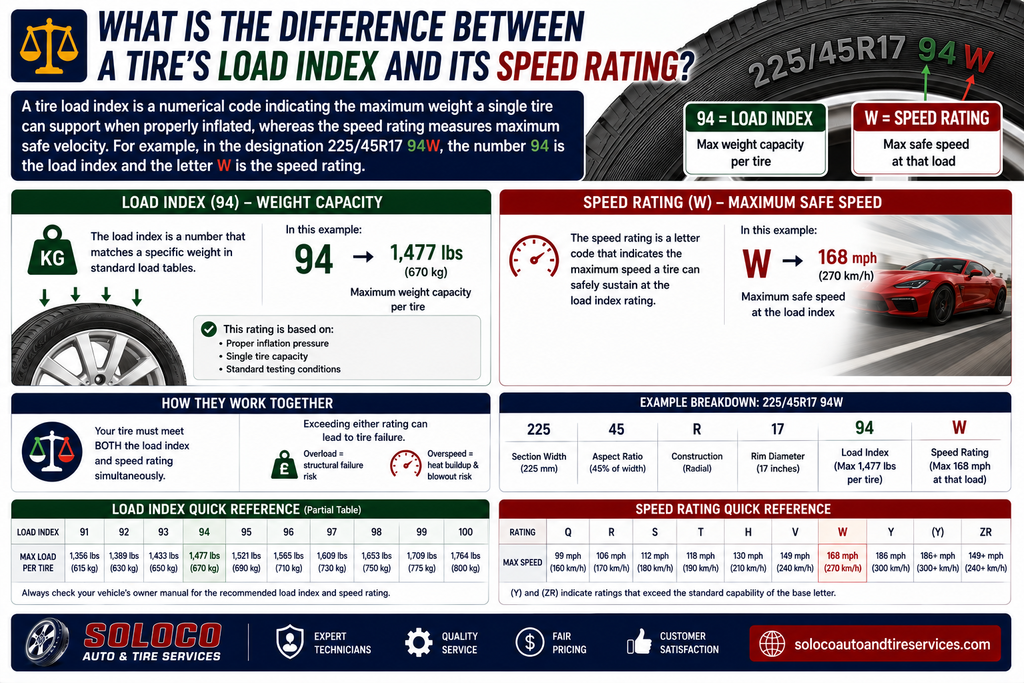
A tire load index is a numerical code indicating the maximum weight a single tire can support when properly inflated, whereas the speed rating measures maximum safe velocity. For example, in the designation 225/45R17 94W, the number 94 is the load index and the letter W is the speed rating.
- Load Index (94): Corresponds to a maximum weight capacity of 1,477 pounds per tire based on standardized load tables.
- Speed Rating (W): Specifies that the tire can safely travel up to 168 miles per hour under that specific load limit.
These two metrics work in tandem. If you exceed the load index by overloading your car, the structural capacity of the tire diminishes, which invalidates the speed rating and creates severe blowout risks during fast driving.
What is the “H” anomaly in tire speed ratings?
The letter H is out of standard alphabetical order in the tire speed rating system because it sits between T and V rather than following G. Historically, the letter H stood for High Performance before the global tire industry standardized alphabetical lettering sequences in the late twentieth century.
When tire manufacturers developed early high-speed radial tires for German autobahns, they designated high-performance variants with an H prefix. As the International Organization for Standardization expanded the grading scale to include Q, R, S, and T for slower utility and passenger vehicles, the legacy H rating was permanently locked between T and V to prevent massive confusion among automotive technicians and parts suppliers worldwide. Recognizing this anomaly prevents confusion when shopping for replacement tires for classic sport sedans and vintage grand tourers.
What does a “Z” or “ZR” speed rating indicate?
A Z speed rating indicates that a tire is engineered to safely exceed speeds of 149 miles per hour. Because the Z category was historically open-ended, modern tire manufacturers incorporated W and Y ratings into the service description to provide precise velocity boundaries for ultra-high-performance vehicles.
When ultra-high-performance tires are rated for speeds exceeding 186 miles per hour, the tire size description includes the letters ZR followed by the Y rating enclosed in parentheses, such as 255/35ZR19 (96Y). The inclusion of parentheses around the load and speed service description denotes that the tire can sustain continuous speeds beyond 186 miles per hour under optimal track conditions. Exotic car owners must verify these specific parenthetical markings to ensure high-speed track safety.
Why do winter tires have lower speed ratings like Q or T?
Winter tires frequently feature lower speed ratings like Q or T because their rubber compounds and aggressive tread patterns prioritize ice traction and snow evacuation over high-speed heat dissipation. Winter tire treads feature thousands of tiny sipes and softer natural rubber compounds that remain flexible in freezing temperatures below 7 degrees Celsius.
During high-speed operation on dry asphalt, these soft rubber blocks flex intensely, generating massive internal friction and thermal energy. Restricting winter tires to lower speed thresholds prevents structural delamination caused by overheating during mild winter days. Drivers who utilize seasonal winter tires must remain mindful of these reduced speed limits on dry highway commutes.
Can you upgrade to a higher tire speed rating than factory specifications?
You can safely upgrade to a higher tire speed rating than the original factory specification, provided the replacement tires match or exceed the vehicle dimensions, load index, and rim diameter requirements. Many automotive enthusiasts upgrade from T-rated or H-rated touring tires to V-rated or W-rated performance tires to gain sharper steering response and enhanced cornering stability.
Upgrading speed ratings improves sidewall stiffness, which reduces lateral roll during aggressive cornering maneuvers. However, this modification will not increase the legal speed limit of public roadways, and it may marginally increase ride harshness due to the stiffer internal casing construction required for high-velocity stability.
How does under-inflation or overloading affect tire speed ratings?
A tire speed rating is rendered completely void the moment a vehicle is chronically under-inflated or carrying a payload that exceeds its maximum load index capacity. When tire pressure drops below manufacturer recommendations, the tire sidewalls flex excessively with every rotation.
This continuous flexing generates extreme internal heat accumulation, causing the synthetic rubber compounds and steel belts to separate long before reaching the rated speed limit. Similarly, overloading a vehicle increases internal carcass tension. If you pile heavy cargo into an SUV outfitted with standard speed-rated tires and drive at highway speeds, the combined heat and weight stress can trigger catastrophic tread separation and sudden blowout events.
Does a professional tire repair void its speed rating?
A professional tire puncture repair using a combined plug-and-patch method permanently voids the official speed rating of the tire, effectively reducing it to an unrated utility tire. Once the inner liner and structural body plies of a tire are punctured by a nail or screw, the internal matrix is permanently altered.
While a professional patch makes the tire safe for normal commuting and moderate speeds, tire manufacturers and the U.S. Tire Manufacturers Association state that repaired tires should no longer be operated at high speeds. Driving at high velocities on a repaired tire creates concentrated thermal stress around the patch repair area, increasing the risk of slow air leaks or sudden structural degradation.
What happens when you mix different speed ratings on the same car?
When you install tires with different speed ratings on the same vehicle, the overall safe operating speed of the vehicle is strictly limited to the lowest-rated tire installed. Putting high-performance W-rated tires on the rear axle and lower-rated S-rated tires on the front axle does not neutralize the risk of the front tires failing at high speeds.
Mixing speed ratings also introduces dangerous handling imbalances. Softer sidewalls on the front axle combined with stiff sidewalls on the rear axle can induce unpredictable understeer or snap oversteer during emergency braking or sudden lane-change maneuvers. Professional technicians always recommend installing matching sets of four tires with identical speed and load ratings.
Can you put a lower speed rating tire on your car to save money?
Installing lower speed rating tires than your vehicle’s factory specification is technically possible to save money, but it introduces significant handling compromises and safety risks. While you may never personally drive 130 miles per hour, higher speed-rated tires feature reinforced internal sidewalls that dictate how your car responds during emergency swerves and braking events.
Dropping from an H-rated factory tire down to an S-rated budget tire makes your steering feel sluggish, spongy, and unresponsive. Furthermore, insurance adjusters and vehicle safety investigators scrutinize tire specifications after accidents, meaning substandard installations can create severe liability complications.
Does a higher speed rating mean the tire wears out faster?
Higher speed-rated tires generally exhibit shorter tread life compared to lower-rated tires because they utilize softer, high-grip rubber compounds engineered to dissipate extreme frictional heat. Tires rated V, W, or Y must maintain maximum traction on dry and wet pavement at elevated velocities, which requires softer tread polymers that wear down faster under normal daily driving friction.
Conversely, standard S-rated and T-rated tires utilize harder, more durable rubber formulations focused entirely on maximizing mileage and fuel efficiency. Drivers seeking maximum tire longevity must balance the desire for high-performance handling against the reality of frequent tire replacements.
How does sustained heat impact high-speed tire durability?
Sustained ambient heat combined with high-velocity rolling friction exponentially increases internal tire temperatures, which can exceed the thermal limits of standard passenger tires. As a tire rolls across pavement, it undergoes continuous deflection and recovery, a mechanical process known as hysteresis that generates internal heat.
When driving at high speeds in hot summer climates, ambient temperatures compound internal thermal buildup. If tire pressure is even slightly low during high-heat conditions, the rubber and steel belts experience thermal degradation, resulting in tread chunking or catastrophic sidewall blowout. High-speed rated tires incorporate specialized heat-resistant polymers to mitigate this exact thermal vulnerability.
Do trailer tires follow the standard automotive speed rating system?
Specialty trailer tires, commonly designated with the ST prefix rather than P or LT, follow a unique speed rating structure where older designs are often capped at 65 miles per hour unless specified otherwise. Many modern radial trailer tires now feature explicit speed ratings like L for 75 miles per hour or M for 81 miles per hour.
Failing to respect trailer tire speed limitations is a primary cause of catastrophic cargo trailer blowouts on interstate highways. Because trailers endure heavy static loads and lack active steering adjustments, towing vehicles at high speeds on standard utility trailer tires without verified speed certifications creates severe highway safety hazards.
Will an insurance company deny a claim for using the wrong speed rating?
Insurance companies can deny coverage or reduce payout claims if an accident investigation proves that improper vehicle modifications, including installing tires with significantly lower speed ratings than manufacturer specifications, directly contributed to the crash.
When a high-speed highway accident occurs due to sudden tire failure, forensic accident investigators inspect tire sidewall service descriptions, load indexes, and DOT date codes. If the installed tires were rated for 99 miles per hour while the vehicle was operated at extreme velocities that exceeded those limits, insurers can classify the setup as negligent vehicle modification, leaving the owner financially liable for damages and injuries.
The Bottom Line
A tire speed rating is much more than a simple letter on a sidewall; it is an engineered safety boundary verifying maximum velocity under proper load and inflation conditions. Always match or exceed your vehicle manufacturer specifications, account for structural limitations like repairs and winter compounds, and prioritize proper tire maintenance to ensure peak handling stability and accident prevention on every journey.