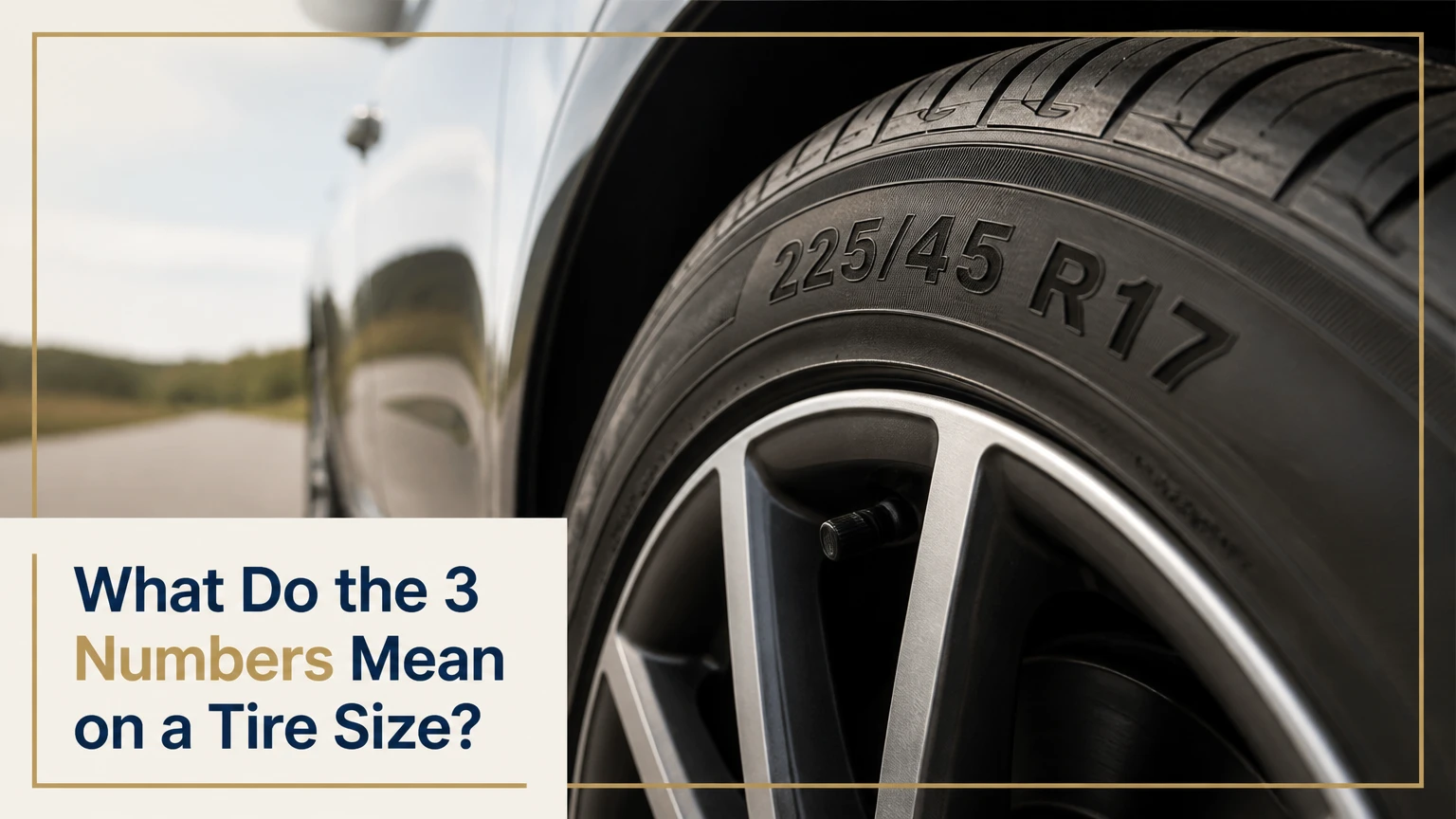
The three primary numbers on a tire size represent the section width in millimeters, the aspect ratio as a percentage of that width, and the wheel diameter in inches. For instance, on a standard passenger tire marked 225/45R17, the 225 indicates width, the 45 specifies sidewall proportion, and the 17 denotes rim diameter.
At a Glance
- The first number measures the sidewall-to-sidewall section width in millimeters.
- The second number calculates the sidewall height as a percentage of the section width.
- The letter ‘R’ designates radial tire construction rather than a speed rating.
- The final number dictates the exact wheel diameter in inches required for installation.
- Flotation sizes and commercial truck tires use completely different numerical formats.
- Ignoring load index and speed ratings alongside these three numbers compromises safety.
What Do the Three Primary Numbers Represent?
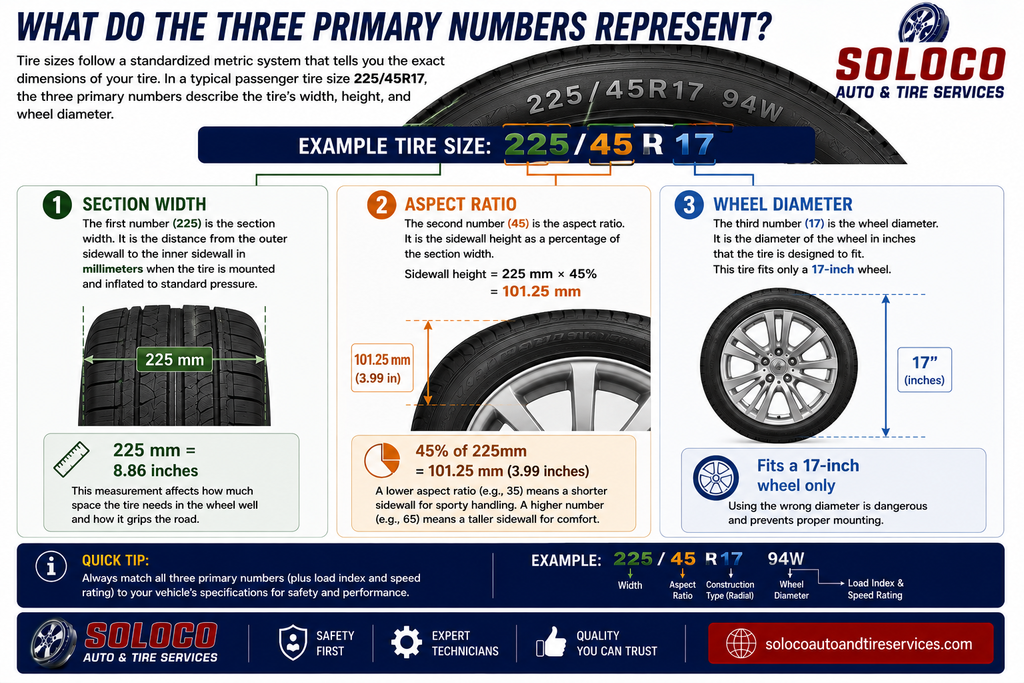
The three primary numbers on a tire sidewall follow a standardized metric sizing system that dictates physical dimensions. In a typical passenger car tire designation such as 225/45R17, each segment serves a precise geometric purpose.
The first number (225) represents the section width, measuring the distance from the outer sidewall to the inner sidewall in millimeters when the tire is mounted and inflated to standard pressure. The second number (45) is the aspect ratio, indicating that the sidewall height is 45 percent of the 225mm section width, which equals 101.25 millimeters of vertical cushion. The final number (17) defines the wheel diameter, meaning the tire fits exclusively onto a wheel measuring 17 inches across.
What Does the Letter in a Tire Size Mean?
Letters embedded within a tire size sequence indicate internal construction type, speed thresholds, or vehicle application categories. The most common letter is R, which stands for radial construction, meaning the internal ply cords run radially at 90 degrees to the tread centerline.
Performance tires sometimes embed a speed rating letter directly into the size code, such as 225/40ZR18. In this configuration, the Z designates a high-performance tire capable of sustained speeds exceeding 149 miles per hour. These letters prevent structural failure by signaling internal engineering limits that raw dimensional numbers alone cannot convey.
How Do You Calculate Tire Sidewall Height?
Calculating tire sidewall height requires multiplying the section width by the decimal equivalent of the aspect ratio. For example, on a tire sized 245/50R16, convert the aspect ratio of 50 percent into the decimal 0.50.
Multiply the section width of 245 millimeters by 0.50, resulting in a sidewall height of 122.5 millimeters. To convert this metric height into inches for comparison, divide by 25.4, which yields approximately 4.82 inches of vertical sidewall cushion between the road and the metal wheel rim.
What Do Flotation Tire Sizes Mean?
Flotation tire sizes use an imperial measurement system found primarily on light trucks, Jeeps, and off-road vehicles. A typical flotation size appears as 33×12.50R15 rather than standard metric formatting.
The first number (33) indicates the total outer height or diameter of the fully inflated tire in inches. The second number (12.50) specifies the total section width in inches. The final number (15) designates the required wheel diameter in inches, giving off-road enthusiasts a quick calculation of ground clearance and rim matching.
How Do Commercial Heavy-Duty Tire Sizes Work?
Commercial heavy-duty and medium truck tire sizes omit the aspect ratio entirely, relying instead on nominal sizing conventions like 7.50R16 or 11R22.5. When a tire size lacks an explicit aspect ratio, the industry standard automatically defaults the aspect ratio to 80% or 82%.
A commercial tire marked 11R22.5 features an 11-inch nominal section width, radial construction, and fits a 22.5-inch wheel. Because commercial vehicles carry immense cargo weights, these high-profile designs prioritize structural durability and load capacity over low-profile handling dynamics.
What Is the Metric Millimeter Wheel Exception?
Extremely rare vintage or specialized European passenger cars use metric millimeter wheel sizes, such as the Michelin TRX system denoted by 220/55R390. In this configuration, the final number 390 represents the wheel diameter in millimeters rather than inches.
A 390mm wheel equals roughly 15.3 inches, making it impossible to install standard 15-inch or 16-inch tires safely. Forcing a standard tire onto a metric millimeter rim creates a catastrophic bead seal failure, leading to sudden deflation at high speeds.
What Is the “Same Width” Fallacy in Tire Buying?
Two different tire brands labeled with the exact same section width number can possess visibly different physical dimensions. Tread block designs, shoulder shaping, and manufacturing mold tolerances mean a 225mm tire from Brand A might measure 229mm across its widest point.
This variance causes real-world installation problems. A wider-than-expected budget tire can rub against your vehicle’s inner suspension struts or outer fender liners during sharp turns, despite matching the factory numeric specification on paper.
What Is the Changing Aspect Ratio Trap?
Changing only the tire width alters your total tire height, throwing off mechanical clearances and calibration instruments. If you upgrade your vehicle from a factory 215/55R17 to a wider 235/55R17 while keeping the same aspect ratio, your sidewall height automatically expands from 118mm to 129mm.
This added height increases the overall outer diameter of the wheel assembly. The physical expansion causes the tire to rub against wheel well liners during suspension compression and distorts your vehicle’s electronic speedometer accuracy.
Why Do Service Descriptions Matter Just as Much as Dimensions?
The numbers and letters following the core tire size, such as 91V in 225/45R17 91V, dictate the structural load index and maximum speed rating. The load index number 91 certifies that an individual tire can safely support a maximum weight of 615 kilograms, while the speed rating letter V authorizes sustained travel up to 240 kilometers per hour.
Matching the three primary size numbers while ignoring service descriptions results in selecting a replacement tire unable to support your vehicle’s gross weight rating. Under-capacity tires generate excessive internal heat, leading to tread separation and dangerous blowouts.
Why Do Prefix Letters Like P and LT Change Tire Application Rules?
Prefix letters at the beginning of a tire size sequence dictate vehicle classification and structural load capabilities. A passenger tire marked P225/70R15 and a light truck tire marked LT225/70R15 share identical outer dimensions, but their internal engineering differs completely.
Light truck tires feature heavier casing plies, require significantly higher air pressure values, and carry substantially more weight than passenger equivalents. Interchanging a passenger tire onto a heavy-duty work truck overloads the casing structure, resulting in premature tire destruction.
Can I Put a Different Tire Size on My Factory Wheels?
Yes, you can install alternative tire sizes on factory wheels provided the overall outer diameter stays within 3 percent of the original factory specification. Staying within this 3 percent threshold prevents interference with mechanical components and computerized safety systems.
If you want a wider tire profile, you must simultaneously lower the aspect ratio to compensate for the added width. For example, swapping a factory 205/55R16 for a wider 225/50R16 preserves the exact overall outer diameter, keeping your speedometer and gearing completely accurate.
What Happens If I Use the Wrong Aspect Ratio?
Using the wrong aspect ratio alters your vehicle’s overall rolling diameter, causing your speedometer and odometer to read incorrectly. A larger overall diameter makes your speedometer read slower than your actual road speed, risking speeding tickets, while a smaller diameter makes it read faster than reality.
Beyond instrumentation errors, incorrect rolling diameters disrupt modern automotive safety systems. Differing front-to-rear wheel rotation speeds confuse Anti-lock Braking Systems (ABS) and Traction Control modules, triggering dashboard warning lights and erratic braking behavior.
Does a Higher Aspect Ratio Mean a Softer Ride?
Yes, a higher aspect ratio designation like 65 or 70 provides a softer, more comfortable ride quality. Higher aspect ratios feature more vertical rubber sidewall between the metal wheel rim and the road surface, creating a deep cushion that absorbs potholes and rough pavement.
In contrast, low-profile performance tires with aspect ratios of 30, 35, or 40 offer sharp steering response and cornering stability at the cost of a stiff, harsh ride over bumps.
Why Does the Tire Industry Mix Metric and Imperial Units?
The tire industry mixes metric millimeters and imperial inches due to a historical manufacturing compromise made during the mid-20th century. European tire manufacturers standardized their tread widths in millimeters to fit metric engineering practices, while American automotive rim manufacturers standardized wheel diameters in inches.
Rather than forcing either continent to completely re-tool industrial manufacturing plants and assembly lines at billions of dollars in cost, the global automotive market adopted this hybrid sizing format permanently.
How Do I Safely Calculate Tire Size Alternatives?
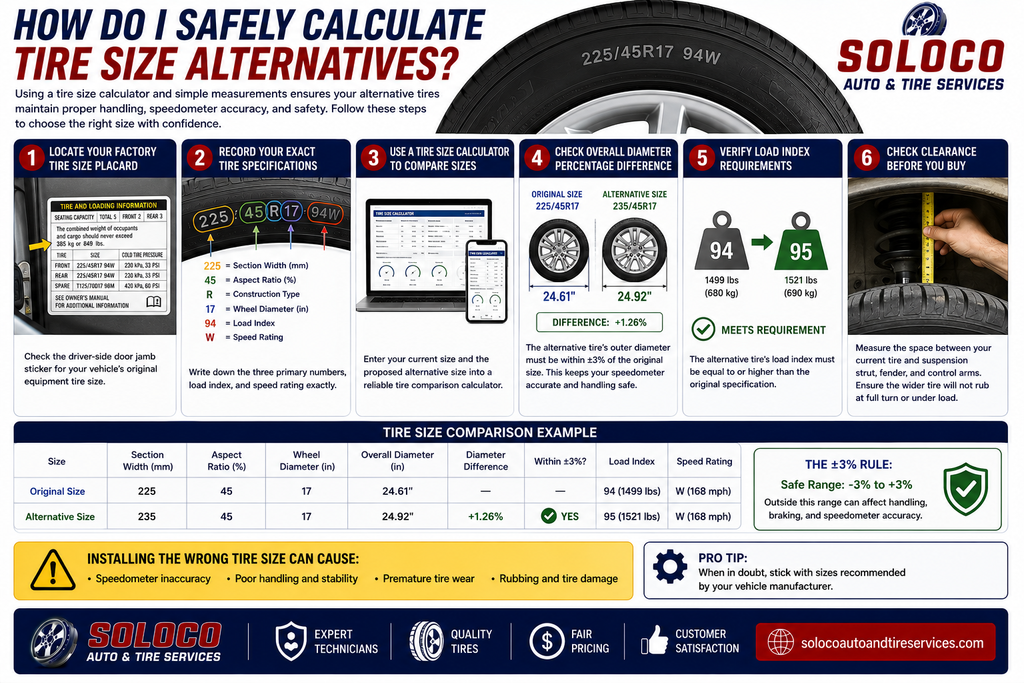
Calculating safe tire size alternatives requires using a dedicated tire dimension calculator to match your vehicle’s exact outer rolling diameter and load requirements. Follow these steps to find a safe alternative:
- Locate your vehicle’s original factory tire size placard found on the driver-side door jamb.
- Record the exact three primary numbers, load index, and speed rating of the factory tire.
- Input your current size and your proposed alternative size into a tire comparison calculator to check the percentage difference in overall diameter.
- Verify that the alternative tire’s outer diameter falls within a plus or minus 3 percent variance of the original size.
- Confirm that the alternative tire’s load index meets or exceeds the original equipment manufacturer specification.
- Check inner clearance by measuring the distance between your current tire and your suspension strut to ensure a wider tread width will not rub.
The Bottom Line
Understanding what the three numbers mean on a tire size prevents costly purchasing mistakes, mechanical damage, and dangerous structural failures. The core metrics define section width in millimeters, aspect ratio percentages, and wheel diameter in inches, but drivers must always account for load indices and vehicle-specific prefixes. Checking overall outer diameters against factory specifications ensures your vehicle maintains proper speedometer calibration, suspension clearance, and safety system reliability.


