Most standard passenger vehicle tires last between 40,000 and 60,000 miles before requiring replacement. However, total tire lifespan varies significantly depending on rubber compound chemistry, daily driving habits, regional climate conditions, and routine vehicle maintenance practices.
At a Glance: Key Tire Replacement Facts
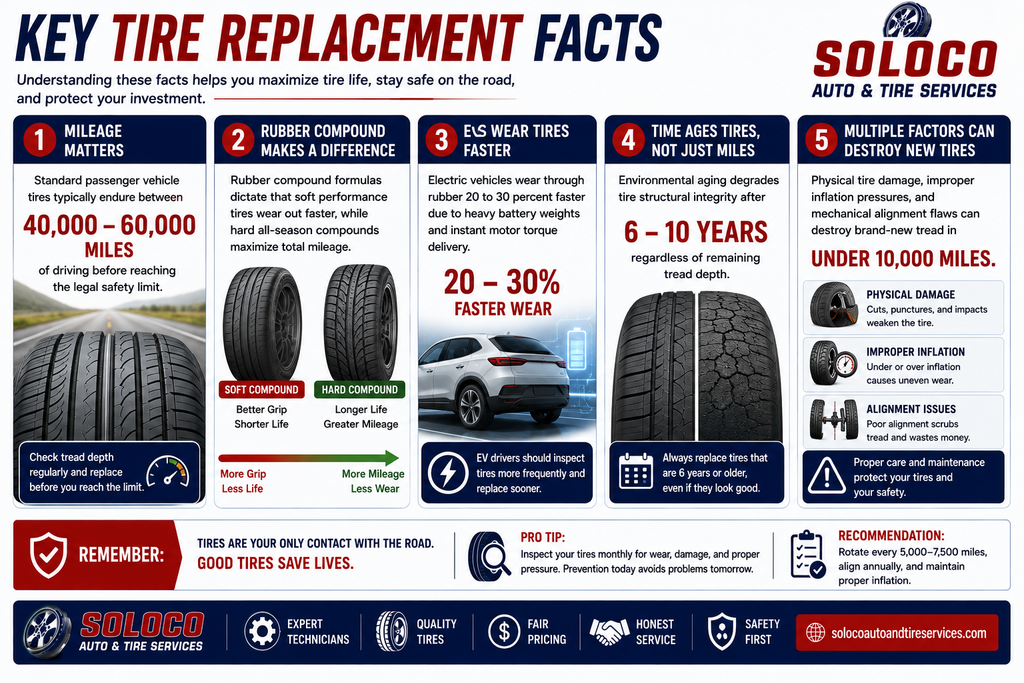
- Standard passenger vehicle tires typically endure between 40,000 and 60,000 miles of driving before reaching the legal safety limit.
- Rubber compound formulas dictate that soft performance tires wear out faster, while hard all-season compounds maximize total mileage.
- Electric vehicles wear through rubber 20 to 30 percent faster due to heavy battery weights and instant motor torque delivery.
- Environmental aging degrades tire structural integrity after six to ten years, regardless of remaining tread depth.
- Physical tire damage, improper inflation pressures, and mechanical alignment flaws can destroy brand-new tread in under 10,000 miles.
What is the lifespan of different tire types?
Tire longevity depends heavily on the chemical compound and engineering purpose of the specific tire category. All-season tires typically deliver between 40,000 and 80,000 miles because they utilize harder rubber compounds engineered for daily commuting. Performance and summer tires last between 20,000 and 40,000 miles because softer rubber compounds are utilized to maximize dry road grip at high speeds. Winter and snow tires likewise last 20,000 to 40,000 miles, but they must be removed during warm seasons because soft winter rubber degrades rapidly in hot weather. All-terrain and off-road tires span 30,000 to 50,000 miles, though aggressive block treads wear unevenly if driven continuously on paved highways.
How do electric vehicles impact tire lifespan?
Electric vehicles accelerate tire wear by 20 to 30 percent, often forcing replacement around 30,000 miles. This accelerated degradation occurs because electric vehicles carry massive lithium-ion battery packs that substantially increase gross vehicle weight. Furthermore, electric motors deliver instant torque directly to the wheels, creating high friction spikes during acceleration that strip rubber from the tread blocks faster than internal combustion engines. Electric vehicle owners must rotate tires every 5,000 miles to mitigate this heavy torque-induced wear pattern.
How do staggered wheel fitments affect tire wear?
Staggered wheel fitments cut expected tire life by roughly 50 percent on sports cars and high-performance sedans. A staggered configuration features wider rear wheels and tires compared to the front axle, preventing traditional front-to-back tire rotations. Because rear tires cannot be swapped to the front axle to equalize wear rates, rear drive tires wear down completely while front tires still retain significant tread depth. Vehicle owners operating staggered setups must budget for rear tire replacements twice as often as front tire replacements.
When does tire aging require replacement regardless of tread?
Tire rubber degrades chemically over time due to oxidation, ozone exposure, and environmental stress, requiring replacement after six to ten years regardless of remaining tread depth. Even if a vehicle sits parked in a garage for years with deep, undamaged tread, the internal steel belts and exterior rubber compounds lose flexibility and structural integrity. Mechanics use the four-digit Department of Transportation code stamped on the sidewall to determine manufacturing date, where the first two digits represent the production week and the last two digits represent the production year. Tires exceeding ten years from their manufacturing date pose catastrophic blowout risks on highways and must be discarded.
How long can you drive on a spare tire donut?
Space-saver spare tires, commonly known as donuts, are strictly rated for a maximum of 50 to 70 miles of total use at speeds under 50 miles per hour. These temporary spares feature minimal tread depth, lightweight construction, and smaller structural dimensions designed solely to get a motorist to a local tire repair shop. Driving long distances or exceeding recommended speed limits on a temporary spare generates dangerous internal heat buildup, which can cause the emergency tire to delaminate or explode. Motorists should repair or replace their primary punctured tire immediately rather than relying on a spare for extended journeys.
How does mechanical wear destroy tires prematurely?
Mechanical suspension faults and steering component wear can completely destroy a tire in fewer than 10,000 miles through rapid, uneven wear patterns known as cupping or feathering. Wiped-out shock absorbers cause the vehicle wheel to bounce rhythmically against the asphalt, gouging high and low spots into the rubber tread. Similarly, out-of-spec wheel alignment angles force tires to scrub sideways against the pavement rather than rolling cleanly, generating intense friction that strips the inner or outer shoulders down to the cords while the rest of the tread looks acceptable.
How does improper tire inflation ruin tread life?
Incorrect tire inflation pressures alter the contact patch between the rubber and the road, causing accelerated wear along specific sections of the tread. Under-inflation causes the center of the tread to sag inward, forcing the outer shoulders to bear the full weight of the vehicle and wear out prematurely. Over-inflation causes the tire to crown or bulge in the middle, concentrating all friction onto the center strip and wearing it away rapidly while leaving the outer edges untouched. Drivers should check tire pressures monthly using a digital gauge when tires are cold to ensure optimal wear characteristics.
How does climate and UV exposure cause tire dry rot?
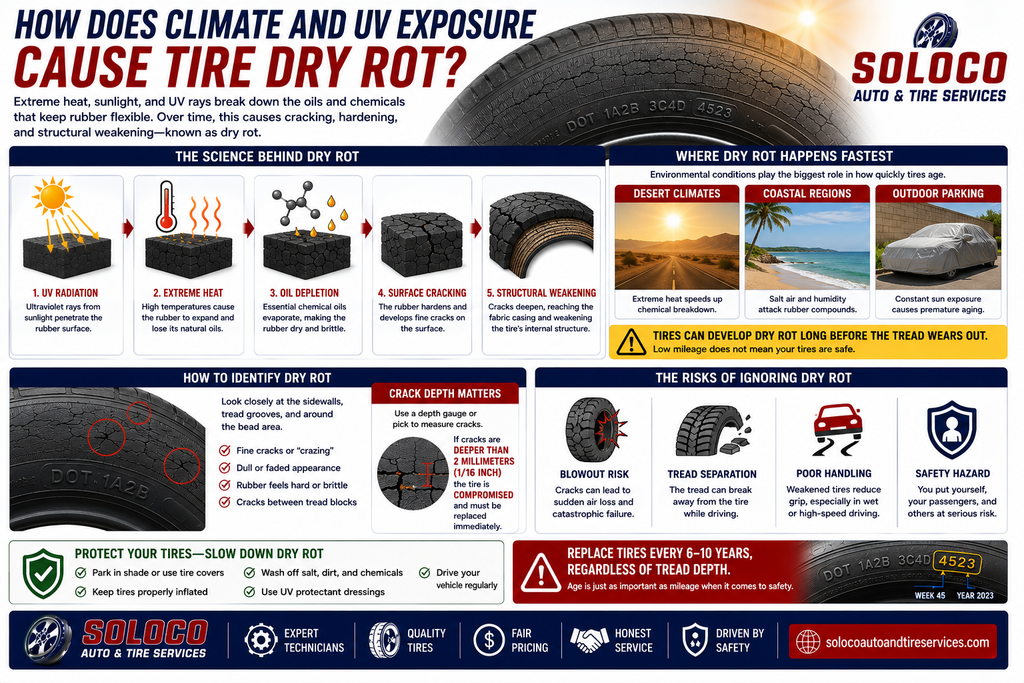
Extreme ambient heat, prolonged direct sunlight, and ultraviolet radiation degrade volatile chemical oils inside rubber compounds, causing surface cracking known as dry rot. This environmental weathering attacks the tire sidewalls and tread grooves, creating fine fractures that weaken the internal fabric casing. Vehicles parked outdoors in desert climates or coastal regions experience accelerated dry rot long before high mileage wears down the tread depth. If visible cracks appear on the sidewall deeper than two millimeters, the tire is compromised and must be replaced immediately for safety.
How do you check tire tread depth without a mileage log?
Motorists can evaluate remaining tire safety without a mileage log by performing the traditional penny test. Hold a standard United States penny with Abraham Lincoln’s head pointing downward, and insert the coin into the shallowest groove of the tire tread. If the top of Lincoln’s head remains entirely visible above the rubber, the tread depth has dropped below 2/32 of an inch, which signifies a legally bald and dangerously unsafe tire. Modern tires also feature built-in treadwear indicator bars molded across the grooves, which become flush with the surface when replacement is urgently required.
Do tire treadwear warranties cover early replacement?
Tire treadwear warranties provide pro-rated credit rather than free replacements if a tire wears out before reaching its rated mileage guarantee. If an 80,000-mile tire wears down to the legal limit at 40,000 miles, the manufacturer grants a 50 percent discount toward the purchase of a new set of identical tires. To qualify for this pro-rated warranty credit, motorists must present meticulous maintenance records proving the tires were rotated professionally every 5,000 to 7,000 miles and maintained at correct inflation pressures throughout their lifecycle.
Should you replace all four tires at the same time?
All-Wheel Drive vehicles require all four tires to be replaced simultaneously to prevent catastrophic mechanical failure within the center differential and transfer case. Differing tread depths on an All-Wheel Drive vehicle force tires of different rolling circumferences to spin at varying rotational speeds, causing constant friction and overheating inside the drivetrain. On traditional front-wheel-drive or rear-wheel-drive cars, motorists can replace tires in pairs on a single axle, provided the newest tires are installed on the rear axle to maintain optimal vehicle stability during emergency braking maneuvers.
Why do brand-new car tires wear out so quickly?
Original Equipment tires installed on brand-new vehicles at the factory often wear out faster than replacement tires purchased later at a retail shop. Vehicle manufacturers prioritize a quiet ride, smooth cabin comfort, and superior fuel economy during test drives, prompting them to select softer rubber compounds with shallower initial tread depths. These factory tires optimize showroom appeal and immediate handling performance at the expense of long-term durability, frequently requiring replacement sooner than aftermarket tires built with hard, long-lasting rubber formulas.
How does wheel alignment frequency affect total tire mileage?
Regular wheel alignment checks performed every 12,000 miles or once a year ensure that suspension geometry angles remain factory-spec, directly maximizing total tire mileage. Hitting deep potholes, striking concrete curbs, or driving over unpaved construction zones knocks the camber, caster, and toe angles out of alignment, causing scrubbing friction that rapidly chews through expensive tread rubber. Maintaining correct wheel alignment prevents premature shoulder wear and ensures that vehicle tires achieve their maximum manufacturer-rated mileage potential.
What temperature ranges cause winter tire rubber to degrade?
Winter tire rubber compounds are engineered to remain flexible in sub-zero temperatures, but ambient temperatures sustained above 45 degrees Fahrenheit cause the soft tread blocks to overheat and degrade rapidly. Driving winter tires during hot summer months accelerates rubber wear by up to 60 percent due to friction heat buildup on warm asphalt. Motorists must swap winter tires for all-season or summer variants once seasonal spring temperatures consistently rise above 45 degrees Fahrenheit.
How does aggressive driving accelerate tread wear?
Aggressive driving habits, including harsh acceleration, hard cornering, and sudden threshold braking, generate massive friction forces that strip rubber away from tire tread blocks at an amplified rate. Ripping around tight turns at high speeds exerts intense lateral G-forces that fold the tire sidewall under, wearing out outer tread shoulders prematurely. Moderate braking and smooth acceleration preserve tire contact patches and significantly extend total mileage expectations.
The Bottom Line
Standard passenger vehicle tires typically last between 40,000 and 60,000 miles under normal driving conditions. However, achieving maximum tire longevity requires monitoring environmental aging limits after six years, maintaining correct inflation pressures monthly, and performing regular wheel alignments. Motorists must always prioritize physical tread depth measurements over generic mileage estimates to ensure safe highway operation.