
Vehicle owners must replace tires every 6 to 10 years regardless of use, or every 60,000 to 130,000 kilometers based on tread wear. Drivers should immediately replace any tire if the tread depth drops below the legal minimum of 1.6 mm or if structural cracking develops from age and oxidation.
At a Glance: Essential Tire Replacement Facts
- Absolute Age Limit: Tires must be replaced after 10 years from their manufacturing date, even if the tread looks brand new.
- Legal Minimum Tread: 1.6 mm (2/32 of an inch) is the legal limit, but wet weather requires at least 3.2 mm (4/32 of an inch) for safe stopping.
- Inspection Milestone: Professional tire inspections should begin annually once a tire reaches 5 years of age.
- EV and Performance Wear: Electric vehicles and sports cars wear through rubber 20% to 30% faster due to high weight, instant torque, and soft compound formulas.
- Axle Replacement Rule: All-wheel-drive vehicles require replacing all four tires simultaneously, while two-wheel-drive vehicles can replace tires in axle pairs.
What are the exact mileage and age limits for tire replacement?
Vehicle tires typically require replacement between 60,000 and 130,000 kilometers, or every 6 to 10 years, whichever comes first. This dual threshold exists because rubber is an organic material that degrades chemically over time through exposure to oxygen, ultraviolet light, and ambient temperature fluctuations, regardless of how many kilometers the vehicle has driven.
Manufacturer warranties generally cover tread wear up to a specified mileage limit, such as 80,000 kilometers for standard all-season touring tires. However, environmental factors often compromise the structural integrity of the internal steel belts and polyester casing long before the rubber tread blocks wear down to the wear bars. Drivers who commute moderate distances will usually hit the mileage limit around years five through seven, while low-mileage drivers will hit the maximum age limit before wearing out the tread.
What tread depth is legally too low for driving?
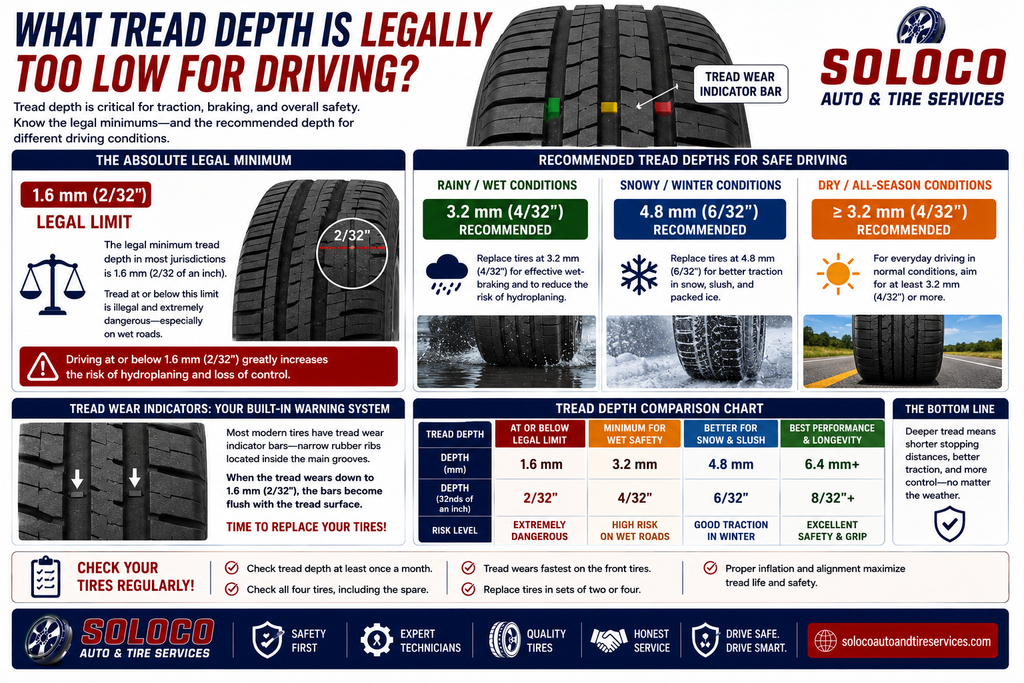
The absolute legal minimum tread depth across most jurisdictions is 1.6 mm, which equals 2/32 of an inch. Operating a vehicle with tread depth at or below this threshold on wet roads creates an extreme risk of hydroplaning, because the shallow grooves can no longer channel water away from the contact patch between the rubber and the asphalt.
Professional safety organizations recommend replacing tires well before reaching the legal limit. Drivers living in rainy regions should replace tires at 3.2 mm, which equals 4/32 of an inch, to maintain effective wet-braking performance.
Drivers encountering heavy winter snow should replace tires at 4.8 mm, which equals 6/32 of an inch, to ensure proper traction in packed powder and slush. Modern tires feature built-in tread wear indicators—narrow rubber bars hidden inside the main grooves—that become flush with the tread surface when the tire reaches the 1.6 mm limit.
How do I read the DOT date code on my tire sidewall?
The Department of Transportation date code is a four-digit number stamped into the lower sidewall of every tire, indicating the exact week and year of manufacture. The code always follows the letters DOT and represents a simple calendar stamp where the first two digits signify the production week from 01 to 52, and the last two digits signify the manufacturing year.
For example, a sidewall stamp reading “2423” means the tire was manufactured during the 24th week of the year 2023, which corresponds roughly to June 2023. Buyers purchasing used vehicles, checking stored spare tires, or evaluating older inventory at a repair shop must locate this four-digit stamp to determine the true age of the rubber. Tires manufactured prior to the year 2000 used a three-digit code and should be discarded immediately due to extreme age.
How do I check tire tread wear with a coin?
Vehicle owners can check tire tread depth quickly at home using a standard coin, such as a local equivalent or a standard coin placed into the main tread ribs. To perform the check, hold the coin between your thumb and forefinger, place it upside down into the center groove of the tread, and observe whether the outer edge of the coin design or the top of the President’s head is visible.
If the tread touches or covers part of the coin’s outer edge, the remaining tread depth is safely above 3.2 mm. If the entire outer edge or head is completely visible with space above it, the tread depth has dropped below 2/32 of an inch, signaling an immediate need for tire replacement. Drivers should test multiple spots across the width of the tire, as uneven wear patterns often indicate alignment issues or incorrect inflation pressures.
Why do low-mileage garage cars still need new tires?
Low-mileage vehicles, often called garage queens, require new tires after 10 years even if the tread depth appears pristine and the vehicle has driven fewer than 20,000 kilometers. Rubber compounds rely on chemical plasticizers and anti-aging agents that migrate to the surface over time; once these additives evaporate through continuous exposure to ambient oxygen and ozone, the rubber loses its elasticity.
This chemical breakdown leads to dry rot, characterized by fine cracking along the sidewalls and between the tread blocks. Internal steel cords protected by thin layers of rubber begin to rust as microscopic moisture penetrates the weakened outer shell. Driving on 10-year-old rubber risks sudden tread separation or catastrophic blowout at highway speeds, making age a strict safety cutoff regardless of visual wear.
Do electric vehicle tires wear out faster than gas car tires?
Electric vehicles wear out tires 20% to 30% faster than comparable internal combustion engine vehicles due to two distinct physical factors: excessive vehicle weight and instant torque delivery. Battery packs add hundreds of kilograms of extra mass to the vehicle frame, putting continuous high loads on the tire contact patch during every turn and stop.
Furthermore, electric motors deliver maximum torque instantly to the wheels upon acceleration, causing microscopic slip between the rubber and the pavement that accelerates tread wear. Drivers switching to an electric vehicle should anticipate replacing their tires much sooner than expected, often needing a fresh set between 40,000 and 50,000 kilometers unless they adopt exceptionally smooth acceleration and braking habits.
How do hot climates and desert heat shorten tire lifespan?
Extreme heat and desert climates accelerate the thermal oxidation of rubber, often reducing total tire lifespan to just 3 to 5 years. High ambient temperatures combined with scorching asphalt surface temperatures cause chemical reactions within the rubber compound to proceed at an exponential rate, drying out the natural oils that keep the tire flexible.
Vehicles parked outdoors in regions like Arizona, the Middle East, or parts of Australia experience severe ultraviolet degradation alongside heat stress. This dual assault causes the rubber to harden prematurely and develop extensive micro-fissures long before the tread wears down from mileage. Drivers in hot climates must inspect their tires biannually for surface hardening and cracking starting in year three.
How does heavy towing or constant hauling affect tire wear?
Heavy towing and constant cargo hauling increase internal tire temperatures and accelerate tread wear by pushing the load index of the tire close to its maximum safe limit. When a trailer tongue weight or heavy payload presses down on the vehicle suspension, the sidewalls flex excessively with every wheel rotation, generating internal friction and heat.
Overloaded tires suffer from rapid shoulder wear, internal belt separation, and structural fatigue. Vehicle owners who frequently tow heavy loads should inflate their tires to the maximum pressure specified on the vehicle placard for heavy-duty operation, inspect tread depths monthly, and anticipate replacing tires up to 25% earlier than standard mileage projections.
What are the hidden signs of internal tire structural failure?
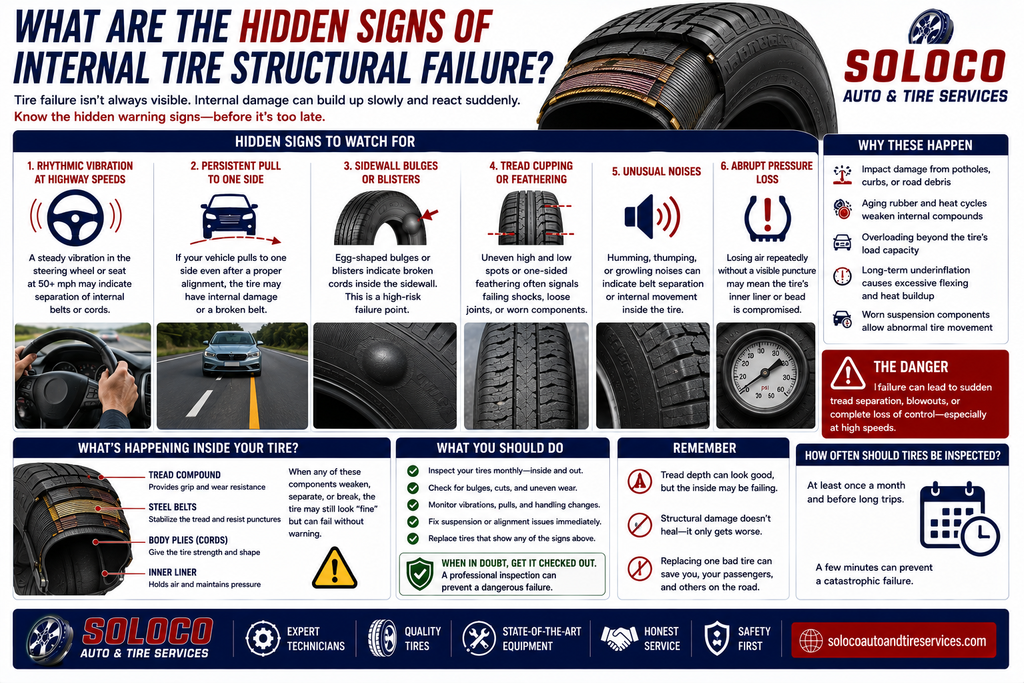
Internal structural failure can occur without any visible loss of tread depth, presenting instead as subtle ride anomalies, steering vibrations, or localized bulges. Drivers should watch for rhythmic steering wheel vibration at highway speeds, a persistent pull to one side that cannot be corrected by an alignment, or visible egg-shaped bulges on the sidewall caused by broken internal cords.
Another critical warning sign is tread cupping or feathering, where specific patches of rubber wear down faster than others due to failing shock absorbers or loose suspension joints. Ignoring these structural red flags can result in sudden deflation or tread detachment while driving at high speeds.
Should I replace all 4 tires at once or just two?
All-wheel-drive vehicles require replacing all four tires simultaneously to prevent severe mechanical damage to the center differential and transfer case. Differing tire diameters or tread depths between the front and rear axles force the differential gears to spin at mismatched speeds constantly, generating excessive heat and wearing out internal components.
Vehicles with front-wheel drive or rear-wheel drive can replace tires in pairs on a single axle. When replacing only two tires on a two-wheel-drive vehicle, technicians must install the new tires on the rear axle regardless of which axle is driven, because fresh rear tires provide critical stability and prevent dangerous oversteer on wet roads.
Can a flat or punctured tire be repaired safely?
A punctured tire can be repaired safely only if the damage is located within the central tread area and measures no larger than 6 mm in diameter. Technicians must remove the tire from the wheel rim, inspect the inner liner for hidden structural damage, and apply a combined patch-plug unit that fills the puncture channel and seals the inner air chamber simultaneously.
Repairs are strictly unsafe if the puncture occurs on the sidewall or the shoulder transition area, because these zones experience extreme flexing that causes plugs to fail. Additionally, tires driven while completely flat for any distance suffer internal sidewall shredding and must be replaced immediately rather than patched.
How do high-performance summer tires differ in longevity from all-season tires?
High-performance summer tires feature soft, specialized rubber compounds engineered for maximum grip on dry and wet pavement, resulting in a much shorter lifespan of 25,000 to 40,000 kilometers. These tires possess lower UTQG treadwear ratings because the sticky rubber compounds sacrifice durability for cornering traction and high-speed stability.
In contrast, standard all-season touring tires utilize hard-wearing synthetic rubber blends reinforced with silica to achieve lifespans exceeding 80,000 kilometers. Drivers choosing high-performance summer tires must accept frequent replacements as the cost of superior handling, and must remove them entirely when ambient temperatures drop below 7 degrees Celsius to prevent rubber cracking.
How do seasonal storage habits impact winter tire aging?
Seasonal storage habits directly dictate whether winter tires survive for five seasons or degrade prematurely in a single year. Improperly stored tires left exposed to direct sunlight, high garage temperatures, or ozone-emitting electric motors will experience accelerated dry rot and rubber hardening while sitting off-vehicle.
To preserve winter tire longevity, owners should clean the tires thoroughly with mild soap, dry them completely, place them inside airtight opaque tire bags, and store them stacked horizontally or hung vertically in a cool, dry, dark indoor environment away from heating equipment and chemical solvents.
How can I make my tires last longer through routine maintenance?
Maximizing tire lifespan requires a strict maintenance schedule involving tire rotation every 8,000 to 10,000 kilometers, monthly pressure checks against the vehicle door placard, and annual wheel alignment inspections. Rotating tires ensures even wear distribution across all four positions, preventing the front axle from wearing out prematurely due to steering loads.
Maintaining correct inflation pressure prevents both center-tread wear caused by overinflation and shoulder-tread wear caused by underinflation. Furthermore, correcting suspension alignment and balancing wheels after hitting major potholes prevents irregular tread cupping, ensuring drivers extract every possible kilometer from their investment.
The Bottom Line
Vehicle tires require replacement every 6 to 10 years or between 60,000 and 130,000 kilometers, governed strictly by a 1.6 mm legal minimum tread depth. Environmental conditions like extreme heat, low mileage garage storage, and heavy electric vehicle weight can accelerate rubber degradation and shorten this timeline significantly. Routine monthly pressure checks, timely tire rotations, and immediate replacement of damaged sets ensure optimal highway safety and maximum tire durability.


