A tire tread depth of 4/32 of an inch is legally compliant in most jurisdictions but represents a borderline safety threshold where wet-weather performance, stopping distances, and hydroplaning resistance become significantly compromised. While dry-road traction remains acceptable, drivers must actively plan for tire replacement before encountering heavy rain, slush, or winter weather.
Key Facts at a Glance
- Remaining Usable Life: A 4/32 inch reading indicates that approximately 75% of the tire’s original tread rubber has been consumed.
- Stopping Distance Impact: Wet braking distances at 60 miles per hour increase by roughly 30% to 50% compared to new tires.
- Hydroplaning Risk: Reduced groove depth prevents effective water evacuation at highway speeds above 45 miles per hour.
- Legal vs. Practical Limit: The legal minimum in most regions is 2/32 of an inch, but tires become unsafe well before reaching that statutory limit.
- Remaining Mileage: A tire at 4/32 typically yields another 2,000 to 5,000 miles of driving depending on driving style and vehicle weight.
What Does a 4/32 Inch Tread Depth Mean Technically?
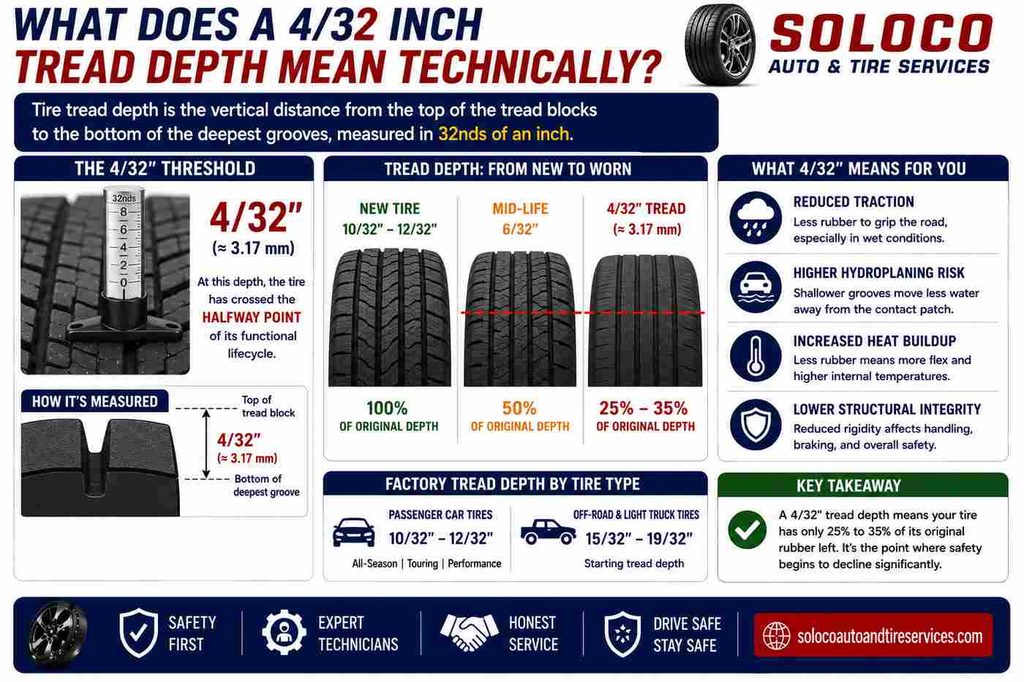
Tire tread depth measures the vertical distance from the top of the rubber tread blocks to the bottom of the deepest drainage grooves, measured in 32nds of an inch. When a tire registers at 4/32 of an inch (approximately 3.17 millimeters), it has crossed the halfway point of its functional lifecycle.
New passenger car tires typically leave the factory with 10/32 to 12/32 of an inch of tread depth, depending on the category (all-season, touring, or performance). Off-road and light truck tires often start deeper at 15/32 to 19/32 of an inch. When a tire wears down to 4/32, it retains only 25% to 35% of its original rubber volume. This reduction directly diminishes the tire’s structural rigidity, heat dissipation capacity, and ability to channel fluids away from the vehicle contact patch.
How Does 4/32 Tread Impact Wet and Winter Traction?
Tire treads are precision hydraulic pumps designed to clear water, slush, and loose debris from beneath the tire contact patch. At 4/32 of an inch, the drainage channels lack the volume required to evacuate standing water at standard highway velocities.
When driving through standing water on a highway, a tire must displace water faster than the vehicle travels forward. At 4/32 inches, water compression causes fluid pressure to build inside the shallow grooves. This pressure lifts the tire rubber off the pavement, creating a wedge of water underneath. This phenomenon, known as hydroplaning, results in an immediate and total loss of steering response, traction, and braking control. In winter conditions, 4/32 inch treads cannot pack snow into the grooves to create the crucial snow-on-snow shear traction required for acceleration and stopping on unplowed roads.
How Much Do Stopping Distances Increase at 4/32?
Stopping distance is the ultimate metric of tire safety, directly correlating with remaining tread depth. As tread depth decreases, the contact patch loses its ability to grip microscopic imperfections in the pavement during high-load braking maneuvers.
| Tire Tread Condition | Remaining Usable Life | Wet Stopping Distance (60 to 0 MPH) | Winter Performance Risk |
| 10/32 Inch (New) | 100% | Approximately 195 feet | Optimal traction and snow compression |
| 4/32 Inch (Borderline) | 25% | Approximately 275 to 290 feet | High risk of sliding in rain or slush |
| 2/32 Inch (Statutory Minimum) | 0% | Approximately 350 to 370 feet | Severe hazard; immediate legal/safety failure |
The data demonstrates that at 4/32 of an inch, a vehicle requires roughly an extra car length or more to come to a complete stop on a wet surface compared to new tires. In emergency braking scenarios, this variance determines whether a vehicle stops safely or experiences a collision.
Legal Compliance Versus Practical Safety Thresholds
A common misconception among motorists is that if a tire is legally compliant, it is entirely safe. In the United States, Canada, and most international jurisdictions, the statutory minimum tread depth is 2/32 of an inch. Once a tire wears down to 2/32, built-in wear indicators (Tread Wear Indicators or TWIs) become flush with the tread blocks, making the tire illegal to operate on public roads.
However, safety organizations, automotive engineers, and tire manufacturers agree that waiting until 2/32 creates an unacceptable hazard. Safety degradation is non-linear; performance drops off sharply once a tire passes the 4/32 threshold. Operating on 4/32 tires is legal, but treating legality as the sole definition of safety exposes drivers to heightened accident risks during sudden weather changes.
How to Accurately Measure and Evaluate Your 4/32 Tires
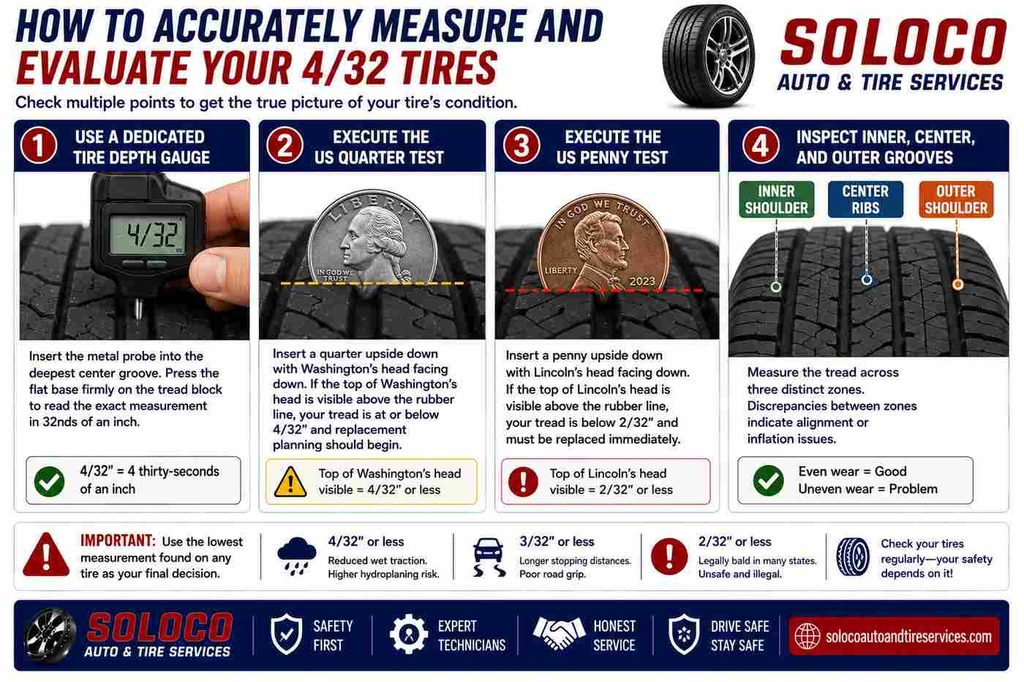
Accurate measurement requires checking multiple points across the width and circumference of every tire on the vehicle. Surface measurements alone can mask underlying mechanical problems or uneven wear patterns.
- Use a Dedicated Tire Depth Gauge: Insert the metal probe of a calibrated tread depth gauge into the deepest center groove. Press the flat base firmly against the tread block to read the exact measurement in 32nds of an inch.
- Execute the US Quarter Test: Insert a standard US quarter upside down into the central tread groove, placing Washington’s head facing downward. If the top of Washington’s head is visible above the rubber line, your tread depth is at or below 4/32 of an inch, signaling that replacement planning should begin immediately.
- Execute the US Penny Test: Insert a US penny upside down with Lincoln’s head facing downward. If the top of Lincoln’s head is visible, the tire has deteriorated below 2/32 of an inch and must be replaced immediately.
- Inspect Inner, Center, and Outer Grooves: Measure the tread across three distinct zones: the outer shoulder, center ribs, and inner shoulder. Discrepancies between these zones indicate alignment or inflation faults.
What Are Your Strategic Options When Tires Reach 4/32?
When your vehicle assessment confirms a 4/32 inch tread depth, you face three primary strategic pathways depending on your budget, climate, and driving habits.
Option 1: Immediate Replacement
Purchasing a full set of new tires immediately restores maximum wet braking efficiency, hydroplaning resistance, and safety margins. While this requires a significant upfront financial investment, it eliminates weather-related driving anxiety and ensures maximum protection for vehicle occupants.
Option 2: Axle Rotation Shift
If the front and rear tires wear unevenly, rotating the deeper tread tires to the rear axle can temporarily preserve directional stability. Automotive safety standards dictate that new or deeper tread tires should always be mounted on the rear axle to prevent oversteer and dangerous spin-outs on wet roads. However, rotation does not increase overall rubber volume or restore lost stopping power.
Option 3: Context-Dependent Deferred Replacement
Drivers operating exclusively in arid, low-speed urban environments during dry summer months can sometimes defer replacement for a few thousand miles. This option carries inherent risk; unexpected severe weather or highway commutes can instantly transform a deferred replacement into an emergency situation.
Common Maintenance Mistakes to Avoid With Worn Tires
Managing tires near the end of their lifecycle requires avoiding critical errors that jeopardize vehicle control.
- Mounting New Tires on the Front Axle: Many drivers mistakenly place two new tires on the front steering axle while leaving worn 4/32 tires on the rear. This creates an unstable rear-heavy grip imbalance, frequently causing dangerous oversteer and vehicle spin-outs during wet cornering maneuvers. Always install new tires on the rear axle.
- Ignoring Inner-Shoulder Wear: Visually inspecting only the outer face of a tire can conceal severe inner-edge wear caused by negative camber or worn suspension bushings. Always inspect the entire width of the tread footprint.
- Relying Solely on Dry Weather Performance: Tires at 4/32 often feel completely normal on dry asphalt, leading drivers to falsely assume they are safe. The true performance deficit only manifests when water or snow enters the roadway interface.
Troubleshooting Uneven Tread Wear at 4/32
Analyzing uneven wear patterns across a 4/32 tire provides critical diagnostic data regarding your vehicle’s mechanical health:
- Center Rib Wear: Excessive wear concentrated in the center of the tread indicates chronic over-inflation, which reduces the contact patch and accelerates middle-rib degradation.
- Dual Shoulder Wear: Accelerated wear on both outer and inner shoulders simultaneously indicates chronic under-inflation, forcing the tire edges to bear excessive vehicle weight and cornering forces.
- Cupping or Scalloping: Spotty, diagonal patches of missing tread around the tire circumference point to failed shock absorbers, worn struts, or loose wheel bearings.
- Single-Edge Wear: Heavy wear restricted to only the inner or outer margin of the tread indicates incorrect wheel alignment (excessive toe or camber angles).
Frequently Asked Questions
Can I pass a state vehicle inspection with 4/32 tire tread?
Yes. State vehicle safety inspections generally set their failure threshold at the federal statutory minimum of 2/32 of an inch. A tire measuring 4/32 of an inch will pass inspection, but inspectors will typically note the measurement as a recommendation for upcoming service.
How many miles can I drive on 4/32 tires?
A tire at 4/32 of an inch typically provides between 2,000 and 5,000 additional miles of use for an average commuter. This mileage range varies based on driving aggressiveness, vehicle weight, climate conditions, and proper tire inflation maintenance.
Is it safe to drive on 4/32 tires in the rain?
Driving on 4/32 tires in light rain is manageable if vehicle speeds are reduced. However, heavy downpours present a high risk of hydroplaning at speeds exceeding 45 miles per hour due to the reduced water evacuation capacity of the shallow grooves.
Should I replace only two tires if the others are at 4/32?
If you replace only two tires, the new tires must be installed on the rear axle to maintain vehicle stability. If your vehicle is all-wheel drive, replacing all four tires simultaneously is generally required by manufacturer specifications to prevent drivetrain damage from rolling-diameter discrepancies.
How does tire age affect 4/32 tread depth?
Rubber compounds degrade chemically over time due to UV exposure, ozone, and thermal cycling, regardless of remaining tread depth. If a tire at 4/32 of an inch is older than six years from its Department of Transportation manufacturing date code, it should be replaced immediately due to rubber embrittlement and structural separation risks.