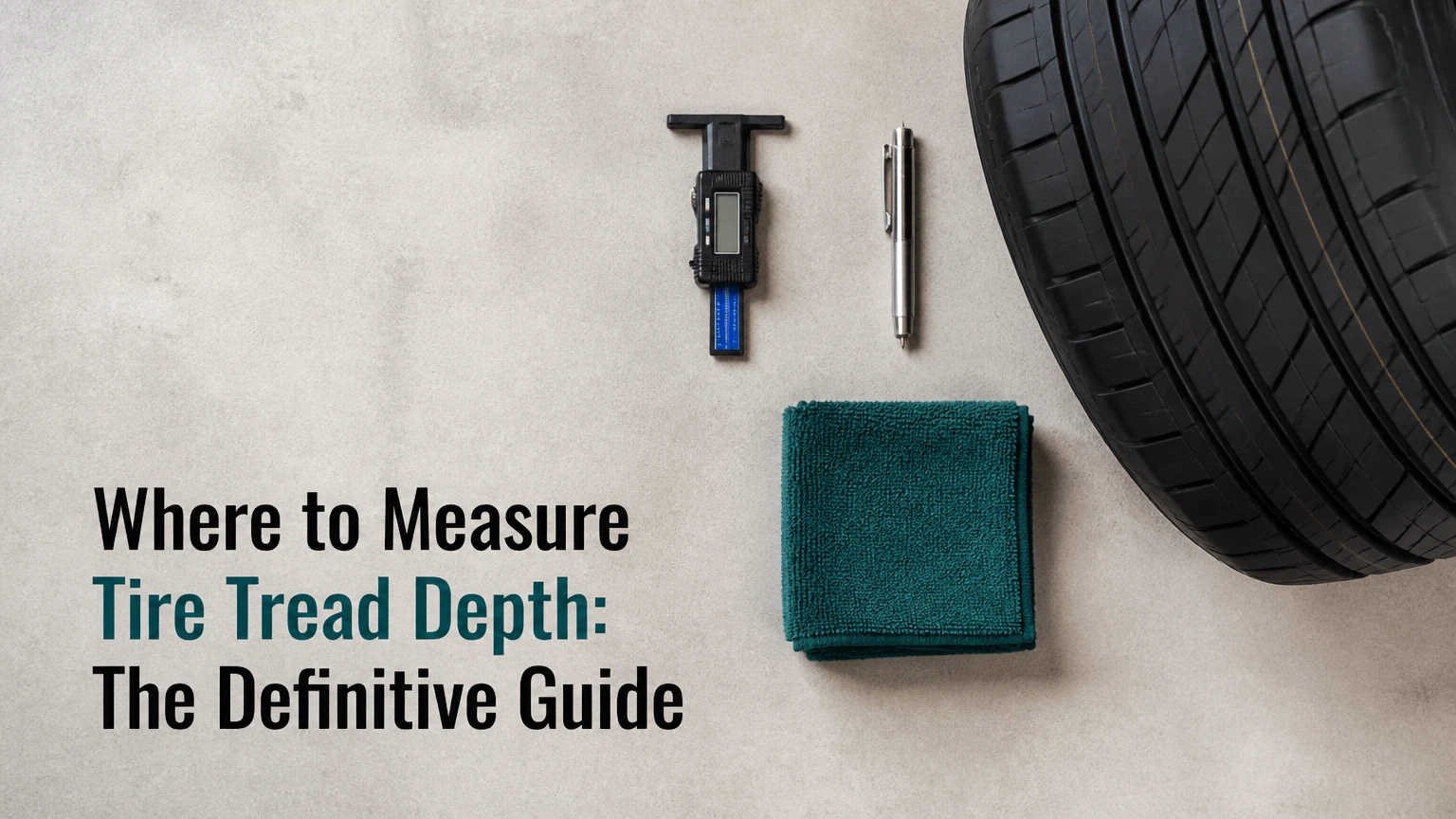
To get an accurate and legally compliant measurement, you must measure your tire tread depth in the main circumferential grooves across the central three-quarters of the tire’s width, and at multiple points around its entire circumference. Avoid the outer shoulders and built-in wear bars.
At a Glance
- Measure tire tread depth across the central 75 percent of the tire footprint in the main grooves.
- The legal replacement limit across most of the United States and Europe is 2/32 of an inch.
- Wet-weather hydroplaning risk increases drastically once tread depth drops below 4/32 of an inch.
- Inspect tires at a minimum of three distinct points around the entire circumference of each wheel.
- Never take measurements directly on top of raised Tread Wear Indicators or along the extreme outer shoulders.
Where to measure tire tread?
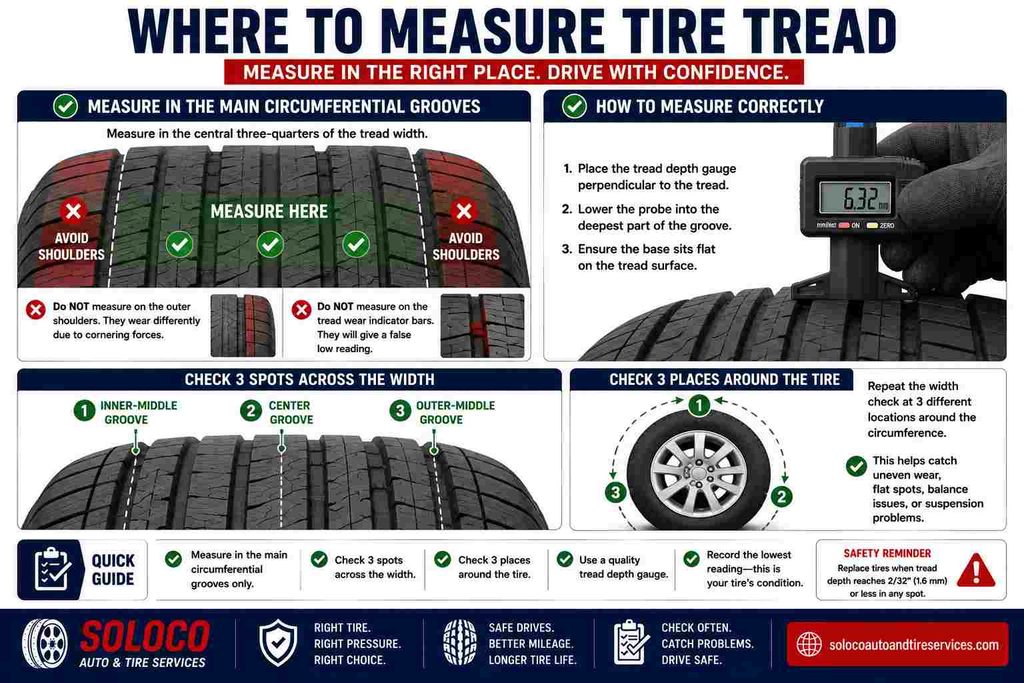
You must measure tire tread depth directly inside the main circumferential grooves located across the central three-quarters of the tire tread width. Professional technicians and safety authorities enforce this specific zone because the outer shoulders naturally experience unique cornering forces that distort standard wear readings. Avoid placing any measuring device on the outermost shoulder blocks or directly on top of the raised rubber wear indicator bars embedded within the grooves.
To execute this properly, place your depth gauge perpendicular to the tire surface inside the deepest part of the groove. You should perform this check at three distinct spots across the width of the tread: the inner-middle groove, the direct center groove, and the outer-middle groove. Repeating this process at three different locations around the circumference of the tire ensures you do not miss localized flat spots, balance issues, or suspension anomalies.
What tool should I use to measure tire tread depth?
You should use a calibrated mechanical or digital tire tread depth gauge to obtain an exact, numerical measurement in 32nds of an inch or millimeters. Digital depth gauges offer superior readability with instant LCD readouts, while mechanical dial gauges and pin-style plunger gauges provide reliable, battery-free performance in varying weather conditions.
If you do not possess a dedicated automotive depth gauge, you can utilize standardized currency tests as a rapid preliminary screening method. However, currency tests only indicate threshold boundaries rather than precise numerical depths. When using any tool, ensure the tire surface is free of embedded gravel, mud, or debris that could artificially inflate your measurement readings. Press the base of the gauge flat against the rubber blocks flanking the groove while pushing the measuring pin down until it touches the absolute floor of the groove.
How many 32nds of an inch is a brand-new tire?
Brand-new passenger car and light truck tires typically feature a tread depth ranging between 10/32 of an inch and 11/32 of an inch, which translates to approximately 8 millimeters. Heavy-duty truck tires, commercial vehicle tires, and specialized off-road or aggressive all-terrain tires often start significantly deeper, ranging anywhere from 13/32 of an inch to 19/32 of an inch.
Knowing your tire’s starting depth provides a critical baseline for calculating your overall tire wear rate relative to mileage driven. High-performance summer tires may start slightly shallower, often between 8/32 of an inch and 9/32 of an inch, to minimize block squirm and maximize dry pavement handling response. As rubber wears down from friction against asphalt, monitoring how quickly you lose these initial 32nds helps predict replacement intervals before safety margins are compromised.
At what tread depth should you replace tires?
You must replace standard passenger vehicle tires when the remaining tread depth reaches 2/32 of an inch, which is the legal minimum limit enforced across the majority of U.S. states and European nations. For wet-weather safety, safety experts and automotive engineers strongly recommend replacing your tires earlier, specifically when the tread depth drops down to 4/32 of an inch.
Allowing your tires to wear down past 4/32 of an inch severely limits the tire’s ability to evacuate standing water from the contact patch. Once tires reach the 2/32 threshold, they are considered legally bald, completely unsafe, and susceptible to immediate citation or failure during safety inspections. At this terminal stage, the rubber is worn down flush with the internal wear bars, completely eliminating the fluid channels required for traction.
How do I use the penny test for tire tread?
You can use a standard U.S. penny to check if your tire tread has reached the legal limit of 2/32 of an inch by placing Lincoln’s head upside down into the deepest groove. If the top of Abraham Lincoln’s head is completely visible above the tread rubber, your tread depth is 2/32 of an inch or less, indicating that your tires must be replaced immediately.
While the penny test serves as a convenient emergency field check, it lacks the precision required to catch developing safety hazards before they become critical. If the tread touches or covers any part of Lincoln’s forehead, you still have more than 2/32 of an inch remaining. Always test multiple spots across the tire width because uneven wear patterns can cause one side of the tread to pass the penny test while the other side remains dangerously bald.
How do I use the quarter test for tire tread depth?
You can use a U.S. quarter to test for adequate wet-weather traction by inserting George Washington’s head upside down into the main tread groove. If the top of Washington’s head is completely exposed above the rubber, your remaining tread depth is 4/32 of an inch or less, signaling that your tires are losing their ability to prevent hydroplaning in heavy rain.
The quarter test provides a much safer replacement threshold than the penny test by alerting you when wet-weather performance drops off precipitously. Drivers who frequently commute in wet climates or regions prone to torrential downpours should upgrade their tires the moment the quarter test reveals the top of Washington’s head. Combined with a digital depth gauge, the quarter test acts as an effective intermediate warning benchmark.
Where are the tread wear indicator bars located?
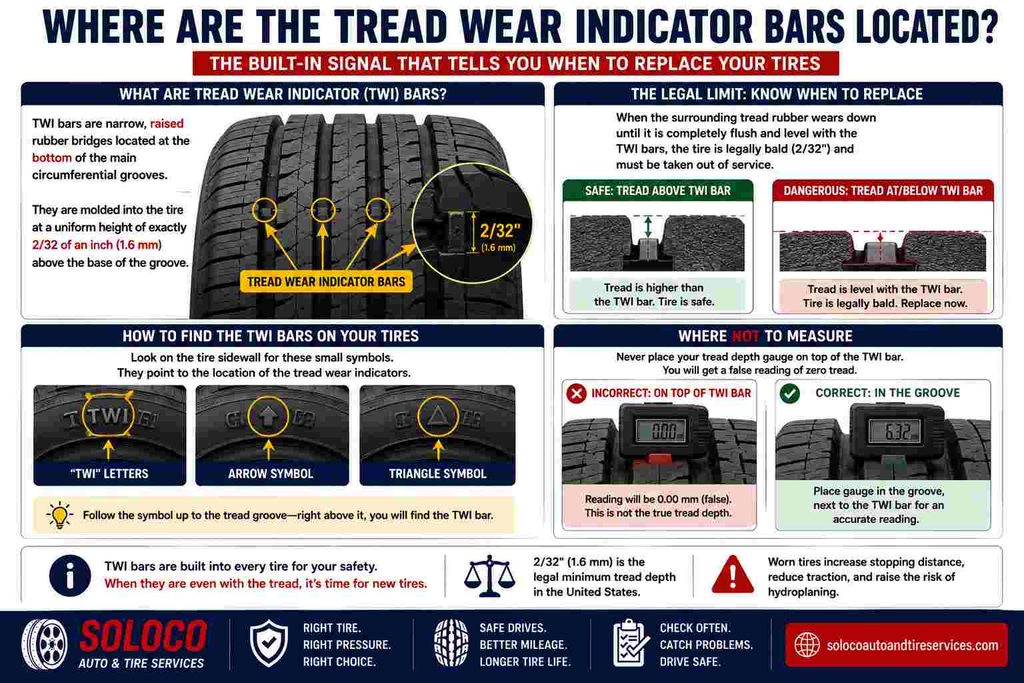
Tread wear indicator bars are located at the bottom of the main circumferential grooves, appearing as narrow, raised rubber bridges spaced evenly around the circumference of the tire. These horizontal rubber bars sit at a uniform height of exactly 2/32 of an inch above the base of the groove, serving as a visual manufacturing signal that the tire has reached the end of its legal service life.
When the surrounding tread rubber wears down until it is completely flush and level with these TWI bars, the tire is legally bald and must be taken out of service.
You can locate these indicators quickly by searching the tire sidewall for small symbols such as the letters “TWI,” an arrow, or a small triangle pointing upward toward the shoulder. Never take measurements directly on top of these raised bars, as doing so will yield a false reading of zero tread depth.
Why is measuring the center groove alone dangerous?
Measuring only the center groove of a tire is dangerous because it hides severe localized wear, structural damage, and alignment issues occurring on the inner and outer shoulders. If your vehicle suffers from incorrect wheel alignment or a failing suspension component, the inner edge of the tire can wear down to the steel cords while the center groove reads a safe and acceptable depth.
Relying exclusively on a single center measurement creates a false sense of security that can lead to sudden tire blowouts at highway speeds. Technicians must inspect the entire footprint from shoulder to shoulder, especially on modern vehicles featuring aggressive factory negative camber settings that naturally load weight onto the interior edges of the tires. Turning your steering wheel completely to the lock position allows you to visually inspect and measure these hidden inner shoulders.
What causes uneven tire wear across the tread width?
Uneven tire wear across the tread width is caused by mechanical failures, improper inflation pressures, worn suspension components, or incorrect wheel alignment geometry. When the inside or outside edge wears significantly faster than the rest of the tread, it indicates improper wheel camber or toe settings that drag the tire sideways across the pavement.
Cupping or scalloped wear patterns—where patches of tread are worn away in a repetitive wave—point directly to failing shock absorbers, worn struts, or severe wheel imbalance. Feathered wear, characterized by tread ribs that are smooth on one side and sharp on the other, indicates a scrub angle issue caused by incorrect toe alignment. Identifying these wear signatures allows you to correct the mechanical root cause before destroying a brand-new set of replacement tires.
How does tire pressure affect where tread wears out?
Incorrect tire inflation pressure forces abnormal weight distribution across the contact patch, accelerating wear on specific sections of the tread footprint. Over-inflation pushes the center of the tire outward, concentrating vehicle weight entirely on the central ribs and causing rapid, premature center wear while the shoulders remain untouched.
Under-inflation allows the tire to sag in the middle, forcing the entire vehicle load onto the outer and inner shoulders. This double-edge loading causes both shoulders to scrub away rapidly while the center groove retains excessive depth. Maintaining proper manufacturer-specified air pressure ensures the entire 75 percent central width of the tire bears the vehicle load equally, maximizing tread life and fuel efficiency.
When should winter tires be replaced?
Winter tires and dedicated snow tires must be replaced when their tread depth drops below 5/32 of an inch or 4/32 of an inch, as the traditional 2/32 legal limit is entirely inadequate for snow and ice traction. Snow tires rely on deep sipes and biting edges that lose their mechanical grip and snow-clearing capability long before reaching the standard legal passenger car wear limit.
Many premium winter tires feature a secondary set of winter wear indicators, often shaped like a snowflake or featuring a specific depth marker, located higher up in the tread pattern. Once the primary tread wears down to this snowflake indicator, the tire can no longer pack and release snow efficiently, rendering it unsafe for severe winter conditions. Relying on standard summer wear limits during winter storms drastically increases stopping distances on ice-covered roadways.
How often should you check your tire tread depth?
You should check your tire tread depth at least once every month, as well as immediately before undertaking any long-distance road trips or seasonal weather transitions. Routine monthly checks catch slow leaks, progressive alignment drift, and uneven wear patterns before they compromise your vehicle’s safety or ruin the tire casing.
Incorporating tread checks into your standard monthly vehicle maintenance routine—alongside checking engine oil levels and adjusting tire pressures—takes less than five minutes. Use this opportunity to visually inspect the sidewalls for bulges, cracks, punctures, or embedded foreign objects that could lead to sudden air loss. Regular monitoring ensures your tires remain within safe operating limits throughout their entire operational lifecycle.
How does low tread depth affect stopping distance on wet roads?
Low tread depth dramatically increases wet braking distances because shallow grooves cannot channel standing water away from the tire contact patch fast enough to maintain friction. At speeds above 45 miles per hour on wet asphalt, a tire with 2/32 of an inch of tread can require up to double the stopping distance of a brand-new tire with 10/32 of an inch of tread.
When the water cannot escape beneath the rubber blocks, it forms a microscopic wedge that lifts the tire completely off the road surface, a dangerous phenomenon known as hydroplaning. During hydroplaning, steering input, braking control, and acceleration are entirely lost, leaving the driver unable to control the vehicle. Maintaining a minimum tread depth of 4/32 of an inch is your primary defense against wet-weather hydroplaning and loss of control.
Do electric vehicles wear out tire tread faster?
Electric vehicles wear out tire tread significantly faster than traditional internal combustion engine vehicles, often requiring replacement up to 30 percent sooner. This accelerated wear is driven by the heavy weight of large lithium-ion battery packs and the instantaneous torque delivered directly to the wheels.
The massive weight of electric vehicles increases the downward frictional force exerted on the tire contact patch during every acceleration, braking, and cornering maneuver. Furthermore, aggressive regenerative braking systems apply immediate deceleration forces through the tires. Electric vehicle owners must check their tread depth more frequently and invest in specialized low-rolling-resistance tires engineered with high-abrasion rubber compounds designed to handle elevated vehicle loads.
Can I replace just two tires if the tread is uneven?
You can replace just two tires on front-wheel drive or rear-wheel drive vehicles, provided the new tires are always installed on the rear axle to prevent sudden oversteer and fishtailing in wet conditions. Putting new tires on the rear axle ensures superior water evacuation at the back of the vehicle, maintaining directional stability during emergency maneuvers.
For all-wheel drive and four-wheel drive vehicles, you can rarely replace just two tires because modern drivetrain differentials require matching rolling diameters across all four wheels. Even a minor difference in tread depth between the front and rear axles can cause differential binding, overheating, and catastrophic mechanical failure of the transfer case. If your AWD vehicle has unevenly worn tires exceeding a 2/32-inch variance across axles, you must typically replace all four tires simultaneously.
The Bottom Line
Measuring tire tread accurately requires inspecting the main grooves across the central three-quarters of the tire at multiple circumference points, avoiding wear bars and shoulders entirely. While the legal minimum across most jurisdictions is 2/32 of an inch, safety professionals recommend replacing tires at 4/32 of an inch to prevent hydroplaning in wet weather. Routine monthly checks paired with prompt alignment and pressure corrections protect your investment and ensure maximum safety on the road.