Tire sizes are standardized alphanumeric codes stamped directly onto the sidewall that dictate a tire’s physical dimensions, structural construction, load limits, and speed capabilities. These codes allow drivers, mechanics, and manufacturers to match the correct replacement tire to a specific vehicle’s suspension load and performance parameters.
At a Glance
- Tire size codes consist of a sequence of letters and numbers like P215/65R15 95H, detailing type, width, aspect ratio, construction, and rim diameter.
- Section width is measured in millimeters from sidewall to sidewall, while rim diameter is measured in inches.
- Aspect ratio is a percentage, meaning the sidewall height is calculated by multiplying the section width by that percentage.
- Load index and speed rating indicate the maximum weight capacity and maximum safe operating speed of the tire.
- Changing tire sizes outside a 3 percent threshold of the original equipment manufacturer specification can trigger anti-lock brake errors and speedometer inaccuracies.
What Does the Anatomy of a Standard Tire Size Mean?
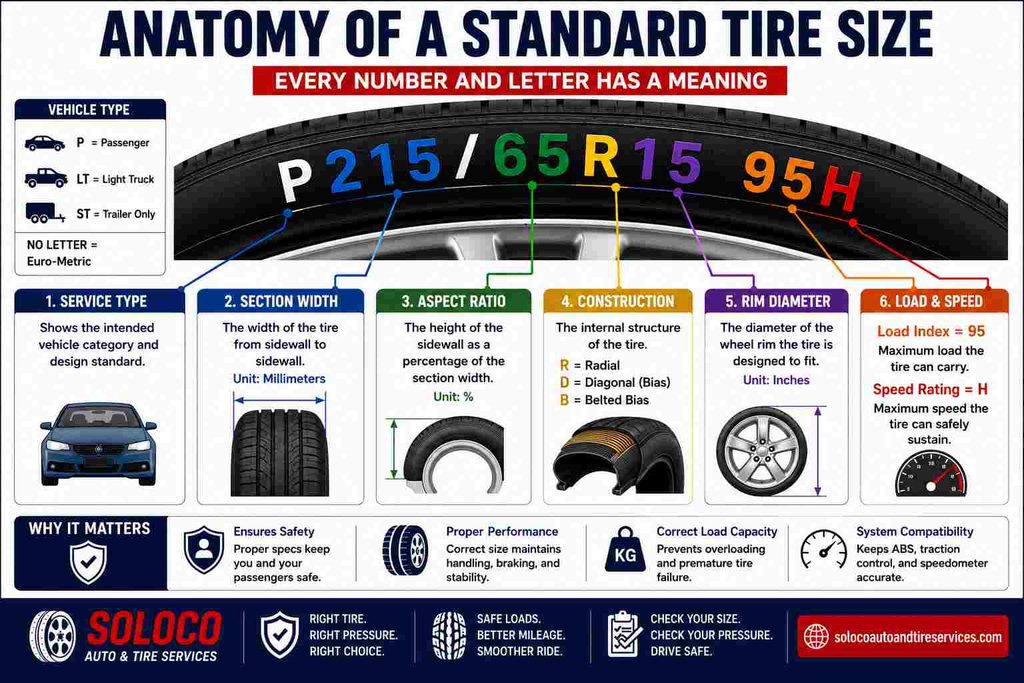
A standard tire size breakdown relies on an alphanumeric sequence, such as P215/65R15 95H, where each segment represents a distinct physical property. The initial letter indicates the intended vehicle category, followed by the millimeter section width, the percentage-based aspect ratio, the internal radial construction type, and the wheel diameter in inches. Ending the sequence is the service description, which pairs a numerical load index with an alphabetical speed rating.
Professionals look at this code as a complete engineering profile. If any single variable is altered incorrectly during a replacement, vehicle handling dynamics, load management, and electronic safety systems can be compromised. Understanding this breakdown is the first step toward safely selecting replacement hardware or executing performance upgrades.
What Do Tire Size Prefixes Like P, LT, ST, and T Stand For?
Tire size prefixes define the primary vehicle application and load category for which the tire was engineered.
- P (Passenger): Indicates a passenger car metric tire designed for standard sedans, minivans, crossovers, and light SUVs, optimized for a smooth ride and standard load capacity.
- LT (Light Truck): Denotes a light truck metric tire built with heavier internal plies and robust sidewalls designed for heavy-duty towing, hauling, and high-pressure work on three-quarter-ton or one-ton trucks.
- ST (Special Trailer): Stands for special trailer tires featuring extra-thick sidewalls to resist lateral sway; these must never be installed on motorized passenger vehicles.
- T (Temporary): Marks temporary spare tires, which are engineered exclusively for emergency low-speed transit to a repair shop over short distances.
Matching the correct prefix to your vehicle type is mandatory. Installing passenger tires on a heavy commercial towing vehicle risks sidewall failure under high heat and heavy payloads.
How Is Tire Section Width Measured?
Tire section width is measured in millimeters as the straight-line distance from the widest point of the outer sidewall to the widest point of the inner sidewall, excluding any raised lettering or rim protectors. For example, a 215-millimeter section width means the tire spans 215 millimeters across its widest inflated profile.
Standard manufacturing increments typically jump by 10 millimeters, yielding sizes such as 205, 215, and 225. This measurement does not tell you the width of the tread footprint touching the road; tread width is usually narrower than the overall section width. When upgrading to wider tires, mechanics check the inner wheel-well clearance to ensure the expanded section width does not rub against suspension struts or plastic fender liners during sharp turns.
How Do You Calculate Tire Aspect Ratio and Sidewall Height?
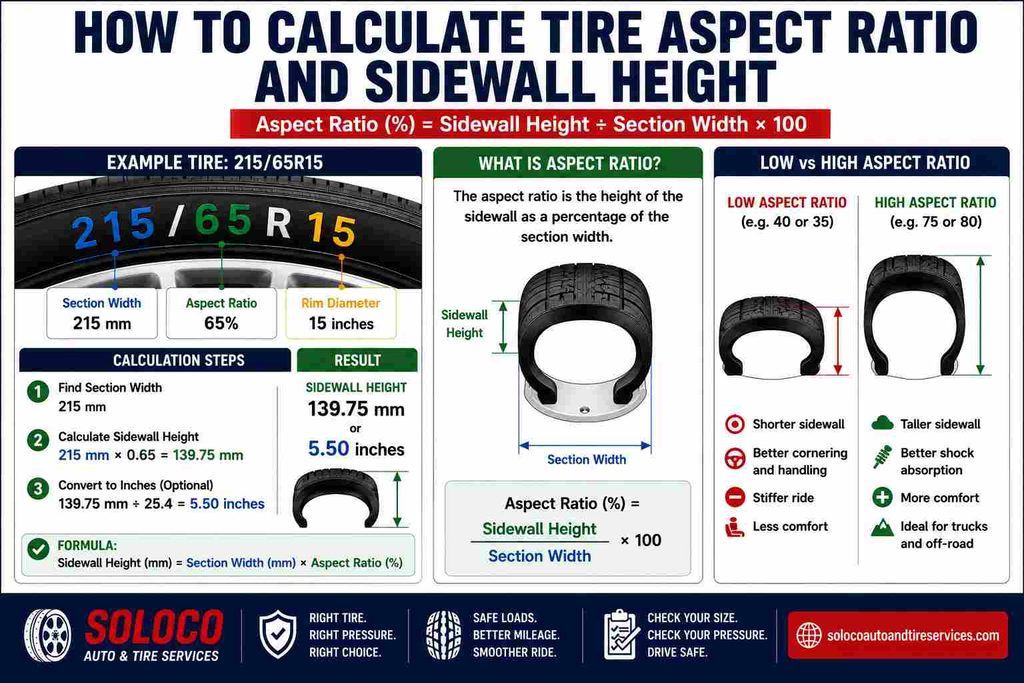
Tire aspect ratio is the percentage that determines the height of the tire profile from the edge of the wheel rim to the outer tread. It is calculated by multiplying the section width by the aspect ratio percentage. For instance, on a 215/65R15 tire, the section width is 215 millimeters and the aspect ratio is 65 percent. Multiplying 215 millimeters by 0.65 yields a sidewall height of 139.75 millimeters.
A lower aspect ratio, such as 40 or 35, creates a low-profile tire with a shorter sidewall, improving cornering response at the expense of ride comfort. A higher aspect ratio, such as 75 or 80, provides a taller sidewall that absorbs potholes and rough terrain more effectively, which is why trucks and off-road vehicles rely on high-profile configurations.
How Does Rim Diameter Affect Tire Selection?
Rim diameter dictates the exact wheel size in inches that a tire is engineered to fit, and it must match the wheel diameter down to the millimeter. A tire designated with an R15 requires a wheel with a 15-inch bead seat diameter. Installing a 15-inch tire on a 16-inch wheel is physically impossible and dangerous, as the tire bead will not seat correctly, leading to rapid air loss and catastrophic detachment.
Standard passenger vehicle rim diameters typically range from 14 inches on older compact cars to 22 inches or larger on modern luxury SUVs and performance trucks. When buying replacement tires, verify the wheel diameter stamped on your current wheel or printed on the driver door placard to ensure absolute compatibility.
What Do Load Index and Speed Rating Mean in a Service Description?
The service description is the combination of a two-digit number and a letter located at the end of the tire size code, such as 95H. The numerical load index maps to a standardized weight capacity table, while the alphabetical speed rating defines the maximum safe sustained operating speed for that tire.
- Load Index (95): Indicates that a single tire can safely support up to 1,521 pounds when inflated to proper specifications.
- Speed Rating (H): Represents a top speed capability of up to 130 miles per hour under controlled conditions. Common ratings include T (118 mph), H (130 mph), V (149 mph), W (168 mph), and Y (186 mph).
Never downgrade a vehicle’s original equipment load index or speed rating. Doing so compromises high-speed stability, braking efficiency, and structural load limits.
How Do Flotation and Off-Road Tire Sizes Work?
Flotation and off-road tires often abandon metric sizing conventions in favor of US customary inches, commonly appearing as 33 x 12.50 R 15. In this notation, the first number represents the total outer tire diameter in inches, the second number represents the nominal section width in inches, and the final number specifies the rim diameter in inches.
- 33: Total tire height of 33 inches when mounted and inflated.
- 12.50: Total tire width of 12.50 inches across the sidewalls.
- 15: Required wheel rim diameter of 15 inches.
These tires are engineered for large trucks and off-road vehicles requiring a wide contact patch to distribute vehicle weight across soft sand, mud, or snow, reducing ground pressure and preventing sinking.
What Are Euro-Metric and Commercial Metric Tire Sizes?
Euro-metric and commercial metric tire sizes modify standard passenger car codes by altering or omitting prefixes to denote specific engineering tolerances. Euro-metric tires, such as 205/55R16, omit the initial “P” prefix. While they share identical external dimensions with P-metric tires, Euro-metric tires often feature different load capacity calculation formulas established by European Tyre and Rim Technical Organisation standards.
Commercial metric tires incorporate a C at the end of the size code, such as 195/70R15C. The “C” signifies a commercial vehicle tire designed for heavy-duty cargo vans and light commercial transport. These tires feature reinforced multi-ply carcasses, stiffer sidewalls, and significantly higher maximum inflation pressures to handle continuous heavy loads safely.
How Do I Read Z-Rated Tire Markings on Performance Vehicles?
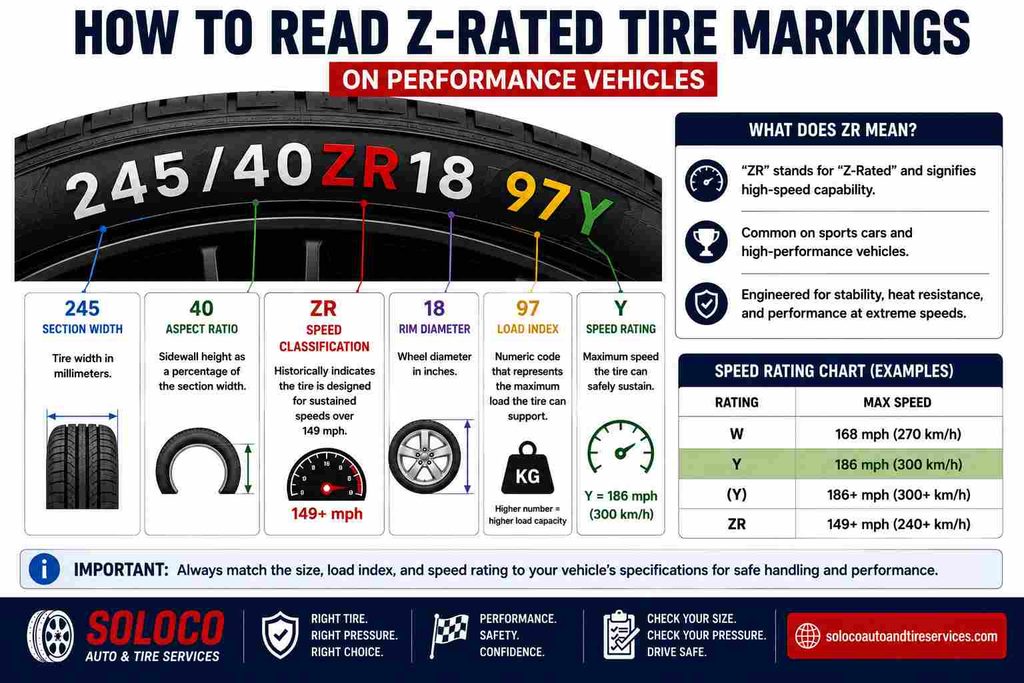
Z-rated tire markings appear on high-performance and sports car tires where the letter ZR is embedded directly into the size designation, such as 245/40ZR18. The “ZR” designation historically indicated that a tire was engineered for sustained speeds exceeding 149 miles per hour.
Modern tire manufacturing standards have evolved, but the ZR designation remains common on ultra-high-performance applications. Today, manufacturers often pair the ZR marking with an appended service description at the end of the string, such as 245/40ZR18 97Y, combining the historic high-speed structural classification with a specific load index and top-tier speed capability letter.
Can I Put a Different Size Tire on My Existing Rims?
Yes, you can install a different size tire on your existing rims, provided the new tire’s total outer diameter remains within a 3 percent tolerance of the original manufacturer specification. Deviating beyond this 3 percent threshold disrupts anti-lock braking systems, traction control algorithms, transmission shift points, and speedometer accuracy.
Furthermore, checking rim width compatibility is mandatory. A tire width cannot be blindly swapped without verifying that the wheel rim width falls within the tire manufacturer’s approved rim width range. Installing a tire that is too wide or too narrow for the rim causes irregular tread wear, bead unseating risks, and poor cornering stability.
What Happens If I Use an LT Tire Instead of a P Tire?
Using an LT (Light Truck) tire in place of a P (Passenger) tire results in a significantly stiffer, harsher ride quality. LT tires feature heavier internal steel belts and multi-ply sidewalls engineered to carry immense payloads and withstand severe off-road impacts.
Because of their rigid construction, LT tires require much higher inflation pressures—often between 50 and 80 PSI—to carry a load that a flexible P-metric passenger tire supports comfortably at 35 PSI. Installing LT tires on a lightweight sedan or small crossover destroys ride comfort and can cause premature wear on sensitive vehicle suspension bushings.
Does Tire Size Affect Fuel Economy and MPG?
Tire size directly impacts fuel economy through rolling resistance, aerodynamic drag, and rotational mass. Wider tires increase rolling resistance because a larger contact patch generates more friction against the asphalt, forcing the engine to burn more fuel to maintain speed.
Additionally, stepping up to larger-diameter tires increases rotational mass at the wheel ends. This extra weight requires more engine torque to accelerate from a standstill, lowering city and highway MPG. Maintaining the factory-recommended tire size and proper inflation pressure is the most effective way to protect your vehicle’s fuel efficiency.
How Do I Know the Age of a Tire From Its Size or DOT Code?
You cannot determine the age of a tire from its size code; instead, you must inspect the Department of Transportation (DOT) serial code stamped on the inner or outer sidewall. The DOT code ends in a four-digit manufacturing stamp where the first two digits represent the production week and the last two digits represent the manufacturing year.
For example, a DOT stamp ending in 3224 indicates that the tire was manufactured during the 32nd week of the year 2024. Automotive safety experts recommend inspecting tires annually after five years of service and replacing all tires once they reach ten years of age, regardless of remaining tread depth, due to rubber compound degradation.
What Is the Plus Sizing Trap When Changing Tire Widths?
The plus-sizing trap occurs when vehicle owners install wider tires to improve grip without adjusting the aspect ratio, which alters the overall outer tire diameter. If you increase the section width from 215 to 225 millimeters while keeping the 65 aspect ratio unchanged, the physical height of the tire sidewall increases, altering your overall gear ratios and throwing off your speedometer calibration.
To widen a tire safely without changing total diameter, you must execute proper plus-zero or plus-one sizing math: as section width increases by 10 millimeters, the aspect ratio must drop by 5 to 10 points to maintain the exact same overall outer diameter as the factory specification.
How Does Rim Width Range Affect Tire Stretch and Bulging?
A specific tire size does not dictate a single fixed rim width, but rather an approved rim width range established by the Tire and Rim Association. For example, a standard 225-millimeter wide tire is typically approved for wheel widths ranging from 6.0 to 8.0 inches.
If you install that tire on a rim at the extreme narrow end of the range, the sidewalls will bulge inward, creating a soft, squishy steering response. Conversely, stretching that same tire onto an excessively wide wheel forces the sidewalls outward, creating a stretched stance that increases rim damage vulnerability, lowers load capacity, and risks sudden bead separation under hard cornering loads.
Why Are Mixed Speed Ratings Dangerous on All-Wheel-Drive (AWD) Vehicles?
Mixed speed ratings and uneven tread depths are hazardous on All-Wheel-Drive vehicles because permanent AWD systems rely on matching rotational speeds across all four wheels to function correctly. Even if two tires share the exact same nominal size numbers, different speed ratings, internal belt constructions, or varying tread depths create subtle differences in rolling circumference and centrifugal growth at highway speeds.
These microscopic rotational speed discrepancies trick the central differential or transfer case into sensing continuous wheel slippage, causing the AWD system to overheat, engage clutch packs prematurely, and suffer catastrophic mechanical failure. Always replace AWD tires as a complete set of four matching brands, sizes, and speed ratings.
How Do I Calculate Tire Diameter Changes for Speedometer Calibration?
Calculating tire diameter changes requires a mathematical formula combining section width, aspect ratio, and rim diameter to determine total outer height in inches.
$$\text{Total Diameter} = \left( \frac{\text{Section Width} \times \text{Aspect Ratio}}{25.4} \times 2 \right) + \text{Rim Diameter}$$
1. Multiply section width in millimeters by the aspect ratio percentage to get the sidewall height in millimeters. 2. Divide that millimeter result by 25.4 to convert it into inches. 3. Multiply by 2 because the tire has two sidewalls contributing to the total height (top and bottom). 4. Add the rim diameter in inches to the result. For example, a 215/65R15 tire yields:
$$\left( \frac{215 \times 0.65}{25.4} \times 2 \right) + 15 = 26.0$inches of total diameter.$$
If your new tire calculation results in a diameter that deviates more than 3 percent from this baseline, your vehicle’s computer must be reprogrammed to recalibrate the speedometer and transmission shift mapping.
The Bottom Line
Mastering tire sizing requires understanding that sidewall codes are integrated engineering formulas rather than simple catalog numbers. Every component—from the vehicle type prefix and section width to the aspect ratio, load index, and speed rating—dictates how a vehicle handles, stops, and carries weight. By respecting structural tolerances, maintaining proper rim width ranges, and keeping overall diameter within a 3 percent threshold of factory specs, you ensure maximum vehicle safety and performance.