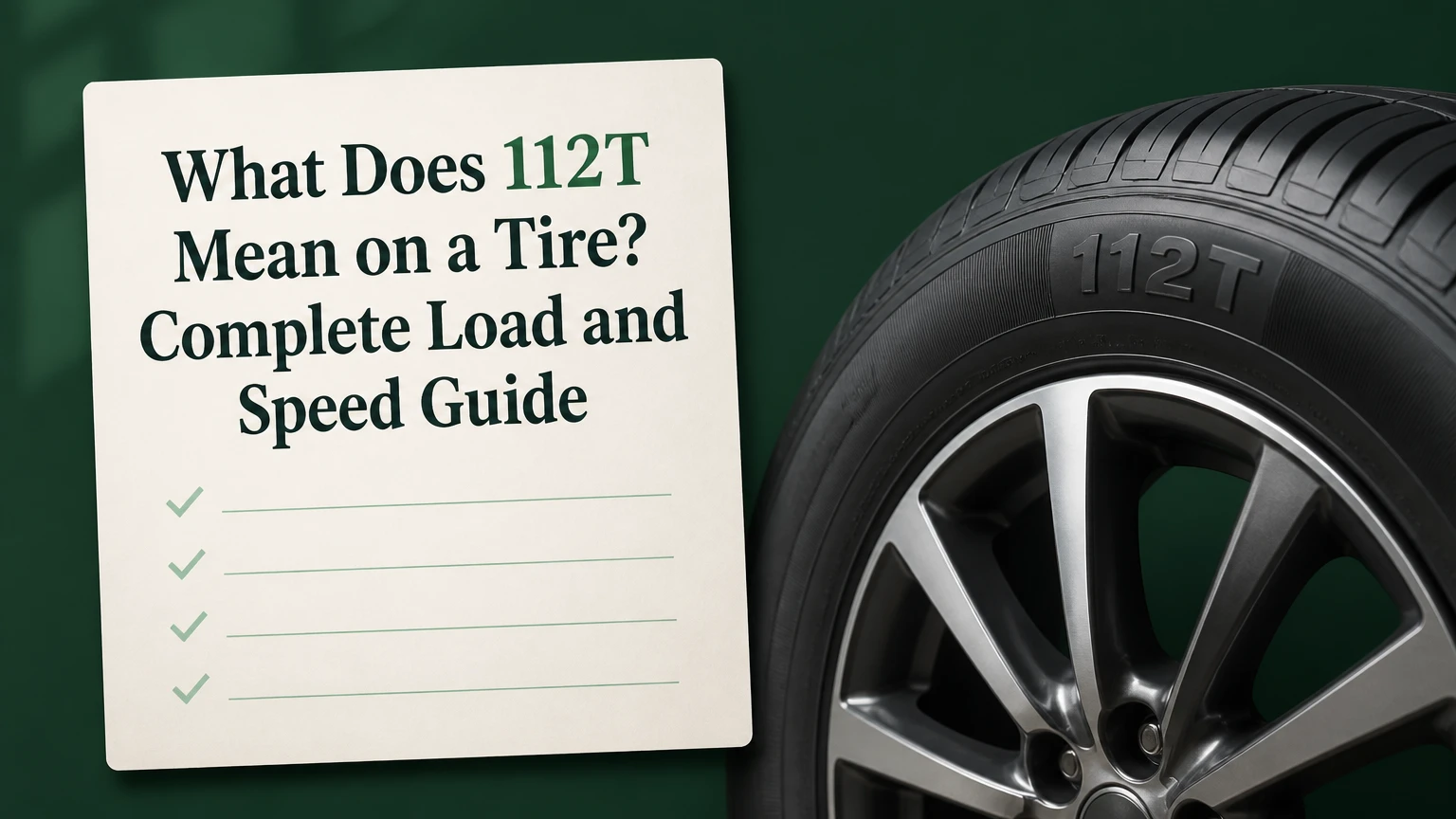
The code 112T on a tire designates its specific load index and speed rating standards. Specifically, the number 112 indicates a maximum weight capacity of 1120 kilograms per tire, while the letter T specifies a maximum safe operating speed of 190 kilometers per hour under full load conditions.
At a Glance: Essential 112T Tire Facts
- Load Index Number (112): Represents a maximum weight capacity of 1,120 kg or 2,469 lbs per individual tire.
- Speed Rating Letter (T): Denotes a maximum safe operating speed of 190 km/h or 118 mph under full load.
- Axle Limits: A complete set of four 112-rated tires supports a maximum gross vehicle weight rating of 4,480 kg or 9,876 lbs.
- Inflation Dependency: Maximum weight limits require proper inflation pressure, typically between 35 and 44 PSI for passenger sizes.
- Upgrading Safety: Upgrading to a higher speed rating like H or V is entirely safe, but downgrading load indices is prohibited.
What is the maximum weight capacity of a 112 load index tire?
A tire with a load index of 112 can safely support a maximum weight of 1,120 kg, which equals 2,469 lbs, when inflated to its proper maximum pressure. This rating applies to a single tire mounted on a standard passenger vehicle, SUV, or light truck axle. For a standard four-wheel vehicle configuration using four identical tires, the combined structural weight capacity reaches a maximum gross weight of 4,480 kg, or 9,876 lbs.
Exceeding this 1,120 kg threshold per tire places excessive stress on the internal casing, polyester cords, and steel belts. This stress generates extreme internal heat during driving. Vehicle owners must always verify that their total vehicle weight distribution does not push any single wheel beyond this foundational 1,120 kg limit, even if the overall vehicle weight appears compliant on a scale.
What is the maximum speed capability of a T speed rating tire?
The T speed rating designates a maximum safe operating speed of 190 km/h, which is 118 mph, for a fully loaded tire. This laboratory-certified rating assumes the tire is structurally sound, properly balanced, mounted correctly, and inflated to the vehicle manufacturer specification. When a vehicle operates at 190 km/h under maximum payload, the T-rated tire maintains structural integrity without experiencing dangerous tread separation or centrifugal deformation.
However, operating a T-rated tire near its maximum speed limit for extended periods generates significant internal hysteresis heat. Experienced technicians advise maintaining a safety margin by keeping sustained cruising speeds well below the 190 km/h threshold, particularly during hot summer months or when navigating unpaved roads.
Why do Euro-metric and P-metric tires have different load-carrying capacities at the same inflation pressure?
Euro-metric and P-metric passenger tires calculate and display load capacities differently based on distinct regional engineering standards governed by the European Tyre and Rim Technical Organisation and the Tire and Rim Association in the United States. While both systems may display a 112 load index, Euro-metric tires often utilize a different load inflation table calculation. This calculation assumes a standard load inflation curve that requires specific pressure adjustments depending on the vehicle application and camber angles.
When a passenger tire lacking an LT prefix is installed on a heavy pickup truck or utility vehicle, federal safety regulations require a mandatory 9.1 percent load de-rating. For example, a passenger tire rated at 112 carries 1,120 kg on a sedan, but its true legal capacity drops to 1,018 kg, or 2,244 lbs, when installed on a truck chassis. This adjustment accounts for the higher center of gravity and harsher duty cycles of light trucks.
How do Light Truck dual-rear-wheel configurations change the load index?
Light Truck tires frequently feature two distinct load index numbers separated by a slash, such as 112/109T, rather than a single rating. The first number, 112, applies when the tire operates in a single-wheel axle configuration on the front or rear of a vehicle. The second number, 109, applies when the tire is utilized in a dual-rear-wheel setup, commonly known as a dually configuration.
In a dually setup, the rating drops to 1,030 kg, or 2,271 lbs, per tire to compensate for several operational factors. Dual rear wheels experience uneven road crowning, increased heat retention between closely spaced sidewalls, and a safety buffer in case one outer tire loses pressure, which temporarily transfers its share of the load to the adjacent inner tire.
How do passenger tires get de-rated when placed on light trucks or SUVs?
Passenger tires installed on light trucks, vans, and sport utility vehicles must be de-rated in load capacity to comply with official vehicle safety standards. The Federal Motor Vehicle Safety Standards mandate a load capacity reduction factor of 9.1 percent when passenger-designated tires are fitted to vehicles primarily designed for cargo transport or off-road utility use.
This means a 112-rated passenger tire rated for 1,120 kg must be calculated as supporting only 1,018 kg when installed on an applicable truck platform. Ignoring this de-rating rule creates a hidden safety hazard. Vehicle owners often overload their suspension and tires while assuming they are safe simply because the sidewall number matches their weight expectations.
How does cargo distribution affect individual tire load limits even when total vehicle weight is compliant?
Uneven cargo distribution can overload individual 112-rated tires even when the total weight of the vehicle remains well below the maximum gross vehicle weight rating. If a driver packs heavy equipment, water tanks, or tools heavily toward one side or the rear of a vehicle, the static weight shifts disproportionately onto the tires on that specific corner or axle.
For instance, if a vehicle weighs 4,000 kg in total, well under the 4,480 kg maximum capacity of four 112 tires, a severe left-side bias can place 1,200 kg onto the left rear tire. Because that tire is rated for a maximum of 1,120 kg, it is critically overloaded despite the vehicle passing an overall weight station check. Proper cargo securement and balanced weight distribution are vital to protect individual tire ratings.
How do winter weather conditions and cold temperatures affect the operational limits of a T-rated tire?
Cold winter weather and sub-zero temperatures significantly alter rubber compound flexibility, which directly impacts the performance envelope of a T-rated tire. Standard all-season rubber compounds harden significantly when ambient temperatures drop below minus 7 degrees Celsius, reducing the tire’s immediate grip and increasing braking distances on snow and ice.
Furthermore, cold air causes a natural drop in tire inflation pressure, typically losing about one PSI for every 5 to 6 degrees Celsius drop in temperature. If a 112T tire drops from 35 PSI down to 25 PSI due to a cold snap, its actual load-carrying capacity drops substantially below 1,120 kg. Drivers must check and adjust tire pressures monthly during winter to maintain safe load thresholds.
Can tire under-inflation cause a 112T tire to fail below its rating?
Under-inflation is the primary cause of premature tire failure and structural blowout, even for robust tires featuring a 112 load index. The 1,120 kg load capacity is strictly contingent upon the tire operating at its maximum designated cold inflation pressure, typically listed on the tire placard or sidewall as 35 to 44 PSI for passenger sizes.
When a tire runs under-inflated, the vehicle’s weight causes the sidewalls to flex excessively with every rotation. This excessive flexing creates extreme internal friction and rapid heat buildup, known as standing wave deformation. Over time, this heat separates the internal rubber plies from the steel belts, resulting in catastrophic tread separation or structural failure, often at highway speeds.
How does speed rating deteriorate due to punctures or tread damage?
A tire’s T speed rating of 190 km/h applies exclusively to an undamaged, properly repaired tire operating within its intended tread life cycle. Once a tire suffers a puncture, a cut, or structural damage, its original speed capability is compromised, regardless of whether a repair was successfully completed by a professional shop.
Industry standards dictate that punctures repaired strictly within the center tread area using a combination plug and patch maintain some level of safe operation, though manufacturers often recommend capping speeds. However, punctures located in the shoulder or sidewall cannot be safely repaired, and any plug-only repair completely invalidates the speed rating, requiring immediate tire replacement if high-speed driving is anticipated.
Can I replace my 112T tires with 112H tires?
Vehicle owners can safely replace 112T tires with 112H tires without risking safety or mechanical compatibility. The letter H indicates a higher speed rating of 210 km/h, which exceeds the 190 km/h limit of a T-rated tire. Upgrading to a higher speed rating is an accepted industry practice that provides an enhanced performance margin.
Installing H-rated tires often improves cornering crispness and high-speed stability due to slightly stiffer sidewall construction. However, drivers should note that this increased sidewall stiffness may produce a marginally firmer ride quality compared to original T-rated comfort touring tires.
Can I replace my 112T tires with 110T tires?
Vehicle owners must never replace 112T tires with 110T tires because doing so represents a dangerous downgrade in load capacity. While the T speed rating remains identical, a 110 load index drops the maximum weight capacity from 1,120 kg down to 1,060 kg per tire.
Using tires with a lower load index than the original vehicle manufacturer placard specifies risks severe tire overloading, excessive internal heat generation, rapid tread wear, and potential blowout conditions. Always match or exceed the original equipment manufacturer load index specification during any tire replacement process.
What are the legal and insurance implications of installing tires with a lower load index than the manufacturer placard?
Installing tires with a lower load index than the official vehicle manufacturer placard creates significant legal, liability, and insurance compliance issues. If a vehicle is involved in a serious accident while fitted with undersized load index tires, insurance investigators can inspect tire data and deny coverage based on operating an unroadworthy or modified vehicle outside safety standards.
Furthermore, commercial vehicles or passenger transport fleets found operating on underrated tires during roadside safety inspections face steep fines, mandatory vehicle impoundment, and citations for negligence. Maintaining or exceeding the original 112 load index protects both legal compliance and occupant safety.
What happens if I mix tires with different load and speed ratings on the same vehicle axle?
Mixing tires with different load indices or speed ratings on the same vehicle axle creates dangerous handling imbalances, unpredictable braking behavior, and uneven wear patterns. Tires with different structural stiffness and load capabilities respond differently to cornering forces, load transfers, and wet traction conditions.
If tires with mismatched ratings are installed across the same axle, the vehicle can pull violently to one side during emergency braking or lose traction prematurely in slick weather. Industry best practices dictate that all four tires on a vehicle, or at minimum both tires on a single axle, should match in brand, size, load index, and speed rating.
Does a higher load index like 115T increase my vehicle payload capacity?
Upgrading to a tire with a higher load index, such as a 115 rating supporting 1,215 kg, does not increase the legal or mechanical payload capacity of your vehicle. The maximum weight a vehicle can legally and safely carry is strictly established by the vehicle manufacturer and certified on the door jamb placard, accounting for frame strength, suspension limits, brake capacity, and axle ratings.
While a higher load index tire provides a stronger safety margin against road hazards and heavy cargo shifts, it cannot overcome the structural limitations of the vehicle itself. Drivers must never load a vehicle beyond its certified Gross Vehicle Weight Rating, regardless of how high the tire load index numbers are.
The Bottom Line
Understanding that 112T represents a 1,120 kg maximum weight capacity and a 190 km/h speed limit is essential for safe vehicle operation. Always maintain proper inflation pressures, match or exceed original manufacturer load specifications, and never downgrade to a lower load index. Proper tire maintenance ensures optimal safety and performance across all driving conditions.