“A/S” on a tire sidewall stands for All-Season, designating a tire engineered to provide balanced, everyday performance across dry roads, wet pavement, and light winter weather. These tires utilize a medium-durometer rubber compound and versatile tread patterns designed to function across a broad spectrum of ambient driving environments without requiring seasonal swaps.
At a Glance: Essential All-Season Tire Facts
- The 7°C (45°F) threshold marks the point where standard All-Season rubber compounds begin to harden and lose grip.
- Standard passenger A/S tires typically carry T (up to 118 mph) or H (up to 130 mph) speed ratings.
- Minimum tread depth for light snow traction is 5/32″, while wet pavement performance remains effective down to 4/32″.
- The M+S stamp indicates geometric tread void ratios but does not guarantee certified winter traction.
- All-Season tires generally deliver 60,000 to 90,000 miles of tread life due to their resilient rubber chemistry.
What Does A/S Mean on Tires?
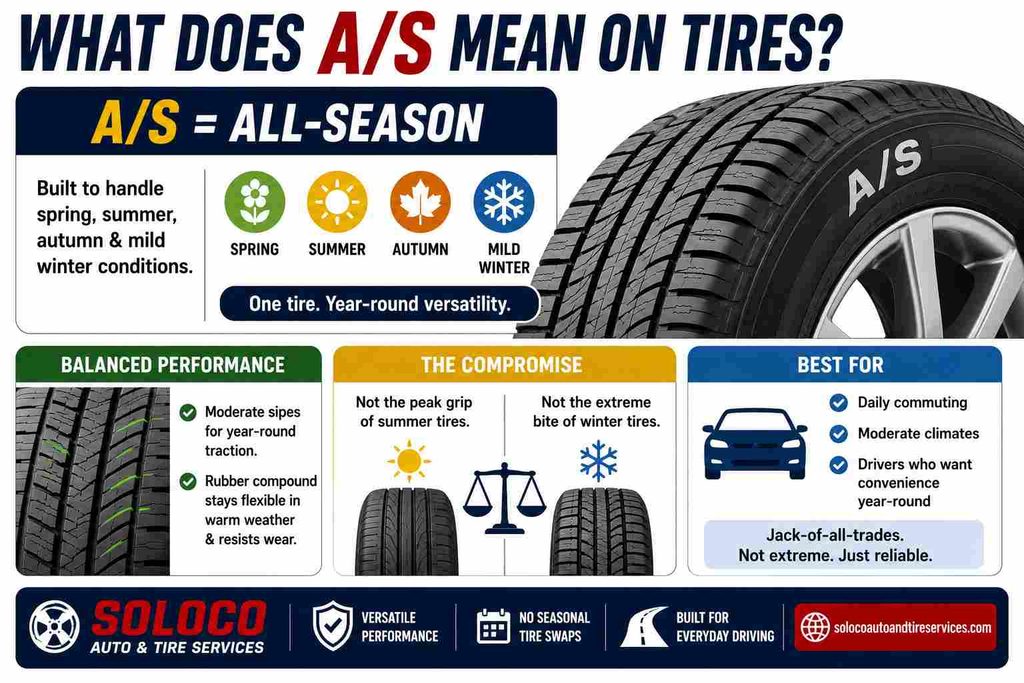
“A/S” explicitly stands for All-Season, serving as a manufacturer designation for tires built to handle a compromise of spring, summer, autumn, and mild winter conditions. These tires strike a middle ground in the automotive industry by eliminating the need to swap dedicated summer and winter tires twice a year in moderate climates.
The engineering behind an A/S tire involves a balanced tread pattern featuring moderate sipes (small slits in the tread blocks) and a rubber compound that remains moderately flexible in warm weather while resisting rapid abrasion.
However, this compromise means they do not match the peak dry cornering grip of a dedicated summer tire, nor do they possess the extreme cold-weather biting edges of a dedicated winter tire. Drivers purchasing vehicles equipped with A/S tires get a jack-of-all-trades product optimized for commuting versatility rather than extreme seasonal specialization.
Is an All-Season Tire the Same as an All-Weather Tire?
No, an All-Season tire is not the same as an All-Weather tire, despite both being marketed for year-round use. All-Weather tires are a modern performance subset that bridges the gap between traditional All-Season and dedicated winter tires.
The defining differentiator is certification. All-Weather tires carry the Three-Peak Mountain Snowflake (3PMSF) symbol, meaning they have passed standardized braking and acceleration tests on packed snow. Furthermore, All-Weather tires utilize a more advanced silica-infused rubber compound that stays pliable below the 7°C threshold. Traditional All-Season tires lack this formal winter certification and lose significant traction when temperatures drop below freezing. If your region experiences persistent winter conditions but you want to avoid seasonal tire swaps, All-Weather tires provide a safer alternative to standard A/S options.
Why Does the 7°C (45°F) Temperature Threshold Matter?
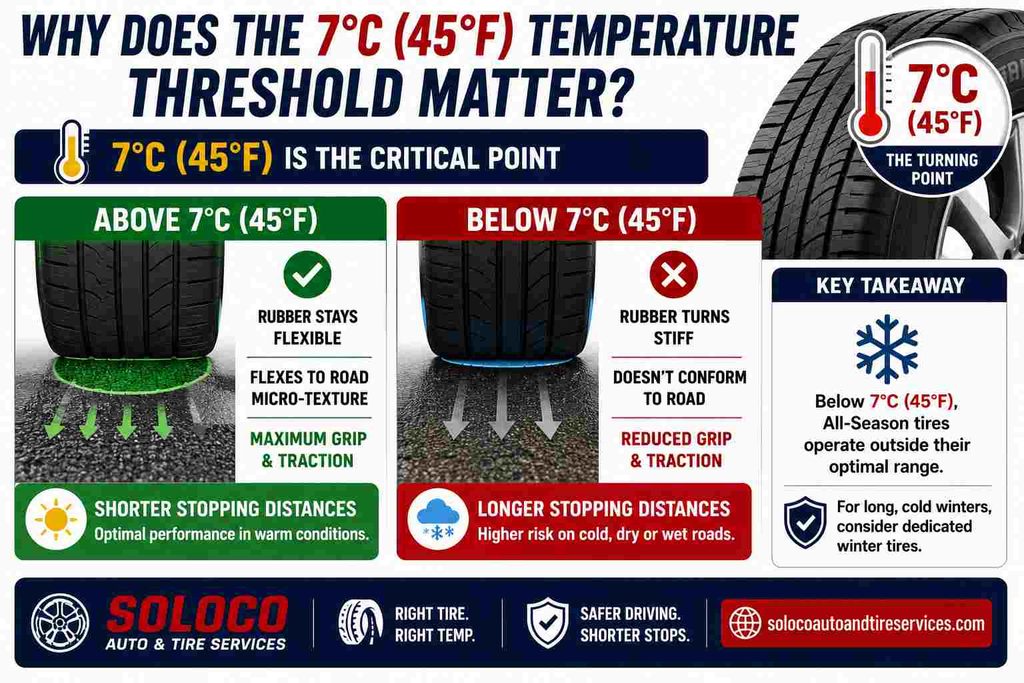
The 7°C (45°F) threshold is the critical physical limit where the rubber compound of a standard All-Season tire transitions from pliable to rigid. Above this temperature, the polymers flex around road micro-texture to generate friction and grip.
When ambient temperatures drop below 7°C, the chemical composition of a standard A/S tire stiffens significantly. This hardening reduces the contact patch’s ability to conform to cold asphalt, resulting in drastically longer stopping distances.
While the tire will still roll and function, emergency braking distances on dry or wet cold roads increase noticeably compared to temperatures above 45°F. Drivers operating in regions with prolonged sub-7°C winters should understand that an All-Season tire is operating outside its optimal thermal window for a large portion of the year.
How Do You Read All-Season Tire Tread Depth and Wear Bars?
All-Season tires feature molded Tread Wear Indicator (TWI) bars embedded deep inside the main circumferential grooves at a height of 2/32 of an inch. When the surrounding tread blocks wear down flush with these horizontal rubber bars, the tire is legally bald and must be replaced immediately.
Measuring tread depth requires a tread depth gauge or a simple coin test. Standard new A/S tires start with a depth between 9/32 and 11/32 of an inch. For effective wet-weather evacuation, tread depth must remain above 4/32 of an inch to prevent hydroplaning. For light snow traction, experts recommend a minimum of 5/32 of an inch; once an All-Season tire wears below 5/32, its ability to bite into snow vanishes entirely, even if the legal 2/32 limit has not yet been reached.
Can I Use All-Season Tires Safely in the Winter?
Yes, you can use All-Season tires in the winter if your local climate experiences only cold rain, occasional slush, and light snow flurries where temperatures rarely stay below freezing for long. No, you cannot use them safely if your region experiences heavy snowfall, ice storms, or sustained sub-freezing temperatures.
When faced with hard-packed snow or black ice, standard A/S tires lose their mechanical grip because their tread blocks pack with snow and their rubber compounds stiffen into a slick surface. Stopping distances on ice at just 50 km/h can balloon past 60 to 70 meters on standard A/S rubber. If your winter involves snowplows, salted highways, and sub-zero mornings, dedicated winter tires or All-Weather tires with the 3PMSF symbol are mandatory for safe operation.
What Are the Legal Differences Between M+S and 3PMSF Ratings?
The M+S (Mud and Snow) stamp is a geometric classification based entirely on the physical void ratio of the tread pattern, whereas the 3PMSF (Three-Peak Mountain Snowflake) symbol is a performance-tested certification. A tire qualifies for an M+S rating if at least 25 percent of the tread footprint consists of open grooves and voids.
Crucially, an M+S rating involves zero laboratory or track testing for actual winter braking, traction, or acceleration on snow or ice. It is an old regulatory standard that satisfies legal winter tire mandates in certain jurisdictions despite offering minimal actual winter capability. Conversely, the 3PMSF symbol requires the tire to pass strict ASTM snow traction testing standards. When purchasing All-Season or All-Weather tires, consumers should always look for the 3PMSF icon if they require genuine cold-weather safety.
How Does Tire Inflation Pressure Affect All-Season Performance in Cold Weather?
Tire inflation pressure drops by approximately 1 PSI for every 10°F drop in ambient outdoor temperature. Running underinflated All-Season tires in winter compromises sidewall stability, increases rolling resistance, and causes uneven shoulder wear.
Maintaining correct pressure during seasonal shifts requires checking tire PSI monthly once cold weather sets in. An underinflated A/S tire exhibits excessive tread flex, which generates internal heat, strains the casing, and reduces wet and snow traction because the center of the tread lifts away from the road surface. Conversely, overinflating reduces the contact patch, diminishing grip on slick surfaces. Always set tire pressures to the vehicle manufacturer placard located inside the driver’s door jamb, adjusting for seasonal temperature swings.
When Do All-Season Tires Fail Catastrophically?
All-Season tires fail catastrophically when pushed past their intended design boundaries into sub-zero hard ice, extreme high-temperature track use, or deep off-road mud. In these scenarios, the compromise engineering of the tire cannot adapt to the extreme physical demands.
- Sub-Zero Hard Ice: Without soft hydrophilic compounds and dense siping, A/S tires on black ice act like hard plastic on glass, providing near-zero friction.
- Extreme Heat: Driving aggressively in ambient temperatures exceeding 35°C (95°F) causes standard A/S rubber compounds to overheat, become greasy, and chunk away, resulting in accelerated tread wear and sloppy steering response.
- Deep Off-Road Mud: Despite carrying an M+S stamp, standard street A/S tires lack the deep, self-cleaning shoulder scoops required to evacuate heavy clay and mud, causing the tread voids to pack solid instantly and turn the tire into a slick.
At What Speed Do Worn All-Season Tires Hydroplane on Wet Roads?
Worn All-Season tires with a tread depth of 2/32 of an inch can begin hydroplaning on standing water at speeds as low as 45 mph (72 km/h). New A/S tires with full 10/32 tread depth typically resist hydroplaning up to speeds exceeding 60 to 65 mph under the same water film conditions.
Hydroplaning occurs when a wedge of water builds up faster than the tire tread can evacuate it, lifting the rubber completely off the pavement and causing total loss of steering and braking control. As All-Season tires wear down, the volume of the drainage channels decreases exponentially. Drivers navigating heavy rainstorms on worn A/S tires must reduce their cruising speed significantly to maintain contact patch integrity and prevent loss of control.
Do All-Season Tires Wear Out Faster Than Summer Performance Tires?
No, All-Season tires generally last significantly longer than dedicated summer performance tires. Standard A/S tires routinely carry treadwear mileage warranties ranging from 60,000 to 90,000 miles.
This longevity stems from the harder rubber compounds and deeper initial tread depths engineered into All-Season tires to handle varied conditions and thermal ranges. Summer performance tires, by contrast, utilize ultra-sticky, soft rubber formulations designed exclusively for maximum adhesion on warm dry and wet pavement. Because of this softness, summer performance tires rarely offer warranties exceeding 30,000 to 40,000 miles. Drivers prioritizing lower operating costs and extended replacement intervals lean heavily toward All-Season options.
How Do Ultra-High-Performance All-Season Tires Differ From Standard A/S Tires?
Ultra-High-Performance (UHP) All-Season tires prioritize warm-weather dry and wet cornering grip, responsive steering feedback, and high-speed stability over snow traction. They feature asymmetric tread patterns, stiffer internal sidewall construction, and higher speed ratings such as W or Y (up to 168 or 186 mph).
Standard passenger All-Season tires, conversely, prioritize ride comfort, low road noise, long tread life, and modest T or H speed ratings. While a UHP All-Season tire like a Michelin Pilot Sport All Season 4 will transform the handling of a sports sedan in dry conditions, it degrades much faster in severe winter weather than a standard touring A/S tire. Selecting between these two categories depends entirely on whether your priority is spirited handling or balanced, long-lasting daily commuting comfort.
Are Two Seasonal Tire Sets Cheaper Than Running All-Season Tires Year-Round?
Running two dedicated seasonal sets (Summer tires plus Winter tires) is almost always more expensive than running a single set of All-Season tires year-round. The higher upfront purchase cost of buying eight tires, combined with bi-annual mounting, balancing, and seasonal storage fees, outweighs the slower wear rate of swapping sets.
However, the financial calculation changes if you measure safety and performance efficiency. Dedicated winter tires prevent accidents in heavy snow climates, potentially saving thousands in collision deductibles, while dedicated summer tires deliver maximum braking performance in hot weather. For drivers in moderate, four-season transitional climates, a single set of quality All-Season or All-Weather tires provides the optimal economic and practical balance.
Can I Mix All-Season and Winter Tires on the Same Vehicle?
Never mix All-Season tires and winter tires on the same vehicle. Doing so creates dangerous imbalances in traction, grip levels, and braking characteristics between the front and rear axles.
If you put winter tires on the front axle and All-Season tires on the rear, the front wheels will grip snow aggressively while the rear A/S tires break loose, causing dangerous oversteer and potential vehicle spins during cornering. Conversely, putting winter tires on the rear causes severe understeer, where the vehicle refuses to turn when steering input is applied. Always maintain a matched set of four identical tire types, tread depths, and load ratings to ensure predictable vehicle dynamics in an emergency maneuver.
How Do You Check a Tire Sidewall for Age and Manufacturing Date?
Every tire sidewall features a Department of Transportation (DOT) serial code ending in a four-digit number that indicates the exact week and year of manufacture. For example, a code ending in “2424” means the tire was manufactured during the 24th week of 2024.
Inspecting tire age is critical because rubber compounds degrade chemically over time due to UV exposure, heat cycles, and oxidation, regardless of remaining tread depth. Industry experts and manufacturers generally recommend inspecting All-Season tires annually once they cross the five-year mark, and mandatory replacement once they reach six to ten years from their manufacturing date, even if the tread blocks appear visually acceptable.
The Bottom Line
Understanding what “A/S” means on tires ensures you match your vehicle’s rubber to your actual regional climate and driving habits. While All-Season tires offer incredible convenience, longevity, and reliable performance across dry, wet, and mild conditions, they have hard physical limits below the 7°C threshold and on solid ice. Assess your local winter severity, monitor your tread depth relative to the 5/32 and 2/32 markers, and upgrade to All-Weather or dedicated winter tires if your local climate demands true cold-weather traction.