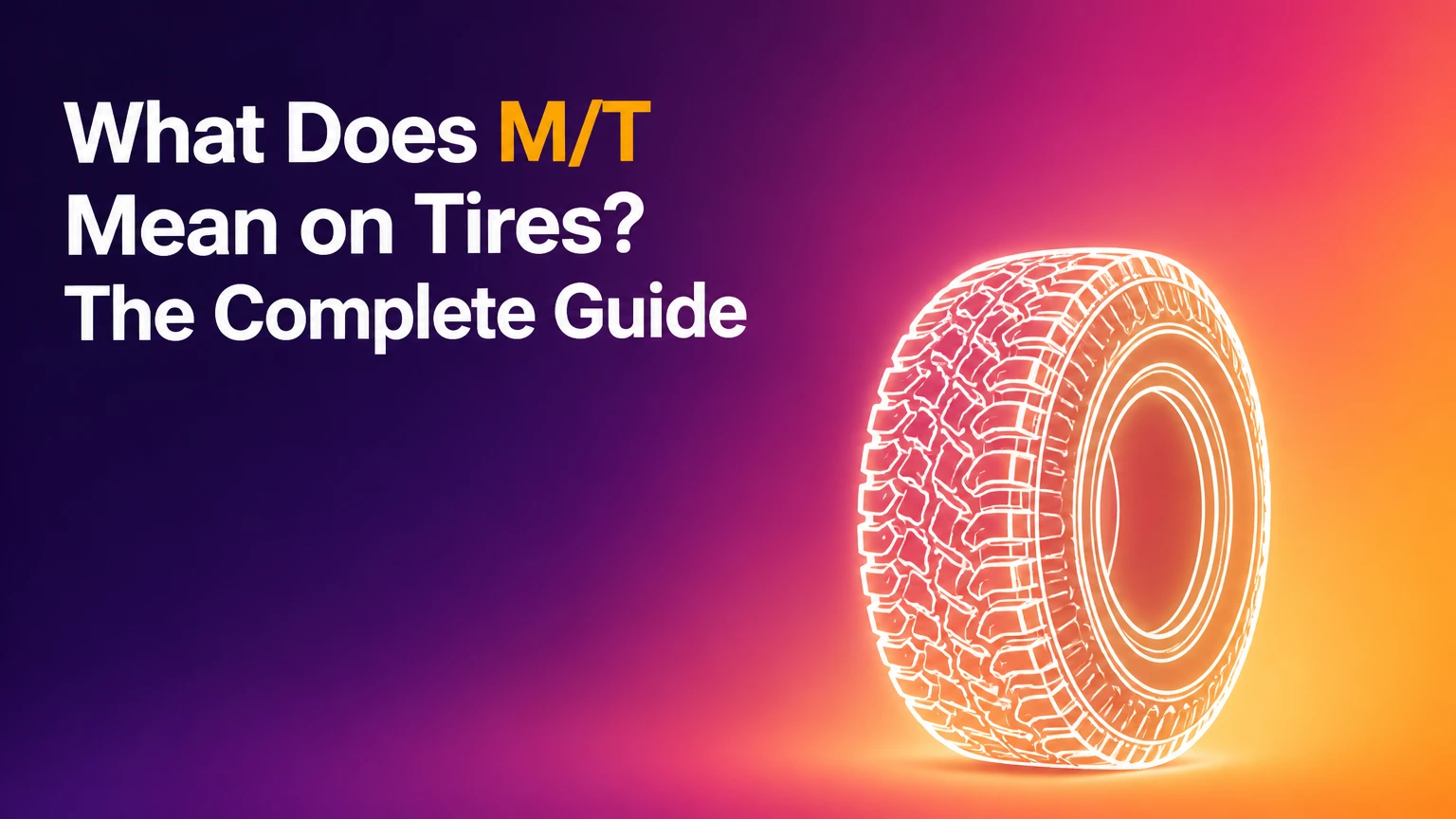
On a tire, M/T stands for Mud-Terrain, a heavy-duty designation engineered specifically for extreme off-road conditions like deep mud, jagged rocks, loose soil, and dense trails. These specialty tires feature aggressive tread blocks, massive void spaces, and reinforced sidewalls designed to maintain traction where standard highway or all-terrain tires fail completely.
At a Glance: Key M/T Tire Facts
- M/T stands for Mud-Terrain, denoting tires built for extreme off-road use.
- They feature a high void ratio of 50% to 60% to prevent mud packing between tread blocks.
- Tread depths are massive, typically ranging from 15/32″ to 22/32″.
- Speed ratings are lower, commonly Q (up to 160 km/h / 99 mph) or R (up to 170 km/h / 106 mph).
- They use heavy-duty construction, often carrying E load ratings (10-ply rated) with 3-ply sidewalls.
- They are notoriously poor on ice and packed snow due to a lack of sipes.
What Does M/T Mean on Tires?
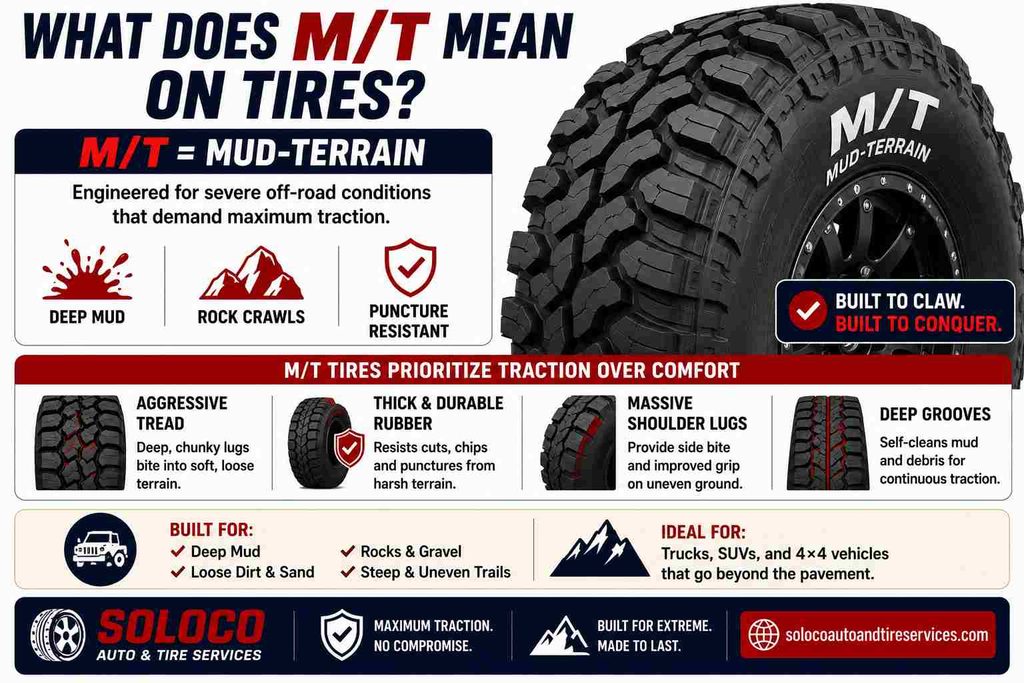
Mud-Terrain (M/T) tire designations indicate that a tire is engineered for severe off-road environments that demand maximum grip on loose, soft, or uneven surfaces. When manufacturers stamp M/T on the sidewall, they are certifying that the product is built to claw through deep mud, conquer rock crawls, and resist sharp punctures from roots and shale.
Unlike standard passenger tires built for smooth highway commuting, M/T tires prioritize mechanical traction over ride comfort. They utilize thick rubber compounds, massive shoulder lugs, and deep grooves that act like tractor treads, biting into unstable terrain to propel heavy trucks and 4×4 vehicles forward when conventional rubber spins helplessly.
How Do M/T Tires Differ Structurally from A/T and H/T Tires?
Mud-Terrain tires differ from All-Terrain (A/T) and Highway (H/T) tires through massive physical dimensions, higher void ratios, and extreme carcass reinforcement. While an H/T tire focuses on smooth road contact and an A/T tire balances dirt and pavement, an M/T tire sacrifices highway manners for raw off-road geometry.
Structurally, M/T tires feature massive tread lugs with depths ranging from 15/32″ to 22/32″, compared to standard highway tires that measure around 9/32″ to 11/32″. Their void ratio is typically 50% to 60%, meaning more open space exists between the rubber blocks than actual rubber touching a flat surface. Furthermore, M/T tires employ heavy-duty carcass architecture, frequently utilizing E load ratings (10-ply equivalent) and reinforced three-ply sidewalls to resist punctures from sharp rocks.
What Are the Speed and Load Ratings of Mud-Terrain Tires?
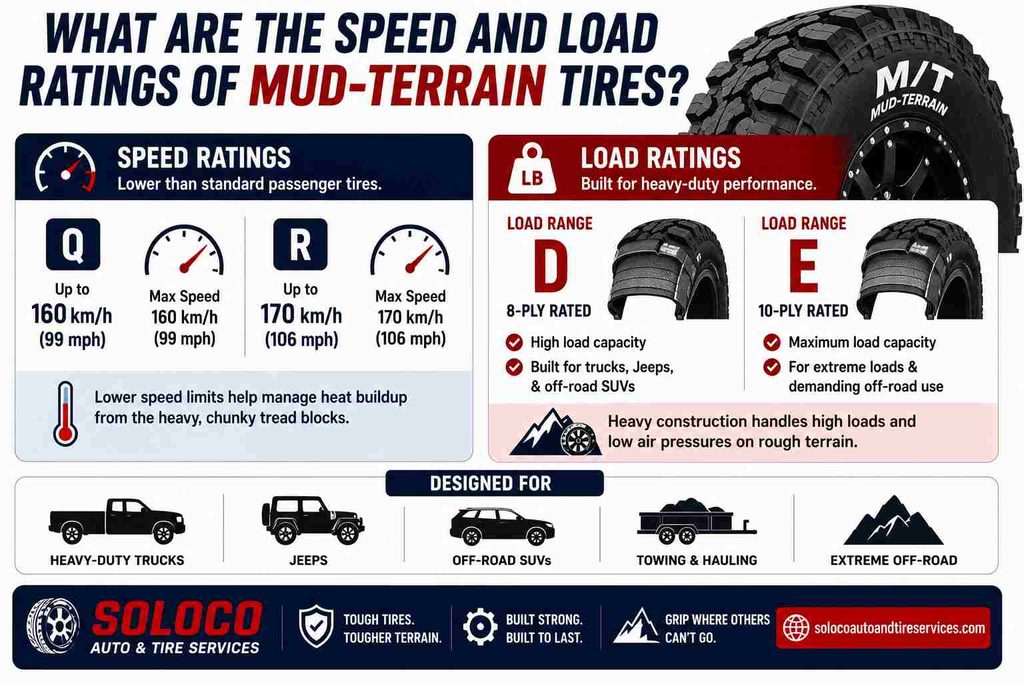
Mud-Terrain tires carry lower speed ratings than standard passenger tires, typically restricted to Q (up to 160 km/h or 99 mph) or R (up to 170 km/h or 106 mph). These conservative speed restrictions are necessary due to the massive physical weight of the thick rubber blocks and the resulting internal heat buildup generated at sustained high speeds.
Because these tires are built for heavy-duty trucks, jeeps, and off-road SUVs, their load ratings are correspondingly high. Most quality M/T tires are offered in D (8-ply rated) or E (10-ply rated) load ranges. This heavy construction allows them to carry substantial cargo weights and withstand high load demands while operating at lower air pressures on rough terrain without unseating from the wheel rim.
How Long Do M/T Tires Typically Last?
Mud-Terrain tires generally last between 45,000 to 65,000 kilometers (30,000 to 40,000 miles) under normal driving conditions. Because the massive, independent tread blocks are flexible and exposed to abrasive asphalt friction, M/T tires wear out significantly faster than All-Terrain or Highway tires, which often exceed 80,000 kilometers.
The lifespan of an M/T tire is heavily dictated by maintenance habits. Due to the aggressive tread design, these tires are extremely prone to uneven wear patterns, such as feathering and cupping. To maximize their longevity, drivers must rotate the tires rigorously every 5,000 to 8,000 kilometers and maintain precise wheel alignment.
Why Do M/T Tires Wear Out Faster Than Regular Street Tires?
Mud-Terrain tires wear out faster than regular street tires because their high void ratio concentrates vehicle weight onto smaller rubber contact points, creating intense localized friction. When a heavy vehicle accelerates, brakes, or corners on paved roads, these tall, isolated tread blocks twist and squirm under the load.
This constant flexing generates localized heat and accelerates abrasive tread wear. Additionally, the rubber compounds used in M/T tires are specially formulated to resist cutting, tearing, and chipping from sharp rocks. This formulation trade-off results in a softer wearing characteristic on smooth, abrasive asphalt compared to hard-compound highway touring tires.
Can You Run Mud-Terrain Tires All Year Round?
Mud-Terrain tires can only be run all year round if you live in a region that completely avoids severe freezing temperatures and winter snowstorms. While they look rugged enough to conquer any climate, M/T tires are notoriously terrible on packed snow and icy winter roads.
The underlying issue is chemical and mechanical. The rubber compound used in Mud-Terrain tires is engineered to resist tearing from sharp rocks, causing the rubber to harden rapidly in sub-freezing temperatures. Furthermore, M/T tread blocks lack sipes, which are the microscopic slits carved into tire blocks that grip ice. Without siping and with hardened rubber, an M/T tire acts like a hard plastic puck on slick winter pavement.
How Do M/T Tires Perform on Wet Pavement and Rainy Roads?
On wet asphalt, Mud-Terrain tires suffer from a severely reduced contact patch and elevated hydroplaning risks. Because 50% to 60% of the tire footprint consists of open voids rather than solid rubber, less physical rubber is available to grip slick, rain-soaked roads, resulting in longer braking distances.
While the massive grooves are brilliant at evacuating thick mud, on smooth wet pavement they can fail to disperse thin standing water quickly enough under high speeds. Drivers transitioning from highway tires to M/T tires must account for this reduced wet-weather traction by increasing following distances and reducing highway speeds during heavy rainstorms.
Are M/T Tires Good for Driving in Sand?
In fine sand, the aggressive digging action of an unmanaged Mud-Terrain tire can work against you and bury the vehicle. Instead of staying on top of loose sand dunes, the massive paddle-like lugs act like excavators, digging the truck straight down into a deep hole if engine torque is applied too aggressively.
However, M/T tires become exceptional in sand if you lower the air pressure significantly. Airing down creates a long, flat footprint that allows the tire to float across the surface rather than trenching into it. Without lowering air pressure, pure sand driving with a rigid, fully inflated M/T tire will quickly result in getting stuck.
Do Mud-Terrain Tires Require Different Air Pressure Settings?
On paved highways, Mud-Terrain tires must be inflated to the vehicle manufacturer’s recommended placard pressure to ensure even wear and stable handling. However, the true off-road performance of an M/T tire is unlocked by lowering the air pressure, commonly referred to as airing down.
When driving off-road over rocks, ruts, and deep mud, dropping tire pressure down to 12 to 15 PSI transforms performance. This intentional reduction allows the stiff sidewalls to flex, elongates the tire footprint for maximum traction, and wraps the tread blocks around obstacles to prevent punctures. Drivers must reinflate their tires before returning to high-speed paved roads.
Why Are M/T Tires So Loud on the Highway?
Mud-Terrain tires produce a loud, high-pitched humming or roaring noise on the highway due to air compression and pattern resonance. As the tire rotates, air gets trapped between the massive, widely spaced tread blocks and is violently squeezed out against the road surface.
This continuous release of compressed air creates an acoustic wave that resonates through the vehicle cabin. Furthermore, the jagged, staggered shoulder lugs strike the pavement sequentially rather than smoothly, generating a distinct mechanical vibration and rhythmic noise that increases in volume as vehicle speed rises.
How Much Fuel Economy Do You Lose by Switching to M/T Tires?
Switching to Mud-Terrain tires typically causes a 3% to 5% drop in overall fuel economy. This noticeable penalty in fuel efficiency stems from a combination of high rolling resistance, aggressive tread pattern friction, and increased rotational mass.
M/T tires are significantly heavier than standard highway tires due to their thick multi-ply sidewalls and massive rubber blocks. Engine power required to turn these heavier wheels increases, and the aggressive tread acts like a parachute against aerodynamic and ground resistance, forcing the engine to burn more fuel to maintain cruising speed.
What Is the Difference Between M/T, A/T, and R/T Tires?
Mud-Terrain (M/T), All-Terrain (A/T), and Rugged-Terrain (R/T) tires represent a sliding scale of aggressive off-road capability versus highway refinement. Choosing the right category depends entirely on your daily driving routine and weekend adventure requirements.
| Tire Category | Void Ratio | Highway Noise | Mud & Rock Traction | Tread Life | Best Suited For |
| Highway (H/T) | Low (15-25%) | Very Quiet | Minimal | Long (80k+ km) | Daily commuting, paved roads, towing. |
| All-Terrain (A/T) | Medium (35-45%) | Moderate | Good | Moderate (70k-80k km) | Mixed driving, light trails, dirt roads. |
| Rugged-Terrain (R/T) | Medium-High (45-50%) | Noticeable | Very Good | Moderate (60k-70k km) | Aggressive look, weekend trails, daily driving. |
| Mud-Terrain (M/T) | High (50-60%) | Loud Hum | Excellent | Shorter (45k-65k km) | Deep mud, rock crawling, extreme off-road. |
How Is a Commercial Traction (C/T) Tire Different from an M/T Tire?
Commercial Traction (C/T) tires are engineered specifically for heavy-duty work trucks operating on gravel, construction sites, and mining roads, whereas Mud-Terrain tires are built for recreational off-road mud and trail exploration. C/T tires focus heavily on chip and chunk resistance rather than deep mud clearing.
While a C/T tire may share a rugged appearance with an M/T tire, its rubber compound is formulated to resist severe lacerations from sharp industrial gravel and jagged stone fragments. Additionally, C/T tires often feature specialized stone ejectors built into the tread grooves to prevent rocks from drilling into the tire casing during heavy commercial hauling.
When Should a Daily Driver Avoid Installing Mud-Terrain tires?
If your vehicle is a daily driver and 90% of your annual mileage is accumulated on paved highways, you should avoid installing Mud-Terrain tires. Running M/T tires in this scenario compromises safety, comfort, and financial efficiency for aesthetic gain.
Commuting on M/T tires on pavement results in rapid, uneven tread wear, loud cabin noise that drowns out conversations, reduced fuel economy, and longer braking distances on wet roads. If you love the aggressive look of an M/T tire but drive mostly on pavement, a hybrid Rugged-Terrain (R/T) or aggressive All-Terrain tire provides a much safer and more comfortable compromise.
How Do You Prevent Uneven Wear and Cupping on Mud-Terrain Tires?
Preventing uneven wear and cupping on Mud-Terrain tires requires strict adherence to tire rotation schedules every 5,000 to 8,000 kilometers, combined with precise suspension alignment checks. Because the large independent tread blocks are vulnerable to heel-and-toe wear, regular rotation is mandatory.
In addition to tire rotations, maintain correct inflation pressures relative to your actual vehicle payload and inspect your shock absorbers regularly. Worn-out shocks allow heavy M/T tires to bounce and skip across the pavement, accelerating cupping and destroying the tread prematurely long before the rubber compound naturally wears out.
How Do You Choose the Right Mud-Terrain Tire for Your Off-Road Rig?
Choosing the right Mud-Terrain tire requires evaluating your vehicle weight, predominant off-road terrain, and climate conditions. Start by verifying your vehicle’s Gross Vehicle Weight Rating (GVWR) to ensure you select a tire with an adequate load range, such as a D or E rating for heavy pickup trucks and full-size SUVs.
Next, analyze your local climate and soil conditions. If you encounter sticky clay and deep ruts, prioritize an M/T tire with a high void ratio and aggressive self-cleaning shoulder scoops. If your trails consist primarily of dry dirt and jagged rock ledges, look for an M/T tire featuring reinforced 3-ply sidewalls and cut-resistant tread compounds to withstand lateral impacts.
The Bottom Line
On a tire, M/T stands for Mud-Terrain, representing a heavy-duty designation engineered for extreme off-road environments featuring deep mud, loose soil, and jagged rocks. While these tires deliver unmatched traction in severe off-road conditions, they require substantial trade-offs in noise, fuel economy, wet-weather braking, and winter performance. Match your tire choice directly to your actual driving habits to ensure safety, performance, and long-term value.