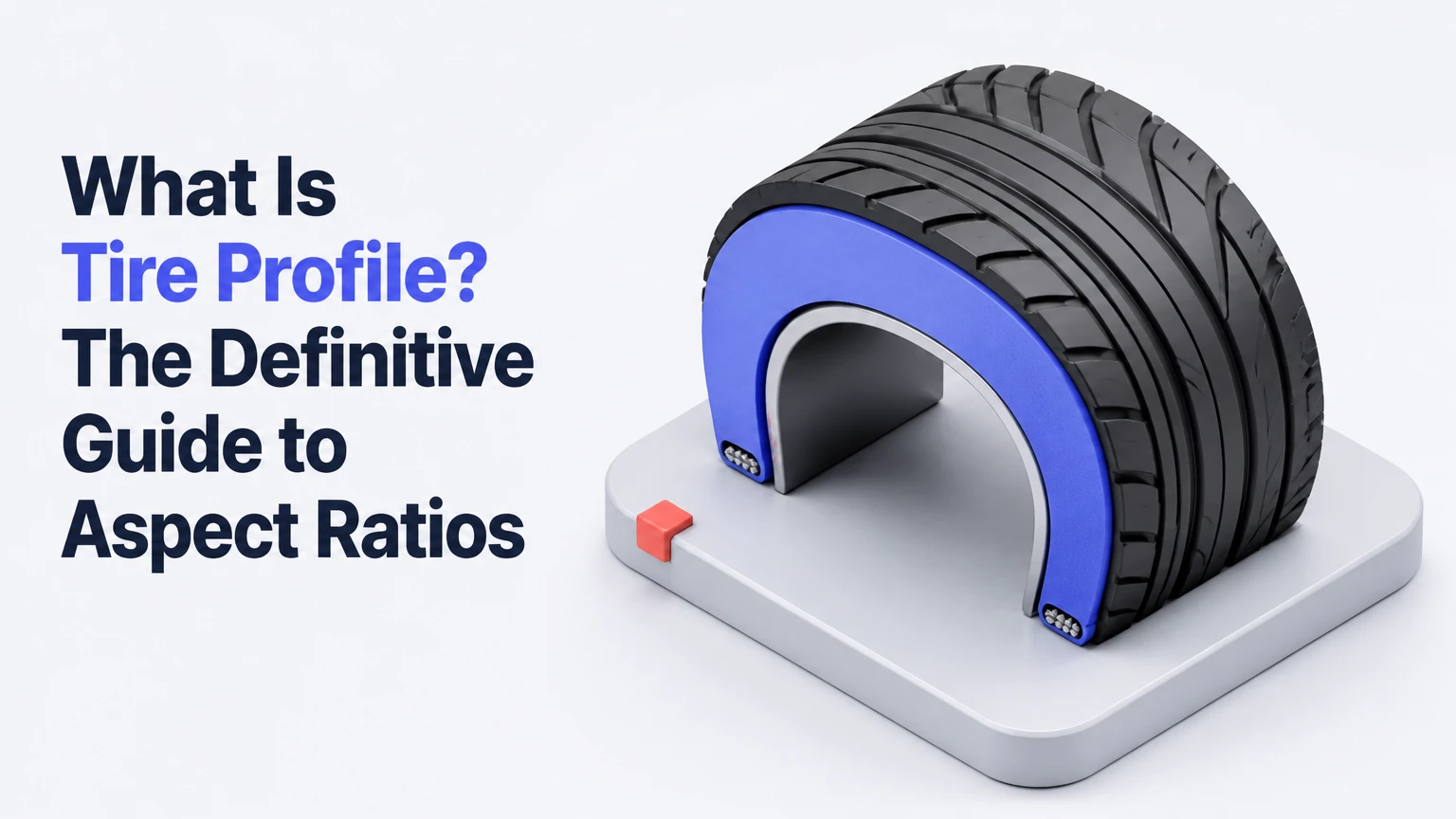
Tire profile, commonly known as the aspect ratio, represents the height of a tire sidewall expressed as a percentage of its overall section width. In standard metric sizing, such as 225/45 R17, the second number indicates that the sidewall height equals 45 percent of the 225 millimeter section width, resulting in a 101.25 millimeter sidewall.
At a Glance: Essential Tire Profile Facts
- Tire profile is calculated as sidewall height divided by section width, expressed as a percentage.
- Low profile tires (30 to 45 aspect ratio) provide sharp cornering and stiff steering response at the expense of ride comfort.
- Standard profile tires (50 to 65 aspect ratio) deliver the best balance of fuel economy, cabin noise reduction, and everyday comfort.
- High profile tires (70 to 85 plus aspect ratio) absorb massive road impacts and allow for lower inflation pressures during off-roading.
- Altering a vehicle tire profile must stay within a strict plus or minus 3 percent rolling diameter threshold to prevent mechanical damage.
- Commercial, vintage, and off-road flotation tires utilize alternative measurement systems that require specialized calculation methods.
What Is Tire Profile?
Tire profile defines the vertical measurement from the outer edge of the wheel rim to the outermost tread boundary, quantified as a percentage of the tire nominal section width. Understanding this metric allows drivers to evaluate how a tire will absorb road imperfections, transmit steering inputs, and handle structural loads. When automotive engineers design a chassis, the tire profile acts as the primary mechanical spring between the unspprung wheel assembly and the vehicle body.
The fundamental measurement relies on tire geometry rather than fixed units. For instance, a wider tire with a lower profile can have the exact same physical sidewall height as a narrow tire with a high profile. This mathematical relationship dictates that profile cannot be evaluated in isolation from section width. Manufacturers stamp these dimensions directly onto the outer sidewall using standardized labeling conventions established by the Tire and Rim Association and the European Tyre and Rim Technical Organisation.
How Do You Read Tire Profile Numbers on a Sidewall?
Reading a tire profile requires decoding the standard metric sizing string stamped into the rubber sidewall, such as the designation P225/45 R17.
- The initial letter P or string indicates the intended vehicle service category, such as passenger car.
- The first numerical value (225) represents the section width measured in millimeters from sidewall to sidewall at the widest point.
- The forward slash separates the width from the profile number.
- The number immediately following the slash (45) is the tire profile or aspect ratio, confirming the sidewall height is 45 percent of 225 millimeters.
- The letter R denotes radial internal carcass construction.
- The final number (17) specifies the wheel rim diameter in inches.
This alphanumeric code provides mechanics and drivers with all structural dimensions required to calculate overall rolling circumference. When replacing tires, maintaining the correct profile ensures that clearance tolerances inside the wheel well remain uncompromised during suspension travel and steering lock turns.
What Is the Difference Between Low, Standard, and High Profile Tires?
Tire profiles are categorized into three primary classifications that dictate vehicle performance, aesthetic stance, and intended operational environment.
| Profile Classification | Aspect Ratio Range | Typical Vehicle Applications | Primary Operational Characteristics |
| Low Profile | 30 to 45 | Sports cars, performance sedans, high-end EVs | Sharp steering response, high dry grip, stiff ride, high pothole damage risk |
| Standard Profile | 50 to 65 | Modern sedans, crossovers, family minivans | Balanced fuel economy, low cabin noise, comfortable ride, stable wet traction |
| High Profile | 70 to 85+ | Heavy-duty trucks, off-road SUVs, classic cars | Maximum impact absorption, rim protection, superior low-pressure flex |
Choosing the correct classification depends heavily on local road quality, vehicle weight distribution, and driving dynamics expectations. Drivers operating in regions with deteriorating infrastructure frequently discover that transitioning from low profile to standard profile tires eliminates bent wheel rims and cracked alloy structures.
How Does Tire Profile Affect Ride Comfort and Handling?
Tire profile directly dictates the balance between mechanical comfort and lateral handling precision through sidewall flex characteristics. A taller sidewall contains a greater volume of compressed air that acts as a primary pneumatic cushion, absorbing high-frequency road vibrations, expansion joints, and sharp potholes before those forces reach the suspension arms. This natural dampening creates a plush, isolated ride quality prized in luxury touring vehicles.
Conversely, a lower profile tire features a shortened sidewall structure that drastically reduces lateral flex during aggressive cornering maneuvers. When a vehicle initiates a high-speed turn, a tall sidewall deforms under lateral load, creating a momentary delay before the chassis follows the steering input. A low profile sidewall resists this rollover effect, providing instant steering reflexes and superior contact patch stability. However, this mechanical stiffness transmits harsh shock loads directly into the vehicle suspension bushings, cabin structure, and occupant skeletal systems.
Why Do Vintage and Commercial Tires Omit Profile Numbers?
Classic vintage tires and certain commercial heavy-duty applications do not display an aspect ratio number on their sidewalls because they were engineered under historical sizing standards that assumed a default profile. For example, classic bias-ply or early radial sizes such as 8.25-16 or European metric sizes like 165R15 completely omit the slash and profile digits.
When a tire size lacks an explicit aspect ratio, industry engineering standards dictate that the profile defaults to an implicit 80 or 82 percent aspect ratio. This means the sidewall height is roughly equal to 80 percent of the nominal section width. Mechanics working on restoration projects or industrial fleet maintenance must account for this implicit ratio when sourcing modern radial replacements to ensure proper gearing ratios and speedometer accuracy are maintained.
How Do You Calculate Sidewall Height for Off-Road Flotation Tire Sizes?
Calculating sidewall height for off-road flotation tires requires using US customary inch measurements rather than standard metric aspect ratio percentages. Off-road tires frequently use sizing formats like 35 x 12.50 R15, where every dimension is expressed in inches.
To determine the sidewall height for a flotation size, apply this mathematical formula:
$$\text{Sidewall Height} = \frac{\text{Total Overall Diameter} – \text{Wheel Rim Diameter}}{2}$$
For a 35 x 12.50 R15 tire:
- Subtract the 15-inch wheel diameter from the 35-inch overall tire diameter, leaving 20 inches of total vertical tire material across the wheel center.
- Divide that 20-inch result by 2 to account for the top and bottom sections of the tire.
- The resulting sidewall height is exactly 10 inches.
This massive 10-inch sidewall allows off-road drivers to deflate tires safely to single-digit pressures during rock crawling or sand driving without risking bead separation or rim destruction.
Why Do Heavy Electric Vehicles Require Specialized Low Profile Tires?
Heavy electric vehicles require specialized extra-load low-profile tires because standard passenger car tires cannot support the massive battery pack weight combined with instant electric torque delivery. When an electric vehicle scales up in weight, standard high-profile sidewalls experience excessive flex, generating internal heat that can lead to tread separation and dangerous highway handling instability.
To counteract this, tire manufacturers engineer Electric Vehicle specific low-profile tires utilizing high-tensile aramid fibers, high-density steel belts, and rigid synthetic polymer compounds. These internal reinforcements keep the tire footprint flat and stable under heavy loads while maintaining rolling efficiency. Drivers who attempt to install soft, high-profile aftermarket tires on heavy battery-electric platforms routinely experience spongy steering feedback, accelerated shoulder wear, and compromised emergency braking performance.
Can I Change My Tire Profile Without Changing My Wheels?
Yes, changing a tire profile without swapping wheel rims is entirely possible, provided the new overall tire rolling diameter stays within a strict plus or minus 3 percent tolerance of the original factory specification. Exceeding this 3 percent window alters final drive ratios, disrupts anti-lock braking calibration, and creates dangerous physical interference between the tire shoulder and inner suspension components or wheel arch liners.
When modifying profiles on an existing wheel rim, drivers must practice plus-zero or minus-zero sizing. For example, moving from a 225/55 R17 tire to a 225/50 R17 tire reduces sidewall height by approximately 11.25 millimeters, lowering the vehicle center of gravity and sharpening turn-in response. However, this downward shift reduces ground clearance and causes the speedometer to display a speed faster than the vehicle is actually traveling.
How Does Changing Tire Profile Impact Fuel Economy and Rolling Resistance?
Changing a tire profile indirectly impacts fuel economy through alterations in total rolling resistance, vehicle aerodynamics, and unsprung weight distribution. Low-profile performance tires typically utilize stickier, high-hysteresis rubber compounds designed to generate maximum mechanical friction for stopping and cornering. This increased grip requires more energy to overcome internal rubber deformation, resulting in higher rolling resistance and a noticeable drop in fuel mileage or electric vehicle range.
Conversely, standard and high-profile tires featuring eco-focused tread compounds flex more efficiently, lowering hysteresis losses and preserving kinetic momentum on open highways. Furthermore, lower profile tires mounted on oversized alloy rims frequently add substantial unsprung weight to each corner of the vehicle. Heavier wheel assemblies require additional engine energy to accelerate from a stop, compounding efficiency losses during urban commuting cycles.
Do Low Profile Tires Wear Out Faster Than High Profile Tires?
Low profile tires generally wear out faster than high profile tires due to differences in rubber compound chemistry, structural stiffness, and load distribution mechanics. Performance-oriented low-profile tires utilize soft tread formulations laden with specialized silicas and synthetic resins designed to maximize grip on hot or wet pavement. These soft compounds sacrifice tread longevity in exchange for traction.
Additionally, because low-profile sidewalls lack the pneumatic compliance needed to absorb sharp road impacts, the rubber tread blocks absorb 100 percent of the abrasive friction forces generated during acceleration, braking, and cornering. High-profile tires, by comparison, permit controlled carcass deflection that dampens localized tread scrubbing against the pavement surface, distributing wear across a larger, more forgiving contact patch over tens of thousands of miles.
Why Do Low Profile Tires Cost More Despite Using Less Rubber?
Low profile tires command a higher retail price than high profile tires despite containing a smaller overall volume of rubber because their internal manufacturing complexity and engineering requirements are substantially greater. To prevent a shallow sidewall from collapsing under a two-ton vehicle, engineers must embed complex layers of high-tensile steel wire, Kevlar reinforcement belts, and dense nylon cap plies directly into the sidewall structure.
Manufacturing tolerances for low-profile tires are exceptionally strict. Any microscopic imbalance in the internal reinforcement matrix at high speeds will cause catastrophic vibration or structural failure. Furthermore, the specialized machinery required to mold, cure, and mount ultra-low-profile tires with stiff bead bundles demands specialized shop equipment, driving up both production overhead and professional installation costs.
How Does Tire Profile Affect Winter Driving and Snow Traction?
Tire profile plays a critical role in winter weather performance, with taller profiles generally outperforming ultra-low-profile options in deep snow conditions. Winter driving demands narrow contact patches and compliant sidewalls that allow the tread blocks to bite deep into loose snow packs and clear out compacted slush efficiently.
Ultra-low-profile tires feature wide, flat contact patches that tend to float or hydroplane over top of slush and deep snow rather than cutting through to firm pavement underneath. Furthermore, freezing winter temperatures make the rigid synthetic polymers used in low-profile sidewalls brittle, drastically reducing their mechanical compliance and ice grip. Drivers operating in heavy snow zones achieve superior winter safety by selecting standard or slightly higher profile tires equipped with deep sipes and certified three-peak mountain snowflake ratings.
What Are the Risks of Stretched Tires in Automotive Tuner Culture?
Stretched tire fitment involves intentionally mounting a narrow tire onto an excessively wide wheel rim—such as installing a 215-millimeter width tire onto a 10-inch wide wheel—to achieve a specific aesthetic stance favored within automotive tuner culture. This practice introduces severe mechanical and safety risks that violate every engineering standard established by tire manufacturers.
Mounting a tire in a stretched configuration forces the sidewalls into a harsh outward angle, destroying the internal load-bearing geometry designed by the factory. Under hard cornering loads or when striking a minor highway pothole, the tire bead can easily unseat from the wheel rim, causing instantaneous and catastrophic deflation. Furthermore, stretched fitments eliminate rim protection, destroy ride quality, and void all manufacturer warranty coverages immediately.
How Does Altering Tire Profile Affect Braking Distance and Safety Systems?
Altering a vehicle tire profile directly impacts emergency braking performance and the electronic calibration of advanced driver assistance systems, including Anti-lock Braking Systems (ABS) and Electronic Stability Control (ESC). Modern safety computers rely on precise wheel speed sensor feedback synchronized with expected tire rolling diameters to calculate vehicle slip angles and stopping thresholds.
If a modified tire profile changes the overall rolling circumference beyond acceptable thresholds, the ABS computer misinterprets wheel rotational speeds during panic braking events. This calibration error can extend stopping distances on wet or dry pavement. Additionally, switching to an overly stiff low-profile tire on bumpy road surfaces causes the tire contact patch to momentarily bounce off the pavement during emergency stops, triggering premature ABS activation and lengthening total vehicle stopping distance.
Do I Need to Recalibrate My Speedometer After Changing Tire Profiles?
Recalibrating the vehicle speedometer is mandatory if a new tire profile changes the overall rolling diameter by more than 2 percent from factory specifications. Because vehicle speedometers calculate speed by measuring the rotational velocity of the driveshaft or wheel hub, any change in the outer tire circumference directly misleads the onboard computer.
Installing a tire with a smaller profile and shorter overall diameter causes the wheels to spin faster for any given true ground speed, resulting in the speedometer displaying a reading faster than actual travel speed, which risks unintentional speeding citations. Conversely, installing a taller profile tire causes the vehicle to travel faster than the indicated speedometer reading, risking unexpected speeding fines and inaccurate vehicle maintenance tracking on the digital odometer.
How Do Insurance Companies View Non-Factory Tire Profile Modifications?
Insurance companies evaluate non-factory tire profile modifications through the lens of risk assessment and regulatory compliance. Modifying a vehicle tire profile to extreme dimensions—such as installing dangerous low-profile stretched tires or drastically altering load indexes—can provide an insurance adjuster with grounds to deny coverage following an accident caused by mechanical failure or loss of control.
Standard equipment insurance policies assume the vehicle operates within manufacturer-approved engineering parameters. When owners install custom modifications that degrade handling safety, emergency braking, or load capacities, underwriters categorize these changes as undisclosed high-risk modifications. Drivers contemplating non-standard tire profile changes should consult with their insurance provider and professional mechanics to ensure all fitments comply with regional vehicle safety inspection codes.
The Bottom Line
Tire profile is far more than a simple aesthetic number stamped on a sidewall; it is a critical engineering baseline governing vehicle handling, ride comfort, and structural safety. Maintaining the correct aspect ratio ensures that your vehicle suspension, braking systems, and electronic safety monitors operate precisely as designed. When modifying tire profiles for performance or appearance, always respect the strict three percent rolling diameter rule to protect both your vehicle mechanical integrity and your personal safety on the road.


