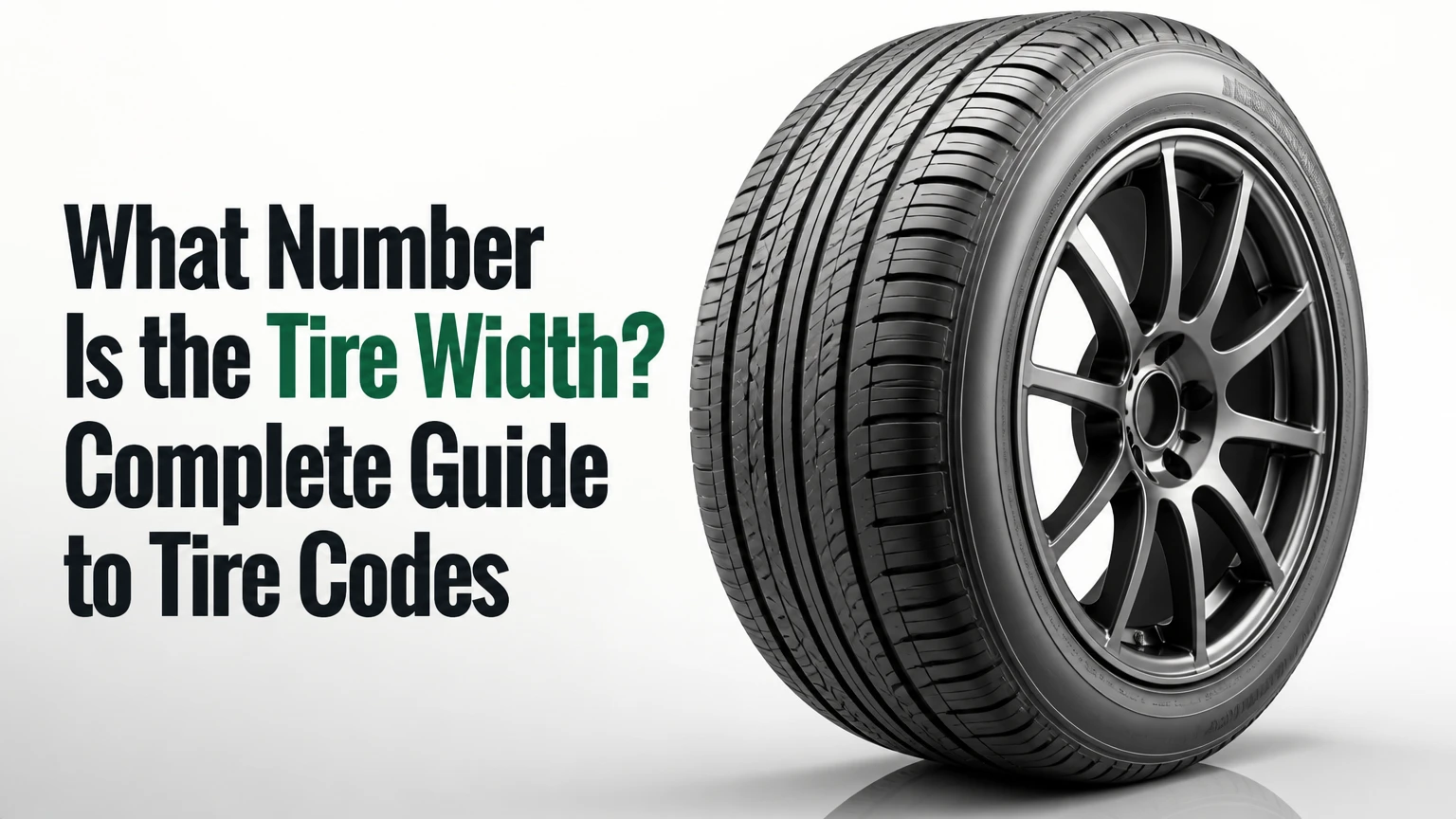
The tire width is always the first three-digit number appearing before the slash in a standard metric tire code sequence, such as the 245 in a 245/45R18 specification. This initial figure establishes the baseline horizontal cross-section measurement of the tire when mounted and inflated to rated pressure.
At a Glance: Key Tire Width Facts
- The tire width is the first number in standard metric tire codes, representing the cross-section measurement in millimeters.
- Standard passenger car widths range from 155 mm for compact vehicles up to 315 mm for performance trucks and large SUVs.
- Flotation tires use an alternative imperial format where the second number indicates the width in inches.
- Changing tire width by more than 10 mm to 20 mm risks inner fender rubbing and suspension component interference.
- Wider tires increase dry pavement grip and cornering stability but reduce resistance to hydroplaning in wet weather.
What Number Is the Tire Width?
The tire width is the very first number displayed in a standard metric tire sizing code, such as the 245 in the sequence 245/45R18. This primary figure gives vehicle owners and technicians an immediate indication of how wide the tire profile is from sidewall to sidewall. When reading sidewall markings, ignore any letters at the very beginning, as the numerical digits dictate the exact footprint profile parameters. Recognizing this number correctly prevents ordering incorrect replacement tires that fail to match factory load indices or clearance boundaries.
What Unit and Physical Points Define Section Width?
Tire width is measured strictly in millimeters and represents the section width of the tire. The section width is defined as the absolute maximum linear distance from the extreme outer edge of the outer sidewall to the extreme inner edge of the inner sidewall. This measurement is taken only after the tire has been mounted onto an industry-approved measuring rim and inflated to its precise recommended cold pressure for 24 hours. It excludes raised lettering, protective rim ribs, and decorative sidewall ornamentation to ensure standardized manufacturing comparisons.
Standard passenger car and crossover tire widths generally fall into predictable brackets based on vehicle class. Compact cars utilize narrow widths ranging from 155 mm to 195 mm to optimize fuel economy and minimize steering effort. Standard sedans and midsize crossovers step up to widths between 205 mm and 245 mm for balanced handling and load capacity. Heavy-duty trucks, sports cars, and large SUVs utilize widths from 255 mm up to 315 mm or greater to support high gross vehicle weight ratings and massive torque deployment.
What Do the Other Numbers Next to the Width Mean?
The numbers and letters following the tire width represent the aspect ratio, internal construction type, and wheel rim diameter. In a standard 245/45R18 designation, the components break down into a precise engineering formula:
- First Number (245): The section width measured in millimeters from sidewall to sidewall.
- Second Number / Aspect Ratio (45): The sidewall height expressed as a percentage of the section width, meaning the sidewall is 45 percent of 245 mm.
- Construction Letter (R): Indicates that the internal carcass plies are constructed using radial ply architecture.
- Final Number (18): Specifies the required wheel rim diameter in inches that the tire is engineered to fit.
Understanding this complete sequence ensures that modifying one variable does not inadvertently compromise load ratings, gear ratios, or electronic stability control calibration thresholds.
How Do Flotation, Vintage, and Commercial Tires Change Width Numbering?
While the metric system governs the vast majority of modern passenger vehicles, specialized tire categories utilize completely different sizing nomenclatures and measurement scales. Off-road flotation tires, vintage collector vehicles, and commercial trailers require distinct decoding methods to identify their actual physical width.
Off-road flotation tires found on light trucks use an imperial format that looks like 33 x 12.50 R 15. In this specific configuration, the first number (33) represents the overall outside diameter of the tire in inches. The second number (12.50) represents the section width in inches, while the final number (15) denotes the wheel diameter in inches.
Vintage and collector vehicles often rely on the numeric system, appearing as a classic size like 6.00-16. Under this legacy framework, the first number (6.00) indicates the section width in inches, and it inherently assumes a tall aspect ratio of either 92 percent or 100 percent.
Commercial and heavy-duty trailer tires incorporate prefixes or suffixes such as ST for Special Trailer or LT for Light Truck, appearing as ST225/75R15. Here, the width remains the first number (225 mm), but heavy carcass construction and high operational load requirements mean actual inflated footprints vary significantly from standard passenger tires.
How Do You Calculate Exact Section Width Changes Across Sizes?
Calculating the exact physical change in section width when transitioning to a non-standard tire size requires applying mathematical formulas to both the width and aspect ratio. When replacing a factory 205/55R16 tire with a wider 225/50R16 tire, the nominal section width increases by exactly 20 millimeters from 205 mm to 225 mm. However, the overall physical diameter of the tire assembly must also be calculated to prevent speedometer error and mechanical rubbing.
To calculate sidewall height, multiply the section width by the aspect ratio percentage. For the original 205/55 tire, multiply 205 mm by 0.55 to yield a sidewall height of 112.75 mm. For the new 225/50 tire, multiply 225 mm by 0.50 to yield a sidewall height of 112.50 mm. The total tire diameter equals the wheel rim diameter plus twice the sidewall height. Maintaining a total diameter variance within plus or minus three percent of the original factory specification protects transmission shift points, anti-lock braking systems, and traction control algorithms from throwing diagnostic trouble codes.
Can I Put Wider Tires on My Factory Rims Safely?
You can usually install wider tires on factory rims, but you must restrict the increase to a maximum of 10 mm to 20 mm over the original factory specification. Exceeding this narrow threshold causes the tire bead to seat improperly against the wheel flange, leading to catastrophic air pressure loss or bead unseating during high-load cornering maneuvers.
Every specific tire model publishes an approved rim width range certified by the Tire and Rim Association. If a tire manufacturer specifies an approved rim width range of 7.0 to 8.5 inches for a 235 mm wide tire, mounting that tire onto a narrow 6.0-inch factory rim forces the sidewalls to pinch dangerously inward. Conversely, mounting a tire onto a rim that is too wide causes excessive stretch, exposing the delicate wheel lip to curb damage and placing abnormal tension on the inner steel belts. Always cross-reference your exact wheel width measurement against the tire manufacturer technical data sheets before purchasing alternative sizes.
Does a Wider Tire Actually Improve Dry and Wet Grip?
A wider tire significantly improves grip on dry pavement by increasing the total surface area of the contact patch shared between the rubber compound and the road surface. This expanded contact patch distributes vehicle weight over a broader area, enhancing lateral cornering stability, reducing braking distances in dry conditions, and improving acceleration traction for high-horsepower applications.
However, wider tires perform substantially worse in heavy rain, standing water, and deep snow conditions. Because a wider tire distributes vehicle weight over a larger footprint, the ground pressure exerted downward decreases, making it far easier for the tire to ride up on top of standing water rather than displacing it. This physical phenomenon, known as hydroplaning, occurs at lower vehicle speeds with wide tires. Similarly, in snow, a wider tire acts like a snowshoe, packing powder beneath the tread rather than slicing through the accumulation down to solid pavement where traction exists.
How Does Changing Tire Width Affect Gas Mileage and Rolling Resistance?
Changing to wider tires increases both rolling resistance and aerodynamic drag, resulting in a measurable decrease in fuel economy ranging from 2 percent to 5 percent. The primary driver of this fuel penalty is increased rolling resistance caused by greater rubber deformation at the contact patch as the tire rolls against the pavement surface.
As tire width increases, the tread footprint broadens and flattens, requiring more engine energy to overcome internal hysteresis losses within the rubber compound. Furthermore, wider tires that protrude past the vehicle body lines increase aerodynamic turbulence around the wheel wells, creating parasitic wind drag at highway speeds. Vehicle owners seeking maximum fuel efficiency should strictly adhere to Original Equipment Manufacturer tire width specifications rather than installing oversized aftermarket options.
When Does General Tire Width Advice Fail Due to Manufacturer Variance?
General advice suggesting that any tire marked with a specific millimeter width will match exact physical dimensions fails due to wide variances in manufacturing tolerances across different tire brands. A 245 mm performance tire produced by Brand A can physically measure 241 mm across its widest point, while a touring tire from Brand B marked with the exact same 245 mm designation can actually measure 248 mm when mounted and inflated.
This variance stems from differences in tread design, shoulder block aggressiveness, sidewall styling, and mold shrinkage rates during the vulcanization process. Track enthusiasts and car customizers often run into severe clearance issues when switching tire brands even while maintaining the same nominal numerical width code. Always check real-world section width specifications published in engineering data catalogs rather than relying solely on the numerical sidewall label when dealing with tight clearance margins.
What Causes Rim Width Mismatch and Tire Stretch Hazards?
Rim width mismatch occurs when a tire width is paired with an incompatible wheel rim width, creating structural mechanical stress concentrations within the tire casing. When an improper mismatch forces a tire to stretch or pinch beyond its engineering limits, the structural integrity of the internal steel wire bead bundle is compromised.
A pinched tire features excessive sidewall bulge, causing rapid heat buildup in the shoulders during sustained highway driving, which can lead to tread separation or blowout. Conversely, an extreme tire stretch setup pulls the bead inward at an unnatural angle, leaving the upper sidewall vulnerable to sharp impacts from potholes and creating microscopic gaps where air can slowly leak out over time. Professional technicians rely on precise rim-to-tire compatibility charts to ensure the internal bead seating angle matches the safety humps engineered into the alloy wheel barrel.
How Do Fender Clearance Limits and Offset Errors Cause Rubbing?
Increasing tire width frequently causes destructive mechanical rubbing against inner suspension struts, wheel well liners, and outer fender lips during full-lock steering turns or heavy suspension compression. Adding just 10 mm to 20 mm of extra width shifts the inner and outer sidewall boundaries outward and inward simultaneously, narrowing the dynamic clearance envelope.
Wheel offset—the distance from the hub mounting surface to the true center line of the wheel rim—determines how a wider tire sits inside the wheel well. If an aftermarket wheel features an incorrect offset combined with an increased tire width, the outer edge of the tire will slice against the inner fender lip when hitting bumps. This friction shreds the rubber tread blocks, damages structural cords, and can slice through plastic wiring harnesses routed inside the inner fender wells. Verify backspacing and offset measurements carefully before altering tire dimensions on vehicles with tight factory suspension packaging.
How Does Improper Tire Width Cause Premature Suspension Wear?
Installing improperly sized wide tires places excessive mechanical leverage loads on suspension components, accelerating wear across ball joints, wheel bearings, steering racks, and control arm bushings. When a wider tire increases the scrub radius—the distance between the steering axis pivot line and the center of the tire contact patch—it alters the steering geometry forces transmitted back through the steering linkage.
This altered scrub radius forces power steering pumps and rack-and-pinion gears to work harder to turn the wheels while stationary, leading to premature hydraulic seal failure and internal gear wear. Furthermore, the increased unsprung weight of wider, heavier tire and wheel assemblies subjects shock absorbers and strut dampeners to higher inertial loads, causing internal valving fatigue and premature oil degradation. Maintaining proper factory width specifications preserves the intended suspension geometry designed by vehicle engineers.
The Bottom Line
The tire width is the foundational first number in a standard tire code, measured in millimeters from sidewall to sidewall. While wider tires offer enhanced dry grip and aggressive styling, they introduce severe trade-offs including reduced hydroplaning resistance, lower fuel economy, and potential mechanical clearance failures. Always verify exact manufacturer measurements, rim width compatibility, and suspension clearance limits before modifying your vehicle tire dimensions.