Truck tires generally cost between $150 and $1,200+ per tire. This massive price variation occurs because the term truck applies to everything from light-duty personal pickups and heavy commercial box trucks to massive 18-wheeler semi-trucks. Pricing also fluctuates heavily depending on tread pattern, load rating, and vehicle drivetrain requirements.
At a Glance: Key Truck Tire Facts
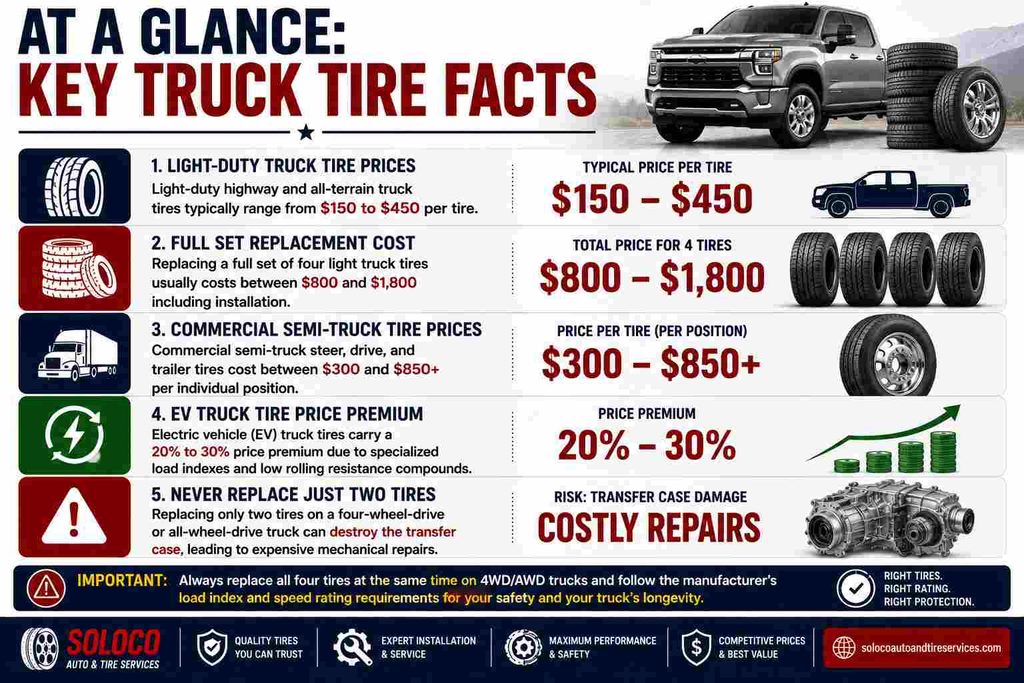
- Light-duty highway and all-terrain truck tires typically range from $150 to $450 per tire.
- Replacing a full set of four light truck tires usually costs between $800 and $1,800 including installation.
- Commercial semi-truck steer, drive, and trailer tires cost between $300 and $850+ per individual position.
- Electric vehicle (EV) truck tires carry a 20% to 30% price premium due to specialized load indexes and low rolling resistance compounds.
- Replacing only two tires on a four-wheel-drive or all-wheel-drive truck can destroy the transfer case, leading to expensive mechanical repairs.
What is the price breakdown for light truck and SUV tires?
Light truck and SUV tires range from $150 to $600 per tire, depending entirely on the tread design and driving application. Highway all-season tires sit at the lower end from $150 to $300 per tire, engineered primarily for quiet pavement commuting and standard fuel economy. All-terrain tires cost $200 to $450 per tire, offering balanced performance for dirt roads and light mud. Mud-terrain tires command $250 to $600 per tire due to aggressive void ratios designed for off-road traction. Purchasing a full set of four light truck tires for vehicles like the Ford F-150, Chevy Silverado, or Ram 1500 typically totals $800 to $1,800 when factoring in mounting and balancing fees.
How much do commercial and heavy-duty truck tires cost?
Commercial and heavy-duty truck tires designed for Class 3 through Class 6 vehicles, such as box trucks, dually pickups, and tow trucks, cost between $300 and $600 per tire. Because these medium-duty working vehicles frequently haul heavy payloads, their tires require reinforced sidewalls and higher ply ratings compared to standard consumer SUVs. A complete tire replacement for a heavy-duty dually pickup or box truck requires four to six tires, bringing the average full set cost to between $1,200 and $3,600. Fleet operators must budget carefully for these commercial replacements to avoid unexpected downtime.
What is the price of semi-truck and 18-wheeler tires?
Semi-truck and big rig tires for Class 7 and Class 8 commercial vehicles vary significantly by wheel position, with total full-set costs ranging from $6,000 to $10,000+ for all 18 wheels. Steer tires installed on the front axle cost $450 to $850+ per tire because they demand the highest structural integrity for vehicle steering and safety. Drive tires positioned on the middle axles cost $400 to $700 per tire to handle high torque and engine power. Trailer tires positioned on the rear axles cost $300 to $500 per tire, designed primarily for smooth rolling resistance under heavy distributed loads.
How much do oversized and lifted truck tires cost?
Oversized and lifted truck tires designed for modified suspensions range from $500 to $900 per tire. When truck owners install suspension lifts to accommodate 35-inch to 40-inch tires like the Toyo Open Country or Nitto Grappler, standard factory sizing no longer applies. Specialty large-diameter off-road tires require complex manufacturing processes, thicker sidewalls, and deep tread blocks. Equipping a lifted truck with four oversized specialty tires easily pushes total material costs to $2,000 to $3,600 before accounting for specialized wheel mounting and speedometer recalibration.
Why are electric vehicle (EV) truck tires more expensive?
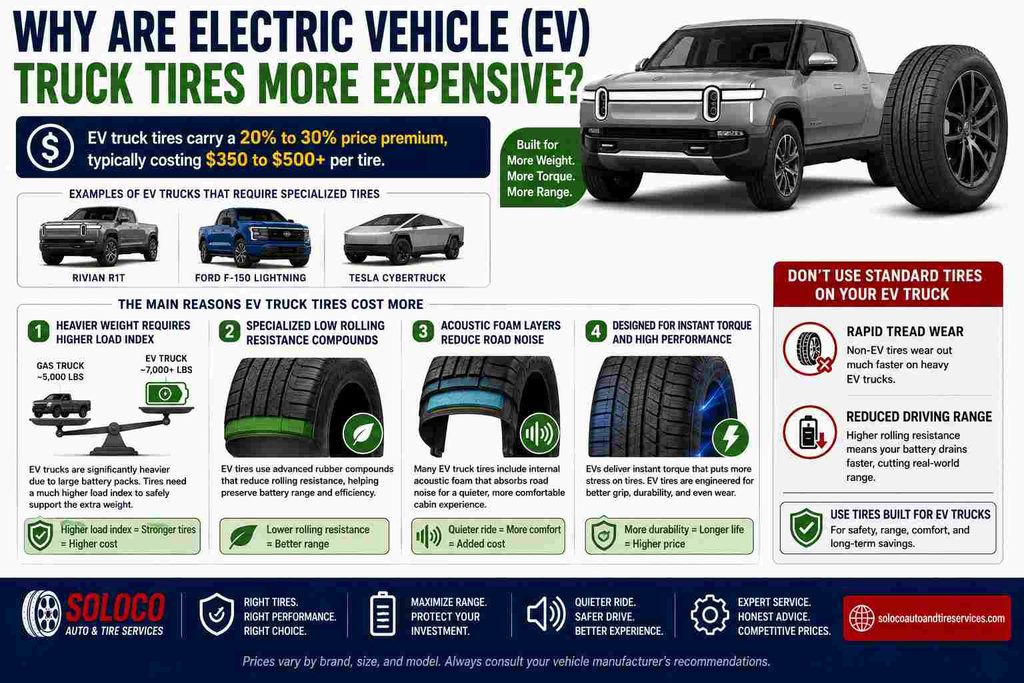
Electric vehicle truck tires, such as those built for the Rivian R1T, Ford F-150 Lightning, and Tesla Cybertruck, carry a 20% to 30% price premium, typically costing $350 to $500+ per tire. Electric trucks weigh significantly more than internal combustion engine trucks due to heavy battery packs, requiring a much higher load index to support the vehicle weight safely. Furthermore, EV tires incorporate specialized low rolling resistance compounds and internal acoustic foam layers to minimize cabin road noise. Using standard non-EV truck tires on an electric truck results in rapid tread wear and a noticeable drop in battery driving range.
Are commercial truck tire retreads safe and cost-effective?
Commercial truck tire retreads are both highly safe and extremely cost-effective for fleet operations, costing only $150 to $250 per tire. Semi-truck fleets rarely purchase 18 brand-new tires at once, instead utilizing retreaded tires where a worn tire casing receives a brand-new vulcanized tread layer. Modern commercial retreading utilizes rigorous electronic inspection methods, including shearography, to detect internal casing flaws before bonding new rubber. Fleets that utilize quality retreads for drive and trailer axles save thousands of dollars annually without compromising highway safety or payload capacity.
How much does truck tire installation and disposal cost?
Truck tire installation typically costs $20 to $50 per tire for standard mounting and computerized balancing at local service shops. Old tire disposal fees add an extra $5 to $10 per tire for environmental recycling and state handling compliance. For commercial semi-trucks stranded on highways, mobile emergency roadside installation services can add $200 to $500 in labor callout fees alone. Commercial operations often minimize these emergency expenses by utilizing dedicated fleet maintenance yards for scheduled replacements.
How many miles do truck tires typically last?
Light truck highway and all-terrain tires generally last 60,000 to 80,000 kilometers, which equals approximately 40,000 to 50,000 miles under normal driving conditions. Mud-terrain tires wear out much faster, often needing replacement around 50,000 kilometers due to softer rubber compounds and large tread voids. Commercial semi-truck tires achieve significantly higher mileage milestones through proper maintenance; brand new steer tires last about 160,000 kilometers, while drive tires can reach up to 400,000 kilometers when systematically rotated and retreaded.
Does aggressive tread lower a truck’s fuel economy?
Aggressive tread patterns significantly reduce a truck’s fuel economy, dropping fuel efficiency by 1 to 3 miles per gallon (MPG). Upgrading from smooth highway tires to heavy mud-terrain tires introduces immense rolling resistance and adds significant rotational weight to the drivetrain. The engine must work harder to overcome this increased friction, converting more fuel into heat and sound rather than forward momentum. Long-distance commuters often discover that the fuel penalty of aggressive off-road tires adds hundreds of dollars in extra fuel costs over the lifespan of the rubber.
Can you replace just two truck tires instead of four?
Replacing only two truck tires instead of all four is acceptable on two-wheel-drive vehicles, but it is dangerous and destructive on four-wheel-drive and all-wheel-drive trucks. Mismatched tire tread depths create a difference in rotational speed between the front and rear axles. This speed discrepancy forces the transfer case and center differentials to work constantly to compensate, generating extreme internal heat that can completely destroy the transmission transfer case and lead to a $3,000 mechanical repair bill. Truck owners with 4WD systems must replace all four tires simultaneously or ensure tread wear variance remains within strict manufacturer tolerances.
Why is load index critical when buying heavy-duty pickup tires?
Load index is critical because installing a tire with insufficient weight capacity on a heavy-duty pickup like a Ford F-350 or Ram 3500 creates an immediate blowout hazard. Budget-friendly $150 passenger tires may physically fit onto a truck wheel, but they lack the heavy ply construction required for hauling heavy cargo or towing large fifth-wheel trailers. Heavy-duty applications require a minimum of “Load Range E” ratings to handle elevated PSI inflation levels and high gross vehicle weight ratings. Ignoring load index ratings under heavy loads causes catastrophic sidewall failure regardless of how deep the tread depth appears.
What is the difference between M+S and 3PMSF winter ratings?
Many truck tires feature an M+S stamp standing for Mud and Snow, which only indicates a specific tread void percentage rather than true winter testing certification. In ambient temperatures below 7 degrees Celsius, standard all-season rubber compounds harden and lose critical friction against ice and packed snow. Only tires bearing the 3-Peak Mountain Snowflake symbol have passed rigorous standardized traction tests confirming genuine grip in severe winter weather conditions. Drivers operating in snowy climates must look for the 3PMSF designation to ensure safe braking and cornering performance during winter storms.
How do tire pressure and alignment affect truck tire lifespan?
Proper tire pressure and precise wheel alignment directly determine whether a set of truck tires reaches its maximum mileage potential or wears out prematurely. Under-inflation causes excessive heat buildup along the outer shoulders, destroying the tire casing, while over-inflation concentrates wear exclusively across the center tread rib. Furthermore, out-of-spec wheel alignment from hitting deep potholes or off-road rocks creates rapid feathering and cupping wear patterns. Maintaining correct PSI levels and scheduling professional wheel alignments every 10,000 kilometers prevents irregular wear and preserves expensive tread rubber.
What are the best seasonal strategies for multi-axle commercial hauling?
Multi-axle commercial hauling requires a proactive seasonal rotation strategy that matches rubber compounds to changing regional weather patterns and road temperatures. Fleets typically install fresh, high-traction steer tires in autumn to combat winter rain and ice before transitioning those casings to drive positions during summer months. Additionally, monitoring dual-tire matching on drive axles prevents load transfer imbalances where one mismatched tire bears disproportionate weight. Executing these structured commercial strategies maximizes overall casing life and reduces unexpected highway blowout incidents.
The Bottom Line
Truck tires represent a major financial investment, with costs scaling dramatically from $150 basic light truck options to over $1,000 for specialized commercial and oversized builds. Selecting the right tire requires evaluating exact vehicle class, heavy towing demands, load index requirements, and seasonal weather needs. Prioritizing correct drivetrain matching and proper maintenance prevents catastrophic mechanical failures and ensures maximum mileage safety on every journey.


