A new set of four tires typically costs between $400 and $1,800, with most drivers spending around $600 to $1,000 for standard passenger vehicles. Out-the-door pricing depends heavily on vehicle classification, tire compound technology, mandatory mounting fees, and regional sales tax.
At a Glance: Essential Tire Facts
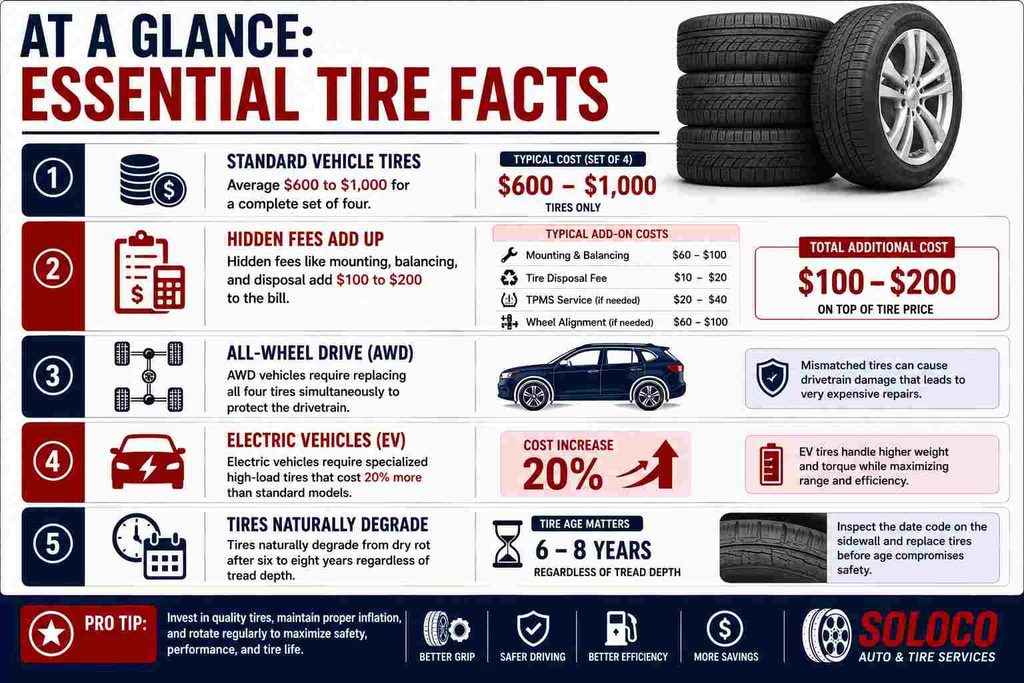
- Standard vehicle tires average $600 to $1,000 for a complete set of four.
- Hidden fees like mounting, balancing, and disposal add $100 to $200 to the bill.
- All-Wheel Drive vehicles require replacing all four tires simultaneously to protect the drivetrain.
- Electric vehicles require specialized high-load tires that cost 20 percent more than standard models.
- Tires naturally degrade from dry rot after six to eight years regardless of tread depth.
What hidden fees are added to the out-the-door price of tires?
The sticker price on a tire is never the final amount you pay at the register. Automotive service centers tack on mandatory service charges that increase your total bill by $100 to $200 per set.
Installation and balancing fees range from $15 to $45 per tire to mount the rubber onto the wheel and balance it on a machine. New valve stems cost $5 to $10 each, though vehicles with Tire Pressure Monitoring Systems require sensor service kits that can exceed $50 per wheel. State disposal fees add $3 to $10 per old tire for recycling processing. Local sales tax is calculated on top of these combined service and hardware charges.
How much do tires cost by vehicle type?
Tire pricing scales directly with the physical dimensions, load rating, and speed capability required by your specific vehicle.
Sedans and hatchbacks require smaller tire diameters, costing $70 to $150 per tire or $300 to $600 per set. SUVs and crossovers use mid-sized options priced at $120 to $250 per tire or $500 to $1,000 per set. Trucks and large SUVs demand heavy-duty load ratings, costing $175 to $350 per tire or $700 to $1,400 per set. Sports cars and luxury sedans utilize high-performance low-profile rubber ranging from $200 to $500 per tire or $800 to $2,000 per set.
How many miles do a new set of tires last?
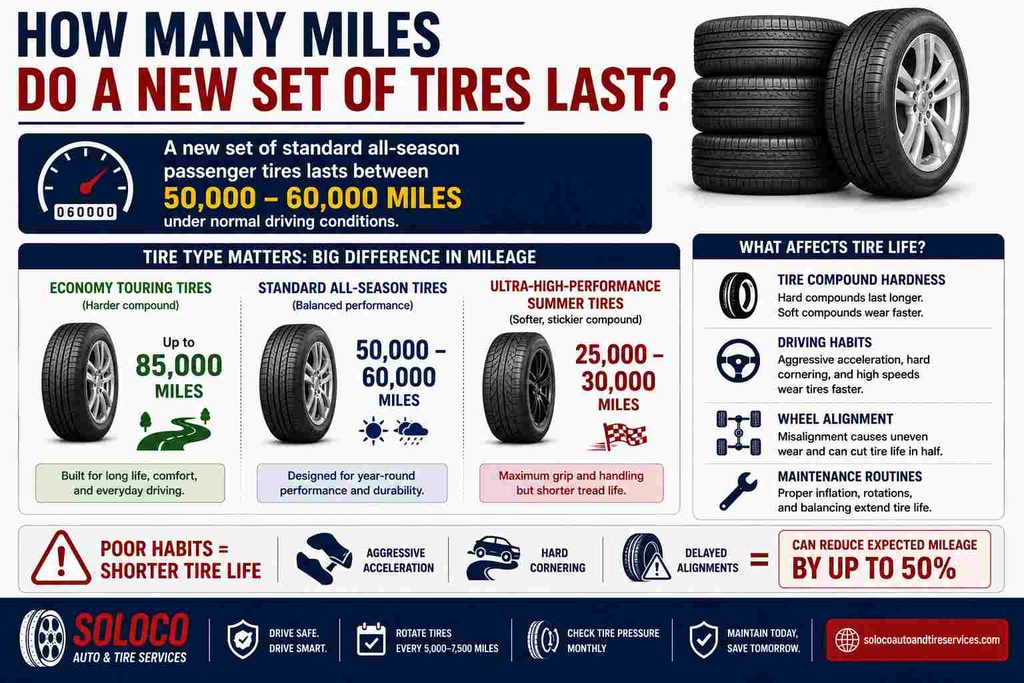
A new set of standard all-season passenger tires lasts between 50,000 and 60,000 miles under normal driving conditions.
Longevity varies drastically depending on tire compound hardness, driving habits, and maintenance routines. Economy touring tires with hard rubber compounds can stretch up to 85,000 miles, while ultra-high-performance summer tires use soft, sticky compounds that often wear out after 25,000 to 30,000 miles.
Aggressive acceleration, hard cornering, and delayed wheel alignments will reduce expected mileage by half.
How do I know when my car needs a new set of tires?
You need a new set of tires when the tread depth drops below 2/32 of an inch or when structural damage compromises the sidewall.
To check tread depth manually, insert a standard U.S. penny into the tread groove with Abraham Lincoln’s head pointing downward. If the top of Lincoln’s head is visible, your tread depth is below 2/32 of an inch and replacement is legally required in most jurisdictions. You should also replace tires immediately if you notice deep cracks, bulges from internal impact breaks, or exposed reinforcing cords.
When is the best time of year to buy new tires?
The best time of year to buy new tires is during major promotional holidays like April during Earth Day sales, July around Independence Day, or October ahead of winter weather changes.
Retailers frequently offer manufacturer rebates, mail-in cash cards, or buy-three-get-one-free promotions during these periods. Purchasing during promotional windows can save you $100 to $200 on a set of four. Avoid buying tires in a panic emergency after a blowout, as you lose all leverage to shop around or wait for promotional discounts.
Do I really need a wheel alignment with new tires?
Yes, you should purchase a wheel alignment whenever you install a new set of tires to protect your financial investment.
If your suspension geometry is out of alignment, your brand-new tires will suffer from rapid, uneven feathering or edge wear and ruin themselves within 5,000 miles. A professional alignment costs $80 to $150. Spending this extra money ensures your new tread wears evenly across the entire contact patch for the full duration of the tire’s lifespan.
Is the road hazard warranty worth buying for new tires?
A road hazard warranty is worth purchasing if you drive regularly on poorly maintained city streets, construction zones, or rural gravel roads.
Warranties typically cost $15 to $30 per tire and cover punctures, sidewall tears, and non-repairable damage from road debris. If you pick up a construction nail that punctures the sidewal, the warranty replaces the tire for free or at a prorated cost. If your daily commute consists entirely of clean, paved highways, you can safely skip the warranty and save money.
Can I just replace two tires instead of four?
Yes, you can replace just two tires instead of four if your vehicle utilizes a standard front-wheel-drive or rear-wheel-drive system.
When replacing only two tires, always install the brand-new tires on the rear axle regardless of whether your car is front-wheel-drive or rear-wheel-drive. Fresh tread on the rear tires prevents dangerous hydroplaning and sudden fishtailing on wet roads. Never mix radically different tread depths on the same drive axle.
What are the rules for replacing tires on an All-Wheel Drive vehicle?
All-Wheel Drive vehicles require all four tires to be replaced at the same time if tread wear differences exceed specific manufacturer tolerances.
AWD systems feature sensitive differential components that demand all four wheels spin at the exact same rotational speed. If you puncture one tire on an AWD car like a Subaru, the difference in diameter can overheat and destroy the central differential. If the remaining three tires have high mileage, you must buy a full set of four or pay a specialty shop to shave down a single new tire to match the exact tread depth of the old ones.
Why do electric vehicles require specialized tires?
Electric vehicles require specialized tires because EVs weigh significantly more due to heavy battery packs and deliver instant torque that accelerates tread wear.
Standard tires on an EV will burn through their tread in roughly half the time compared to a gas-powered vehicle. EV-specific tires feature reinforced sidewalls, stiffer internal construction, and specialized low-rolling-resistance rubber compounds designed to handle high weight loads. These specialized tires cost approximately 20 percent more than standard passenger vehicle tires.
How does extreme weather change tire purchasing requirements?
Extreme cold weather changes purchasing requirements by forcing drivers in heavy snow zones to buy two separate dedicated seasonal sets.
All-season tire rubber compounds harden and lose critical grip when ambient temperatures drop below 45 degrees Fahrenheit. If you live in an area with heavy winter snowfall, you must budget for a dedicated set of winter snow tires and a separate set of summer or all-season tires. This dual-set requirement effectively doubles your upfront equipment costs and introduces semi-annual seasonal swap labor fees.
What complications do staggered fitments cause for tire replacement?
Staggered fitments feature wider tires on the rear axle than the front axle, which prevents traditional tire rotation patterns.
High-performance sports cars use staggered setups to maximize rear-wheel traction during acceleration. Because the front and rear tire sizes are completely different, you cannot rotate them front-to-back to equalize wear patterns. Staggered tires wear out much faster and disqualify you from promotional buy-three-get-one-free sales that require four identical tires.
When do tires expire from age rather than wear?
Tires expire from structural chemical degradation due to age after six to eight years, even if the tread looks completely brand new.
Rubber compounds dry out, oxidize, and form microscopic cracks over time, which can lead to catastrophic tread separation at highway speeds. You can determine the exact age of any tire by locating the Department of Transportation code on the sidewall, where a four-digit stamp indicates the manufacturing week and year. Tires older than eight years must be replaced immediately regardless of remaining tread depth.
Are budget-friendly cheap tires safe or a false economy?
Budget-friendly cheap tires meet federal safety standards, but they often represent a false economy over their total operational lifecycle.
Inexpensive budget tires use harder, low-quality rubber compounds that result in longer wet-braking distances, higher road noise, and reduced fuel efficiency due to rolling resistance. While you save money upfront, budget tires often wear out in 30,000 miles, whereas mid-tier premium tires last 60,000 miles. Purchasing cheap tires means you pay for mounting, balancing, and disposal services twice as often.
How often should tires be rotated to maximize lifespan?
Tires should be rotated every 5,000 to 8,000 miles, or at every routine oil change, to ensure even wear across all four positions.
Front tires wear out faster on front-wheel-drive vehicles because they handle steering, braking, and power delivery simultaneously. Regular rotation redistributes wear patterns, extending the total life of your tire set and ensuring you achieve the maximum mileage warranty promised by the manufacturer. Neglecting rotations leads to premature, uneven tread destruction.
The Bottom Line
A new set of four tires typically costs between $400 and $1,800, with most standard passenger vehicles landing near the $800 mark once installation, mounting, and alignment fees are included. Vehicle type, seasonal climate demands, and drivetrain configurations dictate your final total. Always factor in hidden mounting costs and replacement rules for all-wheel-drive systems to make an informed, cost-effective purchase.


