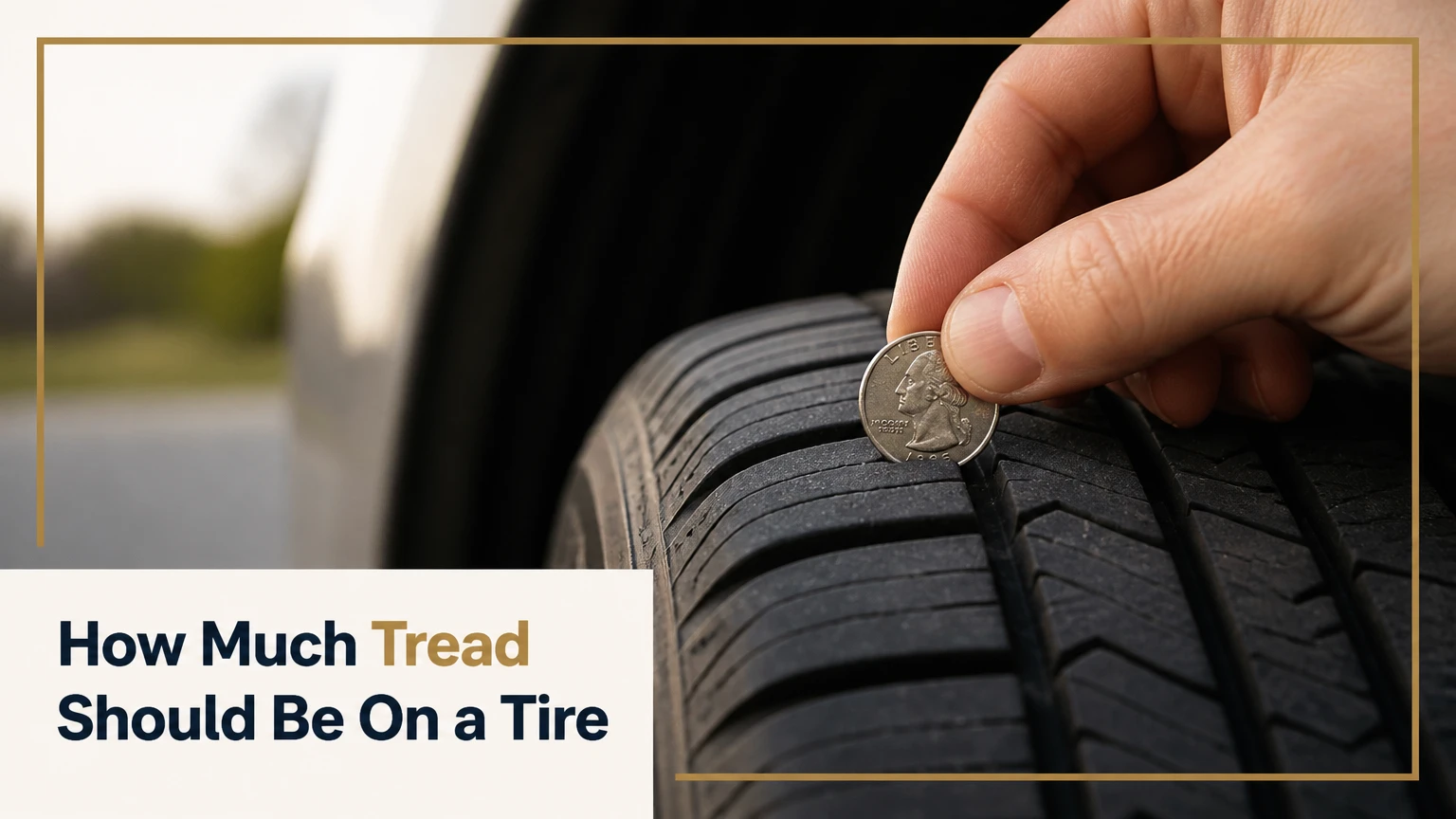
New passenger car tires typically start with $10/32$ to $12/32$ inches of tread depth, while SUVs and trucks often start with $12/32$ to $15/32$ inches. The absolute legal minimum depth in most jurisdictions is $2/32$ of an inch ($1.6\text{ mm}$), at which point tires are completely worn out, legally bald, and unsafe for driving on wet or dry public roads.
At a Glance: Key Tire Tread Facts
- New Tire Depth: Passenger tires begin at $10/32”$ to $12/32”$; trucks and SUVs start at $12/32”$ to $15/32”$.
- Legal Minimum: $2/32”$ ($1.6\text{ mm}$) is the hard legal limit across most states and countries.
- Wet Weather Warning: Traction in heavy rain begins to compromise severely once tread drops to $5/32”$.
- Snow Tire Threshold: Winter tires lose functional snow grip and must be replaced when they wear down to $4/32”$.
- The Penny Test: If the top of Lincoln’s head is visible when inserting an upside-down penny, your tread is below $2/32”$.
What is the legal minimum tire tread depth?
The absolute legal minimum tire tread depth is $2/32$ of an inch, which translates to $1.6\text{ millimeters}$. Once a tire reaches this threshold, the grooves can no longer displace water, drastically increasing the risk of hydroplaning and loss of vehicle control. Law enforcement officers and state safety inspectors use this exact measurement to issue citations or fail vehicle safety inspections.
Drivers should never wait until a tire hits the $2/32”$ legal limit to plan a replacement. Professional mechanics and tire safety experts strongly recommend scheduling tire replacements when tread reaches $3/32”$ or $4/32”$, especially if you regularly drive in wet weather, heavy downpours, or winter conditions.
What do the different tire tread depth levels mean?
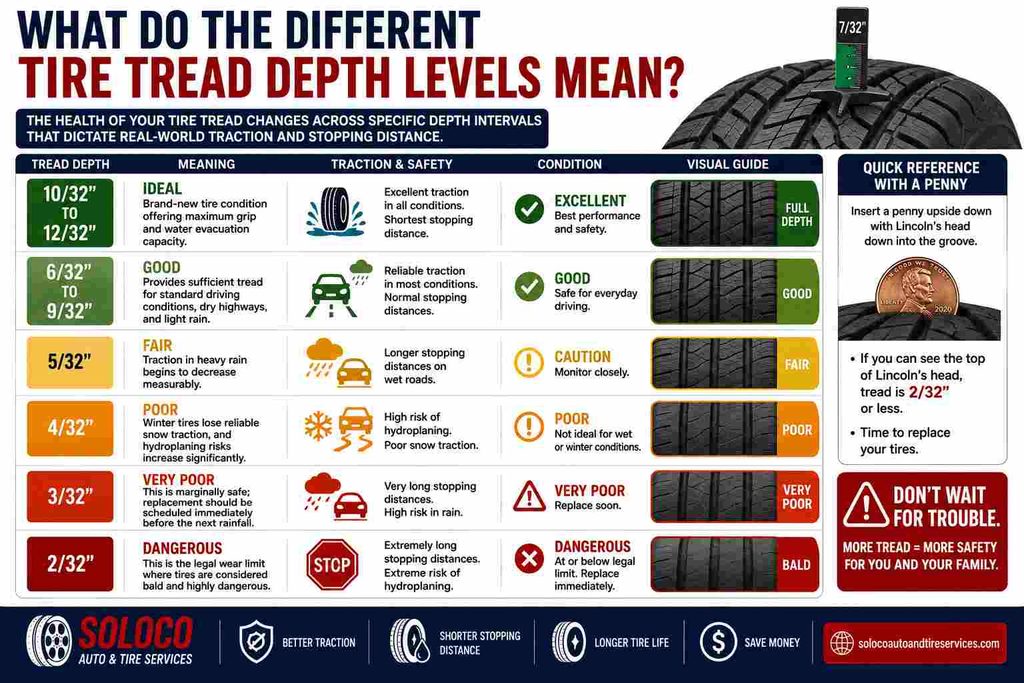
The health of your tire tread changes across specific depth intervals that dictate real-world traction and stopping distance.
- $10/32”$ to $12/32”$: This is ideal, brand-new tire condition offering maximum grip and water evacuation capacity.
- $6/32”$ to $9/32”$: This provides sufficient tread for standard driving conditions, dry highways, and light rain.
- $5/32”$: Traction in heavy rain begins to decrease measurably, requiring longer stopping distances on slick asphalt.
- $4/32”$: Winter tires lose reliable snow traction, and hydroplaning risks increase significantly during heavy storms.
- $3/32”$: This is marginally safe; replacement should be scheduled immediately before the next rainfall.
- $2/32”$: This is the legal wear limit where tires are considered bald and highly dangerous.
How do I check tire tread depth using a coin?
You can check your tire tread depth at home using a standard U.S. penny and a quarter without needing a specialized mechanical gauge.
- Perform the Penny Test ($2/32”$ limit): Hold a penny by the sides with Lincoln’s head facing upside down, and insert the top of his head into the deepest groove of the tread. If the top of Lincoln’s head is fully visible, your tread depth is less than $2/32”$ and you must replace the tires immediately.
- Perform the Quarter Test ($4/32”$ limit): Hold a quarter by the sides with Washington’s head facing upside down, and insert it into the tread groove. If the tread does not reach the top of Washington’s head, you have less than $4/32”$ of tread remaining. This indicates it is time to shop for replacements to maintain safe wet-weather performance.
How do I read tire wear indicator bars?
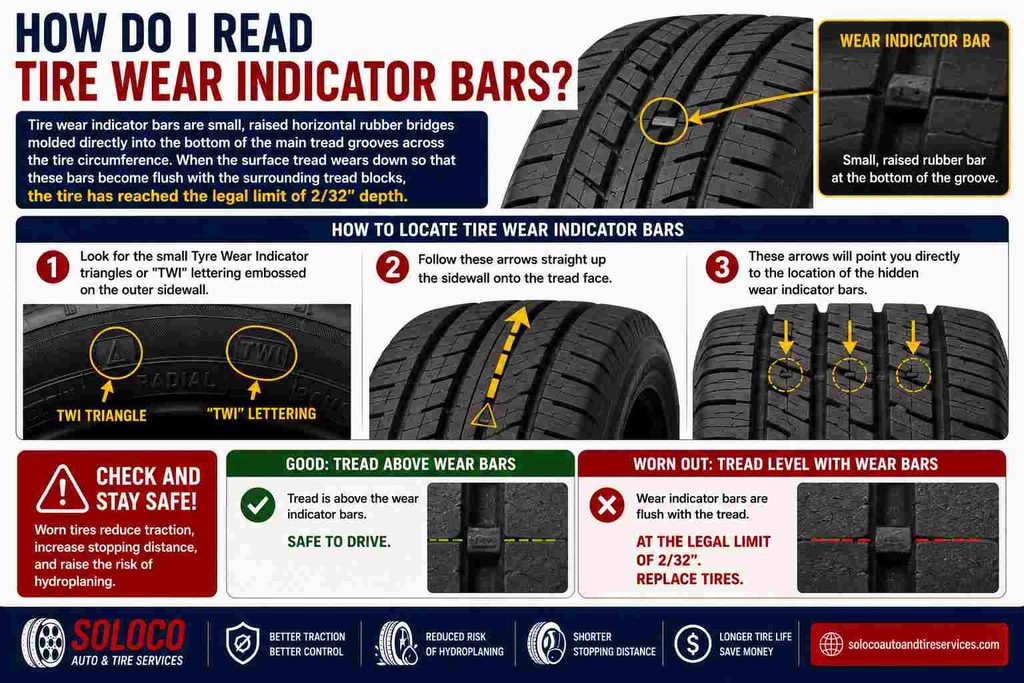
Tire wear indicator bars are small, raised horizontal rubber bridges molded directly into the bottom of the main tread grooves across the tire circumference. When the surface tread wears down so that these bars become flush with the surrounding tread blocks, the tire has reached the legal limit of $2/32”$ depth.
You can locate these indicator bars easily by finding the small Tyre Wear Indicator triangles or “TWI” lettering embossed on the outer sidewall of the tire. Following these arrows straight up the sidewall onto the tread face will point you directly to the location of the hidden wear bars. If you see these bars connecting adjacent tread ribs, the tire is legally exhausted.
Why do winter tires need more tread than standard all-season tires?
Winter and snow tires require a minimum of $4/32”$ to $5/32”$ of tread depth because their specialized rubber compounds and dense sipes rely on deep voids to pack and grip snow. The general $2/32”$ rule fails completely in winter weather because shallow grooves cannot pack snow against snow, which is the mechanical mechanism required for winter friction.
Many high-quality winter tires feature a secondary set of “winter wear indicator” bars that appear much higher than standard summer bars. When these secondary winter indicators are exposed, the tire will no longer grip effectively on packed snow or ice, even though it remains legal for summer highway driving.
How does tire age and dry rot affect safety regardless of tread depth?
Rubber compounds degrade chemically over time due to UV exposure, ambient heat, and oxidation, regardless of how much physical tread depth remains. A tire with a pristine $10/32”$ of tread can still suffer a catastrophic structural blowout on the highway if it is older than 6 to 10 years and severe dry rot has cracked the rubber.
You can determine the age of your tire by inspecting the four-digit Department of Transportation code stamped on the sidewall, where the first two digits represent the production week and the last two digits represent the manufacturing year. If your tires exceed 6 years of age, have them inspected annually by a certified technician for sidewall micro-cracking and rubber separation.
How does uneven tire wear change replacement criteria?
Uneven tire wear caused by faulty wheel alignment, worn suspension components, or incorrect inflation can ruin a tire long before the overall tread depth reaches $2/32”$. If your alignment is severely out of specification, the inner or outer shoulder of the tire might wear down to bare canvas while the center groove still measures a healthy $6/32”$.
This localized wear renders the tire unsafe because structural stability and cornering grip are compromised on the worn edge. Whenever you measure your tread depth, check multiple grooves across the entire width of the tire face rather than relying on a single spot.
Do I need to replace all four tires if only one is worn down?
Whether you must replace all four tires depends entirely on your vehicle drivetrain configuration and the remaining depth of the healthy tires.
- All-Wheel Drive (AWD) Vehicles: Yes, you must usually replace all four tires simultaneously because variations in overall tire diameter create rolling circumference discrepancies. This discrepancy forces the central differential to work continuously, causing severe internal component overheating and expensive drivetrain damage.
- Front or Rear-Wheel Drive Vehicles: You can replace just two tires if the remaining pair has sufficient safe tread depth. Always install the two new tires on the rear axle to maintain vehicle stability, prevent sudden oversteer, and avoid fishtailing during hard braking on wet surfaces.
How many miles do tire treads typically last?
Tire treads have predictable lifespan ranges that vary based on rubber compound formulation, tire category, and vehicle application.
- Standard All-Season Touring Tires: Typically last between $40,000$ and $80,000$ miles under normal commuting conditions.
- High-Performance Summer Tires: Usually last only $15,000$ to $30,000$ miles because they utilize soft, sticky rubber compounds designed to maximize dry traction.
- Longevity Factors: Final mileage depends heavily on aggressive driving habits, regular front-end alignment checks, consistent tire rotations every $5,000$ to $7,000$ miles, and maintaining correct PSI inflation pressures.
How does instant torque on electric vehicles impact tire wear rates?
Electric vehicles (EVs) accelerate tire tread wear significantly faster than internal combustion engine vehicles due to heavy battery pack weights and instant electric motor torque delivery. The sudden application of maximum torque to the contact patch creates micro-slips on the pavement surface, which strips away rubber tread compounds at an accelerated rate.
Drivers switching to an electric vehicle often notice that their tires wear out $20\%$ to $30\%$ faster than expected. To combat this rapid wear, EV owners should choose specialized tires reinforced with high-load capacity ratings and wear-resistant rubber formulations.
How does incorrect tire inflation speed up tread wear?
Incorrect tire inflation pressures distort the contact patch shape, causing accelerated tread wear on specific sections of the tire face.
- Over-inflation: When a tire is inflated above recommended PSI levels, the center of the tread bulges outward and bears the entire vehicle weight, causing the central ribs to wear out rapidly while shoulders remain untouched.
- Under-inflation: When a tire is run below proper PSI levels, the sidewalls sag and the tread center caves inward, forcing the outer shoulders to bear excessive friction and wear down prematurely while generating excessive internal heat.
Check your tire pressure monthly using a reliable digital gauge when the tires are cold to ensure even tread wear and optimal fuel efficiency.
How does proper tire rotation extend overall tread life?
Regular tire rotation extends overall tread life by redistributing the uneven mechanical forces acting on different axle positions. Front tires experience accelerated shoulder wear due to steering cornering forces, while rear tires experience smoother rolling wear on most front-wheel-drive platforms.
Mechanics recommend rotating your tires every $5,000$ to $7,000$ miles following the manufacturer’s recommended pattern, such as the forward cross or rear diagonal method. This simple maintenance practice ensures that all four tires wear down at an equal rate, maximizing the total mileage you extract from your financial investment.
What are the legal penalties and insurance consequences of driving on bald tires?
Driving on bald tires carrying less than $2/32”$ of tread exposes motorists to severe legal penalties, traffic fines, and compromised insurance liability settlements. If a police officer pulls you over and verifies that your tires are bald, you can receive a mandatory traffic citation and have your vehicle impounded until safe replacement tires are installed.
Furthermore, if you are involved in a rear-end collision or wet-weather accident while driving on bald tires, insurance investigators can attribute fault or deny injury claims due to willful vehicle negligence. Maintaining legal tread depth protects you from financial liability and criminal traffic violations.
When should off-road and all-terrain tires be replaced?
Off-road and all-terrain tires require deep, aggressive tread blocks to bite into loose dirt, mud, and rocks, and they become ineffective long before they reach the standard $2/32”$ limit. Heavy-duty truck and off-road tires lose their mud-clearing capability and traction when their tread depth drops below $6/32”$.
If you use your all-terrain tires for serious trail driving, rock crawling, or deep mud navigation, you should plan on replacing them when the tread wears down to half its original depth. Running shallow off-road tires in rugged terrain dramatically increases your risk of getting stuck or suffering a puncture.
How do high-performance summer tires differ in tread depth and lifespan?
High-performance summer tires feature shallower initial tread depths—typically starting around $8/32”$ to $9/32”$—to minimize block squirm and maximize contact patch stability during high-speed cornering. Because they utilize ultra-sticky rubber compounds designed for maximum grip on dry and warm asphalt, they degrade faster than standard touring tires, often lasting only $15,000$ to $30,000$ miles.
These tires lose hydroplaning resistance much earlier in their lifecycle, requiring drivers to exercise extreme caution when navigating heavy rain as the tread approaches $4/32”$.
The Bottom Line
Maintaining safe tire tread depth is critical for ensuring reliable braking traction, preventing hydroplaning, and avoiding catastrophic blowouts on the highway. Passenger car tires should be replaced well before they hit the absolute legal minimum of $2/32”$, with $4/32”$ serving as the practical safety threshold for wet and winter weather driving conditions. Regularly checking your tread using coin tests, monitoring tire age, and maintaining proper inflation will keep your vehicle safe on the road.


