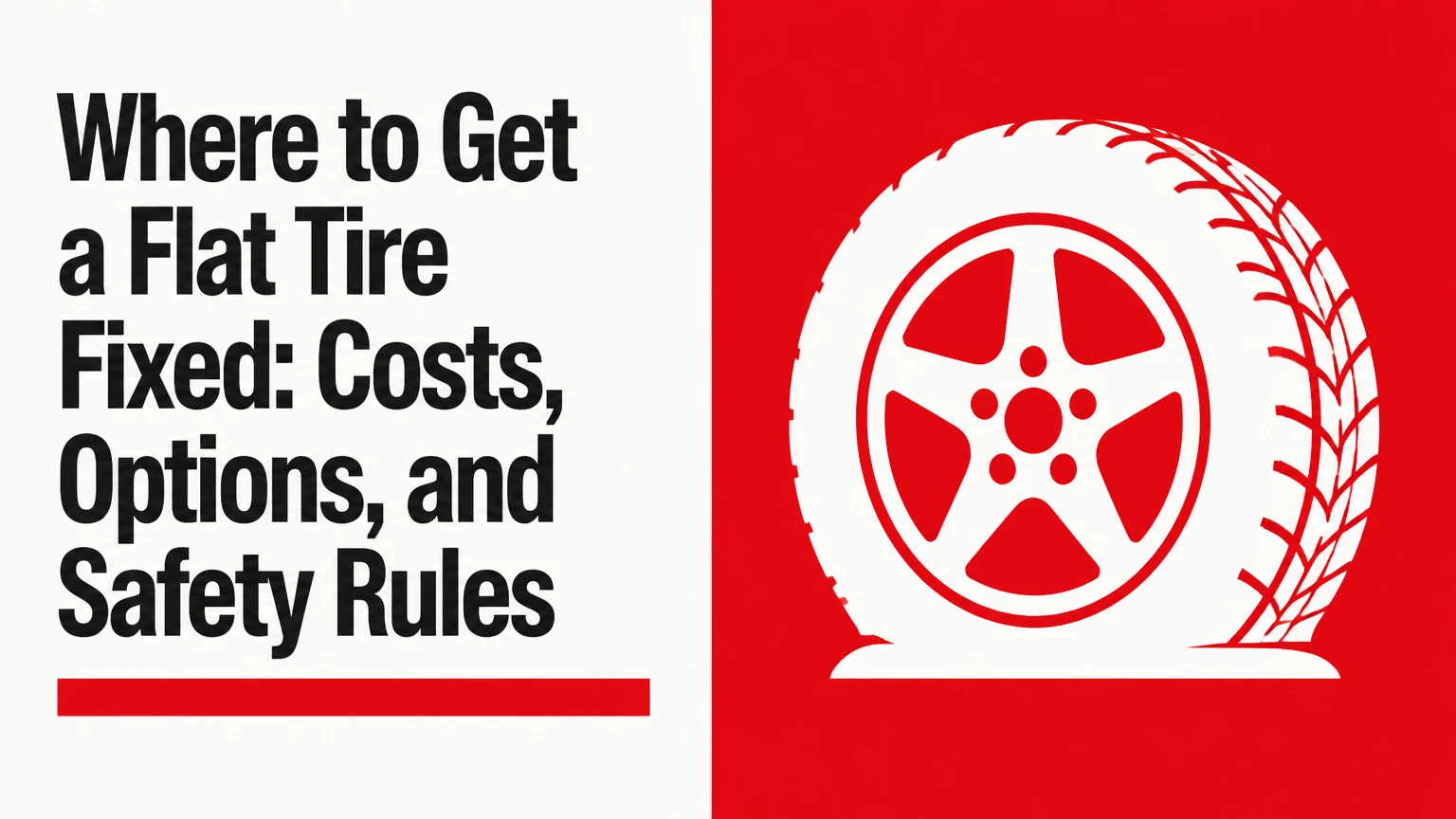
Drivers can get a flat tire fixed at national tire chains, independent local auto repair shops, car dealerships, warehouse clubs, or through mobile roadside assistance services. Total repair costs range from zero dollars to sixty dollars depending on the service provider, warranty coverage, and whether the puncture falls within industry safety guidelines.
- National tire chains like Discount Tire repair punctures for zero dollars, while others charge twenty to thirty dollars.
- Warehouse clubs such as Costco charge eleven to twenty dollars for members.
- Local auto shops charge twenty to forty dollars for standard plug-and-patch labor.
- The puncture must be located within the central tread area and measure less than a quarter-inch to be repairable.
- Driving on a completely flat tire ruins the internal sidewall liner, requiring a total replacement instead of a simple patch.
Where can I get a flat tire fixed near me?
Drivers can get a flat tire repaired at national retail tire chains, local independent mechanic shops, warehouse clubs, authorized car dealerships, or via on-demand mobile roadside assistance vans. Choosing the right provider depends on your budget, membership status, and whether you purchased your tires from that specific retailer. National chains like Discount Tire and Firestone Complete Auto Care operate thousands of locations nationwide with standardized flat repair procedures. Local garages offer faster turnarounds during peak weekend hours, while mobile services dispatch technicians directly to stranded motorists. Selecting a location near your current coordinates prevents driving on an underinflated tire for extended distances.
How much does it cost to get a flat tire repaired?
The total cost to repair a standard tire puncture ranges from zero dollars to sixty dollars for brick-and-mortar locations, while mobile roadside dispatch costs seventy-five to one hundred fifty dollars or more. Discount Tire fixes repairable punctures completely free of charge as a customer courtesy, even if the tires were purchased elsewhere. Other national chains like Pep Boys charge twenty to thirty dollars. Warehouse clubs such as Costco Tire Center and Sam’s Club Services charge eleven to twenty dollars, though they require proof of original tire purchase. Independent local mechanics bill twenty-five to thirty-five dollars based on regional labor rates. Car dealerships are the most expensive physical option, charging forty to sixty dollars for standard internal patches.
How long does a proper flat tire repair take?
A professional flat tire repair takes thirty to forty-five minutes of actual technician labor once the vehicle enters the service bay. Total wait times at busy retail tire centers frequently stretch to one or two hours on weekends if you arrive without a scheduled appointment. Walk-in queues fluctuate based on seasonal tire installation rushes, particularly during the first winter freeze or summer road trip months. Calling ahead to check current bay availability minimizes downtime.
Can I wait in the lobby or do I need to drop off the car?
Motorists can comfortably wait in the customer lobby for standard flat repairs because the service takes less than an hour. Most national chains provide Wi-Fi, seating, and complimentary coffee while technicians dismount the wheel, inspect the inner liner, apply a vulcanized patch, and rebalance the assembly. Dropping off the vehicle is only necessary if the shop experiences heavy backlog or if replacement tires must be ordered.
When is a flat tire unrepairable according to safety standards?
A tire cannot be repaired if the puncture exceeds a quarter-inch in diameter, occurs within the shoulder or sidewall area, or if the tire was driven on while completely deflated. Automotive service centers strictly adhere to safety guidelines established by the U.S. Tire Manufacturers Association. Technicians reject repairs on tires showing internal rubber shredding, bead damage, or previous patch overlaps. Attempting to patch an structurally compromised tire creates an extreme blowout hazard at highway speeds.
Why do shops refuse to patch sidewall punctures?
Shops refuse to patch sidewall punctures because the sidewall flexes constantly under the weight of the vehicle, preventing any adhesive patch from bonding permanently under continuous load and heat. Punctures are only legally and safely repairable if they occur within the flat tread area of the tire. Any nail or screw located within a quarter-inch of the shoulder compromises the structural cords inside the casing, requiring complete tire replacement.
Can run-flat tires ever be repaired safely?
Run-flat tires cannot be repaired once they have been driven on while fully or partially deflated. Major manufacturers like Bridgestone, Pirelli, and Michelin explicitly prohibit repairing run-flat tires that experienced zero-pressure operation because the internal support sidewalls degrade silently under the vehicle weight. If a run-flat tire maintained proper air pressure after a minor nail puncture and was not driven flat, select manufacturers permit a standard internal repair.
What should I do if my tire is completely flat on the ground?
If a tire is completely flat on the ground, you must install the spare tire or call a tow truck rather than driving to a repair shop. Driving even a few hundred feet on a fully deflated tire pinches the rubber between the metal rim and the pavement, reducing the inner liner to shredded black dust. This catastrophic structural failure turns a simple twenty-dollar patch job into a two-hundred-dollar tire replacement. Safety protocols require pulling completely onto the shoulder away from active traffic before attempting any roadside wheel changes.
Can I use a temporary plug kit from an auto parts store myself?
Drivers can use a temporary exterior string plug kit from an auto parts store to achieve a roadside fix, but this is strictly meant to reach a professional repair shop. Temporary exterior plugs do not seal the inner liner permanently. A legal and safe permanent repair requires a combination plug-and-patch unit installed from the inside after dismounting the tire from the wheel rim. Relying solely on exterior string plugs for long-term driving risks sudden air loss.
How do safely change a flat tire on the side of a highway?
Changing a flat tire on a highway requires parking on a flat, level surface at least three feet away from active traffic lanes. Engage the emergency parking brake, turn on hazard lights, and place reflective warning triangles fifty feet behind the vehicle. Wedge wheel chocks against the opposite tires to prevent rolling. Loosen the lug nuts slightly before elevating the vehicle with the hydraulic jack, then remove the nuts completely to swap the flat wheel for the spare.
Why do all-wheel drive vehicles require special care with flat tires?
All-wheel drive vehicles require extreme care because mismatched tire tread depths create permanent rotational speed discrepancies that destroy the center differential or transfer case. Manufacturers like Subaru and Audi specify that all four tires must maintain matching circumference within fractions of an inch. If a flat tire is unrepairable and the remaining three tires have significant wear, replacing just one new tire creates destructive mechanical drag within the drivetrain.
What is tire shaving and when is it necessary?
Tire shaving is a specialized mechanical process that grinds down the tread rubber of a brand-new replacement tire to match the worn tread depth of the other three tires on an all-wheel drive vehicle. Specialty shops utilize bench lathes to shave new tires down by several thirty-seconds of an inch. This eliminates the need to buy four brand-new tires when a single puncture ruins one tire on a vehicle with moderately worn tread.
What causes slow leaks that are not nail punctures?
Slow leaks that are not nail punctures are typically caused by corroded valve stems, failing Tire Pressure Monitoring System sensors, or damaged wheel rims. Road salt, moisture, and age cause aluminum valve stems to corrode and leak air around the core. Additionally, impacts against potholes can bend the steel or alloy wheel lip, creating microscopic gaps where air escapes between the tire bead and the rim edge. Mechanics submerge the wheel in a water tank to isolate these elusive bead leaks.
How much does a replacement TPMS sensor cost?
Replacement Tire Pressure Monitoring System sensors cost between fifty and one hundred fifty dollars per wheel including parts and programming labor. When a sensor battery dies or the metal valve stem snaps due to corrosion, standard tire patch kits fail to resolve the air loss. Technicians must replace the entire sensor unit and use an OBD-II scan tool to relearn the sensor IDs to the vehicle computer.
How do speed ratings affect tire repair eligibility?
Speed ratings significantly influence whether a tire shop will perform a puncture repair. High-performance tires rated V, W, or Y are engineered for extreme velocities, and many manufacturers and retail chains have strict policies against repairing tires with high-speed ratings due to potential high-speed heat buildup. If a Z-rated or Y-rated sports car tire suffers a puncture, shops frequently recommend outright replacement over patching to maintain high-speed safety tolerances.
What is a road hazard warranty and do I have it?
A road hazard warranty is an optional protection plan purchased alongside new tires that covers the full cost of flat repairs or provides prorated replacement if a tire suffers unrepairable damage from nails, potholes, or glass. These warranties typically cost fifteen to thirty dollars per tire at the point of sale. Drivers can determine if they have active coverage by checking their original purchase invoice or contacting the retailer where the tires were originally installed.
The Bottom Line
Getting a flat tire fixed quickly and safely requires understanding cost variations, repair restrictions, and vehicle drivetrain limitations. National chains and local shops offer economical internal repairs ranging from zero to forty dollars provided the puncture remains within the central tread area and measures under a quarter-inch. Never drive on a completely deflated tire or ignore all-wheel drive tread depth limits, as these actions turn minor punctures into expensive mechanical failures.