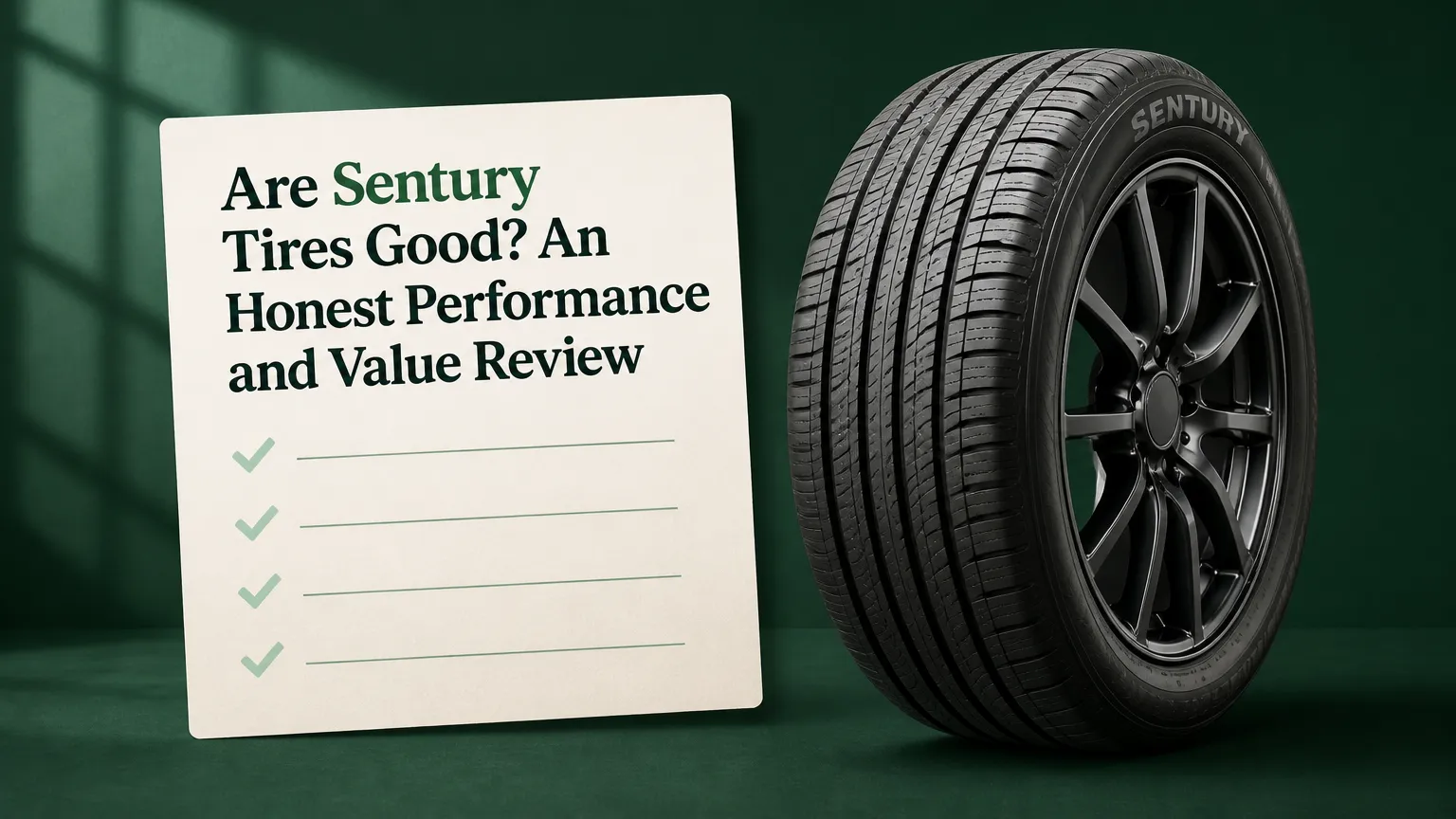
Sentury tires are highly competent budget-tier tires that offer exceptional value for daily commuting, but they fall short of premium performance standards in harsh weather conditions. Manufactured in automated facilities in Thailand and China, they serve as an entry-level house brand primarily distributed through Discount Tire.
At a Glance: Sentury Tires Facts
- Sentury tires cost between $45 and $85 per tire, pricing them at roughly one-third of Tier 1 alternatives like Michelin.
- They feature a modest 40,000-mile limited treadwear warranty and a UTQG rating of 500 A A or 500 A B.
- Automated manufacturing processes yield a 99.67% immediate quality passing rate, making physical structural defects exceptionally rare.
- Sentury tires excel in dry, warm climates for standard sedans and crossovers driven under 10,000 miles annually.
- They harden in sub-freezing temperatures and exhibit extended braking distances in heavy wet conditions.
Who Actually Manufactures Sentury Tires?
Sentury tires are manufactured by Qingdao Sentury Tire Co., Ltd., a large global tire producer headquartered in China. This corporation operates massive production facilities internationally and supplies consumer passenger car tires, light truck tires, and commercial aviation tires for aircraft like the Boeing 737 series.
Understanding the corporate background helps clarify quality expectations. Qingdao Sentury Tire Co. is not a fly-by-night operation producing unverified rubber. They utilize advanced manufacturing infrastructure to supply global markets. Their distribution model relies heavily on serving as an exclusive house brand for major retailers, which keeps marketing overhead low and retail pricing accessible to budget-conscious drivers.
What Other Sub-Brands Does Sentury Own?
Qingdao Sentury Tire Co. produces several recognizable budget and mid-tier sub-brands alongside its flagship Sentury line. These sister brands often share similar rubber compound philosophies, tread patterns, and manufacturing plants while targeting different retail channels.
Consumers evaluating budget options frequently encounter Landsail, Delinte, GroundSpeed, and Pantera tires. Landsail and Delinte are particularly common across independent tire shops and online marketplaces. While branding and tread aesthetics vary across these product lines, they share the core characteristics of Sentury products: aggressive initial pricing, computerized tread designs for low initial noise, and strong performance in dry environments paired with compromises in severe winter weather.
Where Are Sentury Tires Built?
Sentury tires are built in highly automated production facilities located in Thailand and Qingdao, China. These plants utilize advanced robotics and computerized curing presses rather than traditional labor-intensive assembly lines.
The geographic placement of these factories allows the company to leverage lower regional operational costs while maintaining strict global export compliance. These plants export millions of units annually to North America, Europe, and Asia. The reliance on advanced automation ensures that tires leaving the manufacturing floor adhere strictly to computer-generated dimensional specifications, reducing batch-to-batch inconsistencies common in older manufacturing environments.
How Do Automated Smart Factories Affect Structural Quality?
Sentury production lines utilize VMI Maxx technology and fully automated machinery, resulting in a 99.67% immediate quality passing rate. This high passing rate means that physical structural defects like sidewall bubbling, belt separation, and out-of-round shaping are remarkably rare for a budget tire category.
Traditional budget tires often suffered from structural anomalies due to manual handling errors during assembly. Sentury combats this issue by removing human error from critical carcass-building phases. The internal steel belts and polyester casing layers are applied with precise robotic tension. Consequently, drivers rarely experience structural failures during normal use, placing Sentury’s structural reliability well above legacy budget-tier expectations.
How Much Do Sentury Tires Cost?
Sentury tires generally cost between $45 and $85 per tire depending on the specific rim size and aspect ratio. This pricing structure makes them roughly one-third of the price of premium Tier 1 brands like Michelin, Goodyear, or Bridgestone.
For a standard set of four passenger car tires, a driver can expect a total retail cost of $180 to $340 before installation, balancing, and local disposal fees. This low financial barrier makes them an attractive option for motorists driving older vehicles, students, or commuters trying to minimize vehicle maintenance overhead without resorting to unsafe, second-hand used tires.
What Are the Treadwear Warranties and UTQG Ratings?
Sentury tires come with a modest 40,000-mile limited treadwear warranty and feature a Uniform Tire Quality Grading rating of 500 A A or 500 A B. The number 500 in the UTQG rating indicates a theoretical tread life capable of reaching 40,000 to 50,000 miles under ideal standard testing conditions.
The traction grade of A and temperature grades of A or B demonstrate that the rubber compound handles baseline friction and heat dissipation effectively during normal operation. However, real-world mileage often tracks toward the lower end of the theoretical range, particularly if vehicle alignment is neglected or tire rotation intervals are missed. Buyers should view the 40,000-mile warranty as an accurate reflection of expected longevity rather than a conservative estimate.
Are Sentury Tires Safe for Daily Commuting and Highway Driving?
Sentury tires are entirely safe for daily commuting and highway driving under normal weather and road conditions. Their structural integrity, ensured by automated factory assembly, meets all Department of Transportation safety standards for legal road use in North America.
For the average motorist driving a standard sedan, hatchback, or crossover on paved urban roads and interstate highways, Sentury tires provide predictable handling and stable straight-line tracking. They handle dry highway speeds safely, provided the vehicle is properly maintained, tire pressures are checked monthly, and alignments are kept within factory specifications.
How Do Sentury Tires Handle Dry Conditions?
Sentury tires excel in dry, warm climates like Arizona, Texas, or Southern California for drivers operating standard vehicles under 10,000 miles a year. In these environments, dry grip performance closely matches more expensive mid-tier alternatives.
The tread rubber compound remains pliable under warm asphalt temperatures, providing reliable cornering grip and predictable stopping distances. Commuters navigating dry suburban streets will notice little practical difference between Sentury tires and tires costing twice as much. The dry commuter exception represents the strongest use case for this budget brand.
How Do Sentury Tires Perform in Heavy Rain and Standing Water?
Sentury tires feature deep circumferential grooves designed to channel water away from the contact patch, but their wet braking grip remains sub-par compared to premium alternatives. In independent testing such as the Tyre Reviews Summer Braking Super Test, models like the Qirin 990 rank lower, placing 42nd out of 52 tires due to extended stopping distances in wet conditions.
In heavy tropical downpours, such as afternoon storms in Florida, the risk of hydroplaning at highway speeds increases compared to specialized wet-weather tires like the Continental PureContact. Drivers must maintain greater following distances and reduce speeds during severe downpours to compensate for the longer stopping distances inherent in budget rubber compounds.
Do Sentury Tires Work in Snow and Freezing Winter Weather?
Sentury tires do not perform well in severe winter weather and freezing temperatures despite carrying All-Season or Mud and Snow designations. When ambient temperatures drop below freezing, the budget rubber compounds harden significantly and lose their elasticity.
Furthermore, these tires lack the dense micro-siping and advanced silica chemistry required to bite into packed snow and ice. Drivers encountering regular winter snowfall risk sliding out or losing directional control. Motorists residing in northern climates subject to heavy winter storms should invest in dedicated winter tires rather than relying on Sentury all-season models through January and February.
Why Do Sentury Tires Struggle on High-Horsepower or Heavy Vehicles?
Sentury tires struggle on heavy vehicles, full-size trucks, and high-horsepower sports cars because their soft sidewall construction flexes aggressively under heavy loads and high torque. When subjected to extreme cornering forces or aggressive acceleration, the tire carcass deforms beyond optimal geometry.
This structural flexing leads to accelerated shoulder wear and decreased responsiveness. Enthusiast track use or aggressive driving can cause the tread blocks to chunk and deteriorate rapidly in as little as 7 to 10 laps. Drivers of heavy electric vehicles or performance sedans should select higher-tier grand touring or maximum performance tires engineered to handle heavier curb weights and high torque output.
How Long Do Sentury Tires Actually Last in Real-World Driving?
Sentury tires typically deliver between 35,000 and 45,000 miles of usable tread life in real-world driving conditions. While the UTQG rating suggests a potential for 50,000 miles, environmental exposure and road grit gradually wear down the budget rubber compound.
Achieving the upper limit of their lifespan requires diligent maintenance, including tire rotations every 5,000 to 7,000 miles and maintaining correct inflation pressures. Drivers with aggressive driving styles or rough unpaved driveways will likely see tread life drop closer to the 30,000-mile mark.
Do Sentury Tires Get Noisy as They Age?
Sentury tires start out remarkably quiet due to computer-optimized pitch sequencing, but they tend to grow louder and exhibit a firmer ride as they age. After approximately 2 years or 20,000 miles of exposure to UV radiation and thermal cycling, the budget rubber compound hardens.
This hardening alters the acoustic resonance of the tread blocks rolling against the asphalt, introducing a noticeable hum at highway speeds. While not deafening, this increase in road noise is a common characteristic of budget-tier rubber compounds as they lose their initial factory oils and pliability.
Can I Easily Get a Replacement If a Tire Gets Damaged?
Replacement availability for Sentury tires depends entirely on your purchasing channel because they serve as an exclusive house brand for Discount Tire and select affiliates. Walking into an independent, non-affiliated local tire shop will likely require waiting days for a special order.
To mitigate this inconvenience, buyers should purchase optional road hazard certificates or replacement protection plans directly through their distributor at the time of installation. This ensures immediate over-the-counter replacement or repair coverage if a puncture or road hazard renders a tire unusable.
When Should You Avoid Buying Sentury Tires?
You should avoid buying Sentury tires if you live in a region with severe winters, drive a high-performance vehicle exceeding 300 horsepower, operate a heavy electric vehicle or full-size truck, or commute extensively in heavy tropical downpours.
Under these specific circumstances, the performance compromises of budget rubber compounds outweigh the upfront financial savings. For everyday drivers in dry or moderate climates operating standard commuter sedans, Sentury tires remain a sensible and economical choice.