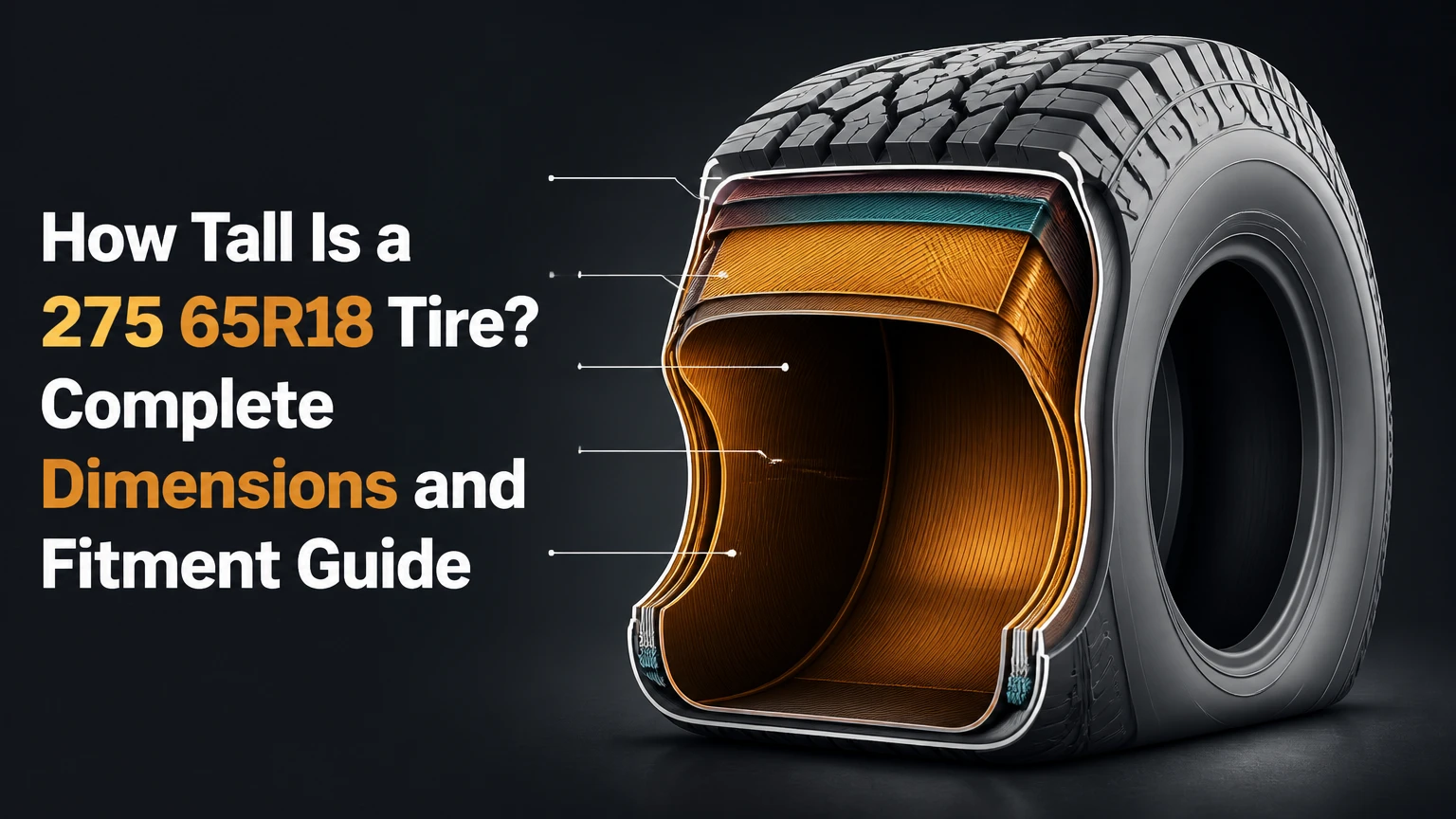
A 275/65R18 tire is precisely 32.07 inches tall, 10.83 inches wide, and engineered to fit an 18-inch wheel rim. This metric size translates to a nominal 32-inch diameter tire, making it a standard factory option for many modern full-size pickup trucks and full-size SUVs.
At a Glance: 275/65R18 Tire Facts
- Nominal Height: 32.1 inches (mathematically 32.07 inches or 814.5 mm).
- Section Width: 10.83 inches (275 millimeters).
- Sidewall Height: 7.04 inches (178.75 millimeters per side).
- Wheel Diameter: 18 inches.
- Standard Fitment: Factory stock on Ford F-150, Ram 1500, and Toyota Tundra.
- Flotation Equivalent: Closely matches the traditional $32 \times 11.00 \text{R}18$ sizing format.
How Is the Total Diameter of a 275/65R18 Tire Calculated?
The total diameter of a 275/65R18 tire is calculated by combining the wheel rim diameter with twice the height of the tire sidewall. Calculating this metric size requires a four-step mathematical formula using millimeters and inches.
- Section Width: The first number in the sequence ($275 \text{ mm}$) defines the maximum linear distance from the outer sidewall to the inner sidewall.
- Width Conversion: Divide the section width in millimeters by the conversion factor of $25.4 \text{ mm per inch}$ to determine width in inches ($275 \div 25.4 = 10.83 \text{ inches}$).
- Sidewall Calculation: Multiply the section width by the aspect ratio percentage ($65\%$) to find the single sidewall height ($275 \times 0.65 = 178.75 \text{ mm}$, which equals $7.04 \text{ inches}$).
- Total Diameter Summation: Multiply the single sidewall height by two (accounting for top and bottom sidewalls) and add the wheel rim diameter ($18 \text{ in} + [2 \times 7.04 \text{ in}] = 32.07 \text{ inches}$).
Real-world manufacturing tolerances, rubber compound curing, and internal carcass construction mean physical tires deviate slightly from this pure mathematical blueprint.
What Is the Standard Flotation Size Equivalent to a 275/65R18?
A 275/65R18 tire is the direct metric equivalent of a traditional $32 \times 11.00 \text{R}18$ flotation size. Truck owners switching between metric and imperial naming conventions frequently use this size interchangeably when looking for a robust, standard-diameter upgrade.
Drivers seeking a slightly taller profile for an aggressive off-road stance often step up to a $33 \times 12.50 \text{R}18$ or a metric 275/70R18 tire. Understanding these sizing equivalents helps prevent clearance issues when transitioning from legacy imperial tire codes to modern metric designations on four-wheel-drive platforms.
Why Do Different Brands of 275/65R18 Tires Measure Differently in Real Life?
Real-world physical dimensions vary by up to half an inch across different brands and tread patterns due to variations in mold design, carcass tension, and aggressive shoulder lug styling. A tire’s advertised specification serves as a generalized category baseline rather than a strict engineering constant.
Mud-terrain (M/T) tires feature deep, aggressive outer shoulder lugs and reinforced sidewall treads that push a true 275/65R18 height closer to 32.3 or 32.4 inches. Highway all-season (H/T) tires utilize smoother, rounded shoulders and shallower tread depths, regularly measuring closer to 31.9 inches when inflated on the exact same rim width.
Will a 275/65R18 Tire Fit a Stock Truck Without a Leveling Kit?
A 275/65R18 tire fits most modern full-size trucks at stock suspension height without any rubbing or modification. Automotive manufacturers utilize this exact dimension as original equipment on popular half-ton platforms like the Ford F-150, Ram 1500, and Toyota Tundra.
Installing this tire size on mid-size trucks like the Toyota Tacoma, Chevrolet Colorado, or Ford Ranger results in severe clearance issues and rubbing against the inner fender liner or body mount crash bars. Mid-size truck owners must install a minimum 2- to 3-inch suspension lift or aftermarket leveling kit to clear a true 32-inch tire safely.
How Does Wheel Offset and Rim Width Change the Physical Dimensions of a 275/65R18 Tire?
Rim width and wheel offset alter the physical contact patch and effective height of a 275/65R18 tire by modifying how the inner carcass stretches across the wheel barrel. Approved rim widths for a 275mm section width span from $7.5 \text{ inches}$ to $9.5 \text{ inches}$ wide.
Mounting a 275/65R18 tire on a narrow 7.5-inch rim pinches the bead inward, forcing the center tread to balloon outward and increasing the static rolling height slightly. Installing that same tire on a wide 9.5-inch rim stretches the tread flat across the pavement, decreasing overall vertical height by a fraction of an inch while widening the operational footprint.
How Does a 275/65R18 Tire Handle Towing and Hauling Compared to Low-Profile Options?
A 275/65R18 tire provides a forgiving 7.04-inch sidewall that absorbs road impacts effectively, but it introduces minor sidewall flex under heavy tongue weights or lateral trailer sway. This characteristic makes passenger-rated versions less ideal for heavy commercial hauling compared to stiff, low-profile 20-inch configurations.
Selecting an E-load capacity (10-ply) rating rather than a standard load (SL) passenger rating eliminates excess sidewall squirm. The internal steel-belted ply construction of an E-load tire maintains structural rigidity under heavy loads, preserving steering stability and cornering predictability when towing utility trailers or heavy campers.
How Much Does Switching to a 275/65R18 Tire Throw Off Your Speedometer and Odometer?
Switching to a 275/65R18 tire alters your vehicle drivetrain rotation calculations, causing your speedometer to read approximately 5% slower than your true GPS ground speed if your truck originally rolled on smaller 30.5-inch factory tires (such as a 265/60R18). When your speedometer indicates you are traveling $60 \text{ mph}$, your actual vehicle velocity is roughly $63 \text{ mph}$.
Uncorrected speedometer error causes your vehicle computer to log fewer total miles on the odometer than you actually drive, skewing fuel economy tracking. Modern truck owners can reprogram their powertrain control module (PCM) using a digital programmer or OBD2 calibration tool to match the exact revs-per-mile of the new tire size.
What Are the Exact Revolutions Per Mile and Rolling Circumference for a 275/65R18 Tire?
A theoretical 275/65R18 tire features a rolling circumference of approximately $100.7 \text{ inches}$ ($8.39 \text{ feet}$), which equates to roughly $629 \text{ revolutions per mile}$ under no-load conditions.
Vehicle weight, inflation pressure, and tread wear reduce this dynamic rolling radius by up to 2%, increasing actual revolutions to roughly $635 \text{ to } 640 \text{ revs per mile}$ on the highway. Inputting this precise revolution-per-mile metric into a speedometer calibration tool ensures precise transmission shift points and accurate digital instrument cluster readouts.
What Is the Difference Between a 275/65R18 and a 275/70R18 Tire?
A 275/70R18 tire stands taller than a 275/65R18 tire, offering an extra inch of overall diameter and a correspondingly higher sidewall profile. Both sizes share an identical 275 mm ($10.83 \text{ in}$) section width and mount cleanly onto identical 18-inch wheel rims.
| Tire Specification | 275/65R18 | 275/70R18 |
| Section Width | $10.83 \text{ in}$ ($275 \text{ mm}$) | $10.83 \text{ in}$ ($275 \text{ mm}$) |
| Aspect Ratio | $65\%$ | $70\%$ |
| Sidewall Height | $7.04 \text{ in}$ ($178.75 \text{ mm}$) | $7.58 \text{ in}$ ($192.5 \text{ mm}$) |
| Total Diameter | $32.07 \text{ in}$ | $33.16 \text{ in}$ |
| Stock Fitment | Universal half-ton standard | Requires leveling kit on most trucks |
How Does Upgrading to a 275/65R18 Tire Impact Your Vehicle Fuel Economy and Gear Ratio?
Upgrading to a heavier 275/65R18 all-terrain or mud-terrain tire decreases fuel economy by 1 to 2 miles per gallon due to increased rotational mass, higher rolling resistance, and a taller effective final gear ratio. The additional unsprung weight forces the engine to expend more energy overcoming inertia from a dead stop.
The taller overall diameter slightly drops engine RPM at highway cruising speeds, which can marginally benefit highway mileage if the engine maintains peak torque in its power band. However, heavy off-road rubber compounds increase aerodynamic drag and friction, offsetting any mechanical cruising advantages.
What Load Index and Ply Rating Should You Choose for a 275/65R18 Tire?
Choose a Standard Load (SL) or XL-rated 275/65R18 tire if your vehicle is a daily driver used primarily for commuting and light cargo transport, as this preserves a plush ride quality. Select an E-load rated (10-ply) tire if you regularly tow heavy trailers, haul construction materials, or navigate sharp rock terrain.
E-load tires require higher inflation pressures (often $65 \text{ to } 80 \text{ psi}$) to achieve their maximum weight capacity of over $3,400 \text{ lbs}$ per tire. Running E-load tires at lower pressures on a lightweight half-ton truck creates a stiff, rigid ride, while failing to inflate them properly under heavy loads causes dangerous heat buildup.
How Does the Contact Patch of a 275/65R18 Tire Perform in Heavy Rain and Snow?
The balanced 10.83-inch width of a 275/65R18 tire provides enough footprint to distribute vehicle weight effectively, offering strong traction in dry conditions while resisting hydroplaning in deep standing water. Wide tires tend to float over water, but the balanced width of this metric size cuts through moderate puddles reliably.
In winter snow conditions, a narrower tire cuts down to the packed surface better, but the 275mm width provides a wide enough platform to pack snow within tread sipes for snow-on-snow traction. Choosing a 275/65R18 tire bearing the Three-Peak Mountain Snowflake (3PMSF) symbol guarantees certified winter performance.
Will a 275/65R18 Tire Fit in a Factory Spare Tire Under-Bed Carrier?
A true 32.1-inch 275/65R18 tire fits into most full-size truck under-bed spare tire carriers, though clearance tolerances against factory trailer hitches and exhaust pipes remain tight. Manufacturers design rear-frame crossmembers to accommodate factory-equipped 32-inch sizes seamlessly.
Truck owners who modify their exhaust systems with aftermarket tailpipes or oversized differential covers sometimes find that a fully inflated 275/65R18 spare binds against the metal components. Verify physical clearance around the winch basket before mounting an aggressive, deep-lug M/T tire in the stock spare location.
What Causes Uneven Tread Wear on a 275/65R18 Tire, and How Do You Prevent It?
Improper inflation pressures, worn suspension components, and neglected tire rotation intervals are the primary causes of irregular cupping, feathering, and premature shoulder wear on 275/65R18 tires. Because light trucks experience variable weight distribution between the front and rear axles, tires develop distinct wear patterns rapidly.
Rotate your 275/65R18 tires every $5,000 \text{ to } 7,500 \text{ miles}$ utilizing a rearward cross or X-pattern rotation scheme. Maintaining precise front-end alignment specifications and verifying cold inflation pressure monthly prevents irregular tread wear and maximizes total tire lifespan.
The Bottom Line
A 275/65R18 tire is mathematically and physically a 32-inch tire (specifically 32.07 inches tall and 10.83 inches wide), making it a dependable factory or upgrade choice for full-size trucks. Real-world dimensions shift based on tread compound, rim width, and vehicle weight, requiring careful attention to load ratings and clearance margins. Selecting the correct load index and maintaining proper inflation pressure ensures optimal safety, handling, and longevity for your vehicle.


