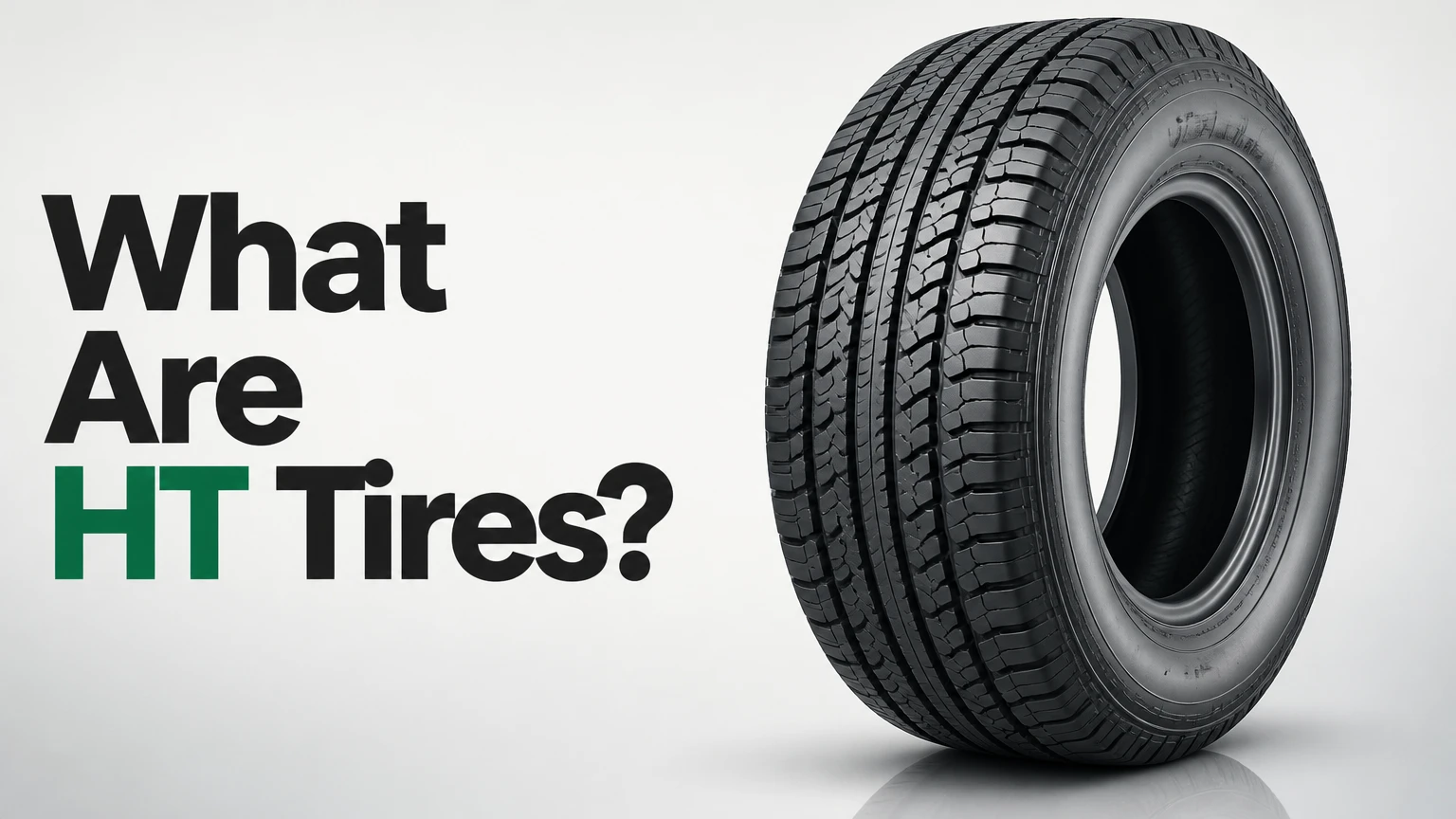
HT (Highway-Terrain) tires are specialized light truck and SUV tires engineered for 80% to 90% on-road driving and 10% to 20% light off-road use. Highway-Terrain tires bridge the gap between standard passenger car tires and aggressive All-Terrain tires, prioritizing ride comfort, tread longevity, and fuel economy on paved surfaces.
At a Glance
- Highway-Terrain tires are optimized for 80% to 90% paved road use and 10% to 20% light utility driving.
- Tread depths typically measure between 9/32 and 12/32 of an inch, outlasting standard passenger tires while running quieter than All-Terrain options.
- Manufacturer mileage warranties generally range from 50,000 to 70,000 miles under normal highway maintenance schedules.
- Fuel economy improves by 1 to 3 MPG when switching from aggressive All-Terrain tires to Highway-Terrain alternatives due to lower rolling resistance.
- Standard Highway-Terrain tires feature high siping density to maximize wet tarmac grip, but they struggle in deep winter snow and muddy job sites.
How Do HT Tires Differ from Touring and All-Terrain Tires?
Highway-Terrain tires occupy the exact middle ground between soft passenger touring tires and rugged All-Terrain tires in construction, rubber compounding, and tread design. Touring passenger tires prioritize maximum plushness and low rolling resistance for sedans, while All-Terrain tires use deep, void-heavy tread blocks to bite into dirt and rocks. Highway-Terrain tires take the casing strength and load capacity required for heavier trucks and SUVs and apply a closed, quiet tread pattern optimized for asphalt longevity.
Touring tires usually feature shallow tread depths of 7/32 to 8/32 of an inch, whereas All-Terrain tires range from 12/32 to 16/32 of an inch. Highway-Terrain tires sit precisely in the middle at 9/32 to 12/32 of an inch. This balanced depth provides enough rubber volume for a 60,000-mile lifespan without generating the high-frequency hum characteristic of chunky off-road treads at highway speeds.
What Are the Standard Specifications of Highway-Terrain Tires?
Highway-Terrain tires possess measurable structural specifications that dictate their performance envelope on asphalt and light dirt roads. Tread depth ranges from 9/32 to 12/32 of an inch, providing a substantial wear layer for high-mileage highway commuting.
Speed ratings for these tires generally fall into three categories: S-rated up to 112 mph, T-rated up to 118 mph, and H-rated up to 130 mph. Load ranges vary drastically by application. Standard Load variants cater to light crossovers, while heavy-duty Load Range E options feature 10-ply ratings capable of supporting up to 3,750 pounds per tire at an inflation pressure of 80 PSI.
How Does Siping Density Affect Wet Road Performance on HT Tires?
Highway-Terrain tires contain 20% to 30% more sipes than All-Terrain tires to maximize wet tarmac grip and prevent hydroplaning. Sipes are the microscopic slits cut into individual rubber tread blocks that flex open when contacting the road surface.
These tiny channels act as reservoirs that squeegee microscopic films of water away from the contact patch, evacuating fluid before the rubber loses adhesion. Because Highway-Terrain tires maintain continuous, unbroken circumferential ribs rather than isolated aggressive lugs, water flows efficiently through wide straight grooves. This design allows vehicles traveling at highway speeds in heavy rain to maintain directional stability where blocky off-road tires might float.
Do HT tires improve gas mileage?
Switching to Highway-Terrain tires improves vehicle fuel economy by 1 to 3 MPG compared to running aggressive All-Terrain tires. Highway-Terrain tires feature lower rolling resistance because their closed, continuous tread patterns eliminate the high void ratios found on off-road alternatives.
When a tire rolls on asphalt, open tread blocks flex, deform, and generate internal friction that wastes engine energy. Highway-Terrain tires utilize stiffer, tightly packed shoulder blocks and optimized rubber compounds that maintain shape under vehicle weight. This structural rigidity reduces energy loss, translating directly into better fuel efficiency on long highway trips.
Should I buy HT or AT tires?
Choose Highway-Terrain tires if you spend 90% of your driving time on paved roads, prioritize a quiet cabin, and want to maximize your fuel economy. Choose All-Terrain tires if you frequently visit active construction sites, drive on sharp gravel roads, or require aggressive styling and traction in deep mud or unplowed winter conditions.
If your daily commute involves a hundred miles of interstate driving followed by a brief stint down a flat dirt driveway, Highway-Terrain tires provide superior braking, quieter rides, and significantly longer tread life. Conversely, purchasing Highway-Terrain tires when your lifestyle demands frequent off-road trail driving will result in punctured sidewalls and trapped tread patterns. Match the tire choice strictly to your primary surface environment rather than occasional aspirations.
How long do highway terrain tires typically last?
Highway-Terrain tires typically last between 50,000 and 70,000 miles when properly maintained and rotated every 6,000 miles. Premium highway tires feature high-abrasion carbon black in their rubber formulas to resist wearing down against abrasive asphalt surfaces.
Tire longevity depends heavily on vehicle alignment, front-end suspension health, and consistent air pressure maintenance. Drivers who haul heavy loads without adjusting tire pressures will experience accelerated shoulder wear, cutting expected tire life down to 35,000 miles regardless of the manufacturer warranty rating.
What factors cause HT tires to wiggle when towing?
Highway-Terrain tires wiggle or feel floaty while towing when a vehicle is fitted with P-metric passenger tires instead of heavy-duty LT-metric truck tires. Passenger-rated Highway-Terrain tires possess flexible sidewalls designed to bend and absorb road imperfections for a smooth daily commute.
When a heavy trailer tongue weight or side wind load presses down on the rear axle, these flexible passenger sidewalls distort laterally. This sidewall deflection creates an unsettling, delayed steering response and a floating sensation at highway speeds. Heavy towing requires LT-metric Highway-Terrain tires with rigid internal casing plies that resist lateral flex under high loads.
Can I use HT tires in the winter?
Highway-Terrain tires work effectively only in mild winter conditions involving light dustings of snow or cold dry pavement. If you experience heavy snowstorms, packed ice, or freezing temperatures that consistently drop below 45 degrees Fahrenheit, standard Highway-Terrain tires lose significant traction.
The rubber compounds in standard Highway-Terrain tires harden in freezing temperatures, reducing grip. Furthermore, the shallow and tightly packed tread blocks lack the aggressive biting edges needed to pack and clear deep snow. For harsh winter climates, look for Highway-Terrain tires carrying the Three-Peak Mountain Snowflake symbol, or transition to dedicated winter tires.
Why do HT tires fail in wet clay or on boat ramps?
Highway-Terrain tires fail completely in wet clay, silt, or algae-covered concrete boat ramps due to their lack of open shoulder lugs and self-cleaning tread grooves. When an Highway-Terrain tire rolls into slick clay or wet organic slime, the microscopic sipes and narrow grooves instantly pack solid with mud.
Once the tread voids fill completely, the tire transforms into a slick circle of smooth rubber with zero surface friction. Without deep lateral evacuation channels to chunk out debris and bite into underlying firm soil, the tires spin freely, leaving the vehicle immobilized on boat ramps or wet fields.
Why do sharp gravel roads cause tread-chunking on HT tires?
Sharp gravel roads cause tread-chunking on Highway-Terrain tires because their rubber compounding is chemically optimized for highway elasticity rather than resistance to sharp rock lacerations. Crushed granite, slate, and sharp flint stone act like miniature knives against highway rubber formulations.
When a vehicle travels at high speeds over sharp stone, the weight of the truck forces jagged rock points deep into the tread ribs. As the tire rotates and breaks contact with the ground, the elastic rubber grips the stone briefly before snapping back, tearing chunks of rubber right out of the tread face. Off-road tires resist this through cut-and-chip resistant compound mixes that sacrifice fuel economy for armor-like durability.
What is the heavy-duty HT anomaly regarding ride comfort?
Most consumers associate Highway-Terrain tires with a soft, plush ride, but purchasing an LT-metric Load Range E variation destroys ride comfort when the truck bed is empty. Heavy-duty Highway-Terrain tires built for commercial towing feature multi-ply internal steel casings and thick sidewalls engineered to support massive payloads at 80 PSI.
When a 1-ton truck runs these stiff tires without a payload, the suspension cannot compress the rigid sidewalls. Every minor road imperfection, expansion joint, and pothole transfers directly into the cabin, resulting in a harsh, jarring ride that surprises buyers expecting a comfortable highway tire.
How do commercial HT tires differ from standard passenger highway tires?
Commercial Highway-Terrain tires utilize hard, highly vulcanized rubber compounds designed for high-torque commercial delivery vans rather than soft passenger comfort. Tires engineered for commercial service prioritize puncture resistance and scrubbing durability against city curbs over initial cold-weather braking traction.
These commercial-grade highway tires feature reinforced casing architectures and thicker sidewall rubbers to withstand the constant weight of delivery shelving and stop-and-go urban abuse. As a trade-off, they provide a stiffer ride and lower wet-braking performance when temperatures plummet compared to consumer-grade highway variants.
What does the M+S rating actually mean on an HT tire?
Nearly all Highway-Terrain tires carry the M+S designation, which signifies a mud and snow rating based purely on geometric tread design rather than actual winter performance testing. Government and industry standards award the M+S label to any tire whose tread pattern features at least 25% open void area in the shoulder design.
This rating does not require the tire to pass any braking, traction, or acceleration tests on snow or ice. Consequently, an Highway-Terrain tire will pack with wet mud instantly and struggle on ice despite proudly displaying the Mud and Snow stamp on its sidewall.
How do you calculate the cost-per-mile efficiency of highway terrain tires?
Calculate the cost-per-mile efficiency of Highway-Terrain tires by dividing the total purchase price of a set by the actual mileage delivered before reaching the 2/32-inch legal wear limit. For example, a set of four premium Highway-Terrain tires costing 1,000 dollars that delivers 60,000 miles yields a cost of approximately 0.016 dollars per mile.
Comparing this metric against All-Terrain tires reveals the economic advantage of highway tires. All-Terrain tires often cost 20% more upfront and wear out 15% faster on asphalt due to high rolling friction, resulting in a significantly higher cost per mile for drivers who rarely leave paved surfaces.
When should you replace your Highway-Terrain tires?
Replace your Highway-Terrain tires immediately when the remaining tread depth reaches 2/32 of an inch, or sooner if sidewall dry rot, cracking, or bulging appears. Built-in treadwear indicator bars run perpendicular across the main grooves; when these bars become flush with the surrounding rubber surface, the tire has reached its legal safety limit.
Furthermore, any Highway-Terrain tire older than six years from its Department of Transportation manufacturing date stamp must be inspected annually for rubber degradation. UV exposure and environmental oxidation weaken internal steel belts over time, increasing the risk of catastrophic tread separation at highway speeds even if sufficient tread depth remains.