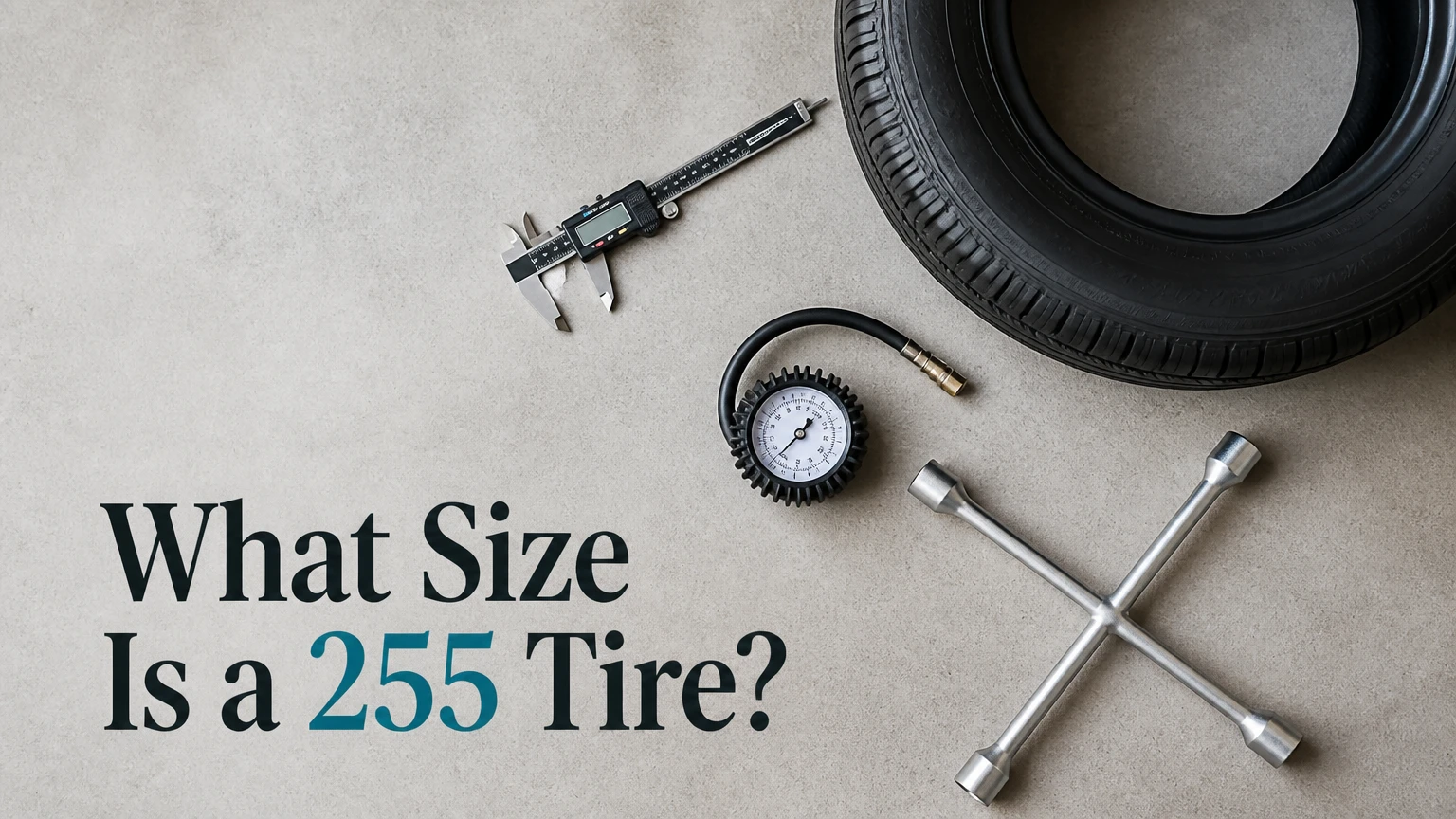
A 255 tire measures exactly 255 millimeters across its widest point from the inner sidewall to the outer sidewall when mounted on an approved measuring rim. This specific metric translates to 10.04 inches of section width. The number 255 dictates only the physical width and provides no information about the overall height of the rubber.
At a Glance
- A 255 width translates to exactly 10.04 inches across the section width.
- The ideal wheel width for a 255 millimeter tire ranges from 8.5 to 9.0 inches.
- Total tire height requires calculating the aspect ratio and adding the wheel diameter.
- Upgrading from a 245 tire adds exactly 10 millimeters of overall width to the vehicle stance.
- Mounting a 255 width tire on a narrow rim pinches the rubber and reduces the actual contact patch touching the road.
How wide is a 255 tire in inches?
A 255 width tire measures 10.04 inches wide at its widest cross-section. You calculate this exact measurement by dividing 255 millimeters by 25.4, which is the standard mathematical conversion rate for millimeters to inches.
Automotive manufacturers and global wheel builders use the metric system for tire section width, but American consumers frequently need the imperial conversion to measure wheel well clearances. A tape measure will confirm this 10.04-inch width only if you measure from the absolute outermost bulge of one sidewall to the exact opposite bulge on the other side. Measuring the flat tread touching the ground will yield a smaller number.
The table below details the inch equivalents for the most common tire widths surrounding the 255 metric standard.
| Metric Width (mm) | Imperial Width (inches) | Difference from 255 (inches) |
| 235 mm | 9.25 inches | -0.79 inches |
| 245 mm | 9.65 inches | -0.39 inches |
| 255 mm | 10.04 inches | 0.00 inches |
| 265 mm | 10.43 inches | +0.39 inches |
| 275 mm | 10.83 inches | +0.79 inches |
How do you calculate the total height of a 255 casing?
You calculate the total height by multiplying the section width by the aspect ratio twice, converting that number to inches, and adding the wheel diameter. The aspect ratio is the two-digit percentage located immediately after the width on the sidewall text.
Consider a standard 255/40R19 size specification. The number 40 means the sidewall height equals 40 percent of the 255-millimeter width. Multiplying 255 by 0.40 yields a sidewall height of 102 millimeters. Since a wheel has two sidewalls contributing to its total vertical height (one above the wheel and one below), you double 102 millimeters to get 204 millimeters. Dividing 204 millimeters by 25.4 converts the rubber height to 8.03 inches. Finally, you add the 19-inch wheel diameter to the 8.03 inches of rubber to find the total standing height of 27.03 inches. Without knowing both the aspect ratio and the wheel diameter, the 255 measurement alone cannot tell you how tall the tire stands.
Does a 255 tire always measure exactly 255 millimeters?
No, a 255 tire rarely measures exactly 255 millimeters in real-world applications due to manufacturing tolerances and dynamic wheel mounting variables. Manufacturers engineer tires within an acceptable variance range defined by strict industry standards rather than an absolute fixed dimension.
The Tire and Rim Association establishes manufacturing guidelines that permit minor dimensional variances across different product lines. A high-performance summer compound from a premium brand often runs intentionally wide, measuring closer to 258 millimeters to maximize dry pavement grip. Conversely, a high-efficiency commuter tire stamped with the same 255 identifier might measure closer to 252 millimeters to reduce aerodynamic drag and improve rolling resistance. Furthermore, the width of the physical metal wheel alters the final dimension. A tire will only hit its exact engineered width when seated on its specific design rim width.
What is the difference between section width and tread width?
Section width measures the distance from the widest outward bulge of the inner sidewall to the widest outward bulge of the outer sidewall. Tread width measures only the specific flat section of rubber that makes physical contact with the pavement.
The 255 identifier on a sidewall refers exclusively to the section width. It does not guarantee a 255-millimeter contact patch. The relationship between these two measurements changes drastically depending on the category of the tire. An aggressive all-terrain truck tire features a blocky, square design where the tread width sits nearly identical to the section width. A stretched track-day tire features heavily sloped sidewalls, meaning a 255 section width might only yield a 235-millimeter actual tread width on the ground. Drivers looking to maximize braking performance must prioritize the tread width specification over the standard section width metric.
How does aspect ratio change the height of the casing?
A higher aspect ratio creates a taller physical sidewall and significantly increases the overall standing diameter of the casing. Because the aspect ratio functions as a percentage of the 255-millimeter width, changing this single two-digit number alters the physical geometry of the entire wheel assembly.
A 255/35 configuration produces a very thin, low-profile rubber band aesthetic favored by modern sports cars. Moving to a 255/45 configuration adds substantial rubber height, which fills out large truck wheel wells and provides massive improvements in ride comfort over broken pavement. This height change directly impacts the vehicle speedometer and gearing. A taller aspect ratio covers more ground per single revolution, causing the speedometer to read artificially slow.
| Tire Size Specification | Sidewall Height (inches) | Total Standing Diameter (inches) | Revolutions per Mile |
| 255/35R19 | 3.51 inches | 26.03 inches | 801 revs |
| 255/40R19 | 4.02 inches | 27.03 inches | 771 revs |
| 255/45R19 | 4.52 inches | 28.04 inches | 743 revs |
| 255/50R19 | 5.02 inches | 29.04 inches | 718 revs |
What rim width do you need for a 255 tire?
The optimal rim width for a 255 tire is 8.5 inches or 9.0 inches. Mounting the rubber on this exact wheel width ensures the sidewalls sit perfectly vertical and the central tread blocks lay completely flat against the pavement.
While 8.5 to 9.0 inches represents the ideal target, the broader acceptable industry safety range spans from 8.0 inches up to 10.0 inches. Matching the casing to the correct metal rim guarantees the internal steel belts maintain their structural integrity during heavy cornering forces. Staying within the optimal 8.5 to 9.0-inch window prevents the center of the tread from bowing upward or cupping inward, which maximizes the lifespan of the compound and provides the most predictable steering response.
| Wheel Width (inches) | Fitment Status | Sidewall Profile Geometry |
| 7.5 inches | Unsafe / Not Recommended | Severe outward bulge |
| 8.0 inches | Minimum Acceptable | Noticeable outward bulge |
| 8.5 inches | Ideal Standard | Perfectly vertical |
| 9.0 inches | Ideal Standard | Perfectly vertical |
| 9.5 inches | Acceptable | Slight inward stretch |
| 10.0 inches | Maximum Acceptable | Heavy inward stretch |
Can this tire fit safely on an 8 inch rim?
Yes, you can physically and safely mount a 255 tire on an 8-inch wide rim. This configuration sits at the absolute minimum acceptable threshold for a 255-millimeter section width, forcing the rubber to bulge noticeably outward past the metal lip of the wheel.
Mechanics refer to this setup as a pinched tire. The narrow 8-inch metal barrel forces the two tire beads closer together than the manufacturer intended. This pinching action pushes the center of the tread slightly upward, creating a slightly crowned contact patch. A typical high-performance alignment shop observes that this convex shape accelerates wear down the absolute center of the tread block. The outward bulging sidewalls do offer one distinct advantage: they provide massive protection against curb rash, as the thick rubber will hit the concrete long before the expensive metal wheel face makes contact.
What happens if you mount the rubber on a 10 inch rim?
Mounting a 255 tire on a 10-inch rim stretches the rubber inward from the wide metal lips toward the narrower tread block. This extreme outward pull creates a highly rigid, diagonally sloped sidewall that transmits severe impact harshness directly into the vehicle cabin.
While a 10-inch wheel technically falls within the maximum acceptable safety parameters, it completely alters the driving dynamics of the vehicle. The heavy stretch pre-loads the sidewall tension, which eliminates all compliance in the rubber. This results in razor-sharp steering response at the cost of bone-jarring ride quality over potholes. The stretching effect pulls the protective rubber rim guard away from the wheel face, leaving the bare metal heavily exposed to curbing damage during parallel parking. In extreme pothole impacts, a heavily stretched tire runs a higher risk of unseating the bead and suffering sudden pressure loss.
Can you replace a stock 245 tire with a wider 255?
Yes, you can replace a stock 245 tire with a 255 tire in almost all modern passenger car applications. The wider option adds exactly 10 millimeters (0.39 inches) of overall width, meaning the rubber sits just 5 millimeters closer to the internal suspension components and 5 millimeters closer to the outside fender lip.
Automotive engineers build factory wheel wells with at least 15 to 20 millimeters of buffer space to accommodate snow chains and suspension articulation. The tiny 5-millimeter inward expansion of a 255 tire easily clears standard MacPherson strut bodies and upper control arms. You must ensure the overall diameter of the new wheel assembly remains within 3 percent of the original equipment specifications to keep the anti-lock braking system and traction control modules functioning correctly. Moving from a 245/40 to a 255/40 hits this threshold perfectly.
Will the upgraded width rub the fenders on a stock car?
An upgraded 255 width rarely rubs the fenders on a factory stock suspension setup. The 5 extra millimeters of outward protrusion falls well within the standard manufacturing clearances built into modern automotive wheel wells.
Fender rubbing only becomes a realistic threat when owners combine the wider 255 rubber with aftermarket wheels featuring aggressive negative offsets. An aggressive wheel offset pushes the entire mounting hub outward, forcing the wider tire directly into the plastic fender liner during heavy cornering or deep suspension compression. Lowering springs or aftermarket coilover kits further reduce this clearance margin. If your vehicle utilizes the factory original wheels and maintains the stock ride height, stepping up to a 255 section width is a virtually guaranteed safe fitment.
How do square shoulder designs affect clearance?
Square shoulder designs push the thickest part of the tread block out further toward the fender lip, which drastically reduces your available clearance. Two distinct tires carrying identical 255 section width metrics can have vastly different clearance profiles based entirely on their shoulder geometry.
High-performance summer tires utilize sharp, 90-degree square shoulders to maximize the amount of rubber touching the ground during aggressive cornering. Standard all-season touring tires utilize highly rounded, sloped shoulders to reduce road noise and improve aerodynamics. A vehicle that perfectly clears a rounded all-season 255 tire might experience severe fender rubbing if the owner switches to a square-shouldered 255 track tire. Mud-terrain off-road tires compound this issue further by adding thick side-biting lugs that extend 5 to 10 millimeters past the calculated casing width.
Does upgrading to wider rubber hurt your gas mileage?
Yes, upgrading to a wider 255 tire usually decreases fuel economy by 1 to 3 percent compared to a narrower stock option. The wider 10.04-inch footprint increases both the aerodynamic drag at highway speeds and the mechanical rolling resistance on the pavement.
Pushing a wider physical object through the air requires more engine horsepower, which directly consumes more fuel. Furthermore, a 255-millimeter contact patch creates significantly more friction against the asphalt than a 235 or 245-millimeter equivalent. A standard industry rule of thumb used by fleet managers suggests that adding 20 millimeters of tire width to a standard sedan reduces average fuel economy by roughly 1.0 to 1.5 miles per gallon during mixed driving conditions. The heavier physical weight of the wider casing also increases the unsprung rotating mass, requiring more kinetic energy to accelerate from a dead stop.
Do wider tires improve cornering grip and performance?
Wider tires significantly improve dry cornering grip by putting more physical rubber in direct contact with the pavement. The increased lateral stiffness provided by the massive 255-millimeter footprint resists structural deformation under heavy cornering loads.
When a vehicle enters a tight turn, the weight transfers violently to the outside wheels. A narrow tire will fold over onto its sidewall under this pressure, causing the vehicle to slide outward. The wider 255 footprint distributes this cornering load across a broader surface area, keeping the flat tread securely planted on the asphalt. A typical track-day setup shifting from a stock 235-millimeter front tire to a 255-millimeter compound yields a measurable 0.05g to 0.08g increase in peak lateral grip on a standard skidpad. This translates directly to faster cornering speeds and noticeably shorter emergency braking distances on dry roads.
Are 255 tires significantly more expensive than narrower options?
Upgrading to a 255 tire typically increases the cost by $15 to $30 per corner compared to the 245-millimeter equivalent in the exact same brand and model. The total price difference usually ranges from $60 to $120 for a complete set of four mounted tires.
Tire pricing scales directly with the amount of raw petroleum, silica, and steel required to construct the casing. The 255 size sits at the entry point of the premium performance tier, meaning manufacturers often price it at a slight premium over standard commuter sizes. High-performance variants see the largest price jumps, while basic all-season touring tires maintain closer price parity between widths.
| Tire Category | Average Cost (245 Width) | Average Cost (255 Width) | Total Set Difference |
| Economy All-Season | $110 per tire | $125 per tire | +$60 |
| Premium Touring | $175 per tire | $195 per tire | +$80 |
| High-Performance Summer | $240 per tire | $270 per tire | +$120 |
Is this width safe for driving in winter snow?
A 255 tire performs noticeably worse in deep snow and slush than a narrower alternative. The massive 10.04-inch footprint acts exactly like a snowshoe, distributing the weight of the vehicle over too large of a surface area.
Safe winter driving requires the tire to slice down through the loose snow to find traction on the hard asphalt underneath. A wide 255 tire traps the snow underneath the tread blocks, causing the vehicle to float or hydroplane across the slippery surface. Rally cars specifically utilize ultra-narrow tires for snow racing to maximize their downward ground pressure. If you live in a climate with severe winter weather, typical tire shop guidance recommends downsizing your winter wheel set to a 225 or 235 width to dramatically improve snow traction and slush evacuation.
The Bottom Line
A 255 tire refers strictly to a section width of exactly 255 millimeters (10.04 inches) and requires calculating the aspect ratio to determine the total physical height. Upgrading to this size provides exceptional dry pavement grip and braking performance, though it introduces minor penalties to fuel economy and deep snow traction. Ensure your wheels measure between 8.5 and 9.0 inches wide to achieve the safest fitment and the longest possible tread life from your investment.