Yes, cold weather significantly affects tire pressure sensors. The sensors accurately detect a real drop in pressure because cold temperatures cause the physical air inside the tires to contract. For every 10∘F drop in ambient temperature, tire pressure decreases by exactly one pound per square inch (PSI), triggering the Tire Pressure Monitoring System (TPMS) alert.
At a Glance
- Tire pressure drops by 1 psi for every 10∘F (5.6∘C) decrease in outside temperature.
- A solid TPMS light indicates low pressure, while a light that blinks for 60–90 seconds before turning solid indicates a failing sensor.
- Driving heats up tire air, which temporarily raises internal pressure and can turn off cold-triggered TPMS warnings.
- Extreme cold severely reduces the voltage in aging TPMS lithium-ion batteries, often causing older sensors to fail entirely in winter.
- Never overinflate tires in anticipation of winter weather; inflate exactly to the vehicle manufacturer’s recommended door jamb specifications.
The Mechanics of Cold Weather and Tire Pressure
Why does tire pressure drop when the temperature falls?
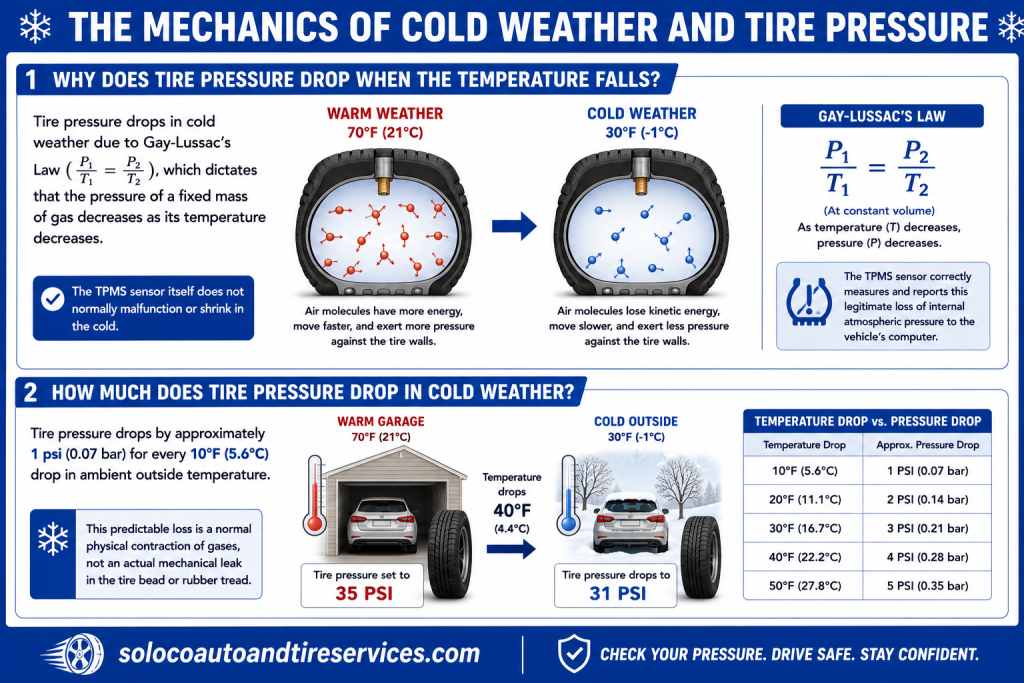
Tire pressure drops in cold weather due to Gay-Lussac’s Law (P1/T1=P2/T2), which dictates that the pressure of a fixed mass of gas decreases as its temperature decreases. The physical air molecules inside the tire lose kinetic energy in freezing environments and contract, exerting less outward outward force against the rubber tire casing. The TPMS sensor itself does not normally malfunction or shrink in the cold. Rather, the sensor correctly measures and reports this legitimate loss of internal atmospheric pressure to the vehicle’s computer.
How much does tire pressure drop in cold weather?
Tire pressure drops by approximately 1 psi (0.07 bar) for every 10∘F (5.6∘C) drop in ambient outside temperature. If a vehicle’s tires are properly inflated to 35 psi inside a heated 70∘F garage, parking that vehicle outside in 30∘F winter weather will cause the internal pressure to naturally plummet to 31 psi overnight. This predictable four-pound loss is an entirely normal physical contraction of gases, not an actual mechanical leak in the tire bead or rubber tread.
At what temperature does cold weather start affecting tire pressure?
There is no singular threshold temperature where cold weather begins affecting tire pressure; the contraction happens continuously along any declining temperature gradient. However, drivers typically begin experiencing dashboard TPMS warnings when overnight autumn temperatures first drop into the 40∘F (4∘C) range. A sudden 30∘F ambient swing from warm afternoon highs to freezing overnight lows represents the statistical tipping point that causes enough PSI contraction to cross a modern vehicle’s factory warning thresholds.
Understanding Cold Weather TPMS Warnings
At what pressure does a TPMS warning light trigger?
Most factory TPMS alerts trigger when a tire’s internal air pressure drops 20% to 25% below the vehicle manufacturer’s recommended placard pressure. For a standard passenger sedan requiring 32 psi, the dashboard warning light activates when internal pressure hits approximately 24 psi to 25.5 psi. The legally required placard pressure calculation is always located on the compliance sticker inside the driver’s side door jamb, never on the raised rubber lettering found on the sidewall of the tire itself.
Why does the TPMS light turn off after driving in winter?
The TPMS light turns off after driving in winter because road friction physically heats the tire rubber, causing the trapped air inside to expand and raise the internal pressure back above the 25% warning threshold. This common phenomenon, known by mechanics as a “phantom light,” usually resolves after 10 to 15 minutes of continuous highway driving. Relying on road friction heat to turn the light off means the tires are being driven while dangerously underinflated, which accelerates outer tread wear and increases emergency braking distances.
Why does the tire pressure light only come on for one tire?
The tire pressure light often illuminates for just one tire because that specific wheel was likely hovering closer to the 25% warning threshold before the seasonal cold snap occurred. Passenger tires naturally lose 1 to 2 psi per month, and this pressure bleeds unevenly across all four wheels. Additionally, a single tire facing a harsh winter wind or parked on a freezing concrete driveway seam will lose slightly more internal radiant heat than the remaining tires sheltered by the vehicle’s undercarriage or a garage wall.
How can you tell if the TPMS sensor is broken or the tire is low?
You can verify a TPMS sensor is broken if the dashboard warning light blinks continuously for 60 to 90 seconds upon starting the vehicle before turning solid. If the TPMS dashboard light stays completely solid from the exact moment the ignition turns on, the physical tire pressure is genuinely low. A blinking light specifically indicates an electronic system fault-most commonly a dead internal sensor battery or a severed radio receiver connection-and simply adding compressed air will not turn the warning off.
Sensor Damage and Extreme Winter Edge Cases
How do freezing temperatures affect TPMS sensor batteries?
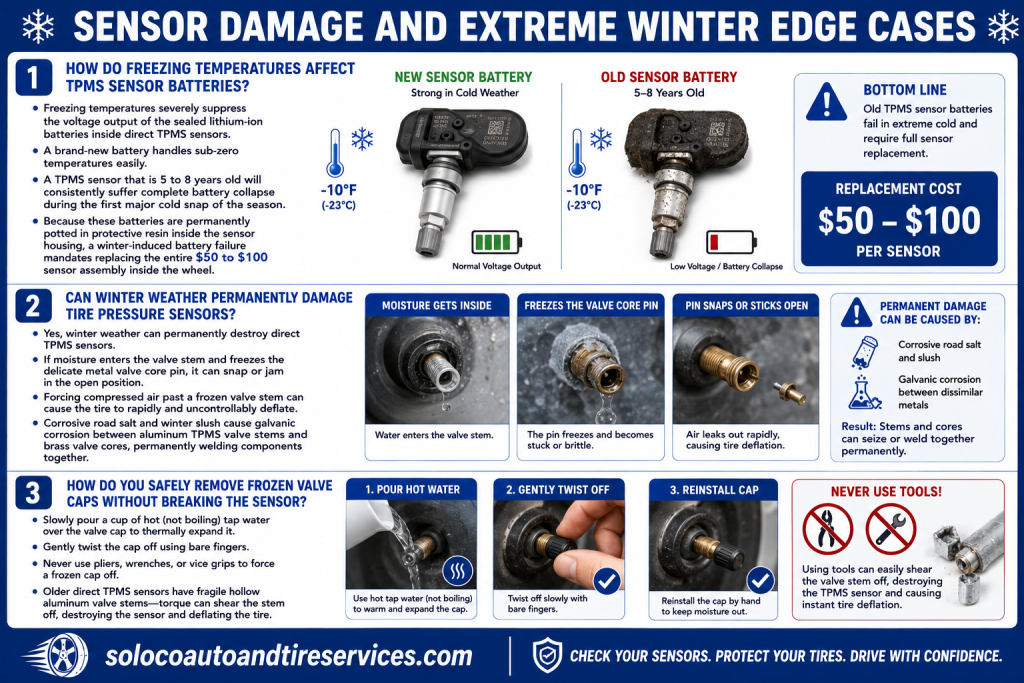
Freezing temperatures severely suppress the voltage output of the sealed lithium-ion batteries housed inside direct TPMS sensors. While a brand-new battery handles sub-zero temperatures easily, a TPMS sensor that is 5 to 8 years old will consistently suffer complete battery collapse during the first major cold snap of the season. Because these tiny batteries are permanently potted in protective resin inside the sensor housing, a winter-induced battery failure mandates replacing the entire $50 to $100 sensor assembly inside the wheel.
Can winter weather permanently damage tire pressure sensors?
Yes, winter weather can permanently destroy direct TPMS sensors if liquid moisture enters the valve stem and freezes the delicate metal valve core pin in place. When a driver attempts to force compressed air past a frozen valve stem, the internal pin often snaps or jams in the open position, causing the tire to rapidly and uncontrollably deflate. Furthermore, corrosive road salt and winter slush frequently create galvanic corrosion between aluminum TPMS valve stems and brass valve cores, permanently welding the metallic components together.
How do you safely remove frozen valve caps without breaking the sensor?
To safely remove a frozen valve cap, slowly pour a cup of hot (not boiling) tap water directly over the cap to briefly thermally expand the plastic or metal, then gently twist it off using bare fingers. Never use pliers, wrenches, or vice grips to force a frozen winter cap off a tire. Older direct TPMS sensors rely on incredibly fragile hollow aluminum valve stems; applying mechanical torque to a frozen cap will easily shear the stem completely off, instantly destroying the sensor and deflating the tire.
Cold Weather Tire Pressure Management
Should you overinflate tires in winter to compensate for cold?
No, you should never overinflate tires in winter in an attempt to preemptively compensate for cold weather pressure drops. Tires must always be inflated exactly to the manufacturer’s recommended door jamb specification when the ambient rubber is entirely cold. Intentionally overinflating tires in winter creates a stiff, rounded tread surface profile that dramatically reduces the vehicle’s contact patch, destroying traction on hard-packed snow and compromising the critical function of the vehicle’s anti-lock braking system (ABS).
How long should tires sit before checking pressure in winter?
Tires must sit parked and immobile for a minimum of three hours before manually checking the pressure during the winter. This mandatory resting period ensures the tire rubber and the internal air mass have completely cooled down to match the ambient outdoor atmospheric temperature, yielding a true “cold tire pressure” reading. Checking pressure immediately after commuting yields falsely high gauge readings due to friction heat, which often tricks drivers into letting air out and resulting in dangerously underinflated tires by the next morning.
Does nitrogen prevent cold weather tire pressure drops?
No, filling tires with nitrogen does not prevent winter pressure drops because pure nitrogen is a gas that still strictly obeys Gay-Lussac’s Law and contracts in cold environments. However, pure commercial nitrogen contains absolutely no water vapor, unlike the heavily humidified compressed air generated by outdoor gas station pumps. Because dry nitrogen lacks freezing moisture, its pressure drops slightly more predictably, and the larger nitrogen molecules permeate through tire rubber 30% to 40% slower, marginally reducing the overall frequency of winter TPMS alerts.
Is it safe to drive with the cold weather TPMS light on?
No, it is never safe to drive a vehicle with the cold weather TPMS light illuminated without first manually verifying the exact tire pressure using a physical dial or digital gauge. Drivers cannot visually differentiate whether the dashboard light triggered due to a minor 4 psi cold contraction or a catastrophic 20 psi blowout caused by a hidden winter pothole puncture. Driving on severely underinflated tires generates massive sidewall heat through flex friction, risking a sudden high-speed tire delamination even in sub-zero winter temperatures.
Does cold weather affect direct and indirect TPMS differently?
Yes, cold weather affects direct and indirect TPMS architectures completely differently. Direct TPMS utilizes physical electronic sensors strapped inside the wheel to measure actual 1 psi increments, making it highly susceptible to triggering precise alerts during overnight temperature plunges. Indirect TPMS entirely lacks internal pressure sensors, relying instead on the vehicle’s anti-lock braking system (ABS) to measure wheel rotational speed. Because extreme cold uniformly shrinks all four tires equally, their rotational speeds remain identical, meaning indirect TPMS systems rarely trigger false temperature-related alarms.
The Bottom Line
Cold weather unequivocally affects tire pressure by causing the air mass inside the tires to physically contract, triggering TPMS dashboard alerts as pressure drops 1 psi for every 10∘F decrease in ambient temperature. While a solid warning light usually dictates simply adding air to meet the cold-tire door jamb specifications, a continuously blinking light points to battery failure or hardware faults severely exacerbated by winter extremes. Ultimately, drivers must rely on a physical pressure gauge rather than waiting for dashboard alerts, checking cold tire pressures monthly to guarantee maximum tread traction and safety on hazardous winter roads.


