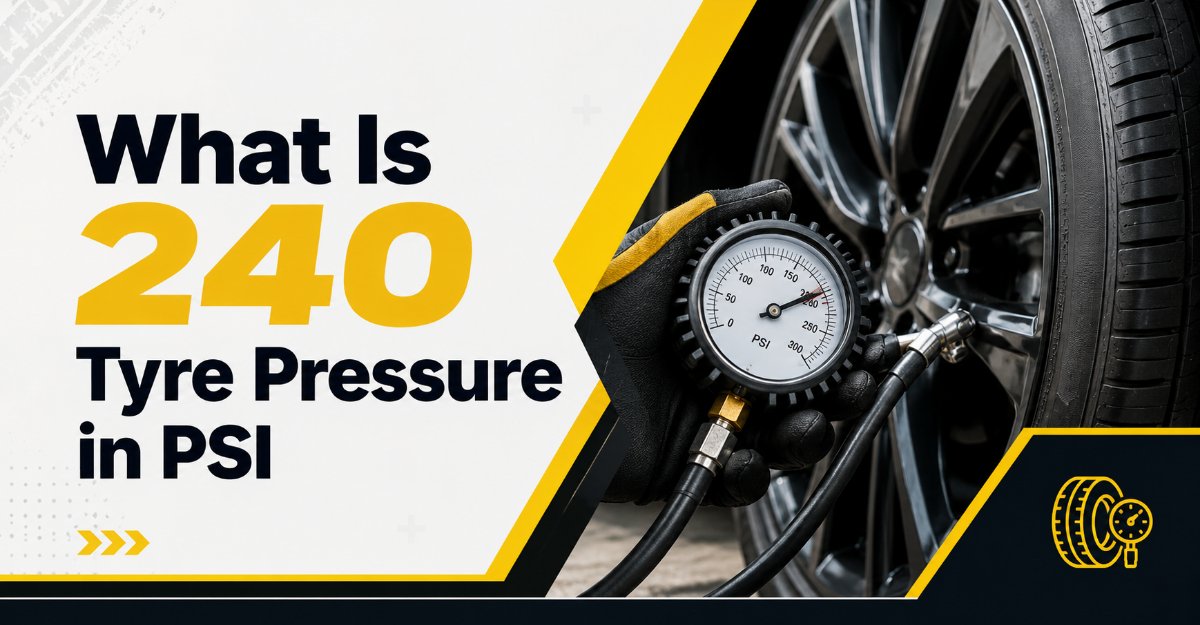
A tyre pressure reading of 240 kilopascals (kPa) converts exactly to 34.81 pounds per square inch (PSI). For everyday driving applications, drivers should round this metric measurement to 35 PSI. This 35 PSI specification represents the standard cold tyre inflation recommendation for most modern passenger cars, hatchbacks, and compact SUVs operating under normal load conditions.
At a Glance
- The exact mathematical conversion for 240 kPa is 34.81 PSI.
- Automotive professionals recommend rounding 34.81 PSI up to a standard 35 PSI for practical gauge reading.
- Drivers must measure the 35 PSI target when tyres are completely cold.
- A temporary space-saver spare tyre requires 60 PSI and will fail if inflated to only 35 PSI.
- Every 10 degree Fahrenheit drop in ambient temperature reduces actual internal tyre pressure by roughly 1 PSI.
What Types Of Vehicles Use 240 kPa Tyre Pressure?
Standard sedans, compact hatchbacks, and small crossover SUVs most commonly use a 240 kPa tyre pressure specification. Automotive manufacturers select this 35 PSI equivalent because it offers the optimal balance of fuel economy, ride comfort, and tread longevity for vehicles weighing between 2,800 and 4,000 pounds.
You will frequently find this exact specification printed on the driver-side door jamb placard of vehicles like the Honda Civic, Toyota Corolla, and Ford Escape. The 240 kPa rating assumes the vehicle is operating under normal daily driving conditions with one to three occupants and minimal trunk luggage.
High-performance sports cars and heavy-duty pickup trucks rarely use this measurement. Sports cars often require staggered pressures (different values for front and rear axles) to manage heat distribution, while heavy-duty trucks require significantly higher pressures to support heavy cargo.
What Is The Difference Between 240 kPa And 2.4 Bar?
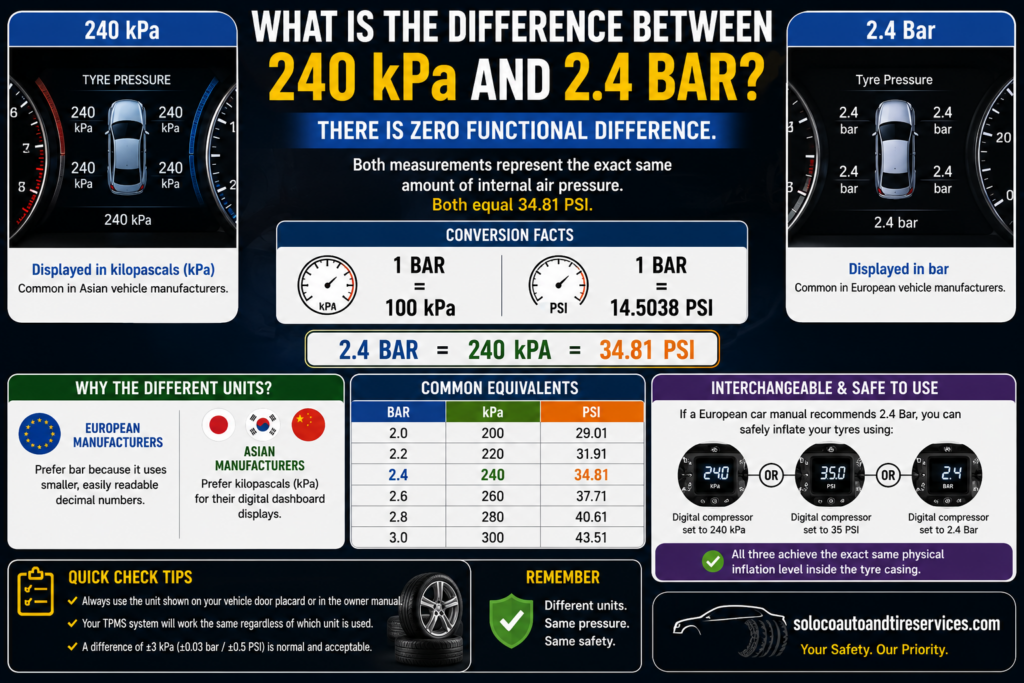
There is zero functional difference between 240 kPa and 2.4 Bar. Both measurements represent the exact same amount of internal air pressure, which equals 34.81 PSI.
The distinction lies entirely in the metric scaling. One Bar equals exactly 100 kilopascals. European automotive manufacturers frequently display tyre pressure in Bar because it uses smaller, easily readable decimal numbers. Asian vehicle manufacturers tend to prefer kilopascals for their digital dashboard displays.
If a European car manual recommends 2.4 Bar, the owner can safely inflate the tyres using a digital air compressor set to 240 kPa or 35 PSI. All three metrics achieve the exact same physical inflation level inside the tyre casing.
Should I Round 240 kPa Up To 35 PSI Or Down To 34 PSI?
Drivers should always round 240 kPa up to 35 PSI rather than down to 34 PSI. Operating a vehicle with slightly higher tyre pressure is significantly safer than driving on tyres that are under-inflated.
Under-inflation creates excess friction. When a tyre is low on air, the rubber sidewalls flex extensively under the weight of the vehicle. This excessive flexing generates dangerous heat buildup inside the tyre structure. Over long distances at highway speeds, this thermal stress can cause the internal steel belts to separate from the rubber casing, leading to a sudden blowout.
Rounding up to 35 PSI provides a small safety buffer against natural air loss. It ensures the tyre maintains its structural rigidity, keeps the tread footprint flat against the pavement, and prevents the dangerous heat accumulation associated with under-inflation.
How Do You Accurately Measure 240 kPa Using A Standard PSI Gauge?
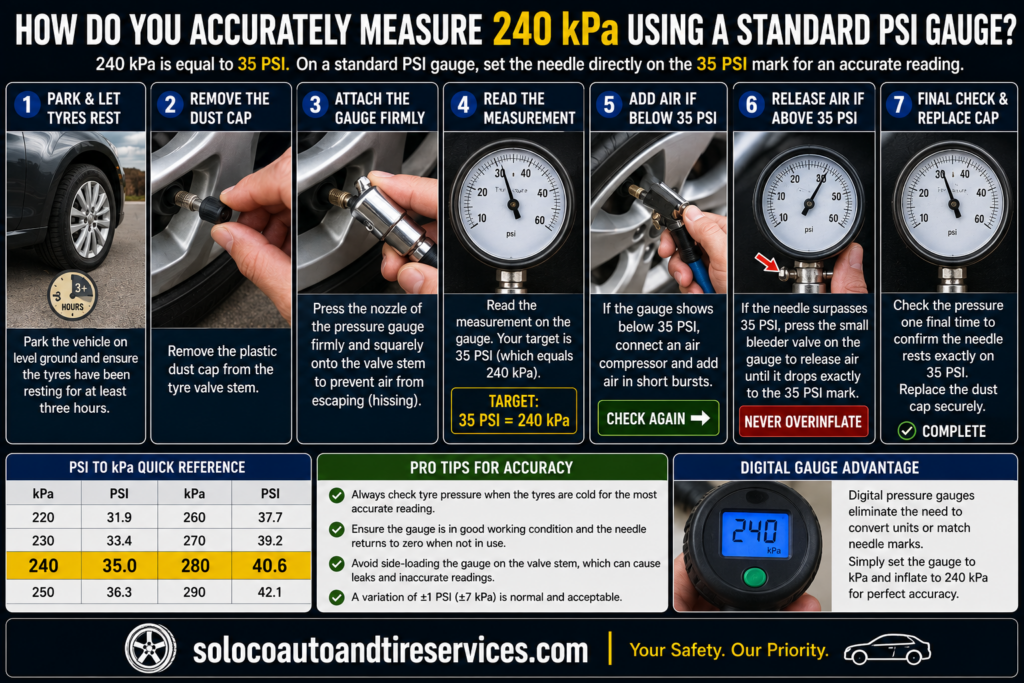
To accurately measure 240 kPa on a standard mechanical PSI gauge, you must inflate the tyre until the indicator needle rests directly on the 35 PSI hash mark.
Follow these specific steps for the most accurate reading:
- Park the vehicle and ensure the tyres have been resting for at least three hours.
- Remove the plastic dust cap from the tyre valve stem.
- Press the nozzle of the pressure gauge firmly and squarely onto the valve stem to prevent air from escaping (hissing).
- Read the measurement. If the gauge shows below 35 PSI, connect an air compressor and add air in short bursts.
- Check the pressure again. If the needle surpasses 35 PSI, press the small bleeder valve on the gauge to release air until it drops exactly to the target mark.
Digital pressure gauges eliminate the need to interpret hash marks. If using a digital gauge, simply add air until the liquid crystal display reads exactly 35.0 PSI.
How Do Warm Tyres Affect A 240 kPa Pressure Reading?
Measuring a warm tyre will falsely show a higher pressure reading than the tyre actually contains. If a driver measures exactly 240 kPa (35 PSI) immediately after driving on the highway, the true cold pressure of that tyre is likely dangerously low at roughly 215 kPa (31 PSI).
Air expands when heated. As a vehicle drives, friction between the rubber tread and the asphalt generates significant heat. This thermal energy transfers to the air inside the casing, causing the air molecules to expand and increase the internal pressure by up to 4 PSI.
Vehicle manufacturers account for this thermal expansion when they set the 240 kPa specification. The target of 35 PSI is strictly a “cold” measurement. You must only measure and adjust tyre pressure when the vehicle has been parked for three hours or driven for less than one mile at low city speeds.
How Does Cold Winter Weather Affect A 240 kPa Tyre Setting?
Sudden drops in winter temperature will cause a tyre previously set to 240 kPa to lose internal pressure rapidly. For every 6 degrees Celsius (10 degrees Fahrenheit) the ambient outside temperature drops, tyre pressure decreases by approximately 1 PSI.
Consider a scenario where a driver sets their tyres to exactly 240 kPa (35 PSI) inside a heated 70-degree Fahrenheit garage. If that driver parks the vehicle outside overnight in 30-degree Fahrenheit winter weather, the ambient temperature drop of 40 degrees will shrink the air inside the tyre.
By morning, the actual tyre pressure will have dropped to 31 PSI. This sudden pressure loss is the most common reason Tyre Pressure Monitoring System alerts activate during the first cold snap of autumn. Drivers must proactively add air to their tyres as winter weather approaches to maintain the required 240 kPa level.
Why Does My Car Dashboard Display Tyre Pressure In kPa?
Vehicle manufacturers program digital dashboard displays in kilopascals (kPa) because it is the official metric system standard for atmospheric pressure used globally outside the United States. Many Asian and European automakers use kPa as the factory default setting on international production lines.
Most modern vehicles allow the driver to change this metric display back to PSI. This setting is rarely found on the main dashboard screen. Instead, drivers usually need to navigate deep into the infotainment system settings or use the steering wheel buttons to access the instrument cluster menu.
Look for a sub-menu labeled “Units” or “Measurements” within the vehicle settings. Switching the system from Metric to Imperial will instantly convert the 240 kPa dashboard readout to a familiar 35 PSI display.
Why Is My TPMS Light On When My Tyres Are At 240 kPa?
A Tyre Pressure Monitoring System (TPMS) light remains illuminated at 240 kPa either because the digital system requires a manual dashboard reset or because the tyres were inflated while they were hot.
If you adjust the tyres to exactly 35 PSI at a gas station after a long drive, the tyres will cool down overnight. As they cool, the pressure will drop below the 240 kPa threshold, triggering the warning light the next morning.
Alternatively, many vehicles from brands like Honda and Volkswagen do not use internal air sensors. Instead, they use wheel speed sensors to detect flat tyres. In these indirect systems, adding air to reach 240 kPa does not automatically turn off the warning light. The driver must press and hold a physical TPMS reset button located in the glovebox or navigate to a calibration menu on the dashboard screen to tell the computer the new pressure is correct.
How Does Carrying A Heavy Load Affect The 240 kPa Recommendation?
Carrying maximum passenger capacity or towing a heavy trailer requires increasing the rear tyre pressure above the standard 240 kPa recommendation. A vehicle that normally requires 35 PSI might demand up to 280 kPa (41 PSI) on the rear axle to safely support maximum payload.
When you load a vehicle with five adults and heavy trunk luggage, the rear suspension and rear tyres bear the brunt of that weight. If left at the standard 240 kPa, the rear tyres will compress excessively, compromising the vehicle’s high-speed stability and increasing the risk of a blowout.
Drivers should check the owner’s manual or the secondary tire placard on the door jamb. Manufacturers explicitly list a “Normal Load” pressure (often 240 kPa) and a “Maximum Load” pressure. You must increase the rear tyre inflation to the maximum load specification before beginning a road trip with heavy cargo.
Can I Inflate A Space-Saver Spare Tyre To 240 kPa?
No, you must never inflate a space-saver spare tyre to only 240 kPa. Temporary compact spare tyres (commonly called donuts) physically require a much higher pressure of 420 kPa (60 PSI) to support the weight of the vehicle safely.
Space-saver spares are significantly narrower and hold less internal air volume than standard passenger tyres. To compensate for this lack of physical volume and prevent the heavy metal rim from crushing the small rubber casing, the internal pressure must be nearly double that of a standard tyre.
Running a donut spare at 35 PSI is highly dangerous. The under-inflated tyre will overheat rapidly, and the bead (the edge of the tyre that grips the wheel) can easily detach from the rim while cornering, causing an immediate loss of control. Always check the sidewall of the spare tyre, which will clearly display the 60 PSI requirement.
Should I Inflate To 240 kPa If The Tyre Sidewall Says 50 PSI Max?
Yes, you should inflate the tyre to the vehicle manufacturer’s 240 kPa (35 PSI) specification regardless of the maximum pressure limit listed on the tyre sidewall. The sidewall number represents the physical bursting limit of the rubber casing, not the correct operating pressure for your specific car.
Tyre manufacturers build tyres to fit dozens of different vehicle models. A tyre that states “50 PSI Max” on the rubber might be installed on a heavy minivan that requires 40 PSI, or it might be installed on a lightweight hatchback that only requires 240 kPa (35 PSI).
If you ignore the vehicle’s door jamb placard and inflate the tyre to the 50 PSI sidewall maximum, you will severely over-inflate the tyre. Over-inflation causes the center of the tyre tread to bulge outward. This reduces traction, creates an incredibly harsh ride over bumps, and accelerates center-tread wear, destroying the tyre prematurely.
What Happens If You Drive On Tyres Under-Inflated Below 240 kPa?
Driving on tyres under-inflated below the required 240 kPa causes excessive sidewall flexing, premature edge tread wear, and a severe drop in fuel economy. In extreme cases, the resulting heat generation causes catastrophic tread separation at highway speeds.
When pressure drops below 35 PSI, the tyre can no longer maintain its intended shape under the weight of the car. The center of the tread lifts slightly off the pavement, forcing the outer edges (the shoulders) of the tyre to bear the entire load. This causes the edges of the rubber to wear down rapidly while the center remains untouched.
Furthermore, the flattened profile creates higher rolling resistance. The engine must burn significantly more fuel to push the vehicle forward. Studies show that a drop of just 5 PSI below the 240 kPa target can reduce highway fuel efficiency by up to 3 percent.
Does Upgrading To Larger Alloy Wheels Change The 240 kPa Requirement?
Yes, upgrading to larger aftermarket wheels with lower-profile tyres almost always requires a higher tyre pressure than the factory 240 kPa specification. Lower-profile sidewalls need more internal air volume to prevent the alloy rim from bending upon impact with potholes.
When you install larger wheels (a process known as plus-sizing), the new tyres must have shorter sidewalls to ensure the overall diameter of the wheel remains identical to the factory setup. A shorter sidewall has less vertical distance to absorb impacts.
If you maintain the original 240 kPa (35 PSI) pressure in a low-profile tyre, a sharp pothole will compress the thin rubber instantly, causing the pavement to strike and crack the expensive alloy wheel. Tyre technicians usually recommend increasing the baseline pressure by 2 to 4 PSI when switching to lower-profile performance tyres to protect the rim structure.
Is 240 kPa Suitable For All-Terrain Or Off-Road Driving?
No, 240 kPa (35 PSI) is generally too high for off-road driving and too low for heavy-duty all-terrain highway use. Standard metric recommendations apply primarily to paved road conditions using standard passenger tyres.
For off-road driving in mud, sand, or loose rocks, off-roading enthusiasts actively “air down” their tyres to pressures between 15 and 20 PSI. Reducing the pressure allows the tyre to flatten out, creating a wider footprint that grips loose surfaces without sinking.
Conversely, heavy-duty trucks equipped with massive all-terrain tyres require much higher pressures for highway stability. An E-load rated all-terrain tyre on a heavy pickup truck often requires 50 to 80 PSI to safely carry cargo at highway speeds. Inflating a heavy truck tyre to only 240 kPa will cause immediate handling failure.
How Often Should You Manually Check Tyres That Are Set To 240 kPa?
Drivers should manually check their 240 kPa tyre pressure with a handheld gauge at least once every 30 days and immediately before any long road trip. You cannot rely strictly on the dashboard warning light for routine maintenance.
A perfectly healthy, puncture-free tyre naturally loses about 1 PSI of pressure per month due to microscopic air permeation through the rubber casing. If you set your tyres to 35 PSI in January and never check them, they could drop to a dangerous 29 PSI by July simply through natural air loss.
The dashboard TPMS warning light is a fail-safe, not a maintenance tool. By design, the warning light only illuminates when a tyre drops 25 percent below the recommended threshold. This means a tyre requiring 240 kPa (35 PSI) can drop to a highly inefficient and unsafe 26 PSI before the car ever alerts the driver.
The Bottom Line
A tyre pressure specification of 240 kPa equals exactly 34.81 PSI, which mechanics universally round to 35 PSI for practical gauge reading. This measurement is the industry standard for modern sedans and compact SUVs operating under normal load conditions.
To maintain safety and fuel economy, you must always measure this target pressure when the tyres are completely cold, as driving heats the air and skews the reading. Remember to increase this baseline pressure if you plan to carry maximum passenger weight or tow a trailer, and completely ignore this metric if you are filling a high-pressure space-saver spare tyre.