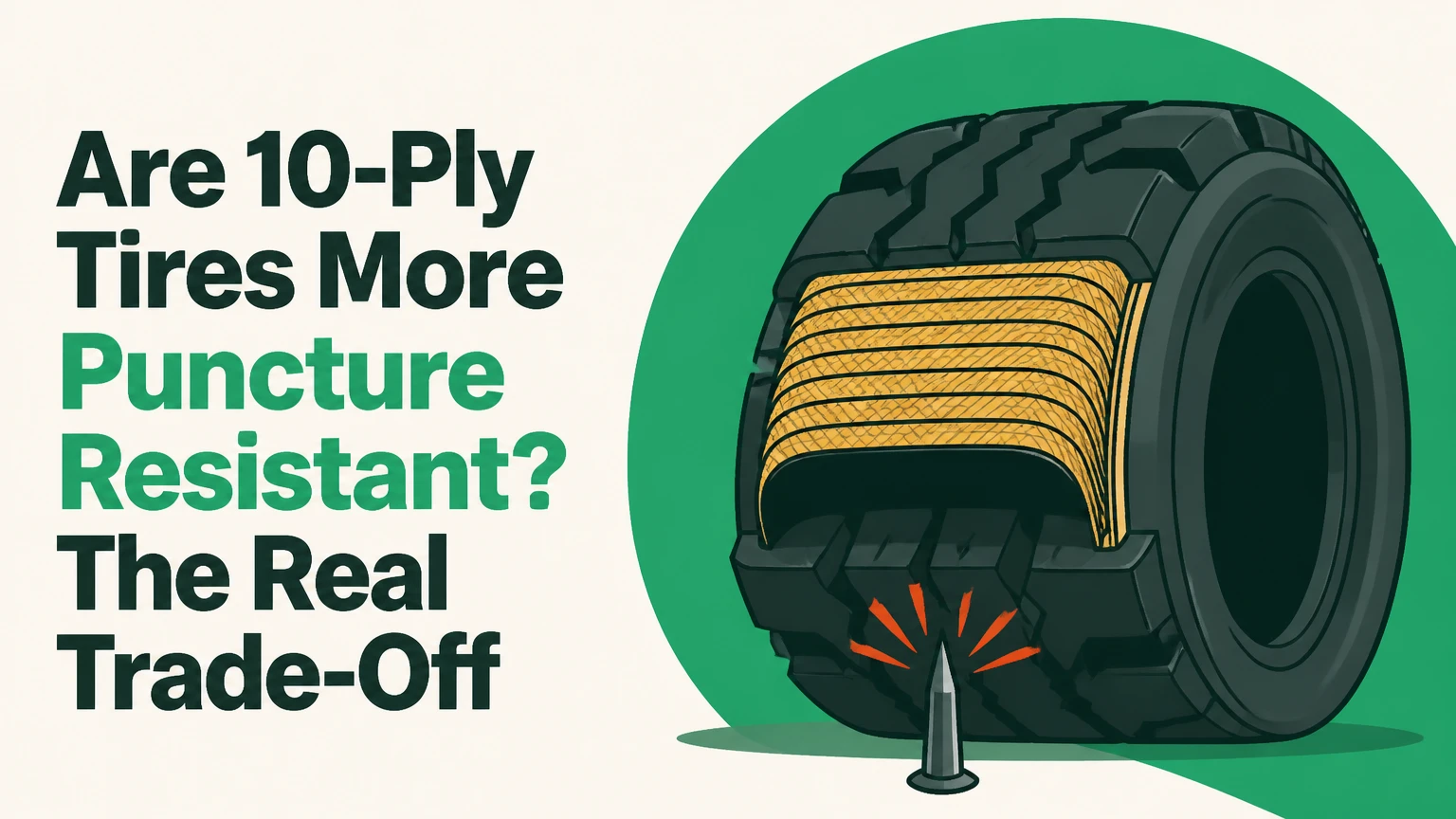
Yes, 10-ply-rated tires are usually more resistant to tread punctures than standard passenger tires, because Load Range E tires commonly use stronger casing cords, thicker tread packages, and heavier construction. The rating does not make a tire puncture-proof, however. Tread design, rubber compound, sidewall construction, inflation pressure, and the type of debris determine the actual result.
Key Facts at a Glance
- “10-ply” is a historical strength designation, not a count of ten physical layers in a modern tire.
- A modern 10-ply-rated light-truck tire usually corresponds to Load Range E, but the tire’s sidewall marking and load table control.
- Many Load Range E LT tires have an 80 psi maximum cold inflation pressure, although exact limits vary by tire size and model.
- Load Range E construction generally improves casing durability but can reduce ride comfort and fuel economy.
- A reinforced tread does not make a light-truck tire immune to nails, screws, sharp rocks, or sidewall cuts.
- The vehicle manufacturer’s tire placard determines normal inflation pressure, not the maximum pressure molded on the tire.
Are 10-Ply Tires More Puncture Resistant?
A 10-ply-rated tire normally provides better resistance to tread punctures than an SL or XL passenger tire, especially on heavy trucks, gravel roads, construction sites, and rocky trails. The advantage comes from the entire casing and tread package rather than the number “10” itself. A Load Range E highway tire can resist ordinary debris well, while an aggressive mud tire may better resist rock damage but wear faster on pavement.
The comparison is therefore useful but incomplete. A high-quality Load Range C or D all-terrain tire may outperform a poorly designed Load Range E tire against a particular type of object. A thick tread protects the crown, while sidewall protection depends on separate rubber and cord features. A nail entering at a shallow angle may cause no immediate leak, but a sharp rock striking a flexed sidewall can damage internal cords.
The most accurate answer is: yes, usually for tread and casing durability, but not equally against every puncture and not without trade-offs.
What Does “10-Ply” Mean Today?
“10-ply” means a tire has a strength level historically associated with ten cotton body plies; it does not mean a modern tire contains ten identical structural layers. Tire manufacturers now use fewer layers of stronger polyester, nylon, aramid, or steel-reinforced materials, so “ply rating” describes load-carrying capability and casing strength.
Load Range E is the modern designation most commonly associated with a 10-ply rating for light-truck tires. The distinction matters because consumers sometimes compare the label as though every tire has the same internal construction. Two Load Range E tires in different sizes can have different load capacities, tread compounds, sidewall protections, and puncture behavior.
A tire marked LT265/70R17 Load Range E is built for a different duty cycle from a P265/70R17 passenger tire, even when the physical dimensions appear similar. The LT tire typically has a stronger carcass and higher load capability, but it also weighs more and requires the correct wheel, pressure, and vehicle application.
How Does a Load Range E Tire Resist Punctures?
A Load Range E tire resists punctures through several interacting features: tread thickness, belt material, casing cord strength, sidewall design, and casing stiffness. The tread rubber slows penetration, steel belts limit deformation around the crown, and high-tensile cords help prevent a small cut from spreading into a structural failure.
The tire’s construction usually includes these functional zones:
| Tire area | Main material or feature | Damage it helps resist | Important limitation |
|---|---|---|---|
| Tread cap | Rubber compound, often 13/32-18/32 inch deep | Nails, gravel, small sharp fragments | A long screw can still reach the air cavity |
| Belt package | Steel belts, sometimes nylon reinforcement | Crown penetration and tread distortion | Belts do not protect most sidewall cuts |
| Body casing | Polyester or nylon cords | Tearing, impact deformation, casing fatigue | Damaged cords can make the tire unsafe |
| Inner liner | Airtight rubber layer | Air loss after minor casing damage | The liner is not an armor layer |
| Sidewall | Rubber over body cords, sometimes added plies | Curb scuffs and some rock impacts | Thin or badly cut sidewalls may require replacement |
Does Tread Thickness Matter More Than Ply Rating?
Tread thickness increases the distance an object must travel before reaching the belt or inner liner, but tread depth alone does not predict puncture resistance. Rubber hardness, belt placement, reinforcement, object angle, and impact speed can matter just as much.
A 16/32-inch mud-terrain tread may provide more sacrificial rubber than a 13/32-inch highway tire, yet its large voids can expose more casing between lugs. Conversely, a highway tire with a continuous center rib and strong belt package may handle road debris effectively while offering less protection against a sharp rock landing on the shoulder.
Tread depth also affects braking, noise, rolling resistance, and wet-road behavior. Replacing a tire solely because it advertises the deepest tread can produce the wrong result if the vehicle spends nearly all its time on pavement.
Do 10-Ply Tires Protect the Sidewalls?
Some 10-ply-rated tires have stronger sidewalls, but the Load Range E label alone does not guarantee maximum sidewall protection. Sidewall durability depends on the number and orientation of body cords, rubber thickness, shoulder design, and features such as raised protective ribs or a manufacturer’s additional sidewall shield.
Sidewall damage is more serious than a simple crown puncture because the sidewall flexes continuously and cannot safely be repaired in the same way as a repairable tread puncture. A bulge, exposed cord, deep cut, or air leak after a hard impact requires professional inspection and often replacement.
An all-terrain tire marketed with a three-ply sidewall can offer a different type of protection from a highway-terrain Load Range E tire with a two-ply sidewall. Read the model’s construction details rather than assuming the load range answers every durability question.
Which Tire Type Handles Different Puncture Risks Best?
Highway-terrain, all-terrain, and mud-terrain tires solve different problems. Highway-terrain tires prioritize quiet pavement operation and towing stability, all-terrain tires balance pavement and loose surfaces, and mud-terrain tires prioritize traction and casing protection in severe off-road conditions.
| Tire type | Typical tread depth | Best environment | Common protection feature | Main compromise |
|---|---|---|---|---|
| Highway terrain | 13/32-16/32 inch | 80-100% paved roads | Closed ribs and stable belt package | Less shoulder bite on rocks |
| All terrain | 14/32-18/32 inch | 30-70% off-road use | Reinforced shoulders and stone ejectors | More noise and rolling resistance |
| Mud terrain | 16/32-21/32 inch | Rock, mud, trails | Large lugs and available sidewall shields | Shorter pavement life and wet-road trade-offs |
| Commercial all-season | 14/32-18/32 inch | Fleet roads and loaded vans | Durable compound and casing | Limited deep-mud traction |
Are Highway-Terrain 10-Ply Tires Puncture Resistant?
Highway-terrain Load Range E tires are generally the best choice for loaded highway trucks that encounter nails, road debris, and occasional gravel. Their continuous ribs distribute contact pressure and their casing construction supports towing loads, but their road-focused shoulders do not match an aggressive all-terrain tire on sharp rocks.
A highway tire also often produces less noise and lower rolling resistance than an equivalent mud-terrain tire. For a contractor driving 30,000 highway miles per year and only occasional access roads, the smoother tread can reduce fatigue and irregular wear.
Are All-Terrain 10-Ply Tires Better for Gravel?
All-terrain Load Range E tires usually provide the best compromise for mixed pavement and gravel use. Interlocking blocks, reinforced shoulders, and stone-ejecting grooves reduce the chance that loose rock will remain trapped and work into the tread, while the stronger casing tolerates moderate impacts.
All-terrain tires are not automatically suitable for severe rock crawling. Drivers who air down below the recommended road pressure must follow the tire manufacturer’s limits, avoid excessive speed, and reinflate before returning to pavement. Low pressure increases the contact patch but also increases sidewall flex, heat, bead-unseating risk, and impact exposure.
Are Mud-Terrain Tires the Most Puncture Resistant?
Mud-terrain tires often provide the strongest off-road protection among comparable designs, but they are not universally the most puncture resistant. Large lugs and optional multi-ply sidewalls help against rocks and ruts, while the open tread can expose sections of casing to sharp objects.
Mud-terrain tires can also wear quickly on highways, create more vibration, and perform differently on wet pavement. Their off-road advantage only justifies the trade-off when the vehicle regularly encounters deep mud, ledges, sharp rock, or remote trails.
Load Range E Versus SL and XL Tires
Load Range E tires offer higher load capacity and stronger construction than Standard Load and Extra Load tires, but the correct comparison depends on vehicle weight and the tire’s exact size. SL and XL tires often provide a softer ride and lower mass, while Load Range E tires tolerate heavier duty cycles and higher operating pressures.
| Rating | Typical maximum pressure | Example load capacity range | Typical construction use | Typical ride result |
|---|---|---|---|---|
| SL | 35-44 psi | 1,500-2,200 pounds per tire | Passenger cars and light SUVs | Softest |
| XL | 41-51 psi | 1,700-2,500 pounds per tire | Crossovers and lightly loaded trucks | Moderately firm |
| C | 50 psi | 1,800-2,800 pounds per tire | Moderate light-truck service | Firm |
| D | 65 psi | 2,200-3,300 pounds per tire | Loaded pickups and vans | Very firm |
| E | 80 psi on many LT sizes | 2,600-3,750 pounds per tire | Heavy payloads and towing | Firmest |
The figures are typical ranges, not universal specifications. A tire’s sidewall, manufacturer load-inflation table, wheel rating, axle rating, and vehicle placard take priority over this overview.
| Decision factor | SL or XL passenger tire | Load Range E LT tire |
|---|---|---|
| Tire mass in a common pickup size | 35-50 pounds | 50-75 pounds |
| Cold pressure capability | 35-51 psi | Often 80 psi maximum |
| Loaded towing stability | Suitable for light loads | Better for sustained heavy loads |
| Empty-bed ride | Softer and more compliant | Firmer and sometimes harsh |
| Fuel economy effect | Lower rolling mass | Often 1-3 mpg worse, vehicle-dependent |
| Typical retail price | $120-$240 | $180-$350 or more |
| Best use | Commuting and occasional cargo | Payload, towing, gravel, and work use |
Does a 10-Ply Rating Reduce Fuel Economy?
A 10-ply-rated tire can reduce fuel economy because its greater mass, stiffer casing, higher rolling resistance, and larger tread package require more energy. A typical pickup may lose approximately 1-3 mpg after moving from a passenger tire to a heavy LT Load Range E tire, but wheel size, tread pattern, pressure, gearing, weather, and driving speed can change the result.
The fuel penalty is not a reason to avoid Load Range E tires when the truck regularly operates near its payload or trailer limits. It is a strong reason to avoid them on a lightly loaded crossover that never needs their capacity.
How Much Do 10-Ply Tires Cost and How Long Do They Last?
A typical Load Range E tire costs about $180-$350 per tire before mounting, balancing, taxes, and disposal fees, while premium specialty sizes can exceed $400. Service life commonly ranges from 40,000-65,000 miles, but tread compound, alignment, rotation, load, inflation, heat, and age can shorten that range substantially.
| Use pattern | Typical annual mileage | Expected tread life | Likely replacement factor |
|---|---|---|---|
| Highway towing | 15,000-25,000 miles | 40,000-60,000 miles | Heavy loads and heat |
| Mixed work and pavement | 12,000-20,000 miles | 40,000-65,000 miles | Gravel cuts and irregular wear |
| Frequent rock trails | 5,000-12,000 miles | 25,000-45,000 miles | Sidewall or shoulder damage |
| Light commuting | 8,000-15,000 miles | 50,000-70,000 miles | Age may precede tread wear |
Tire age matters even when tread remains. The National Highway Traffic Safety Administration advises consumers to inspect tires regularly and replace tires that are old, damaged, or worn, while tire manufacturers commonly publish age guidance based on six or ten years from manufacture. The tire identification number on the sidewall provides the production week and year.
How Should You Set Pressure in a Load Range E Tire?
Set cold inflation pressure according to the vehicle manufacturer’s door-jamb placard for ordinary driving, unless a qualified tire professional calculates a different pressure for a documented load condition. Do not automatically inflate an empty half-ton pickup to the tire’s 80 psi maximum, because excessive pressure can reduce contact area, worsen ride quality, and accelerate center tread wear.
Use the tire’s load-inflation table when carrying unusually heavy cargo or towing, and confirm that the axle, wheel, tire, and vehicle ratings remain adequate. Measure pressure before driving or after the vehicle has been parked for at least three hours. Pressure rises as the tire heats, so a hot reading is not a reliable setting target.
An underinflated Load Range E tire can be dangerous too. Excessive sidewall flex creates heat, reduces handling precision, increases shoulder wear, and raises the risk of casing damage. Tire pressure is part of puncture prevention because a properly supported casing deflects impacts more predictably.
What Should You Do After a Puncture?
Leave a screw or nail in place until the tire can be inspected, because removing the object may turn a slow leak into a rapid leak. Spray soapy water around the object and valve stem, monitor the TPMS warning, and use a spare tire or roadside service if pressure is falling quickly.
Use this inspection sequence:
- Identify the leak location. Check the tread, shoulder, sidewall, valve stem, and bead.
- Measure pressure with a gauge. Record the loss over 15-30 minutes if the tire remains inflated.
- Do not drive on a visibly flat tire. Internal cords can be destroyed even when the exterior looks repairable.
- Have a technician remove the tire. An internal inspection is required before a permanent repair.
- Repair only an eligible tread puncture. The puncture should be within the repairable crown area, limited in size, and free from internal run-flat damage.
- Replace unsafe damage. Sidewall punctures, bulges, exposed cords, separated belts, and large shoulder cuts normally require replacement.
A plug inserted from outside may temporarily stop air loss, but a combination plug-patch installed from inside is the standard professional repair approach for an eligible puncture. Repair policies vary by manufacturer and tire shop.
When Is a 10-Ply Tire the Wrong Choice?
A 10-ply-rated tire is often the wrong choice for a lightly loaded SUV, crossover, or half-ton truck used almost entirely for commuting. The extra casing strength may bring higher purchase cost, increased unsprung weight, a harsher empty ride, more noise, and lower fuel economy without solving the driver’s actual risk.
Choose SL or XL construction when the vehicle manufacturer specifies it and the vehicle carries modest loads on paved roads. Choose Load Range E when the truck regularly carries heavy payloads, tows near its rated capacity, travels on coarse gravel, or operates on work sites where casing durability has practical value.
A stronger tire cannot compensate for an overloaded axle, an unsuitable wheel, poor alignment, worn suspension components, or driving at excessive speed on low pressure. Load range is one selection variable, not a substitute for matching the complete wheel-and-tire system to the vehicle.
Which 10-Ply Tire Type Fits Your Driving?
The best Load Range E category depends on the surface, load, and annual mileage rather than on puncture resistance alone.
| Driver profile | Recommended category | Typical duty split | Why it fits | Avoid when |
|---|---|---|---|---|
| Commercial tower | Highway terrain LT E | 80-100% pavement | Stable tread and towing support | Trails dominate the route |
| Gravel-road worker | All terrain LT E | 50-80% pavement | Shoulder protection and loose-surface control | Quiet highway operation is mandatory |
| Rock-crawling overlander | Aggressive all terrain or mud terrain LT E | 30-60% pavement | Strong casing and rock traction | Wet pavement and low noise matter most |
| Daily half-ton commuter | SL or XL, if approved | 95-100% pavement | Lower weight and softer ride | Payload regularly approaches the placard limit |
| Loaded van or fleet vehicle | Commercial all-season LT E | 70-100% pavement | Durable casing and consistent wear | Deep mud is routine |
A practitioner rule is to buy the lightest tire construction that safely supports the real axle load and terrain. Excess capacity does not automatically produce better handling, because a stiff tire can reduce grip over broken pavement when it cannot conform to the surface.
The Bottom Line
Are 10-ply tires more puncture resistant? Generally yes, especially against tread punctures, casing cuts, and repeated heavy impacts, but Load Range E is not a guarantee of sidewall immunity or puncture-proof performance. The strongest choice combines the correct load range with an appropriate tread design, sidewall construction, tire size, pressure, and vehicle application.
For heavy towing and work-site use, a Load Range E highway or all-terrain tire is usually justified. For severe rocks, an aggressive all-terrain or mud-terrain design may provide more useful protection. For ordinary commuting, SL or XL tires usually deliver better comfort and efficiency when the vehicle manufacturer permits them.
Frequently Asked Questions
Can a nail still puncture a 10-ply tire?
Yes. A nail, screw, or bolt can penetrate a Load Range E tire if its length, angle, and impact force reach the inner liner. Stronger casing materials may reduce tearing and slow air loss, but they do not block every object. Inspect any embedded object promptly, and avoid removing it before a professional leak assessment.
Are 10-ply tires safer for towing?
Load Range E tires can improve towing stability because their stiff sidewalls support higher loads and resist sway-inducing deformation. They do not increase the truck’s legal tow rating, hitch rating, axle rating, or braking capacity. Use the vehicle placard and manufacturer ratings, then set pressure for the actual load.
Do 10-ply tires need 80 psi?
No. Many LT Load Range E tires list 80 psi as their maximum cold pressure, but the vehicle may require substantially less pressure when lightly loaded. The door-jamb placard specifies normal pressure, while the tire load-inflation table helps determine pressure for unusual cargo. Never use maximum pressure as a default.
Are 10-ply tires better in winter?
A 10-ply rating does not determine winter traction. The tread compound, siping, rubber temperature range, and severe-snow designation matter more on ice and packed snow. A three-peak mountain snowflake-rated tire with a suitable winter compound can outperform a heavily built mud tire that lacks cold-weather traction features.
Can a sidewall puncture be repaired on a 10-ply tire?
A sidewall puncture generally should not be repaired, regardless of the tire’s ply rating. Sidewalls flex continuously, and a repair cannot reliably restore damaged load-carrying cords. A technician should replace a tire with a sidewall hole, deep cut, bulge, exposed cords, or structural separation.
Is Load Range E the same as 10-ply?
Load Range E is commonly called 10-ply-rated, but the terms are not identical descriptions of physical construction. Load Range E identifies a standardized load-capability category, while ply rating is a historical strength comparison. Confirm the exact tire size, load index, maximum pressure, and manufacturer specifications before comparing tires.


