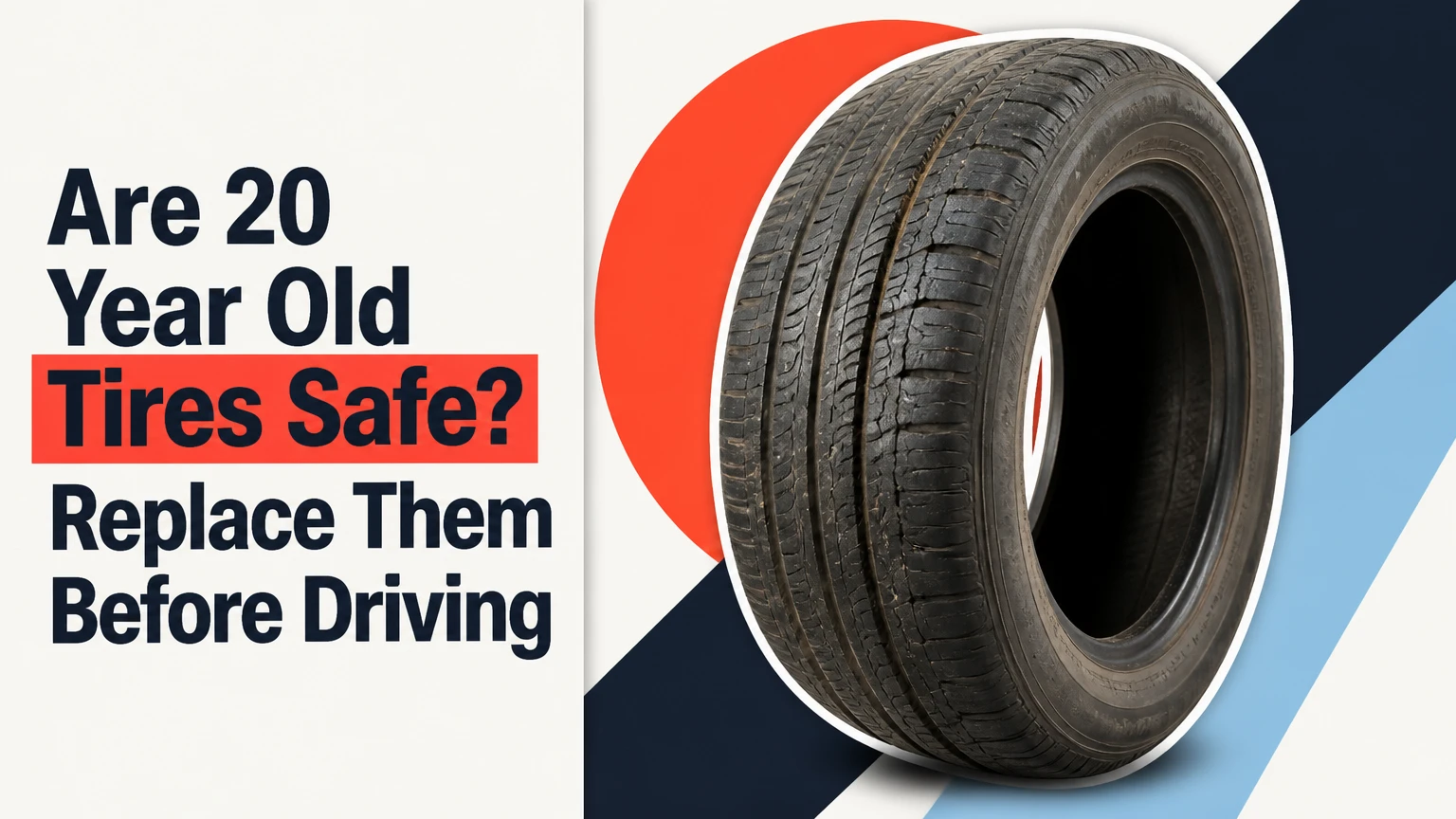
No, 20-year-old tires are not safe for public-road driving, even when they retain deep tread and appear clean. Tire rubber, steel-belt adhesion, cords, and inner-liner materials deteriorate with time through oxygen, heat, ozone, and repeated stress, so a 20-year-old tire should be replaced rather than tested on the road.
Key Facts at a Glance
- A tire’s DOT date code identifies its manufacturing week and year, not the date of purchase or installation.
- Michelin recommends removing tires from service 10 years after manufacture, regardless of tread depth or appearance.
- NHTSA does not set one universal tire-expiration age, because climate, storage, inflation, load, speed, and tire construction alter aging.
- The 2/32-inch tread benchmark addresses tread wear, not the structural condition of a 20-year-old casing.
- A tire can fail internally without visible sidewall cracking, so a clean appearance cannot prove roadworthiness.
- A 20-year-old tire should be moved only at walking speed on private property, or transported by tow or mobile tire service.
Are 20-year-old tires safe?
Twenty-year-old tires are unsafe for normal driving because their age exceeds the service-life limit recommended by major tire manufacturers. The immediate risk is not merely reduced tread grip. Aged rubber can lose flexibility, while the bond between rubber, steel belts, and textile cords can weaken under heat, load, braking, and cornering.
No inspection can turn a 20-year-old passenger, trailer, RV, or spare tire into a dependable road tire. A tire technician can identify obvious defects, but a visual check cannot fully measure internal oxidation or belt-edge adhesion. The prudent decision is replacement before highway travel, towing, commuting, or emergency use.
The 20-year figure is a safety boundary, not a prediction that every tire will fail at a precise hour. Some tires fail earlier, particularly after outdoor storage, underinflation, hot climates, or heavy loading. A few may remain intact longer in controlled storage, but that uncertainty is the reason continued road use is an unacceptable experiment.
How does tire aging damage the structure?
Tire aging is a thermo-oxidative process in which oxygen and heat alter rubber compounds over time. Oxygen diffuses through the inner liner and outer rubber, while ultraviolet light, ozone, moisture, temperature cycling, and mechanical flexing accelerate cracking and changes in elasticity.
A modern radial tire contains several functional layers. The tread supplies traction, the sidewall flexes, steel belts stabilize the footprint, textile cords carry tension, the bead anchors the tire to the wheel, and the inner liner retains air. Aging affects each layer differently, which explains why remaining tread is an incomplete safety measure.
Common age-related changes include:
- Hardening and reduced elasticity: Rubber becomes less able to conform to wet pavement and absorb impact.
- Cracking: Surface cracks can form in grooves, sidewalls, bead areas, and between tread blocks.
- Adhesion loss: Rubber-to-steel or rubber-to-cord bonds may weaken, allowing separation under centrifugal force.
- Air-retention deterioration: The inner liner, valve stem, or bead may no longer maintain pressure reliably.
- Heat sensitivity: Aged material tolerates less heat from speed, heavy loads, braking, and hot pavement.
The most dangerous deterioration may occur beneath the visible surface. A tire can retain black rubber and usable tread while its belt edges, carcass, or inner liner have lost important performance margins.
Does deep tread make an old tire safe?
Deep tread does not make an old tire safe because tread depth measures remaining groove material, not rubber chemistry or internal bonding. A 20-year-old tire with 7/32 inch of tread can be more hazardous than a newer tire with less tread, especially when the older tire has hardened or developed hidden separation.
The 2/32-inch threshold is widely used in the United States as a replacement or legal-wear benchmark, but it answers only one question: how much tread remains? It does not certify braking performance, casing integrity, sidewall condition, correct load capacity, or resistance to heat.
Tread depth also fails to describe the age of an unused tire. A full-size spare that has never touched pavement still absorbs oxygen and experiences temperature changes. A stored collector-car tire can develop flat spots and age-related brittleness without accumulating mileage.
Age and tread are separate replacement triggers
| Condition | Typical measurement | What it tells you | Correct action |
|---|---|---|---|
| New tire with shallow tread | 8/32 inch | Manufacturing or design tread depth | Confirm specification and wear pattern |
| Worn tire | 2/32 inch | Common legal replacement benchmark in the USA | Replace immediately |
| Aged tire with deep tread | 7/32 inch at 20 years | Remaining rubber only | Replace before road use |
| Unevenly worn tire | 4/32 inch on one shoulder | Alignment, suspension, or inflation issue | Inspect vehicle and replace as needed |
| Tire with exposed cord | 0/32 inch at damaged area | Structural material is exposed | Do not drive; replace or tow |
How old can tires safely remain in service?
Tire manufacturers commonly recommend replacement at 10 years from the manufacturing date, while many recommend professional inspections beginning around five or six years. Those recommendations are not a guarantee that every six-year-old tire is safe or proof that every nine-year-old tire will fail; condition and use still matter.
Michelin states, “Michelin recommends that tires be removed from service 10 years from the date of manufacture.” Bridgestone similarly advises replacing tires that reach 10 years, including unused spare tires, and recommends annual professional inspections after five years. The exact wording varies by brand and market.
NHTSA takes a more limited position. The agency warns that tire aging can contribute to failure but does not prescribe one universal expiration date for every tire, because manufacturers, tire designs, climate, vehicle use, and storage conditions differ. Manufacturer guidance remains the most relevant service-life reference for a particular tire.
A 20-year-old tire is beyond both the common inspection window and the commonly recommended maximum service age. That makes replacement the correct decision even when mileage is low.
How do you read the DOT tire date code?
Read the final four digits of the DOT Tire Identification Number on a post-1999 tire. The first two digits identify the production week, and the last two identify the production year: code 2306 means the tire was manufactured in week 23 of 2006.
The complete DOT marking may appear on only one sidewall. A tire mounted with the full code facing inward may require a technician to inspect the vehicle’s inner side. The letters “DOT” may be followed by plant and size-related characters before the final date window.
Use this process:
- Find the letters DOT on the tire sidewall.
- Locate the final four-digit group.
- Read the first two digits as the calendar week.
- Read the final two digits as the year.
- Calculate the tire’s age from that manufacturing date, not from the installation invoice.
A three-digit date code indicates a tire manufactured before 2000. The code does not reliably identify the decade without a symbol that some older tires used, so a three-digit code should be treated as an extremely old tire requiring replacement, not decoded casually as a modern date.
| Date code | Manufacturing date | Age in 2026 | Road-use decision |
|---|---|---|---|
| 2306 | Week 23 of 2006 | About 19 years, 8 months | Replace; do not use normally |
| 1210 | Week 12 of 2010 | About 16 years | Replace before driving |
| 3520 | Week 35 of 2020 | About 5 years, 6 months | Inspect condition and wear |
| 0423 | Week 4 of 2023 | About 3 years | Inspect pressure, damage, and wear |
| 236 | Pre-2000 three-digit code | At least about 26 years | Remove from road service |
The date code identifies manufacture, but it does not reveal how the tire was stored, overloaded, inflated, repaired, or exposed to heat. Date decoding is the first screening step, not a substitute for a physical inspection.
What visible signs mean an old tire must be removed?
Visible cracking, bulges, cuts, exposed cords, tread separation, bead damage, or severe flat spotting require immediate removal from service. A tire with any of these defects should not be driven to a repair shop because speed and load can turn a visible defect into a sudden failure.
Inspect the outer and inner sidewalls, tread grooves, shoulder areas, and bead. Look for:
- Fine cracks that connect across a sidewall or continue into grooves.
- Bulges or bubbles, which indicate damaged casing cords.
- Tread blocks lifting, a circumferential groove opening, or a raised belt area.
- Cuts that reach cords, punctures near the shoulder, or failed repair plugs.
- Severe flat spots that cause vibration after storage.
- Rust, deformation, or bead damage around the wheel.
- Repeated pressure loss without an obvious puncture.
The absence of those signs does not clear an aged tire. Internal belt separation can develop without an obvious external symptom, and some failures occur after the tire heats at highway speed. An experienced technician can improve the assessment, but no shop inspection provides a reliable exemption from a 20-year replacement decision.
What can happen if a 20-year-old tire fails?
Aged tire failure can cause rapid air loss, tread separation, loss of steering control, wheel-well damage, or a crash. On a trailer or RV, a detached tread can damage wiring, plumbing, body panels, brake components, and adjacent tires before the driver can stop.
Failure modes vary by tire position and application:
| Failure mode | Typical trigger | Immediate vehicle effect | Higher-risk applications |
|---|---|---|---|
| Sidewall rupture | Heat, impact, weakened cords | Rapid air loss and instability | Passenger cars, SUVs |
| Tread separation | Belt adhesion loss and centrifugal force | Vibration, body damage, loss of control | Trailers, RVs, highway vehicles |
| Bead failure | Corrosion, mounting damage, aged rubber | Sudden deflation at the wheel | Stored vehicles and heavy loads |
| Valve or liner leak | Perished rubber and pressure loss | Underinflation and heat buildup | Spares, trailers, low-use vehicles |
| Flat-spot cracking | Long storage under load | Vibration and casing stress | Collector cars, motorhomes |
Underinflation amplifies heat generation because the sidewall flexes more. Overloading increases carcass stress, and high speed raises the centrifugal and thermal forces acting on an already aged structure. A 20-year-old tire has little sensible safety margin for any of these conditions.
Can you drive 20-year-old tires to a tire shop?
Driving 20-year-old tires to a tire shop is not a safe recommendation, particularly when the route includes a highway, heavy traffic, long distance, high speed, or visible damage. Arrange mobile tire installation, use a flatbed tow truck, or have the vehicle transported with the tires unloaded from road duty.
If the vehicle must move on private property, keep the distance minimal and the speed near walking pace. Avoid public roads, passengers, abrupt steering, braking, and towing. Do not inflate a visibly cracked or bulged tire to operating pressure, because inflation can release stored energy from a damaged casing.
A practical transport decision looks like this:
| Situation | Safer method | Typical cost range | Reason |
|---|---|---|---|
| Four old car tires, vehicle rolls | Mobile installation | $100-$250 service fee, plus tires | Removes road travel |
| Vehicle has damaged or flat tires | Flatbed tow | $100-$250 locally | Prevents loading a failed casing |
| Classic car stored indoors | Trailer transport | $150-$500 locally | Avoids road stress before replacement |
| Trailer with aged tires | On-site tire service | $100-$300 service fee, plus tires | Prevents a loaded highway blowout |
| Workshop repositioning only | Private-property movement | $0-$50 | Low-speed handling only, not road use |
Prices are typical United States ranges and vary by location, tire size, emergency timing, and whether mounting, balancing, disposal, and taxes are included.
How much does replacing old tires cost?
Replacing four passenger tires typically costs about $400-$1,000 or more, including ordinary mounting and balancing, while large SUV, performance, run-flat, RV, and specialty trailer tires can raise the total substantially. Mobile fitting, premium load ratings, alignment, valve stems, and disposal may add separate charges.
The correct replacement must match the vehicle placard and owner’s manual for size, load index, speed rating, construction, and seasonal use. Do not choose a cheaper tire with a lower load rating for an SUV, trailer, or motorhome.
| Application | Typical tire-only range | Typical installed set range | Cost variables |
|---|---|---|---|
| Compact passenger car | $70-$150 each | $350-$700 | Size, all-season compound |
| Midsize sedan or crossover | $100-$220 each | $500-$950 | Speed rating, brand, alignment |
| SUV or pickup | $140-$300 each | $700-$1,300 | Load range, wheel diameter |
| Utility trailer | $80-$220 each | $400-$1,000 | ST rating, spare, service call |
| RV or motorhome | $250-$600 each | $1,400-$3,000 | Load range, commercial casing |
These are typical planning figures, not a quote. A shop should also inspect wheel condition, TPMS sensors, valve stems, alignment, and suspension components, because aged tires can conceal or coexist with vehicle problems.
Are stored, spare, classic-car, and trailer tires different?
Stored, spare, classic-car, trailer, and RV tires still age chemically, although their failure exposure differs. Low mileage reduces tread wear, but it does not stop oxygen diffusion, temperature cycling, ozone attack, or long-term stress at the bead and sidewall.
A spare tire may be overlooked because it is rarely used. Its pressure can fall unnoticed, and its date may be older than the four tires on the vehicle. Check the spare during every tire inspection and replace it according to the same manufacturer guidance.
Collector cars create a special trade-off. Indoor, climate-controlled storage is better than sunlight and rain, but a 20-year-old casing remains too old for public-road use. For a vehicle driven only to shows, replacement tires still need the correct load rating, speed rating, dimensions, and period-appropriate appearance.
Trailer and RV tires deserve stricter attention because they often carry high static loads, sit unused for months, and travel at sustained highway speed. Follow the tire manufacturer’s age guidance, maintain cold inflation from the certification label, and inspect before every trip.
Storage conditions change risk, not the verdict
Heat, sunlight, ozone, moisture, and underinflation accelerate aging. A cool indoor garage can slow deterioration compared with an uncovered driveway, but good storage does not restore the original flexibility or reset the manufacturing date.
Tire dressings cannot reverse polymer oxidation or rebuild weakened belt adhesion. Clean sidewalls may improve appearance while hiding the fact that chemical degradation has already occurred inside the casing.
What myths cause people to keep old tires?
The most common myths confuse appearance, mileage, or legal tread with structural safety. Each mistake removes a different warning signal from the decision.
- “The tread looks new.” Tread depth cannot measure belt adhesion, cord strength, or inner-liner condition.
- “The vehicle was stored indoors.” Controlled storage slows some mechanisms but does not stop time-dependent oxidation.
- “There are no cracks.” Internal separation and rubber hardening may precede visible sidewall cracking.
- “A tire shop can certify it.” Inspection can find defects, but it cannot guarantee a 20-year-old casing under highway load.
- “Tire shine protects it.” A surface dressing cannot penetrate the rubber matrix or reverse chemical aging.
- “Low mileage means low risk.” Mileage is only one stress measure; age, load, heat, and pressure also matter.
- “The tire is still legal.” Legal tread depth does not mean the tire satisfies manufacturer service-life guidance.
One counterintuitive practitioner rule matters here: unused tires are not preserved by inactivity. A tire that spends years mounted on a vehicle can age differently from one stored unmounted, but neither condition makes a 20-year-old road tire dependable.
Which replacement decision fits your vehicle?
Replacement before road use is the correct choice for every vehicle carrying 20-year-old tires, but the transport and specification details differ by application. Daily drivers need immediate mobility, collector vehicles need correct fitment, and trailers or RVs need careful load and pressure verification.
| Vehicle or user | Primary hazard | Recommended next step | Avoid |
|---|---|---|---|
| Daily commuter | Blowout during speed and traffic | Mobile installation or flatbed transport | Highway trip to a tire shop |
| Family SUV | High passenger and vehicle load | Replace all tires that share the age risk | Mixing one aged axle with new tires without advice |
| Classic-car owner | Low use masks age | Fit new period-correct tires before driving | Show-route testing on old casings |
| Utility-trailer owner | Tread separation and wheel-well damage | Replace tires and inspect hubs | Carrying a heavy load on old tires |
| RV owner | High axle load and long highway exposure | Verify load range, pressure, and age | Relying on visual inspection before travel |
| Emergency-spare owner | Unknown pressure and hidden age | Replace spare and check its hoist | Treating the spare as a permanent backup |
Replace tires in axle pairs when possible, and follow the vehicle manufacturer’s guidance for matching sizes and tread patterns. If only two tires are replaced, many tire professionals place the tires with greater wet traction on the rear axle, because rear traction loss can produce oversteer and loss of control.
What should you check after installing new tires?
After replacement, verify the DOT dates, tire size, load index, speed rating, cold inflation pressure, wheel torque, balancing, and TPMS operation. A correct installation prevents the new tires from being compromised by an incorrect vehicle setup.
Use the vehicle placard, usually located on the driver’s doorjamb, rather than the maximum pressure molded into the sidewall as the normal inflation target. The sidewall value is generally a maximum rated pressure, not the vehicle’s recommended cold setting.
Ask the installer to confirm:
- Correct tire size and load index.
- Correct rotation direction or outside-facing sidewall.
- Valve stem and TPMS service.
- Wheel torque using the vehicle specification.
- Balance results and post-installation vibration.
- Alignment if the old tires had shoulder wear.
- Disposal of the removed aged tires.
Check cold pressure after the first significant temperature change and at least monthly thereafter. New tires cannot compensate for chronic underinflation, overloaded cargo, damaged suspension, or misalignment.
FAQ
Is a 20-year-old tire safe if it has never been used?
No. A never-used tire still experiences oxygen diffusion, heat cycling, and chemical changes in rubber compounds during storage. Indoor storage may reduce ultraviolet and ozone exposure, but it does not stop aging. A 20-year-old unused tire should be replaced before public-road use, including when it is a full-size spare.
Can a tire be too old to mount safely?
Yes. Mounting can be unsafe when an old tire has cracks, bulges, bead damage, severe flat spotting, or weakened casing material. Inflation stores substantial energy, so technicians may refuse installation of a visibly deteriorated tire. A three-digit pre-2000 DOT date is a strong reason to remove the tire rather than mount it.
Are six-year-old tires automatically unsafe?
No. Six years is commonly an inspection milestone, not a universal automatic-failure date. Michelin, Bridgestone, and other manufacturers advise closer inspection after roughly five years, while service-life guidance depends on the tire, climate, storage, pressure, load, and condition. A six-year-old tire with damage may be unsafe, while a well-kept tire requires professional assessment.
Does tire age affect insurance or vehicle inspection?
Tire-age rules vary by jurisdiction, insurer, vehicle type, and policy language. Many places enforce tread depth, visible damage, construction, and load requirements rather than one universal age limit. A tire can comply with a local tread rule yet violate manufacturer guidance or fail an insurer’s condition requirements, so check local regulations and the policy.
Should all four tires be replaced when one is 20 years old?
Usually, replace all tires that are similarly aged because the other casings have undergone the same time-dependent degradation. The final decision must account for drivetrain type, tread matching, tire size, and manufacturer instructions. On all-wheel-drive vehicles, large differences in rolling circumference can stress the drivetrain, making matched replacement especially important.
How often should tire pressure be checked on an old vehicle?
Check pressure monthly and before every long trip, but pressure checks do not make aged tires safe. Cold pressure should match the vehicle placard, and a tire that repeatedly loses air needs immediate inspection. A 20-year-old tire with correct pressure remains outside a sensible road-use decision.
The Bottom Line
Are 20 year old tires safe? No, they should not be driven on public roads, regardless of tread depth, mileage, storage history, or clean appearance. Decode the DOT date, stop using any 20-year-old casing, arrange mobile installation or towing when necessary, and select replacements that match the vehicle’s size, load index, speed rating, and inflation requirements.