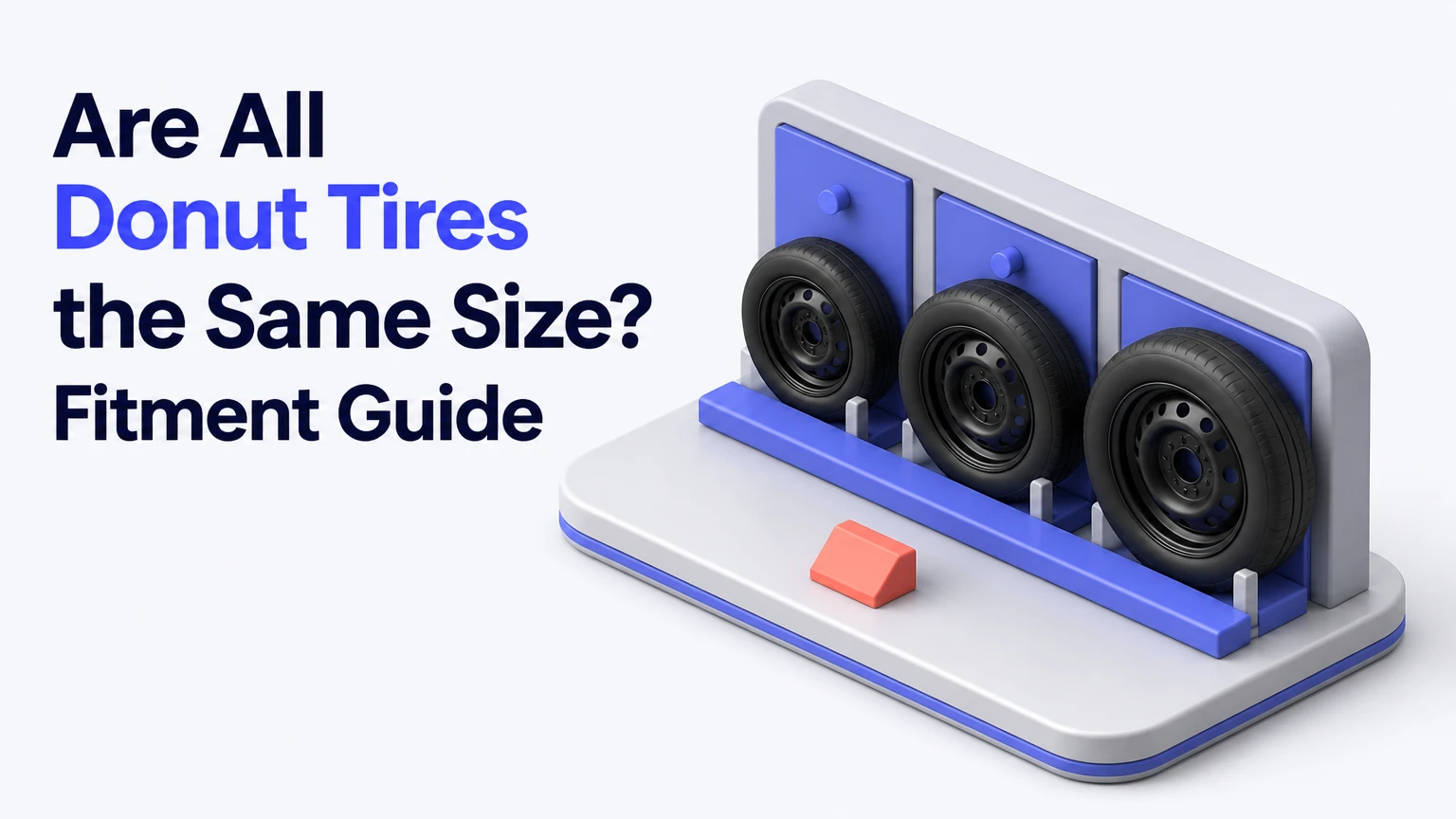
No, all donut tires are not the same size. A donut tire, formally a temporary-use spare tire or space-saver spare, is engineered for a particular vehicle, wheel, brake package, and load rating; its outer diameter is usually close to the vehicle’s normal tire diameter, while its width is much narrower. A donut from another car may look similar yet fail to fit safely.
Key Facts at a Glance
- Donut spare tires are vehicle-specific, not universal replacement tires.
- The correct spare must match more than diameter: bolt pattern, center bore, offset, brake clearance, load rating, and lug-seat design also matter.
- Temporary spares commonly carry a 50 mph maximum, but the owner’s manual and sidewall label control.
- Many compact spares require approximately 60 psi, rather than the 32-35 psi commonly used by regular passenger tires.
- A temporary spare is an emergency-use tire intended to reach a repair facility, not a permanent replacement.
- AWD and some 4WD vehicles may restrict temporary spares because a small circumference difference can stress the driveline.
Are All Donut Tires the Same Size?
Donut tires are not the same size because automakers specify different tire diameters, wheel dimensions, brake clearances, bolt patterns, and load requirements. A compact spare for a Honda Civic, Ford F-150, and BMW 3 Series can differ in every important fitment measurement, even when each tire is narrow and visually similar.
The word “donut” describes a design category, not a standardized dimension. Temporary spares are reduced-width tires mounted on dedicated wheels, and their sidewalls often carry a different size code from the normal tires. For example, a vehicle using 225/50R17 tires might use a compact spare marked T125/70D16, while another vehicle with a similar road-tire diameter could use T135/80D16.
The letter T identifies a temporary-use tire in many size codes. The number after it describes nominal width in millimeters, the aspect ratio describes sidewall height as a percentage of width, and the final number identifies rim diameter. Those numbers must be checked against the vehicle, not guessed from appearance.
Why does a donut look smaller?
A donut looks smaller because its tread width and wheel diameter may be reduced, even when its rolling diameter remains close to the normal tire. The narrow casing saves weight and trunk space, while the temporary tread and construction reduce long-distance capability.
A 125 mm-wide temporary spare has roughly half the tread width of a 245 mm tire. That difference reduces cornering grip and changes braking behavior, especially on wet pavement. A smaller rim can also be used only when it clears the vehicle’s brake calipers.
Why Must the Diameter Be Close?
The temporary spare’s rolling circumference must remain close to the other tires because the wheel-speed sensors, differential, transmission, and stability-control system interpret wheel rotation as vehicle motion. A major mismatch can create driveline stress or trigger electronic-system faults, particularly on AWD vehicles.
Diameter matching is a design goal, not a guarantee that every donut is exactly equal to the normal tire. Tire wear, inflation pressure, production tolerances, and the manufacturer’s permitted difference all affect the final circumference. Tire Rack notes that temporary spares are designed for limited emergency use, while vehicle manufacturers specify the exact fitment and operating restrictions.
A 3 percent circumference difference means one wheel travels approximately 3 percent farther per revolution than another. On a two-wheel-drive vehicle, the differential can usually accommodate temporary differences for short distances. On a full-time AWD system, the coupling or center differential may remain under continuous correction, producing heat and wear.
Which measurements determine fitment?
The correct donut must match the vehicle’s mounting and operating specifications, not merely the tire’s outside diameter. The following measurements determine whether a temporary spare can be installed and used safely.
| Fitment attribute | What it controls | Typical verification method |
|---|---|---|
| Tire diameter or circumference | Wheel-speed difference and ground clearance | Owner’s manual, OEM catalog, tire-size calculation |
| Bolt pattern | Whether the wheel studs align | Count lugs and measure manufacturer pattern |
| Center bore | Hub location and wheel centering | OEM wheel specification or parts catalog |
| Offset | Suspension, fender, and brake position | Wheel stamp or OEM fitment record |
| Brake clearance | Caliper and rotor clearance | Vehicle-specific wheel test or OEM approval |
| Load rating | Maximum supported axle load | Tire sidewall and vehicle certification label |
| Lug-seat type | Secure nut-to-wheel contact | Conical, ball, or flat-seat specification |
A wheel can have the right bolt pattern and still be unsafe. Incorrect offset can place the wheel against a suspension component, while insufficient brake clearance prevents the wheel from seating. Center-bore mismatch can also cause vibration or prevent proper mounting.
How Do You Find the Correct Donut Tire?
Find the correct donut by identifying the vehicle’s exact year, make, model, trim, drivetrain, brake package, and factory tire size, then confirming the spare specification in the owner’s manual or an OEM parts catalog. The door-jamb placard usually lists regular tire pressures and sizes, but it may not list the temporary spare.
Use this process:
- Read the spare’s sidewall. Record the full tire code, maximum pressure, speed warning, and load index.
- Check the owner’s manual. Look for temporary-spare installation, axle placement, speed, distance, and AWD restrictions.
- Confirm the wheel. Match bolt pattern, center bore, offset, lug-seat type, and brake clearance.
- Match the load rating. The spare must support the vehicle’s axle load, including passengers and cargo.
- Verify the drivetrain. AWD, 4WD, hybrid, and performance models can have extra restrictions.
- Use VIN-based ordering. An OEM dealer or reputable tire retailer can identify the factory spare by vehicle identification number.
- Test-fit before an emergency. Confirm that the jack, wrench, lock key, and spare all work together.
The tire-size code alone is not enough. A T125/70D16 tire mounted on a wheel with the wrong bolt pattern is unusable, and a correctly patterned wheel can still interfere with a large front brake caliper.
What Types of Spare Tires Exist?
Four common spare-tire arrangements exist: compact temporary spares, collapsible spares, full-size nonmatching spares, and full-size matching spares. Run-flat tires and tire-repair kits are alternatives rather than physical spare tires.
| Spare type | Typical speed or distance | Main specification | Best use |
|---|---|---|---|
| Compact donut | 50 mph maximum; approximately 50 miles typical | 50-60 psi; narrow temporary casing | Short trip to a repair facility |
| Collapsible spare | 50 mph maximum; manual-specific distance | Inflates with compressor, often near normal diameter | Vehicles with minimal storage |
| Full-size nonmatching | Normal tire limit if approved; manual-specific distance | Full tire diameter, different tread or casing | Rural travel and larger vehicles |
| Full-size matching | Normal vehicle tire limit | Same size, load rating, and tread family | Long-distance use and AWD compatibility |
| Run-flat system | Manufacturer-specific reduced-speed range | Reinforced sidewall; no spare wheel | Vehicles designed around run-flats |
A collapsible spare is not automatically more compatible than a conventional donut. It still requires the correct wheel, pressure, load rating, and vehicle approval. Some collapsible systems use a compressor and seal arrangement that must remain with the vehicle.
A full-size spare can be a poor substitute if its tire is old, its load rating is lower, or its wheel does not clear the brakes. A matching fifth tire is the most seamless option, but it costs more and requires enough storage space.
How Much Pressure Does a Donut Need?
Most compact donut tires require about 60 psi, but the exact pressure is printed on the tire sidewall or specified in the owner’s manual. The regular tire-pressure placard, often showing 32-35 psi, does not automatically apply to a temporary spare.
Check pressure with an accurate gauge while the tire is cold. A donut stored beneath the cargo floor can lose pressure over months, and visual inspection is unreliable because its stiff sidewall may look inflated even when substantially underinflated.
| Tire location or type | Typical cold pressure | Authority to follow |
|---|---|---|
| Regular passenger tire | 30-36 psi | Driver-door placard |
| Compact temporary spare | 50-60 psi | Spare sidewall or manual |
| Light-truck temporary spare | 60-80 psi in some applications | Tire and vehicle documentation |
| Collapsible spare | Manufacturer-specific pressure | Manual and inflation label |
Never inflate a temporary spare to 60 psi merely because another donut uses that number. Sidewall pressure is model-specific, and exceeding the marked maximum can damage the tire or wheel.
How Long Can You Drive on a Donut?
A donut should normally be driven no faster than 50 mph and only far enough to reach a safe repair facility, often within 50 miles. Those figures are common limits, not universal rules; the temporary spare’s sidewall and the vehicle owner’s manual override generic guidance.
Avoid sustained highway travel, hard cornering, sudden braking, towing, and heavy cargo. The narrow tire has less wet-road grip, a different slip angle, and reduced heat tolerance. Goodyear’s spare-tire guidance similarly treats a temporary spare as a short-term emergency solution rather than a normal tire.
The 24-hour repair suggestion is practical, not a mechanical expiration rule. A shop may need more time if the tire requires replacement, a wheel is damaged, or the correct tire is unavailable. The important limit is to arrange a permanent repair or replacement promptly.
How Do You Install a Temporary Spare?
Install a donut on level, firm ground in approximately 20-30 minutes, using the vehicle’s designated jack point, factory wrench, wheel chock, and torque specification. The most important success factor is preventing vehicle movement while the wheel is lifted.
- Secure the vehicle. Turn on hazard lights, select Park or first gear, apply the parking brake, and place a chock in front of or behind an opposite wheel.
- Loosen the lug nuts. Break each nut loose by about one-half turn while the flat tire remains on the ground.
- Position the jack. Use the designated lift point shown in the manual. Raise the vehicle until the flat tire clears the ground.
- Remove and mount. Remove the nuts, pull off the damaged wheel, and install the temporary spare without forcing it onto the hub.
- Hand-tighten the nuts. Start every nut by hand to prevent cross-threading, then snug them in a star pattern.
- Lower and torque. Lower the vehicle until the tire contacts the ground, then tighten the nuts to the manufacturer’s torque specification with a calibrated torque wrench.
You will know the installation succeeded when the wheel sits flush against the hub, all nuts turn smoothly by hand, and the tire rotates without contacting the brake or suspension. Recheck torque after driving a short distance if the manual recommends it.
Do not crawl under a vehicle supported only by the factory jack. Do not place a temporary spare on a different axle unless the owner’s manual permits that arrangement.
What Changes for FWD, RWD, AWD, and 4WD Vehicles?
Front-wheel-drive, rear-wheel-drive, AWD, and 4WD vehicles can have different temporary-spare procedures, so axle placement must come from the owner’s manual. The common instruction to avoid a donut on the driven axle is not universal, because some manufacturers approve direct installation while others require a tire swap.
On a front-wheel-drive vehicle, a smaller front tire can affect steering, braking, and drive traction. Some manuals instruct the driver to move a full-size rear tire to the front and mount the donut on the rear. That procedure requires two wheel changes, but it preserves steering and front-drive behavior.
AWD systems deserve greater caution. Subaru, Audi, BMW, Mercedes-Benz, and other manufacturers may specify tight circumference limits or prohibit certain temporary spares. A mismatched tire can cause clutch-pack heat, differential wear, or driveline binding even when no warning appears immediately.
For 4WD trucks, restrictions can differ between two-wheel-drive mode, part-time four-wheel drive, and locked four-wheel drive. Disengage 4WD unless the manual explicitly says otherwise, and never use a temporary spare with a locked drivetrain unless the manufacturer approves it.
How Does a Donut Compare With a Full-Size Spare?
A donut saves weight and cargo space, while a full-size matching spare provides better handling and fewer distance restrictions. A full-size nonmatching spare occupies more space and may have a different tread, so it is not automatically suitable for permanent use or AWD operation.
| Decision factor | Compact donut | Full-size nonmatching | Full-size matching | Repair kit or run-flat |
|---|---|---|---|---|
| Typical purchase cost | $50-$150 tire; $150-$400 kit | $150-$350 complete | $250-$600 complete | $30-$250, vehicle-dependent |
| Cargo-space demand | 10-15 inches of well depth typical | Full tire diameter and width | Full tire diameter and width | Minimal to none |
| Normal highway suitability | No; 50 mph typical limit | Manual-specific | Usually yes if fully approved | System-specific |
| AWD compatibility | Often restricted | Depends on circumference | Best option when matched | Designed by vehicle maker |
| Repair duration | Reach shop promptly | Longer emergency use | Longest practical use | Sealant or sidewall limit |
| Handling change | Large | Moderate | Small | Run-flat steering may feel stiff |
The full-size matching spare is the strongest choice for long rural routes, frequent towing, severe weather, or vehicles with sensitive AWD systems. The compact donut is reasonable when storage space and weight matter more than prolonged emergency mobility.
What Does a Replacement Donut Cost?
A replacement donut tire typically costs $50-$150, while a complete wheel-and-kit assembly commonly costs $150-$400. OEM, luxury, truck, and collapsible-spare systems can exceed those ranges because the wheel, compressor, retaining hardware, and tire-pressure sensor add expense.
| Replacement item | Typical price range | Common additional requirement |
|---|---|---|
| Temporary tire only | $50-$150 | Existing compatible wheel |
| Used wheel and tire | $75-$200 | Age and damage inspection |
| New complete donut assembly | $150-$400 | Jack, wrench, retainer may cost extra |
| OEM collapsible system | $300-$700 | Compressor and inflation hardware |
| Full-size matching spare | $250-$600 | Storage well and mounting hardware |
Used spares require a date-code inspection. A tire that has never touched pavement can still suffer ozone cracking, pressure loss, or rubber aging. The U.S. Tire Manufacturers Association recommends following the vehicle and tire manufacturer’s service guidance; many manufacturers advise replacing tires at approximately six to ten years from manufacture, regardless of tread.
Why Did the ABS or Traction-Control Light Turn On?
A donut can trigger ABS, traction-control, or stability-control warnings because its rolling circumference and wheel-speed signal differ from the other tires. A warning may clear after the original wheel is restored, but persistent illumination can indicate a sensor, wiring, bearing, or tire-pressure fault.
Drive slowly and avoid assuming every warning is harmless. Stop if the brake pedal feels abnormal, the vehicle pulls sharply, the tire loses pressure, or the warning is accompanied by a red brake or drivetrain message. Scan the vehicle after returning to four matching tires if the light remains on.
Can a donut cause the vehicle to pull?
A temporary spare can make the vehicle pull because its narrower tread, different circumference, and altered grip change steering balance. A strong pull is not normal enough to ignore, especially if the tire is on the steering axle or the wheel is not seated correctly.
Check lug tightness, pressure, wheel seating, and contact with suspension components. If the pull remains, stop driving and request roadside assistance.
Which Alternative Suits Your Situation?
The best spare arrangement depends on distance from repair services, drivetrain design, storage space, and the consequences of losing one tire. A city commuter can usually accept the factory donut, while a rural driver, AWD owner, or frequent traveler may need a full-size matching spare.
- City commuter: Keep the factory temporary spare correctly inflated and replace it when aged.
- Rural or road-trip driver: Choose a full-size spare with the vehicle’s required load rating.
- AWD owner: Confirm circumference limits with the manufacturer before buying any spare.
- EV owner: Check whether battery packaging, lifting points, and tire sealant rules permit a physical spare.
- Performance-car owner: Use the factory-approved collapsible or full-size system because brake clearance and handling tolerances are often tight.
- Heavy-duty truck owner: Verify axle load, wheel rating, and 4WD operating restrictions before using a passenger-style donut.
Tire sealant and an inflator cannot repair every puncture. They are ineffective for many sidewall cuts, separated tread injuries, valve failures, and wheel damage. Roadside assistance remains the safer alternative when the vehicle has no approved spare.
Common Mistakes That Make a Donut Unsafe
The most serious donut-spare mistakes involve incorrect fitment, pressure, axle placement, and distance assumptions. Drivers often focus on the tire’s diameter while overlooking the wheel’s brake clearance, load rating, or bolt pattern.
- Buying by tire size alone: Confirm the complete wheel fitment and vehicle application.
- Using the door-placard pressure: Read the spare sidewall because temporary tires often require much higher pressure.
- Exceeding 50 mph: Follow the lower limit if the sidewall or manual specifies one.
- Driving until convenient: Plan a repair immediately rather than treating the donut as a second set of tires.
- Ignoring age: Inspect the DOT date code, cracks, bulges, corrosion, and missing air.
- Using cruise control in poor weather: Reduced traction and changing wheel speeds make active driver control preferable.
- Leaving the donut on an AWD vehicle: Restore matching tire circumferences as quickly as possible.
- Skipping torque: An under-tightened wheel can loosen, while an over-tightened nut can damage studs or distort the rotor.
A practitioner rule is simple: if the spare’s identity, pressure, or fitment cannot be verified, do not install it as a guess. Call a tire professional or roadside service.
FAQ
Can I use a donut from another car?
Use a donut from another car only when a qualified tire professional confirms the tire, wheel, load rating, bolt pattern, center bore, offset, brake clearance, and circumference are compatible. Matching the visible tire diameter is insufficient, and a borrowed wheel can contact the caliper or fail to center on the hub.
Are donut tires interchangeable between brands?
Donut tires are not generally interchangeable between brands because vehicle platforms use different wheel offsets, lug-seat designs, brake clearances, and load ratings. Even vehicles with the same tire size may require different spare wheels. Use an OEM catalog, VIN lookup, or documented application guide before purchasing.
Can I put a regular tire on a donut wheel?
A regular tire can be mounted on a donut wheel only if the wheel is approved for that tire’s size, width, load, and operating speed. Many temporary-spare wheels are narrow and have limited ratings, so fitting a normal road tire can create an unsafe combination.
Should I replace a donut after using it once?
Replace a donut after use if it has been driven beyond its speed or distance limit, suffered impact damage, lost pressure, or developed cuts, bulges, or cracks. A properly used temporary spare can remain serviceable, but inspect it and restore its pressure before returning it to storage.
Can I drive 100 miles on a donut?
Driving 100 miles on a donut is not automatically safe because many temporary spares carry an approximately 50-mile recommendation. The vehicle manual and sidewall control, but even within the limit, avoid high speed, heavy cargo, rain, towing, and extended highway driving.
The Bottom Line
Are all donut tires the same size? No. A donut tire is a vehicle-specific temporary spare whose correct fit depends on rolling diameter, wheel hardware, brake clearance, load rating, pressure, and drivetrain requirements. Confirm those specifications in the owner’s manual or through a VIN-based parts lookup, then use the spare only within its marked speed and distance limits.