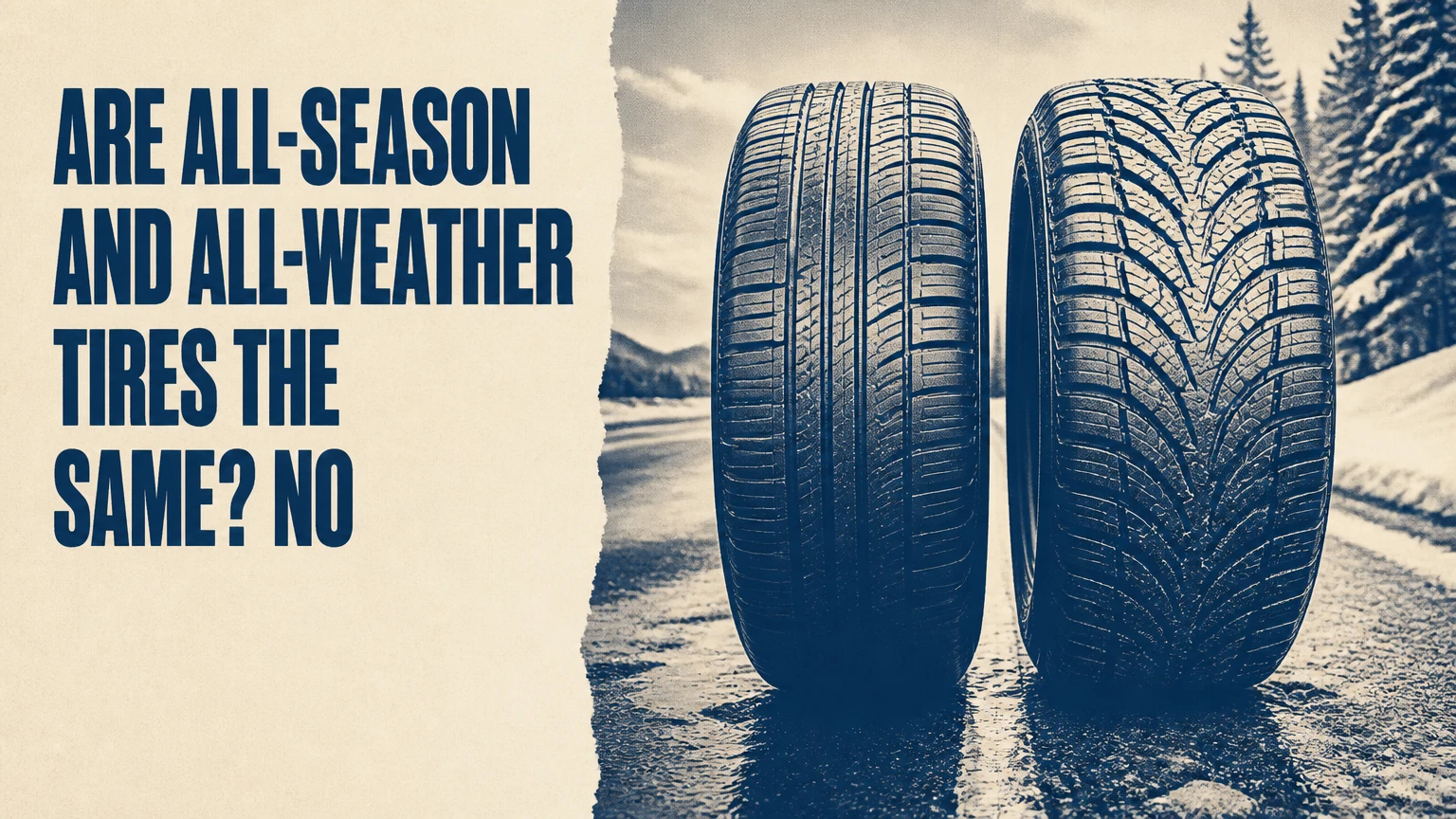
All-season and all-weather tires are not the same category. All-season tires prioritize dry roads, rain, comfort, efficiency, and tread life in mild conditions, while all-weather tires use a more winter-capable compound and tread and usually carry the Three-Peak Mountain Snowflake symbol for tested severe-snow traction. Neither category automatically replaces a dedicated winter tire in extreme ice or deep snow.
Key Facts at a Glance
- All-season tires generally favor warm-weather handling, quietness, fuel economy, and longer tread life.
- All-weather tires are a compromise between conventional all-season tires and dedicated winter tires.
- The 3PMSF symbol identifies a tire that passed a standardized snow-traction test; it does not guarantee strong ice braking.
- The often-cited 7°C or 45°F threshold is a practical winter-tire guideline, not a legal changeover temperature for every tire.
- All-wheel drive improves acceleration but does not shorten braking distances on an unsuitable tire.
- Drivers facing frequent ice, deep snow, mountain travel, or unplowed roads usually benefit from dedicated winter tires.
What Is the Difference Between All-Season and All-Weather Tires?
All-season tires are primarily three-season tires with limited winter ability, whereas all-weather tires are four-season compromises designed to retain usable winter traction without requiring a second tire set. The difference comes from the compound, tread geometry, sipe density, casing, and certification, not merely from the words printed in a product name.
“All-season” and “all-weather” are marketing categories rather than perfectly uniform global engineering standards. A manufacturer can position a tire between categories, so buyers should inspect the sidewall markings and the manufacturer’s technical description instead of relying only on the label.
Conventional all-season tires typically use a compound tuned for dry pavement, rain, and moderate temperatures. Their tread blocks are often more continuous, which reduces noise and rolling resistance. All-weather tires usually have more open grooves, greater sipe density, sharper block edges, and a compound that remains more flexible in cold conditions.
The distinction is about priority. An all-season tire commonly gives away winter grip to improve mileage and warm-weather refinement. An all-weather tire gives away some summer precision, efficiency, or tread life to gain cold-weather traction.
Is the 7°C Rule Exact?
The 7°C rule is a useful guideline, not a switch that makes every all-season tire unsafe below 7°C. Tire behavior changes progressively with temperature, and pavement moisture, ice, speed, tread depth, tire model, and inflation pressure also affect grip.
A common winter-tire recommendation uses 7°C, or 45°F, because many winter compounds remain more flexible below that point than standard all-season compounds. The Tire and Rubber Association of Canada uses the 7°C guideline in consumer winter-tire education, but the exact performance crossover differs by product.
An all-season tire can remain controllable at 5°C on a dry road. That fact does not mean it will match an all-weather or winter tire on cold, wet, slushy pavement. Treat 7°C as a seasonal planning threshold, not a precise failure temperature.
How Do the Tire Designs Behave?
All-season tires use continuous tread elements and moderate siping to maintain a stable contact patch, evacuate rainwater, and limit tread movement. All-weather tires add more biting edges and open channels, which improve snow and slush evacuation but can increase noise and rolling resistance.
| Design attribute | Conventional all-season | All-weather | Dedicated winter |
|---|---|---|---|
| Typical compound priority | Dry, wet, mild temperatures | Cold flexibility plus summer usability | Maximum cold flexibility |
| Sipe density | Moderate, often 1-3D grooves | High, often 2D and 3D sipes | Very high, flexible block edges |
| Main groove design | Continuous rain channels | Wider slush and snow channels | Deep channels and snow-catching voids |
| Block stability | High on dry pavement | Moderate to high | Lower for warm-dry precision |
| Severe-snow marking | Usually M+S; 3PMSF varies | Commonly 3PMSF | Commonly 3PMSF |
| Best operating emphasis | Rain, dry roads, mild winters | Mixed seasons and moderate snow | Ice, packed snow, persistent cold |
Sipes create small edges that press into snow and help disperse water. They cannot create friction on glare ice by themselves. Ice traction depends heavily on compound flexibility, surface temperature, tread contact, vehicle speed, and sometimes studs where legal.
All-weather tread blocks are not automatically better in heavy rain. Their open tread can evacuate slush effectively, but a touring all-season tire may deliver shorter wet braking and a quieter ride because its contact elements are more stable.
What Does the 3PMSF Symbol Mean?
The 3PMSF symbol means a tire met a defined snow-traction performance threshold in a standardized test compared with a reference tire. The mark is represented by a mountain with three peaks surrounding a snowflake and is more meaningful for winter use than the M+S marking alone.
M+S, or mud and snow, is a manufacturer-declared tread designation in many markets. It does not require the same severe-snow test used for 3PMSF. A tire can carry M+S and still perform poorly on packed snow or ice.
The 3PMSF test has limits. It measures snow traction under specified conditions, not braking on black ice, cornering on a frozen road, longevity, or performance in every snow depth. Transport Canada and provincial authorities also set their own rules, so certification does not automatically satisfy every local winter-tire law.
Which Tire Performs Better in Common Conditions?
All-season tires generally perform better on warm dry pavement, while all-weather tires generally perform better in cold rain, slush, and light-to-moderate snow. Dedicated winter tires remain the strongest option for repeated ice, deep snow, and temperatures that stay below freezing.
| Driving condition | Conventional all-season | All-weather | Dedicated winter |
|---|---|---|---|
| Hot, dry highway at 30°C | Strong stability and efficiency | Usable, with more tread movement | Excessive wear and softer handling |
| Heavy rain at 15°C | Often shortest wet stopping among the three | Strong evacuation, model-dependent | Safe but less precise in warmth |
| Cold rain at 3°C | Adequate to moderate | Usually stronger cold grip | Strongest cold compound response |
| Fresh snow, 5 cm | Limited to moderate | Moderate to strong, 3PMSF-dependent | Strongest traction |
| Packed snow | Weak to moderate | Moderate | Strong |
| Glare ice at -10°C | Weak | Better than all-season, still limited | Strongest non-studded option |
| Deep unplowed snow | Poor | Limited by clearance and void depth | Better, but vehicle clearance still matters |
No seasonal tire wins every test. A performance all-season tire can out-handle an all-weather tire on a dry summer road, while the all-weather tire can provide a meaningful safety margin during an unexpected February snowfall.
Consumer Reports and independent tire testing organizations regularly find large differences between individual models within the same category. Category labels establish a starting expectation; model-specific braking and handling results determine the final ranking.
Are All-Weather Tires Good in Summer?
All-weather tires are suitable for summer driving, but they rarely equal the sharp steering response, low noise, fuel economy, and heat durability of a well-designed touring or performance all-season tire. The difference becomes more noticeable during fast cornering, emergency lane changes, and sustained hot-weather highway travel.
A driver who spends July on dry highways may prefer an all-season tire. A driver who uses one tire set through cold rain and snow may accept the all-weather trade-off. Tire pressure, alignment, vehicle weight, and compound design can matter more than the category name in ordinary commuting.
What Tire Types Are Available?
All-season and all-weather labels contain several subcategories, so the correct comparison must include the vehicle and intended use. A touring all-season tire, ultra-high-performance all-season tire, passenger all-weather tire, and all-weather all-terrain tire have different priorities.
| Tire type | Typical warranty range | Typical tread depth | Primary vehicle use | Representative examples |
|---|---|---|---|---|
| Touring all-season | 60,000-90,000 miles | 10/32-12/32 inch | Sedan, crossover, commuter | Michelin Defender2, Goodyear Assurance ComfortDrive |
| UHP all-season | 30,000-50,000 miles | 9/32-11/32 inch | Sport sedan, performance SUV | Michelin Pilot Sport All Season 4, Continental DWS06 Plus |
| Passenger all-weather | 50,000-60,000 miles | 10/32-12/32 inch | Sedan, crossover, mixed climate | Michelin CrossClimate2, Bridgestone WeatherPeak |
| All-weather all-terrain | 50,000-60,000 miles | 12/32-14/32 inch | Pickup, SUV, gravel and snow | BFGoodrich All-Terrain T/A KO3, Falken Wildpeak A/T4W |
Warranty mileage is not a guaranteed service life. Heat, underinflation, alignment faults, aggressive acceleration, road surfaces, and low annual mileage can change the outcome.
An all-terrain tire with a 3PMSF symbol may improve snow mobility for a truck, but it can be noisier and less effective on ice than a passenger winter tire. Deeper tread also does not compensate for an unsuitable compound.
How Much Do All-Season and All-Weather Tires Cost?
Typical retail pricing is about $80-$200 per all-season tire and $130-$300 per all-weather tire in common passenger sizes, before mounting, balancing, taxes, and disposal fees. Larger wheels, premium brands, run-flat construction, and SUV load ratings can push both categories well above those ranges.
| Cost item | All-season typical range | All-weather typical range | Replacement timing |
|---|---|---|---|
| Passenger tire, each | $80-$200 | $130-$300 | As tread or age requires |
| Set of four | $320-$800 | $520-$1,200 | Usually 3-7 years, condition-dependent |
| Mount, balance, disposal | $80-$180 per set | $80-$180 per set | At installation |
| Seasonal swap, twice yearly | $100-$240 annually | $0 for tire swaps | Applies when using two sets |
| Storage, annual | $60-$150 | $0 | Applies when using two sets |
| Rotation interval | 5,000-8,000 miles | 5,000-8,000 miles | About every 6-12 months |
All-weather tires can cost more initially, but one set may avoid annual swapping and storage. The financial advantage disappears if a driver replaces the all-weather set substantially sooner because of high mileage or hot-weather wear.
Tire age also matters. NHTSA advises owners to inspect tires regularly and follow the vehicle and tire manufacturers’ replacement guidance; many manufacturers recommend replacement around six years from service or ten years from manufacture, even when tread remains.
Which Tire Should Each Driver Choose?
The best choice depends on snowfall frequency, ice exposure, temperature, annual mileage, vehicle type, and tolerance for seasonal maintenance. The practical decision is not “which tire is universally better?” but “which performance compromise matches the roads this vehicle actually uses?”
Mild-Winter Commuter
Choose a touring all-season tire when winters bring occasional frost or light snow, roads are quickly cleared, and summer driving dominates. A 70,000-90,000-mile warranty, low rolling resistance, and quieter tread can make this category the better daily choice.
Do not choose it for a driver who must leave before roads are treated or regularly crosses steep, snowy routes.
Four-Season Driver Without Storage
Choose an all-weather tire when snowfall occurs several times each winter, temperatures routinely fall near freezing, and storing two tire sets is impractical. The 3PMSF marking gives a stronger severe-snow baseline than M+S alone.
All-weather tires are especially practical for moderate climates with alternating rain, frost, slush, and dry pavement.
Mountain or Ice-Belt Driver
Choose dedicated winter tires when the vehicle regularly encounters packed snow, freezing rain, steep grades, unplowed roads, or prolonged temperatures below freezing. A true winter tire has a more cold-flexible compound and tread designed around snow and ice rather than year-round compromise.
An all-weather tire may be acceptable for occasional storms, but it is not a substitute for maximum winter braking.
Performance-Car Owner
Choose a UHP all-season tire for warm-weather steering response when winter driving is limited to light snow or cold rain. Choose separate summer and winter sets when dry-road handling and winter grip both matter, because one compromise tire cannot equal the best specialized tire in both seasons.
Pickup or SUV Owner
Choose an all-weather all-terrain tire when gravel, mud, light off-road travel, and certified snow traction are all part of the use case. Choose a passenger all-weather tire instead when the vehicle stays on pavement, because aggressive all-terrain tread can increase noise, weight, and rolling resistance without improving everyday braking.
What Mistakes Cause Poor Results?
Most tire problems blamed on the category actually come from incorrect fitment, low pressure, mixed designs, worn tread, or an unrealistic assumption about winter capability. Tire maintenance cannot turn a worn all-season tire into a winter tire.
- Buying by the label alone: Confirm size, load index, speed rating, 3PMSF status, warranty, and independent test results.
- Treating M+S as winter certification: M+S does not equal 3PMSF severe-snow performance.
- Mixing categories on one axle or vehicle: Different tread response can confuse stability control and produce uneven handling, especially during braking.
- Ignoring inflation pressure: Check pressure monthly and before long trips when the tires are cold; use the vehicle placard, not the maximum pressure molded into the sidewall.
- Keeping a tire because tread remains: Cracking, bulges, vibration, irregular wear, and age can require replacement before the legal tread minimum.
- Assuming AWD solves winter grip: AWD distributes engine torque, but all four tires still need adequate braking and cornering traction.
A vehicle with uneven tread depth may pull or respond inconsistently even when all four tires share the same model. Replace tires in axle pairs when possible, and follow the vehicle manufacturer’s instructions for AWD tread-difference limits.
Why Are All-Weather Tires Wearing Quickly?
All-weather tires can wear faster in hot weather because their compound and tread geometry prioritize cold-weather flexibility and biting edges. Underinflation, aggressive alignment angles, heavy loads, and high ambient temperatures accelerate the pattern.
Use the vehicle placard pressure, rotate at 5,000-8,000 miles, and have alignment checked when wear appears on one shoulder. Heel-and-toe wear can create a hum that drivers mistake for a defective tire.
Why Do All-Season Tires Slip in Winter?
All-season tires lose winter performance when their compound becomes less flexible and their tread edges cannot generate enough grip on snow or ice. The loss is gradual, but braking distance and cornering control can deteriorate before the driver notices a visible problem.
Cold pavement is not the same as ice. A well-maintained all-season tire may be adequate on a dry road at -2°C, yet inadequate on polished snow at the same temperature.
What Should You Check Before Buying?
Verify the tire’s complete specification, not just its seasonal category. The correct tire must match the vehicle’s approved size, load index, speed rating, construction, and any run-flat or electric-vehicle requirements.
Use this buying sequence:
- Read the driver-door placard for approved size and pressure.
- Match or exceed the original-equipment load index and speed rating.
- Confirm 3PMSF if snow performance is a purchase requirement.
- Compare wet braking, snow braking, noise, rolling resistance, and tread warranty for the exact model.
- Check the DOT date code and avoid old inventory when fresher stock is available.
- Install four matching tires whenever possible.
- Recheck pressure after installation and schedule rotation at 5,000-8,000 miles.
Legal requirements vary. Quebec, British Columbia, Colorado, and European jurisdictions do not apply identical winter-tire rules, and some laws specify dates, road conditions, 3PMSF status, or minimum tread depth. Check the transport authority where the vehicle is registered and driven.
All-Season and All-Weather Tires: The Bottom Line
Are all-season and all-weather tires the same? No. All-season tires are usually the stronger choice for warm, wet, and dry driving with mild winters, while all-weather tires are the more balanced choice for drivers who face recurring cold, slush, and moderate snow but want one year-round set.
Choose dedicated winter tires when ice, deep snow, mountain roads, or persistent freezing temperatures dominate the route. Whichever category you select, verify 3PMSF status, load and speed ratings, tire age, pressure, and vehicle compatibility before installation.
Frequently Asked Questions
Can all-weather tires replace winter tires?
All-weather tires can replace winter tires for some drivers in moderate winter climates, especially where snow is intermittent and roads are promptly cleared. They cannot match dedicated winter tires on glare ice, deep snow, severe cold, or repeated mountain travel. The 3PMSF symbol confirms tested snow traction, not maximum winter performance.
Are all-season tires better for rain?
All-season tires are often optimized for warm and moderate-temperature rain, with stable tread blocks and low rolling resistance. All-weather tires can perform very well in cold rain and slush because of their open grooves and flexible compound. The exact model’s wet-braking test result matters more than the category name.
Can you mix all-season and all-weather tires?
Do not mix all-season and all-weather tires casually. Install four matching tires whenever possible, because different compounds and tread patterns can alter braking, cornering, and stability-control behavior. If only two tires are replaced, follow the vehicle and tire manufacturer’s placement guidance, which commonly puts the pair with greater tread depth on the rear axle.
Do all-weather tires use more fuel?
All-weather tires may use slightly more fuel than low-rolling-resistance touring all-season tires because deeper grooves, heavier construction, and flexible tread blocks increase rolling resistance. The difference varies by model, pressure, temperature, vehicle, and driving speed. Correct inflation can offset part of the efficiency penalty.
How often should either tire type be rotated?
Rotate all-season and all-weather tires about every 5,000-8,000 miles, or according to the vehicle manufacturer’s schedule. Rotate sooner when the vehicle has front-wheel drive, high torque, uneven wear, or frequent short trips. Inspect tread depth, shoulder wear, cracks, and pressure at every service.
Is a 3PMSF tire safe on ice?
A 3PMSF tire is safer on snow than a tire with only an M+S marking, but the symbol does not certify ice braking. Dedicated winter tires generally use compounds and tread designs that provide better ice traction. Drive below the limit, increase following distance, and use approved chains or studs where conditions and law require them.


