No. All-season tires are adequate for mild cold, rain, and occasional light snow, but dedicated snow or winter tires provide better braking, cornering, and traction on cold pavement, packed snow, and ice. The difference comes from winter-tire rubber compounds and tread designs that remain flexible below about 7°C (45°F).
Key Facts at a Glance
Dedicated winter tires remain more flexible than standard all-season tires in sustained temperatures below approximately 7°C (45°F).
The 3PMSF symbol identifies a tire that meets a standardized severe-snow performance requirement; M+S alone does not.
All-wheel drive improves acceleration on slippery surfaces, but winter tires still determine much of the vehicle’s braking and cornering grip.
All-weather tires offer a certified winter compromise, while dedicated winter tires remain the stronger choice for frequent snow, ice, and sub-freezing travel.
Winter tires should be installed as a matching set of four, not only on the vehicle’s powered axle.
Typical winter-tire ownership costs include $500-$1,100 for tires, plus $200-$400 for a second wheel set if desired.
Are All-Season Tires as Good as Snow Tires?
All-season tires are not as good as snow tires when temperatures stay below freezing or roads contain snow and ice. All-season tires usually deliver quieter operation, longer tread life, and stronger warm-weather value, while winter tires trade some summer efficiency for shorter stopping distances and more predictable control in severe winter conditions.
The practical answer depends on exposure, not the calendar. A driver in Atlanta who encounters one brief snowfall has a different requirement from a driver in Minneapolis, Montreal, Denver’s foothills, or a rural area where roads remain packed for days.
A standard all-season tire can be a sensible choice when winter means cold rain, occasional flurries, promptly cleared roads, and daytime temperatures mostly above freezing. It is a poor substitute when the vehicle regularly encounters hard-packed snow, black ice, steep untreated roads, or temperatures below 7°C.
Quick verdict by driver
| Driver situation | Recommended tire | Reason |
|---|---|---|
| Warm climate, rare frost | Standard all-season | Better heat tolerance, cost, and tread life |
| Mild city winter, occasional snow | All-weather, 3PMSF | Year-round use with certified snow performance |
| Frequent snow and sub-freezing roads | Studless winter | Best balance of ice grip, noise, and road compatibility |
| Mountain roads and persistent glare ice | Studded winter where legal | Metal studs add bite on polished ice |
| AWD vehicle in a snowy region | Four winter tires | AWD cannot replace braking and cornering grip |
What Is the Difference Between All-Season and Winter Tires?
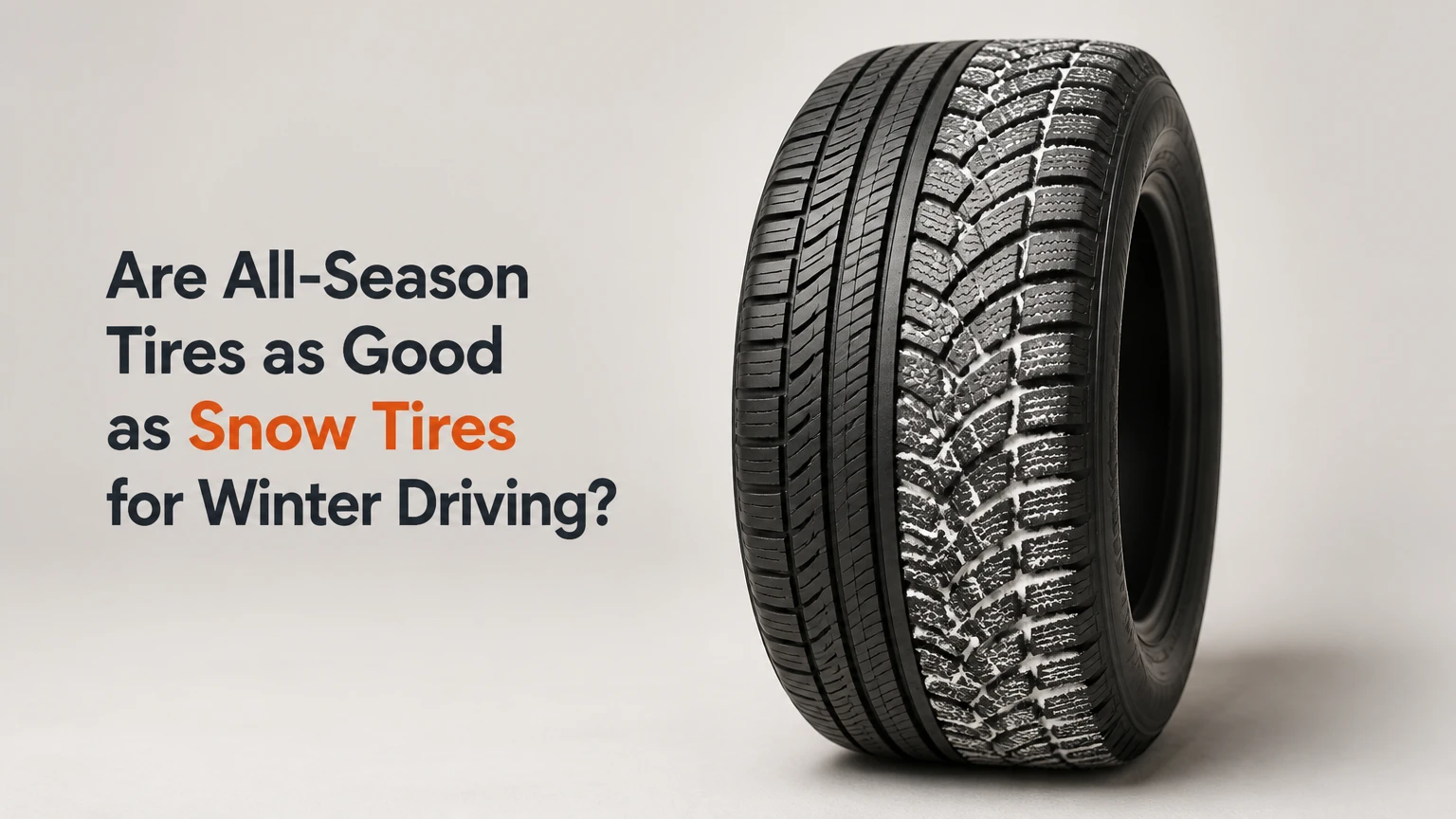
All-season tires use a compromise compound and tread pattern for dry roads, rain, light snow, comfort, and mileage. Winter tires use softer cold-weather rubber, deeper voids, more flexible tread blocks, and many additional sipes to maintain contact and generate edges in snow and ice.
Rubber flexibility matters because tire grip depends on the tread conforming to microscopic road texture. As temperatures fall, many all-season compounds become less compliant. The 7°C guideline describes the point at which winter-oriented designs commonly begin to show an advantage, although the actual crossover varies by tire model, road surface, inflation, and vehicle.
Tread geometry matters just as much. Standard all-season tires often use continuous ribs and fewer sipes to improve steering response and wear on dry pavement. Winter tires use independent blocks and dense sipe networks that open under load, creating biting edges and channels for snow, slush, and water.
The “snow grips snow” principle also has a mechanical basis. Snow trapped in a winter tire’s voids can interlock with snow on the road, whereas a relatively closed all-season tread may fill and lose its edges sooner.
Tire design comparison
| Attribute | Standard all-season | All-weather | Studless winter | Studded winter |
|---|---|---|---|---|
| Cold-weather target | Above roughly 7°C preferred | Mild to moderate winter | Sustained sub-freezing use | Persistent ice and hard-packed snow |
| Winter marking | Usually M+S | 3PMSF | 3PMSF | 3PMSF |
| Sipe density | Low to moderate | Moderate to high | High | High plus metal studs |
| Dry-summer behavior | Quiet and stable | Acceptable, faster wear | Softer, less precise | Noisy and faster wear |
| Best surface | Dry, wet, light snow | Rain, slush, light-medium snow | Snow, ice, cold asphalt | Glare ice and packed snow |
Why Do Winter Tires Grip Better in Cold Weather?
Winter tires grip better because their compounds stay flexible and their tread blocks retain usable edges when cold pavement reduces the performance of standard all-season rubber. The result is greater road conformity, more snow evacuation, and more controlled braking under winter loads.
The 7°C threshold is useful for scheduling, but it should not be interpreted as a switch that makes an all-season tire suddenly unsafe at 6°C. Tire construction, asphalt temperature, moisture, sunlight, and speed all affect traction. A wet road at 2°C can be more hazardous than a dry road at -5°C.
Winter tires also behave differently during braking. A softer compound can deform around surface texture, while dense sipes create small edges that resist sliding. The trade-off appears on dry pavement, where flexible tread blocks can produce slower steering response and more squirm.
The U.S. Tire Manufacturers Association summarizes the central safety principle this way: “Tires are the only part of your vehicle that touches the road.” That contact patch is small, so drivetrain power cannot compensate for a compound and tread unsuitable for the surface.
How Much Better Are Winter Tires on Snow and Ice?
Winter tires commonly produce a meaningful braking advantage over all-season tires on snow and ice, but no single percentage applies to every tire, vehicle, speed, or surface. A typical comparison can show 30% or more improvement in stopping distance, while some tests show much larger differences under severe ice conditions.
The frequently repeated claim of an exact 26-meter difference from 48 km/h should not be treated as universal. Results change with tread depth, ABS calibration, temperature, ice texture, tire brand, vehicle mass, and whether the all-season tire is new or worn.
Typical performance pattern
| Driving condition | Standard all-season response | Winter-tire response | Main safety consequence |
|---|---|---|---|
| Dry pavement at 20°C | Precise and quiet | Adequate, softer steering | All-season usually feels better |
| Wet pavement at 5°C | Variable cold grip | Usually more compliant | Winter tire offers a margin |
| Light snow at 0°C | Usable with careful speed | Stronger launch and braking | Winter tire controls better |
| Packed snow at -10°C | Reduced bite and more slip | Deep edges and flexible compound | Winter tire is strongly favored |
| Glare ice below 0°C | Very limited grip | Better, though still limited | Speed reduction remains essential |
Winter tires cannot make ice behave like dry asphalt. Even the best studless design can slide when a driver accelerates, brakes, or turns too abruptly. Traction control and ABS manage wheel slip, but they cannot create friction that the road surface does not provide.
What Do M+S and 3PMSF Mean?
M+S means Mud and Snow, but the marking does not prove that a tire passed a severe-snow traction test. The 3PMSF symbol, a mountain with three peaks and a snowflake, indicates that the tire met a defined severe-snow performance requirement under the applicable testing standard.
M+S is often found on conventional all-season and all-terrain tires. The designation primarily relates to tread geometry and the tire manufacturer’s classification. It does not establish performance on ice, freezing rain, or prolonged sub-zero pavement.
3PMSF is more useful for winter selection because it involves a standardized snow-traction test. It still does not mean the tire is a dedicated winter tire, and it says little about braking on glare ice. A 3PMSF all-weather tire usually sacrifices some summer wear and steering sharpness for better cold-weather capability.
Check local regulations before driving across borders or mountain passes. Some jurisdictions recognize 3PMSF tires for winter requirements, while others specify tread depth, chains, or approved stud periods.
Are All-Weather Tires a Better Middle Ground?
All-weather tires are a better middle ground for drivers who need one year-round set and encounter regular but moderate winter conditions. Unlike most standard all-season tires, all-weather models carry the 3PMSF symbol and use a more winter-capable compound and tread design.
The compromise is real. All-weather tires generally wear faster in hot weather, produce more tread noise, and feel less crisp than a touring all-season tire. They also remain less capable than dedicated winter tires on deep snow, polished ice, and long sub-zero journeys.
For many urban drivers, the compromise is rational. A driver who cannot store or swap two sets may gain more practical safety from a reputable 3PMSF all-weather tire than from a standard all-season tire used through repeated snowstorms.
When each category makes sense
| Tire category | Typical purchase range, four tires | Seasonal convenience | Winter capability | Main limitation |
|---|---|---|---|---|
| Standard all-season | $400-$900 | One set | Light snow and cold rain | Weak ice and packed-snow grip |
| All-weather | $500-$1,000 | One set | Light to medium snow | Faster warm-weather wear |
| Studless winter | $500-$1,100 | Seasonal swap | Strong snow and ice performance | Extra storage and changeover |
| Studded winter | $600-$1,200 | Seasonal swap | Maximum ice bite where legal | Noise, road wear, restrictions |
Prices are typical North American retail ranges for common passenger-car and crossover sizes, excluding premium fitments, taxes, mounting, and alignment. A large SUV, performance vehicle, or EV can exceed these ranges because of tire size, load rating, and speed rating.
When Should You Change to Winter Tires?
Install winter tires before sustained daily temperatures remain near 7°C, commonly in October or November in northern regions. Remove them when spring temperatures consistently stay above that range, often in March or April, because warm pavement accelerates wear in the softer compound.
Temperature is a better trigger than the first forecast snow. Waiting for a storm creates appointment shortages and leaves the vehicle on summer-oriented rubber during the first freezing mornings. Drivers in mountainous regions should also consider elevation, because passes can remain cold while the home valley is mild.
A second wheel set usually reduces repeated mounting costs and protects tire beads from twice-yearly demounting. Seasonal storage should keep tires indoors, away from sunlight, ozone-producing motors, standing water, and extreme heat.
Rotate tires according to the vehicle and tire manufacturer’s schedule, commonly every 8,000-12,000 kilometers. Check inflation when the tires are cold, using the pressure on the driver-door placard rather than the maximum pressure molded into the sidewall.
Does AWD Replace Winter Tires?
AWD does not replace winter tires because all-wheel drive helps transmit engine power during acceleration, while tires determine most available braking and cornering friction. An AWD vehicle on all-season tires can start moving effectively and still slide through a turn or require a longer stop on ice.
Michelin states the distinction directly: “AWD helps you go, but it doesn’t help you stop or steer.” The wording captures the common driver error. Four driven wheels can reduce wheelspin during takeoff, but all four tires still need appropriate compound and tread to slow the vehicle.
AWD also adds weight and complexity, which can increase confidence without reducing physical stopping distance. Electronic stability control can help correct a developing skid, but it works within the grip available from the tires.
For an AWD crossover used in a snowy climate, install four matching winter tires with the correct load index, speed rating, diameter, and rolling circumference. Mixing winter and non-winter tires can produce unpredictable handling and, on some vehicles, drivetrain stress.
When Are Studded Tires Worth Considering?
Studded tires are worth considering for frequent travel on glare ice, hard-packed snow, steep untreated roads, and rural routes where sanding or plowing is delayed. Studs can provide additional mechanical penetration into ice, but they are noisy, wear roads, perform less advantageously on bare pavement, and are restricted in some regions.
Studless winter tires are usually the better default for urban drivers who encounter alternating dry pavement, slush, snow, and ice. Modern studless designs use silica-rich compounds, high sipe counts, and specialized tread blocks to create grip without metal hardware.
Do not assume studs are automatically safer in every winter condition. On wet or dry bare asphalt, studs may reduce smoothness and can offer less benefit than a high-quality studless tire. Verify local dates and legal limits before purchase, because regulations vary by state, province, and municipality.
What Does a Second Tire Set Cost?
A second winter tire set typically costs $500-$1,100, while an additional set of steel or alloy wheels often costs $200-$400. Seasonal mounting and balancing commonly cost $60-$120 per visit, so two annual visits add approximately $120-$240 when tires share one wheel set.
Typical ownership expenses
| Expense | Typical amount | Timing | Cost-control choice |
|---|---|---|---|
| Four standard all-season tires | $400-$900 | Every 4-6 years, usage dependent | Buy correct size, not oversized wheels |
| Four winter tires | $500-$1,100 | Commonly 4-5 winter seasons | Preserve them with seasonal use |
| Steel wheel set | $200-$400 | One-time purchase | Avoid repeated tire demounting |
| Seasonal mounting | $60-$120 per visit | Twice yearly | Use complete mounted assemblies |
| Tire storage | $50-$150 per season | Twice yearly or annual | Store indoors if permitted |
Tire lifespan is not determined by tread depth alone. Heat exposure, age, ultraviolet light, alignment, inflation, and driving style also matter. Inspect for cracking and follow the vehicle and tire maker’s replacement guidance; many manufacturers advise replacing tires around six to ten years from manufacture regardless of remaining tread.
Why Is the Car Vibrating After Snowfall?
A vehicle that vibrates after snowfall often has packed snow or ice inside a wheel, not a failed balance. Snow freezes to the inner wheel barrel and creates an imbalance that becomes noticeable at highway speeds.
Stop safely and inspect all four wheels, especially the inner surfaces that are difficult to see from outside. Remove packed material with warm water or a suitable tool, never by striking an aluminum wheel or forcing a frozen object against a brake component.
If vibration remains after cleaning, request a balance check and inspect for a bent wheel, separated tire belt, uneven wear, or low pressure. Winter tires can also feel softer in steering because their tread blocks move more under load. That sensation is normal within limits, but sudden pulling or severe wobble requires inspection.
Cold weather lowers tire pressure. A commonly used approximation is about 1 psi for every 10°F, or roughly 1 psi for every 5.5°C, change in temperature. Set pressure when the tires are cold and recheck after a significant weather change.
Which Tire Type Fits Your Driving Situation?
The best tire choice depends on winter temperature, snow frequency, road treatment, driving hours, and tolerance for seasonal maintenance. A standard all-season tire suits warm climates, an all-weather tire suits moderate mixed conditions, and a dedicated winter tire suits repeated severe exposure.
Mild-city commuter
Choose a 3PMSF all-weather tire if the city receives occasional snow but clears major roads quickly. Choose a standard all-season tire only when freezing conditions are rare and the vehicle can remain parked during storms.
Severe-winter commuter
Choose studless winter tires if the vehicle travels daily through sub-freezing temperatures, packed snow, slush, or untreated residential streets. The extra purchase and storage work buy more consistent braking and cornering control when conditions are worst.
Mountain or rural driver
Choose a winter tire matched to local law and road conditions. Studded tires may be justified on persistent glare ice and steep untreated grades, while studless tires remain preferable when routes alternate between bare pavement and snow.
Infrequent winter driver
If the vehicle can stay parked during storms and winter travel is limited to cleared urban roads, all-weather tires may provide a practical balance. If a long highway trip is unavoidable, check weather, carry required equipment, and reduce speed regardless of tire type.
Electric-vehicle owner
EV drivers should verify load index, speed rating, rolling resistance, and manufacturer approval before selecting winter tires. Instant electric torque can overwhelm low-grip all-season tires during takeoff, while a winter tire’s additional rolling resistance can reduce range.
Common Mistakes That Reduce Winter-Tire Safety
Avoid these errors when selecting or using winter tires:
- Installing winter tires only on the drive axle: Use four matching winter tires. Two winter tires can create a grip imbalance that promotes oversteer or understeer.
- Treating M+S as winter certification: M+S does not equal 3PMSF and does not guarantee ice performance.
- Leaving winter tires on through summer: Hot pavement softens the compound, increases wear, and can reduce dry-road handling.
- Using the vehicle’s maximum sidewall pressure: Follow the door-placard pressure, then check it cold.
- Ignoring tread depth: A worn winter tire loses the deep grooves and sipe effectiveness that make it useful in snow.
- Driving at summer speeds in winter conditions: No tire removes the need for longer following distances, smoother inputs, and lower speeds.
The most counterintuitive rule is that tread depth and compound work together. A winter tire with substantial-looking grooves but an aged, hardened compound may perform poorly, while a newer tire with less visible wear can retain better cold-weather flexibility.
FAQ
Are all-season tires safe for one day of snow?
All-season tires can be safe for limited travel in light snow when tread is healthy, pressure is correct, speeds are low, and roads are not icy. They become a poor choice when snow is deep, roads are untreated, temperatures remain below freezing, or the driver must stop and turn repeatedly on compacted snow.
Are snow tires better than all-season tires in rain?
Winter tires can perform well in cold rain because their compounds remain flexible, but a quality all-season tire may provide stronger wet handling in warm rain. The correct comparison depends on temperature, tread design, water depth, and the specific models rather than the category name alone.
Can I use two winter tires with two all-season tires?
Using only two winter tires is unsafe because it creates different grip levels between axles. Install four winter tires with compatible size, load rating, speed rating, and tread design, following the vehicle manufacturer’s instructions for AWD, ABS, and stability-control systems.
Do winter tires improve braking on dry cold pavement?
Winter tires often improve grip on cold dry pavement because their compounds remain compliant below approximately 7°C. Their flexible tread can feel less precise than all-season rubber, however, so the benefit is greatest when low temperature combines with snow, slush, moisture, or ice.
How many years do winter tires last?
A dedicated winter set commonly lasts four to five winter seasons, but mileage, storage, tread depth, heat exposure, alignment, and age determine the actual replacement point. Inspect each season for cracking, uneven wear, damaged studs, and insufficient tread instead of relying on a fixed year count.
Are all-weather tires good enough for Canadian winters?
All-weather tires can suit Canadian drivers in moderate cities with frequent plowing and limited mountain or rural travel. Drivers facing prolonged sub-zero temperatures, deep snow, black ice, or untreated roads generally gain stronger braking and control from dedicated winter tires.
The Bottom Line
Are all-season tires as good as snow tires? No. Standard all-season tires are more convenient and often better suited to warm, wet, or lightly wintry climates, but dedicated winter tires provide superior cold-weather traction, snow evacuation, braking, and cornering control.
Choose all-weather tires when one year-round set must handle moderate winter conditions. Choose four dedicated winter tires when snow, ice, sub-freezing pavement, mountain routes, or daily winter travel are predictable parts of driving. AWD can help you accelerate, but only suitable tires can provide the contact-patch grip needed to stop and steer.