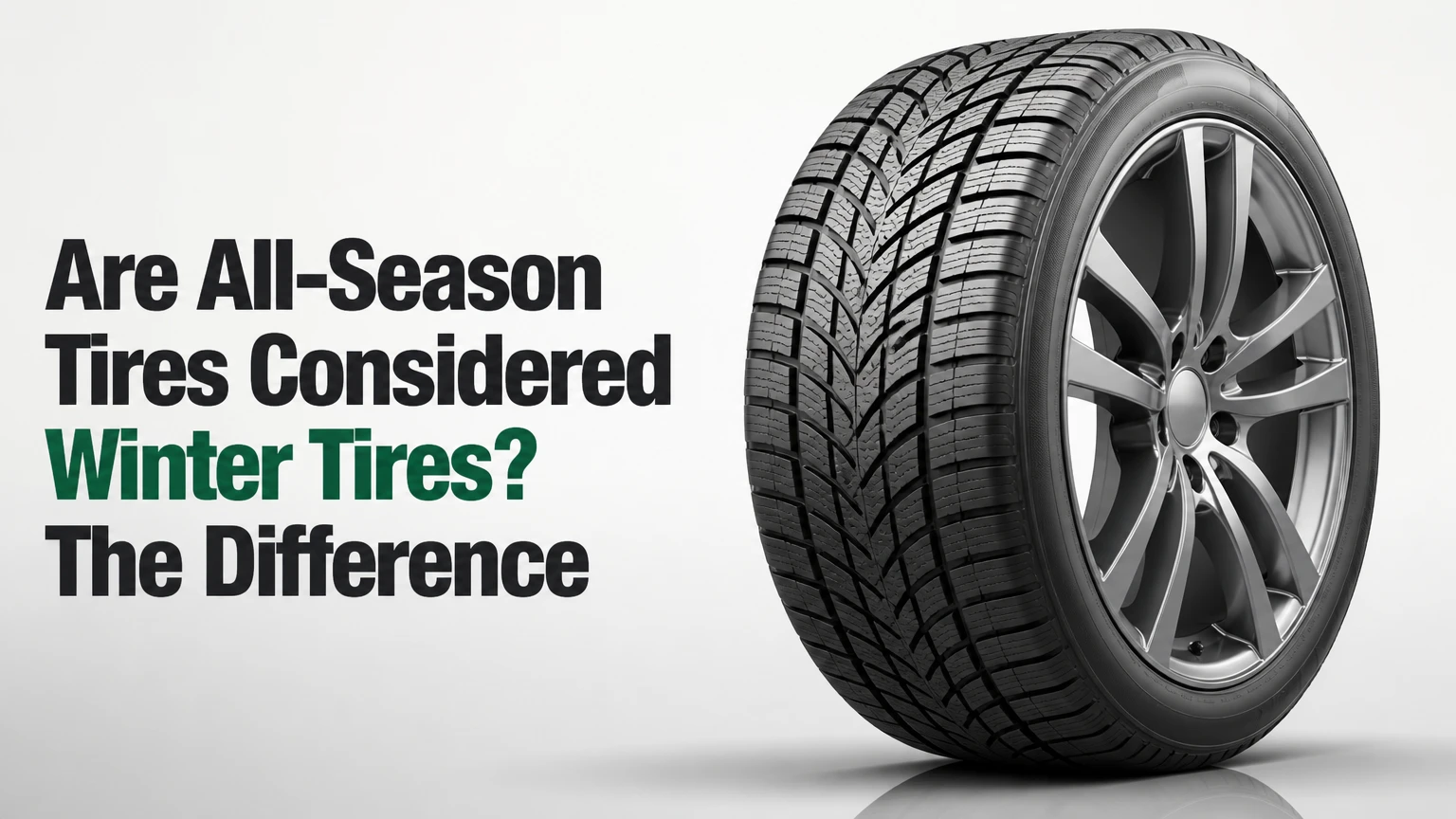
No, all-season tires are not considered winter tires. All-season tires are built for moderate temperatures, rain, dry pavement, and occasional light snow, while winter tires use cold-flexible compounds and specialized tread features for snow and ice. An all-season tire is suitable for mild winters, but it is not a substitute for a dedicated winter tire in severe conditions.
Key Facts at a Glance
- An all-season tire is a compromise tire, not a certified winter tire by default.
- The 7°C or 45°F guideline indicates when winter tires often begin gaining traction advantages; rubber does not suddenly become unsafe at one exact temperature.
- The M+S marking does not prove tested severe-snow performance.
- The 3PMSF symbol identifies a tire that meets a regulated severe-snow traction test, but it does not guarantee strong polished-ice traction.
- All-weather tires usually carry 3PMSF certification and offer more winter capability than ordinary all-season tires.
- AWD improves acceleration on slippery roads, but it does not provide the winter rubber needed for shorter braking or safer cornering.
Are All-Season Tires Considered Winter Tires?
All-season tires are not winter tires because their design priorities differ. An all-season tire balances warm-weather handling, wet-road drainage, cabin comfort, rolling resistance, and long tread life, whereas a winter tire sacrifices some warm-weather efficiency to preserve flexibility and grip in cold conditions.
The term “all-season” also causes confusion because it means different things in different markets. In much of North America, a conventional all-season tire may carry M+S, while an all-weather tire is marketed as a separate year-round product with the 3PMSF symbol. In some regions, retailers use “all-season” loosely for both categories.
The practical distinction is certification and construction. A normal all-season tire can handle cold, dry pavement and light snow, but its compound and tread usually provide less traction as temperatures fall and snow or ice accumulates. A winter tire is engineered around those conditions from the beginning.
What Makes a Winter Tire Different?
Winter tires remain more pliable in low temperatures and use tread blocks, grooves, and sipes that create traction on snow-covered roads. The compound contains a higher proportion of winter-oriented polymers and silica technologies, although the exact formulation varies by manufacturer and model.
A winter tread typically has:
- More biting edges from dense siping
- Deeper tread depth at installation
- Larger grooves and voids for slush evacuation
- Tread blocks designed to compress and release packed snow
- A compound that stays flexible below freezing
Snow traction depends on more than tread depth. Snow can adhere to a suitable tread pattern, creating snow-on-snow friction, while ice requires flexible rubber and many sharp edges. Slush creates a separate problem because the tread must remove water and wet snow quickly enough to maintain road contact.
A winter tire cannot eliminate every hazard. Polished ice, steep grades, excessive speed, worn tread, incorrect pressure, and poor driver inputs can defeat any tire.
Does 7°C Mean All-Season Tires Stop Working?
No. The 7°C or 45°F threshold is a useful seasonal rule, not a precise failure point. All-season tires do not suddenly lose all grip at 7°C, and winter tires do not become unusable above it. The guideline marks a temperature range where winter compounds often begin offering measurable advantages.
Standard all-season compounds are tuned for a wider balance of conditions. As temperatures fall, the tread generally becomes less flexible, which can reduce microscopic road contact and increase braking distance. Winter compounds remain softer, but that flexibility causes faster wear and less precise handling on hot pavement.
The surface temperature matters more than the afternoon air temperature. A shaded road at 4°C can remain slippery, while a sunlit road at the same air temperature may be dry. Drivers should consider overnight lows, road exposure, snowfall frequency, and the number of cold-weather trips rather than treating 7°C as a legal or mechanical switch.
Temperature Is Only One Part of the Decision
Temperature alone cannot determine tire choice. A driver who sees 2°C rain on dry, heavily salted roads may face less tire demand than a driver who encounters -2°C black ice on a rural hill.
Use the 7°C guideline alongside these conditions:
- Frequent snow accumulation
- Freezing rain or black ice
- Unplowed roads
- Hills and untreated rural routes
- Early-morning commuting
- Emergency driving when conditions cannot be postponed
What Do M+S and 3PMSF Mean?
M+S means Mud and Snow, but the marking does not establish the same performance standard as 3PMSF. M+S generally describes a tread pattern with more void area than a basic highway tread, and manufacturers can apply the designation without passing a standardized severe-snow traction test.
The 3PMSF symbol, a three-peak mountain surrounding a snowflake, indicates that the tire passed a regulated severe-snow traction test under the applicable regional standard. It is a stronger winter-performance indicator than M+S, but it does not certify braking on glare ice, performance in every snow depth, or suitability for extreme winter driving.
| Marking | What it indicates | What it does not prove |
|---|---|---|
| M+S | Mud-and-snow tread geometry | Tested severe-snow traction |
| 3PMSF | Passed a severe-snow traction test | Guaranteed ice braking |
| Stud symbol or studded construction | Metal studs installed in tread | Legal use in every jurisdiction |
| UTQG rating | Treadwear, traction, and temperature grades in the United States | Winter suitability |
A tire may carry both markings. When winter capability matters, look for 3PMSF first, then verify the tire’s tested reviews, tread depth, vehicle fitment, and local legal requirements.
How Do All-Season, All-Weather, and Winter Tires Compare?
All-season tires prioritize balanced three-season performance, all-weather tires add verified severe-snow capability, and winter tires maximize cold-weather traction. The categories overlap in marketing language, so the sidewall marking and manufacturer specifications matter more than the product name.
| Tire category | Typical certification | Main operating conditions | Typical usable life |
|---|---|---|---|
| Standard all-season | M+S, sometimes no winter symbol | Dry roads, rain, light snow, roughly above 7°C | 65,000-100,000 km |
| All-weather | Usually 3PMSF and M+S | Year-round driving with recurring moderate snow | 50,000-80,000 km |
| Studless winter | 3PMSF, often M+S | Frequent snow, freezing temperatures, and ice | 3-5 winter seasons |
| Studded winter | 3PMSF where applicable | Hard-packed snow and recurring glare ice | 3-4 winter seasons |
The mileage ranges are typical planning figures, not guarantees. Alignment, inflation, vehicle weight, driving style, heat, road surfaces, and seasonal mileage can shorten or extend service life.
Are All-Weather Tires a Winter Tire Alternative?
All-weather tires are the closest single-set alternative to dedicated winter tires. They usually combine a cold-capable compound with a directional or asymmetric tread, substantial siping, and 3PMSF certification, allowing them to handle moderate snow more effectively than conventional all-season tires.
All-weather tires remain compromises. They commonly produce more noise, wear faster in hot weather, and provide less ice and deep-snow traction than dedicated winter tires. They suit drivers who need one set year-round and encounter occasional snow, but they are a weaker choice for frequent mountain travel or untreated roads.
Which Tire Performs Better in Snow and Ice?
Dedicated winter tires generally provide the strongest snow and ice traction because their compound stays flexible and their tread presents more biting edges. The size of the advantage varies with speed, vehicle, tire model, snow temperature, road surface, tread depth, and whether the comparison tire is a basic all-season or a 3PMSF all-weather tire.
| Driving condition | Standard all-season | All-weather | Dedicated winter |
|---|---|---|---|
| Dry pavement at 20°C | Strong steering response | Moderate response | Softer response |
| Wet pavement at 10°C | Strong drainage | Strong drainage | Adequate drainage |
| Packed snow at -5°C | Limited traction | Moderate traction | Strong traction |
| Polished ice at -10°C | Weak braking | Moderate braking | Best available, still limited |
| Hot pavement at 30°C | Lowest wear rate | Moderate wear rate | Highest wear rate |
Claims that winter tires always stop 30%-40% shorter should be treated cautiously. Independent tests can produce large differences, but a single percentage cannot represent every tire, speed, surface, or vehicle. The sound conclusion is consistent: winter tires usually shorten stops and improve control in genuine winter conditions, especially compared with worn or conventional all-season tires.
Does AWD Make All-Season Tires Safe in Winter?
AWD does not make all-season tires equivalent to winter tires. All-wheel drive can distribute engine torque to improve acceleration, but tire contact patches still provide the braking and cornering grip, so AWD cannot prevent a slide into a stopped vehicle or a bend.
This limitation is easy to miss because AWD vehicles often feel confident when pulling away on snow. That confidence can encourage higher speeds, while the vehicle’s stopping distance remains governed by tire-road friction, brake control, load transfer, and surface condition.
When Should You Install and Remove Winter Tires?
Install winter tires when temperatures consistently approach 7°C or when regular snowfall and freezing conditions begin, then remove them when sustained warm weather returns. Many drivers in cold regions change tires in late October or early November and switch back in late March or April, but local climate should control the date.
A temperature-based schedule works better than a fixed calendar:
- Review typical overnight temperatures and snowfall timing.
- Book installation before the first major storm, when seasonal demand is lower.
- Confirm that all four tires meet the vehicle’s size, load, and speed requirements.
- Remove winter tires after sustained warm conditions, not during a brief spring thaw.
- Store tires clean, dry, shaded, and away from petroleum products.
Winter tires can be driven briefly on warm roads when necessary, but extended summer use accelerates tread wear and can make steering feel less stable. The soft compound also increases rolling resistance and may reduce fuel economy.
Can You Mix All-Season and Winter Tires?
You should not mix all-season and winter tires on the same vehicle unless the vehicle manufacturer and a qualified tire professional specifically approve the arrangement. Different axle traction can create handling imbalance, causing oversteer or understeer during braking and cornering.
Install four matching winter tires when converting for the season. Four-wheel replacement maintains a more predictable balance between front and rear grip, which matters during emergency lane changes and downhill braking.
If one tire is damaged, replacement options depend on tread depth, drivetrain, tire model, and manufacturer limits. AWD vehicles can be especially sensitive to rolling-circumference differences. A shop should measure the remaining tread and consult the owner’s manual before installing a single replacement tire.
What Does Winter Tire Ownership Cost?
Typical retail pricing ranges from $80-$180 per standard all-season tire, $100-$220 per all-weather tire, and $100-$250 per dedicated winter tire in the United States and Canada. Complete ownership cost also includes wheels, mounting, storage, installation, repairs, and the opportunity to extend the life of each seasonal set.
| Ownership item | Standard all-season | All-weather | Dedicated winter set |
|---|---|---|---|
| Typical tire price each | $80-$180 | $100-$220 | $100-$250 |
| Four-tire purchase | $320-$720 | $400-$880 | $400-$1,000 |
| Seasonal change service | $60-$120 | $0 for seasonal changes | $60-$120 per change |
| Typical storage period | 0 months | 0 months | 5-7 months |
| Second wheel set | Usually unnecessary | Usually unnecessary | $250-$800 typical |
A second wheel set costs more initially but can reduce repeated tire demounting and balancing. It also makes seasonal changes faster and reduces the risk of bead or rim damage from frequent mounting.
Tread life depends on winter use. A winter tire used only during cold months may provide three to five seasons, while a driver who leaves it on through hot summers can consume much of its useful tread in one year.
How Should You Check Winter Tire Condition?
Inspect tread depth, pressure, age, irregular wear, sidewall damage, and the condition of the studs or sipes before installation. A 3PMSF symbol does not restore traction to a tire with worn tread or hardened, aged rubber.
Check these items:
- Tread depth: Replace before the manufacturer’s limit; winter performance declines well before a tire becomes visibly bald.
- Age: Read the DOT date code, which identifies the production week and year.
- Pressure: Inflate to the vehicle placard specification, not the maximum pressure molded into the sidewall.
- Wear pattern: Feathering or cupping can indicate alignment, suspension, or balance problems.
- Damage: Reject tires with sidewall bulges, exposed cords, deep cuts, or unsafe repairs.
- Storage: Keep tires in a cool, dry, dark location and avoid stacking mounted assemblies under heavy loads.
Cold air changes pressure. A common engineering estimate is about 1 PSI for each 5.5°C, or 10°F, decrease in temperature, although the actual change depends on the tire and measurement conditions. Check pressure at least monthly and before long trips, using cold tires.
How Do You Verify Tire Fitment?
Confirm the full size, load index, speed rating, wheel diameter, clearance, and TPMS requirements before buying. A tire that fits the rim can still be unsuitable if its load capacity is too low or its rolling circumference differs from the vehicle specification.
Use the vehicle placard and owner’s manual as the primary references. The placard is commonly located on the driver’s doorjamb, fuel door, or glove-box area. For performance vehicles, vans, and heavy SUVs, never substitute a lower load or speed rating without manufacturer approval.
Which Tires Suit Different Drivers?
The correct tire category depends on winter severity, road treatment, driving schedule, and tolerance for seasonal changes. A mild-climate commuter may gain little from dedicated winter tires, while a rural driver in a snow belt can face a meaningful safety disadvantage with ordinary all-seasons.
| Driver situation | Recommended category | Reasonable limitation |
|---|---|---|
| Coastal city, rare snow, winter lows above freezing | Standard all-season | Not suited to recurring ice |
| City with several snow events and warm summers | All-weather | Less ice grip than winter tires |
| Snow-belt commute, frequent sub-freezing roads | Studless winter | Requires storage and seasonal changes |
| Remote roads with hard-packed snow and glare ice | Studded winter where legal | More noise and road restrictions |
| AWD crossover in a mixed climate | All-weather or winter | AWD does not replace cold-weather tires |
Mild-Winter Urban Driver
Choose a quality all-season tire when snow is rare, roads are promptly treated, and winter temperatures usually remain above freezing. Prioritize wet braking, hydroplaning resistance, tread warranty, and the tire’s wet traction rating.
Do not choose this setup if you regularly leave before road crews treat ice or snow. A mild climate can still produce short periods when ordinary all-season traction is inadequate.
Variable-Climate Driver
Choose a 3PMSF all-weather tire when one year-round set matters and snowfall is occasional or moderate. This option avoids storage and twice-yearly installation while adding verified severe-snow capability beyond M+S alone.
Avoid treating all-weather tires as equal to premium winter tires. Drivers who face weekly snow, steep hills, or frozen rural roads should use dedicated winter tires instead.
Snow-Belt or Mountain Driver
Choose four studless winter tires when sub-freezing temperatures, packed snow, slush, or black ice are routine. A second set of wheels simplifies seasonal changes and protects the tire beads from repeated mounting.
Studded tires may help on recurring glare ice, but check local laws first. Some jurisdictions restrict stud use to specific dates, vehicle types, or roads because studs can damage pavement.
What Common Mistakes Reduce Winter Traction?
The most damaging mistakes involve assuming a vehicle’s drivetrain, tire label, or tread appearance tells the whole story. Correcting pressure, using four matching tires, and replacing aged rubber often matters more than choosing a premium brand with the wrong category.
- Treating M+S as winter certification: M+S does not equal 3PMSF. Check the mountain-and-snowflake symbol.
- Installing winter tires on one axle: Mixed axle grip can produce unpredictable rotation. Use four matching tires.
- Leaving winter tires on in summer: Heat increases wear and reduces steering precision. Change them when warm weather becomes consistent.
- Relying on AWD for stopping: AWD helps acceleration only. Brake early and fit tires for the road temperature.
- Using the sidewall maximum pressure: Use the vehicle placard pressure, measured cold.
- Buying by tread pattern alone: Verify size, load index, speed rating, date code, and vehicle approval.
- Ignoring ice conditions: Even a 3PMSF winter tire has limited grip on polished ice. Slow down before the hazard, not during it.
Frequently Asked Questions
Are all-season tires acceptable in light snow?
All-season tires can be acceptable in light, shallow snow when tread is healthy, speeds are low, and roads are treated. They are less suitable for repeated snowfall, packed snow, freezing rain, or temperatures that remain below freezing because the compound and siping provide less winter traction than dedicated winter tires.
Are all-weather tires better than all-season tires?
All-weather tires are generally better than conventional all-season tires in snow because most carry the 3PMSF severe-snow symbol and use more winter-oriented compounds and siping. Conventional all-season tires usually offer lower noise, longer warm-weather wear, and sharper dry-road handling.
Can I use winter tires on an AWD vehicle?
Yes, winter tires can be used on AWD vehicles when the complete set matches the manufacturer’s size, load, speed, and rolling-circumference requirements. AWD improves propulsion, but winter tires remain important because braking and cornering depend on tire-road grip.
How many years do winter tires last?
Winter tires commonly last three to five winter seasons when stored properly and removed during warm weather. Actual life depends on tread depth, annual mileage, road temperatures, alignment, inflation, storage conditions, and whether the rubber has aged or developed damage.
Are studded winter tires legal everywhere?
No. Studded winter tires are restricted or prohibited in some jurisdictions, while other regions allow them only during defined months or on approved vehicles. Check the transportation authority where the vehicle is registered and where it will be driven before purchasing studs.
Should I buy winter tires or all-weather tires?
Buy dedicated winter tires if snow, ice, and freezing roads are frequent or safety margins matter more than convenience. Choose 3PMSF all-weather tires when winters are moderate and you want one year-round set. Choose standard all-season tires only when winter conditions are mild and infrequent.
The Bottom Line
Are all-season tires considered winter tires? No. Standard all-season tires are designed for balanced performance in dry, wet, and light winter conditions, while winter tires use cold-flexible compounds and specialized tread designs for frequent snow and ice.
A 3PMSF all-weather tire is the practical middle option for many moderate climates. Dedicated winter tires remain the safer choice for persistent freezing temperatures, heavy snow, steep roads, and untreated routes. AWD can help a vehicle accelerate, but only appropriate tires provide the grip needed to brake and turn.