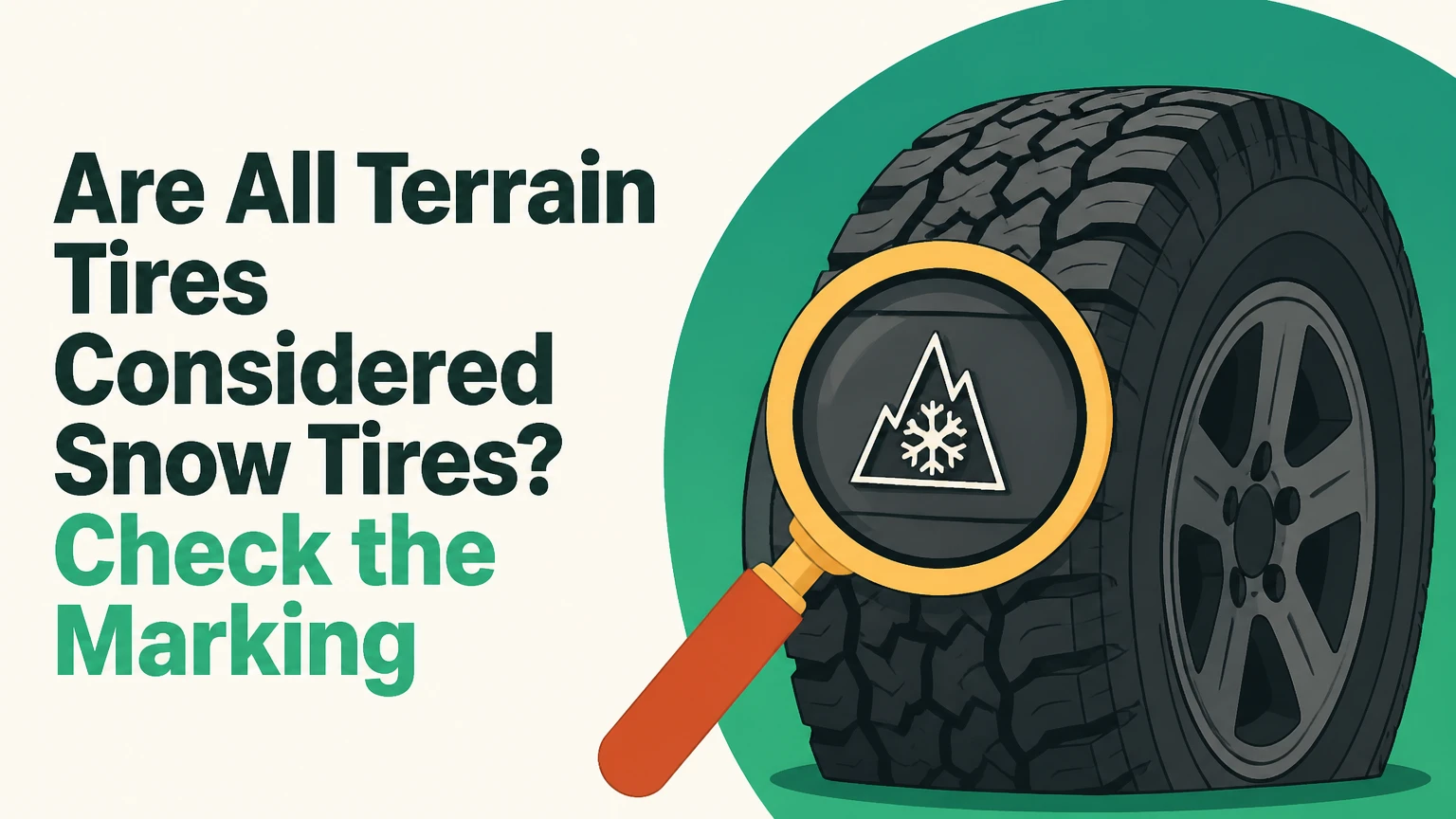
No, all-terrain tires are not automatically considered snow tires. An all-terrain tire with the Three-Peak Mountain Snowflake, or 3PMSF, symbol has passed a defined severe-snow traction test, while an A/T tire marked only M+S has no equivalent severe-snow certification. Dedicated winter tires still generally provide better ice braking and cold-weather control.
Key Facts at a Glance
- An all-terrain tire is a vehicle-use category, not a winter certification.
- M+S means Mud and Snow, but the marking does not prove tested severe-snow traction.
- The 3PMSF symbol identifies a tire that meets a recognized severe-snow performance requirement.
- A 3PMSF all-terrain tire can suit moderate snow and mixed road use, but it is not automatically equal to a dedicated winter tire.
- Dedicated winter tires use cold-flexible compounds and dense siping for stronger ice and packed-snow braking.
- Tire pressure, tread depth, age, load rating, and four-wheel matching affect winter safety as much as the sidewall symbol.
What Is the Difference Between an All-Terrain Tire and a Snow Tire?
An all-terrain tire balances paved-road mileage with traction on gravel, dirt, rocks, and moderate mud. A dedicated snow or winter tire prioritizes cold-weather grip, braking, and steering on snow-covered, icy, or cold pavement, so the two categories solve different engineering problems.
All-terrain tires usually have larger tread blocks, reinforced casings, stone ejectors, and wider grooves. Those features help a truck reach a campsite or construction site, but large blocks can squirm on wet pavement and may provide fewer active biting edges on ice.
Dedicated winter tires use a softer compound that remains more flexible in cold conditions. Their tread often contains many narrow sipes, flexible block edges, and grooves designed to manage slush and retain compacted snow. Snow-on-snow contact can create more grip than a smooth rubber surface against packed snow.
The common 7°C, or 45°F, guideline is useful but not a switch that makes every all-terrain tire unsafe below one exact temperature. Compound behavior changes progressively, and the actual result depends on tire design, road surface, speed, inflation, tread depth, and weather.
Is an M+S Tire a Real Snow Tire?
An M+S tire is not automatically a severe-winter tire. In North America, the M+S designation generally describes tread geometry and is commonly applied by the tire manufacturer; it does not represent the same standardized severe-snow traction requirement as 3PMSF.
M+S can be adequate for occasional light snow in a mild climate when the driver reduces speed and roads are cleared. It is a weak buying signal for regular ice, mountain snow, or emergency braking. A tire can carry M+S and still use a compound intended primarily for warmer conditions.
The U.S. Tire Manufacturers Association distinguishes the voluntary M+S description from the Three-Peak Mountain Snowflake designation. Canadian Tire and Rubber Association guidance likewise treats the mountain-snowflake symbol as the relevant severe-snow indicator rather than relying on M+S alone.
What Does the 3PMSF Symbol Mean?
The 3PMSF symbol is a mountain outline containing a snowflake, and it indicates that the tire met a defined severe-snow traction performance requirement. The symbol is stronger evidence for winter capability than M+S, but it does not promise the same ice performance as a dedicated studless winter tire.
The test associated with the symbol evaluates acceleration traction on a packed-snow surface against a reference tire. In the United States, the severe-snow designation is connected with ASTM F1805 testing and regulatory criteria administered through the National Highway Traffic Safety Administration framework.
The symbol does not mean that a tire:
- Is designed exclusively for winter.
- Will stop quickly on glare ice.
- Has a soft winter compound identical to a Blizzak or X-Ice tire.
- Can replace tire chains where chains are legally required.
- Will retain severe-snow performance after the tread becomes worn or the rubber ages.
Look at both sidewalls when inspecting a mounted tire. The marking should be molded into the sidewall, not confused with a retailer’s “snow-ready” description. Check the exact tire model because two tires in the same product family may have different sizes, constructions, or certifications.
How Can You Identify a Winter-Capable A/T Tire?
Identify a winter-capable all-terrain tire by locating the 3PMSF symbol, then verify the tire’s size, load index, speed rating, and vehicle fitment. A sidewall showing only M+S identifies an all-season or all-terrain tread designation, not proven severe-snow performance.
Use this inspection sequence:
- Find the mountain-and-snowflake symbol on the sidewall.
- Record the complete model name and size, including LT or P construction.
- Confirm the tire’s load index meets the vehicle placard or owner’s manual.
- Check the production date and remaining tread depth.
- Confirm local winter-tire and chain requirements.
- Fit four compatible tires unless the vehicle manufacturer specifies another arrangement.
A tire store listing can be incomplete or wrong, particularly when an older model has been replaced by a newer version. The manufacturer’s technical specification sheet and the physical sidewall marking are the better authorities.
How Do A/T and Dedicated Winter Tires Behave in Snow and Ice?
Dedicated winter tires generally outperform all-terrain tires on ice, cold wet pavement, and packed snow, while 3PMSF all-terrain tires can provide stronger deep-snow mobility and off-road durability. The winner changes with the surface, temperature, speed, and need for pavement comfort.
| Driving condition | M+S-only A/T | 3PMSF A/T | Dedicated winter tire |
|---|---|---|---|
| Light snow on cleared pavement | Adequate at reduced speed | Stronger margin | Strongest margin |
| Packed snow acceleration | Variable | Good | Very good |
| Glare ice braking | Weak | Moderate | Strongest |
| Deep loose snow | Good casing clearance | Very good | Good, size-dependent |
| Gravel and rocky trails | Strong | Strong | Usually weak |
| Warm dry highway | Quietest of these three, model-dependent | Moderate noise | Fast tread wear risk |
| Slush evacuation | Moderate to good | Good | Good to very good |
| Towing with heavy load | Load-rating dependent | Load-rating dependent | Vehicle and tire-specific |
A 3PMSF A/T tire is a compromise tire. It often gives a truck better forward traction in snow than a conventional highway tire, but its stiff blocks, heavier casing, and lower sipe density can still lengthen braking on ice.
Dedicated winter tires are also not magic. A worn winter tire, an underinflated tire, or a winter tire fitted to only two wheels can perform dangerously. Traction control, ABS, suspension condition, and driver speed remain part of the stopping equation.
Why Does Siping Matter More on Ice?
Siping matters because narrow cuts create additional flexible edges and help the tread conform to irregularities in snow and ice. Dedicated winter tires usually carry more and finer sipes than A/T tires, although modern 3PMSF A/T designs may add interlocking sipes to improve winter grip.
The trade-off is block stability. Large, reinforced A/T tread blocks resist deformation on rocks and under heavy loads, while highly siped winter blocks flex more readily on cold pavement. That flexibility improves winter contact but can wear quickly in warm weather or feel less precise during dry towing.
Ice remains the hardest surface. Snow tires cannot create friction where the tire has no clean contact, and a thin layer of water from melting ice can reduce grip sharply. Gentle inputs, longer following distances, and smooth braking matter even with the correct tires.
Which Tire Type Fits Your Driving Pattern?
Choose a dedicated winter tire for frequent ice, repeated mountain travel, or daily driving on unplowed and packed-snow roads. Choose a 3PMSF A/T tire when off-road durability and year-round utility matter, but winter conditions are moderate or intermittent.
| Driver situation | Recommended tire | Reason | Main compromise |
|---|---|---|---|
| Daily mountain commuter | Dedicated winter | Better cold-road braking and steering | Seasonal swap and storage |
| Pickup on gravel roads with snow | 3PMSF A/T | Snow traction plus casing durability | Less ice grip and more noise |
| Warm region with two snowstorms yearly | Highway or all-weather tire | Better wet-road comfort and efficiency | Limited mud and rock ability |
| Heavy towing in mixed seasons | 3PMSF A/T with correct load index | Utility, load support, and snow mobility | Weight, noise, and fuel penalty |
| Frequent black ice on paved roads | Studless winter | Compound and sipe density favor ice | Poor warm-weather durability |
| Serious mud and summer off-roading | M+S or rugged A/T | Open tread and chip resistance | Weakest cold-weather safety |
A mountain commuter should not choose an A/T tire merely because the vehicle has four-wheel drive. The vehicle can accelerate through snow while still taking too long to stop on ice. A dedicated winter tire provides the better control margin for repeated cold-road travel.
A weekend hunter or trail user may reasonably choose a 3PMSF A/T tire. The decision makes sense when the vehicle must travel gravel, ruts, and snow-covered access roads, and when the driver accepts weaker ice performance than a winter tire provides.
An urban driver who rarely leaves pavement may be better served by an all-weather tire. Products such as the Michelin CrossClimate 2 use a 3PMSF designation and generally offer lower noise and better road manners than aggressive light-truck A/T tires, although they are not substitutes for rock-oriented tires.
How Much Do These Tires Cost and How Long Do They Last?
Typical retail pricing is about $140-$300 per tire for a passenger or SUV winter tire, $180-$400 for a 3PMSF light-truck A/T tire, and $150-$350 for an M+S A/T tire. Actual ownership cost depends on size, load range, wheels, mounting, storage, alignment, and regional supply.
| Tire category | Typical price per tire | Typical usable mileage | Seasonal replacement pattern |
|---|---|---|---|
| M+S A/T, P-metric | $150-$280 | 45,000-70,000 miles | Usually year-round |
| M+S A/T, LT load range | $200-$350 | 35,000-60,000 miles | Usually year-round |
| 3PMSF A/T, LT | $220-$400 | 40,000-65,000 miles | Usually year-round |
| Dedicated studless winter | $140-$300 | 20,000-35,000 miles | Winter-only |
| All-weather passenger tire | $160-$300 | 40,000-60,000 miles | Usually year-round |
These are typical planning ranges, not guarantees. A heavy LT tire can last longer structurally yet wear faster under a loaded truck, while a winter tire may deliver several seasons because it is removed before warm temperatures arrive.
Winter tires need adequate tread. Many manufacturers recommend replacement at 4/32 inch for winter service because snow performance declines before the legal minimum tread depth is reached. At 2/32 inch, a tire is generally at the U.S. legal wear limit, but legal minimum is not a winter-performance target.
Wheel packages add a typical $400-$1,200 for four wheels, depending on steel or alloy construction and vehicle-specific fitment. Seasonal mounting and balancing commonly add $80-$200 per change, so a second wheel set may recover its cost through reduced mounting charges over several seasons.
Can You Use 3PMSF A/T Tires All Year?
You can use 3PMSF all-terrain tires year-round when the manufacturer permits it, but warm pavement usually increases noise, rolling resistance, and tread wear compared with a highway or all-season design. Dedicated winter tires should not remain installed through hot weather because their softer compounds can wear rapidly and handle poorly.
A 3PMSF marking does not make an A/T tire season-specific. Many 3PMSF A/T models are designed as permanent all-year tires, including products in the Falken Wildpeak, BFGoodrich All-Terrain, and Goodyear Wrangler families, but exact certification varies by model and size.
Check four details before buying:
- The manufacturer’s stated service conditions.
- The tire’s speed rating for sustained highway travel.
- The load index for passengers, cargo, and trailer tongue weight.
- Whether the tread pattern creates unacceptable noise or fuel consumption.
A common practitioner rule is to change dedicated winter tires when average temperatures remain consistently above about 7°C, or 45°F, rather than waiting for the first hot day. The reverse change should occur before regular freezing conditions arrive. Local weather patterns matter more than a calendar date.
What Happens If Winter Tires Stay on in Summer?
Winter tires left on warm pavement can lose tread quickly, develop squirm, and provide less precise steering during emergency maneuvers. The softer compound also increases rolling resistance and may reduce fuel economy, especially on heavy SUVs and pickup trucks.
The damage is not always visible after one warm trip. Repeated highway driving in 20-30°C weather can round tread edges and remove the features needed for the next winter. Store removed tires in a cool, dry, dark location, away from electric motors, solvents, and direct sunlight.
Do AWD and Four-Wheel Drive Replace Snow Tires?
AWD and four-wheel drive do not replace winter tires because drivetrains help transmit engine torque but do not create additional braking friction. A 3PMSF or dedicated winter tire can improve acceleration, steering, and stopping, while AWD mainly helps the vehicle move away from a stop.
This distinction explains many winter crashes. A vehicle with worn A/T tires may feel confident climbing a snowy hill, then slide through an intersection because all four tires have limited lateral and braking grip.
Electronic stability control and ABS also require usable tire traction. They can modulate braking and reduce wheelspin, but they cannot overcome a hardened compound, bald tread, or polished ice.
How Should You Install and Maintain Winter-Capable Tires?
Install four matching tires with compatible tread, size, load index, and speed rating, then set cold inflation pressure to the vehicle placard specification. Rotate according to the tire manufacturer’s interval, inspect monthly, and recheck pressure when ambient temperature changes significantly.
Never install winter tires only on the drive axle. Two winter tires on the front can make a front-wheel-drive vehicle oversteer when the rear tires lose grip; two winter tires on the rear can make a rear-wheel-drive vehicle understeer. Either imbalance can surprise the driver during braking or cornering.
Use this maintenance checklist:
- Verify all four tires have similar tread depth.
- Set pressure before driving, when tires are cold.
- Inspect for cuts, bulges, embedded stones, and irregular wear.
- Confirm TPMS sensors communicate after installation.
- Retighten wheel fasteners according to vehicle specifications.
- Carry chains or approved traction devices where local rules require them.
Tire age also matters. Rubber hardens through time, heat, ultraviolet exposure, and oxidation, even when tread remains. Michelin’s tire-maintenance guidance recommends professional inspection after five years of service and replacement considerations at ten years, while other manufacturers use more conservative schedules.
What Mistakes Cause Poor Snow Performance?
Poor snow performance usually comes from the wrong marking, insufficient tread, incorrect pressure, mixed tires, or excessive speed rather than from the word “all-terrain” alone. Drivers should diagnose the tire’s construction and condition before blaming the tread category.
| Failure mode | Observable symptom | Likely cause | Corrective action |
|---|---|---|---|
| M+S tire slides on packed snow | Wheelspin below 20 mph | No severe-snow design | Replace with 3PMSF or winter tire |
| 3PMSF tire feels poor on ice | ABS activates early | A/T block design or polished ice | Use dedicated winter tires |
| Vehicle pulls while braking | Uneven steering response | Mixed brands or tread depths | Install a matched set of four |
| Tire loses grip suddenly | Pressure warning or soft handling | Cold-pressure loss | Inflate to placard pressure |
| Winter tire wears in weeks | Rounded edges and noise | Warm-weather use or aggressive driving | Remove in warm season |
| Snow traction declines with tread left | Hard, shiny rubber | Age or heat aging | Check date and replace if needed |
A counterintuitive point is that deeper A/T tread does not automatically equal shorter stopping distance. Deep voids can improve propulsion in loose snow, while a densely siped winter tread can stop more effectively on packed snow and ice.
Another practitioner rule is to judge winter readiness by the worst surface on the route, not the best surface in the driveway. If a commute includes shaded bridges, steep grades, and untreated intersections, ice performance deserves more weight than deep-snow appearance.
What Are the Legal and Fitment Limits?
Winter tire laws, chain requirements, and severe-snow markings vary by jurisdiction, and a 3PMSF symbol may satisfy one local requirement while a vehicle-specific chain rule still applies. Consult the transportation authority for the state, province, or country where the vehicle will travel.
Fitment must follow the vehicle placard and owner’s manual. A tire with the correct diameter but a lower load index can be unsafe on a loaded pickup, and an LT tire with a higher load range can alter ride quality, braking balance, and required inflation.
Before purchasing, verify:
- Original-equipment tire size.
- Load index and load range.
- Speed rating.
- Wheel width and diameter.
- Clearance around suspension and bodywork.
- Chain or cable compatibility.
- TPMS sensor compatibility.
- Regional stud restrictions and dates.
Studded winter tires may outperform studless tires on some glare-ice surfaces, but they can be restricted by road law and may damage bare pavement. Studless tires are the more flexible legal choice in many regions.
Frequently Asked Questions
Are all-terrain tires better than all-season tires in snow?
Many all-terrain tires provide better loose-snow traction than ordinary all-season highway tires because their grooves and block geometry clear snow more effectively. A 3PMSF A/T tire offers a stronger winter specification, but a dedicated winter tire generally remains better on ice and cold pavement.
Can a 3PMSF A/T tire replace chains?
A 3PMSF A/T tire cannot automatically replace chains. Chain-control laws may require approved chains or traction devices on particular roads, regardless of tire certification, and vehicle clearance may limit which devices are permitted. Check the route authority and the vehicle owner’s manual before departure.
How much tread should a snow tire have?
A practical winter replacement threshold is 4/32 inch of remaining tread, although legal limits may be lower. Snow traction decreases as grooves become shallow, and a tire can fail a winter trip because of age or hardened rubber even when its tread exceeds the legal minimum.
Are rugged-terrain tires snow tires?
Rugged-terrain tires are not automatically snow tires. Some models carry 3PMSF certification and can handle moderate winter conditions, while others carry only M+S. Read the exact sidewall marking and manufacturer specification rather than inferring winter capability from the aggressive tread pattern.
Should tire pressure be lower in snow?
Do not deliberately lower road-tire pressure below the vehicle placard specification for ordinary winter driving. Cold weather reduces pressure naturally, so measure pressure indoors or before driving and inflate to the placard value. Off-road pressure adjustments are separate, temporary procedures with different hazards.
The Bottom Line
Are all terrain tires considered snow tires? No. An M+S-only A/T tire is not a certified severe-snow tire, while a 3PMSF A/T tire is suitable for many mixed-use winter conditions but still gives up ice performance to a dedicated winter tire. Choose according to the worst road surface, driving frequency, load, local law, and need for off-road durability.