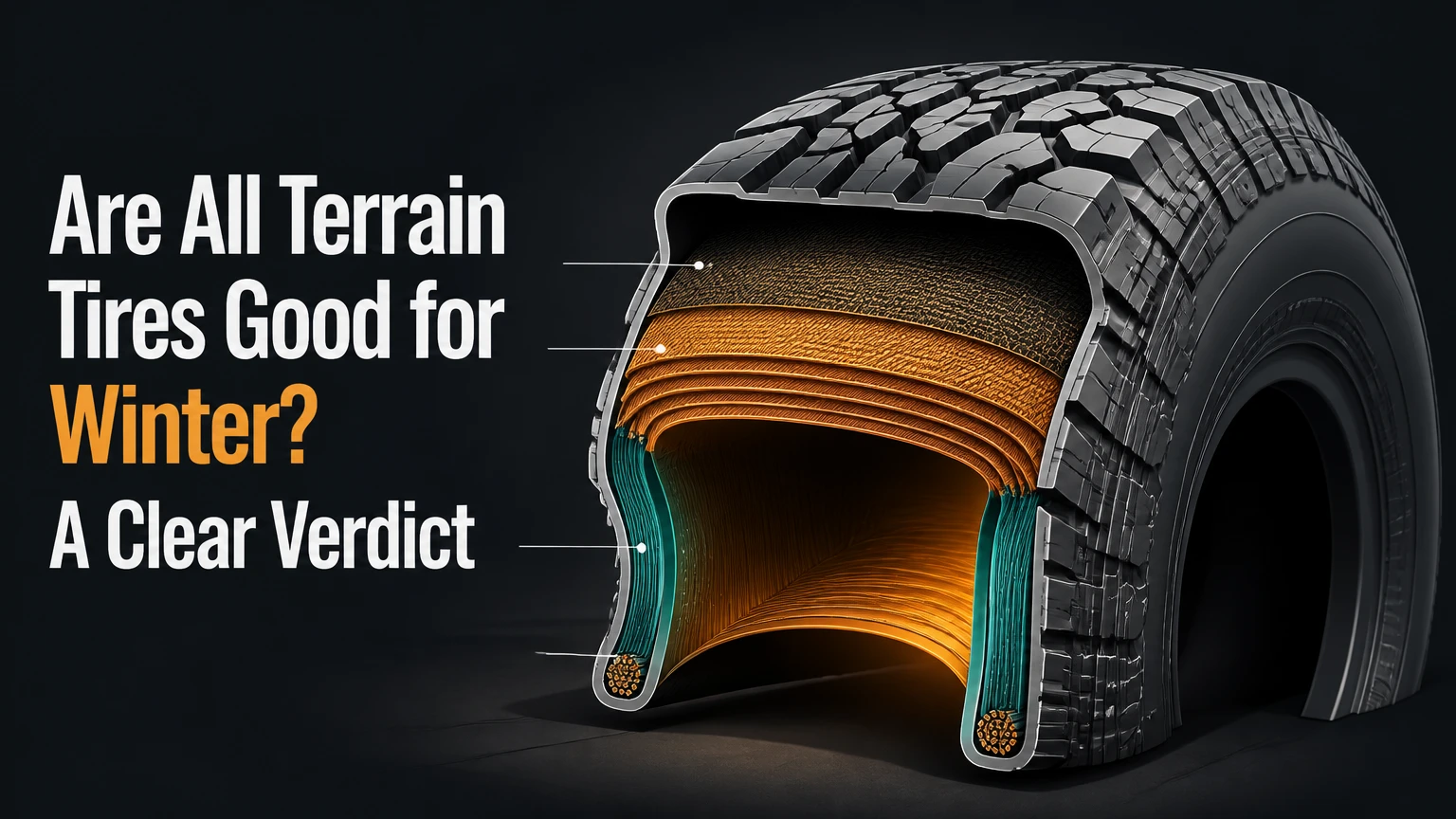
All-terrain tires are acceptable for light to moderate snow, but they are not equal to dedicated winter tires on ice, packed snow, or prolonged subfreezing roads. A 3-Peak Mountain Snowflake, or 3PMSF, rated A/T tire is the better single-set compromise, while a dedicated winter tire remains the safest choice for frequent severe winter conditions.
Key Facts at a Glance
- Standard all-terrain tires usually provide useful traction in loose snow but can lose flexibility as temperatures fall.
- The M+S marking does not prove that a tire passed a standardized severe-snow traction test.
- The 3PMSF symbol identifies a tire that met a regulated packed-snow acceleration performance threshold.
- Dedicated winter tires normally provide superior ice braking because their compounds remain flexible and their tread contains more dense siping.
- Four-wheel drive improves acceleration in snow, but it does not create additional braking or cornering friction.
- A practical winter inspection should replace or reconsider an A/T tire below about 5/32 inch of usable tread, although the tire maker and local law control the final limit.
What Is an All-Terrain Tire?
An all-terrain tire is a road-and-off-road tire designed to balance highway mileage with traction on gravel, dirt, mud, sand, and moderate rock. Compared with a highway-terrain tire, an A/T tire usually has larger tread blocks, wider grooves, reinforced shoulders, and stronger casing protection.
The tread pattern creates several winter advantages. Open grooves can evacuate slush, while staggered blocks can bite into loose snow. A wide void ratio also gives the tread room to accept snow, allowing snow-on-snow friction to contribute to forward movement.
The design involves trade-offs. Large blocks and reinforced construction add weight, rolling resistance, and noise. A/T tires also dedicate less tread area to the dense, flexible siping that improves grip on ice and polished packed snow.
An A/T tire is therefore a compromise category, not a winter category by definition. Individual models differ substantially, so the sidewall markings and manufacturer specification matter more than the words “all-terrain” on the product name.
How Does an A/T Tire Work in Snow?
An all-terrain tire gains traction in loose snow through tread depth, void space, block edges, and snow-on-snow friction. Deep grooves help the tire avoid becoming a smooth, snow-filled cylinder, while interlocking blocks generate forward and lateral grip.
Loose snow is the surface where an aggressive A/T pattern can outperform a conventional all-season tire. The tread can dig down to a firmer layer, and shoulder lugs may help when the vehicle must climb through an unplowed driveway or trail.
That advantage declines as snow becomes compacted. Packed snow behaves more like a low-friction road surface, so the tire needs flexible rubber and many biting edges rather than only large voids. Slush creates another challenge because a heavily open pattern can feel less stable at highway speed if the vehicle encounters standing water beneath the slush.
A/T traction also depends on the vehicle. A heavy pickup with a stiff load-range E tire may have excellent durability but a less compliant contact patch than a lighter SUV using a passenger-rated tire. Correct fitment, inflation, vehicle weight, and electronic stability control all affect the result.
What Do M+S and 3PMSF Mean?
The M+S marking means the tread has a mud-and-snow geometry that meets a defined void-to-lug relationship; it does not mean the tire passed a severe winter traction test. The 3PMSF symbol means the tire passed a standardized packed-snow acceleration test relative to a reference tire.
M+S is not a winter-performance guarantee
“M+S,” “M/S,” or “Mud and Snow” remains common on A/T and some all-season tires. The marking can be useful for identifying a more open tread, but it says little about ice braking, cold-weather flexibility, or performance on polished snow.
The 45°F, or 7°C, rule is a practical buying guideline rather than a universal chemical cutoff. Many all-season and standard A/T compounds lose flexibility progressively in cold conditions, but rubber does not suddenly become a hockey puck at one exact temperature. Tire design, compound, speed, pavement, and moisture change the outcome.
3PMSF shows tested snow traction
The 3PMSF symbol is a mountain outline containing a snowflake. In North America, the designation is associated with the tire industry’s severe-snow standard and a packed-snow traction test. The test supports a stronger claim than M+S, but it does not certify equal performance to a studless winter tire.
3PMSF also does not measure every winter behavior. It does not by itself guarantee short ice stops, strong wet braking, quiet highway operation, or dependable traction after the tread has worn substantially. Certification can apply to a specific tire size or configuration, so inspect the actual sidewall.
Are 3PMSF A/T Tires Better for Winter?
3PMSF all-terrain tires are substantially better winter compromises than non-certified A/T tires when a driver wants one year-round set. Their tread and compound package must meet a more demanding packed-snow threshold, and many use additional siping or silica-focused rubber technology.
The symbol is particularly valuable for drivers who face occasional storms, plowed suburban roads, ski-trip access roads, and gravel routes. Models such as the Falken Wildpeak A/T4W, BFGoodrich All-Terrain T/A KO3 in applicable sizes, and Continental TerrainContact A/T are commonly considered in this category, but certification and load-range details must be confirmed for the exact size.
A 3PMSF A/T tire still has compromises. Its tread may be noisier than a touring all-season tire, and its ice performance may remain behind a dedicated winter tire. Aggressive casing construction can also reduce ride comfort and increase fuel consumption.
A severe-snow symbol is a screening tool, not a ranking system. Compare independent testing, warranty terms, wet braking, noise, tread depth, and the actual roads you drive.
How Do A/T and Winter Tires Compare?
Dedicated winter tires generally win on ice, packed snow, cold wet pavement, and emergency braking, while A/T tires generally win on gravel durability, loose deep snow, warm-weather versatility, and off-road resistance. The right choice depends on the surface that creates the greatest safety risk.
| Attribute | Standard A/T | 3PMSF A/T | Dedicated winter tire | All-weather tire |
|---|---|---|---|---|
| Packed-snow certification | M+S only or none | 3PMSF | Winter design, often 3PMSF | Usually 3PMSF |
| Typical tread depth when new | 12/32-18/32 in | 13/32-19/32 in | 10/32-14/32 in | 10/32-12/32 in |
| Ice traction | Low to moderate | Moderate | High | Moderate to high |
| Deep loose snow | Moderate to high | High | Moderate | Moderate |
| Dry-road summer use | High | Moderate to high | Low to moderate | Moderate to high |
| Typical tread warranty | 40,000-60,000 miles | 50,000-65,000 miles | Often no mileage warranty | 50,000-70,000 miles |
| Typical price per tire | $150-$300 | $180-$350 | $130-$300 | $160-$300 |
The price ranges are typical U.S. retail ranges for common SUV and light-truck sizes, not quotes for every vehicle. Large 20-inch wheels, high load ranges, run-flat construction, and specialty fitments can increase the purchase price substantially.
How do A/T tires perform on ice?
A/T tires are weaker on ice because their tread pattern and rubber compound usually prioritize durability and off-road bite over low-temperature conformity. Ice has almost no compressible material for large lugs to dig into, so the tire needs flexible rubber and numerous small edges.
Winter tire siping creates edges that open and close as the tread contacts the road. A winter compound also remains more compliant in cold weather, helping the tread follow microscopic pavement texture. No tire makes ice safe, but dedicated winter rubber usually gives the driver more braking and cornering margin.
The difference is most noticeable during braking and turning, not necessarily during gentle acceleration. A four-wheel-drive truck can pull away confidently on an icy incline and still slide through the first corner.
What is the best alternative for mixed climates?
An all-weather tire is often the better choice for drivers who stay on pavement, encounter regular snow, and want one set without the off-road compromises of an A/T tire. All-weather tires normally carry 3PMSF certification, use more winter-oriented siping, and provide better cold-road manners than standard A/T tires.
A 3PMSF A/T tire becomes more appropriate when gravel, construction sites, rutted roads, puncture exposure, or deep unplowed snow are routine. A dedicated winter tire remains preferable when ice, compacted snow, or temperatures below freezing dominate the driving season.
| Driving environment | Recommended tire type | Main reason | Main limitation |
|---|---|---|---|
| Plowed city roads, occasional snow | All-weather | Cold-road and snow balance | Limited off-road protection |
| Gravel roads and weekly snow | 3PMSF A/T | Stronger casing and deeper tread | More noise and ice compromise |
| Frequent ice and packed snow | Dedicated winter | Best low-temperature grip | Seasonal change and storage |
| Deep unplowed access roads | 3PMSF A/T or winter plus chains | Void space or winter flexibility | Neither replaces careful route judgment |
| Mud, rocks, and occasional storms | 3PMSF A/T | Off-road durability with snow certification | Inferior ice braking to winter tires |
| Warm climate with rare snow | Highway all-season | Quiet, efficient daily driving | Poor choice for unexpected ice |
Which Winter Tire Features Matter Most?
The most important features are 3PMSF certification, compound temperature range, sipe density, usable tread depth, casing strength, and vehicle-specific load capacity. Tread appearance alone cannot predict winter performance.
Tread pattern and siping
Large shoulder lugs help in deep snow and mud, but central tread siping matters more on compacted snow and ice. A road-oriented 3PMSF A/T can therefore outperform a more aggressive mud-terrain tire on a frozen highway, even when the mud tire looks more capable.
Full-depth siping helps preserve winter behavior as the tread wears. Some manufacturers use three-dimensional interlocking sipes that open under load while limiting block squirm on dry pavement.
Compound and construction
Winter compounds stay flexible at low temperatures, whereas many standard A/T compounds emphasize chip resistance, heat tolerance, and long tread life. Silica, polymer selection, and tread architecture influence wet and cold performance, but consumers should rely on measured tests and manufacturer documentation rather than a single compound label.
Load range also matters. A stiff LT or Load Range E tire can carry heavy cargo and resist punctures, but its higher inflation pressure and rigid sidewall may reduce compliance on a light SUV. Never substitute a lower load index simply to obtain a softer ride.
Size, pressure, and wheel compatibility
Tire size changes contact patch shape, gearing, clearance, load capacity, and available models. Use the vehicle placard and owner’s manual as the baseline, then confirm wheel width, speed rating, load index, TPMS compatibility, and fender clearance.
A wider tire is not automatically better in snow. A narrower, correctly sized tire may cut through loose snow more effectively, while an oversized tire can rub suspension components or reduce steering control.
How Much Tread Depth Is Enough for Snow?
About 5/32 inch is a practical lower limit for snow performance on an A/T tire, although replacing the tire at that point is a risk-management decision rather than a universal legal requirement. New A/T tires often begin around 12/32 to 18/32 inch, depending on model and size.
Tread depth affects more than stopping distance. As grooves become shallow, snow evacuation declines, sipes lose working depth, and the tire has less ability to generate snow-on-snow friction. A tire with uneven wear, exposed casing damage, cracking, or poor pressure is unsuitable even if a gauge shows adequate depth.
Measure in at least three circumferential positions and across the tread width. Check the legal wear bars, but do not treat the wear-bar threshold as a winter-performance target. Tire Rack and several tire manufacturers advise greater remaining tread for severe conditions because winter capability falls before the tire reaches the legal minimum.
Does Four-Wheel Drive Replace Winter Tires?
Four-wheel drive does not replace winter tires because the drivetrain can distribute engine torque but cannot increase the friction available during braking or cornering. The tire remains the only component directly connecting the vehicle to the road.
Four-wheel drive is valuable when one axle would otherwise spin during acceleration. It cannot prevent an icy downhill slide, shorten a stop on packed snow, or make a sharp turn safe at excessive speed. Electronic stability control can help manage a developing skid, but it also works within the grip available from the tires.
This distinction explains a common winter accident pattern: a 4WD vehicle accelerates past traffic on a snowy road, then discovers that its A/T tires cannot stop or turn at the same pace. Winter tires improve every phase of vehicle control, not only launch.
When Should You Switch to Winter Tires?
Switch to winter tires when temperatures regularly remain below about 45°F, or 7°C, and remove them when sustained warm conditions return, commonly above that range. The temperature guideline concerns compound flexibility, not the first snowfall date.
Many drivers switch in October or November and remove winter tires in March or April, but local climate is more useful than the calendar. A driver in Minnesota may need winter tires earlier than one in coastal Oregon, while a mountain resident may need them until late spring.
Typical seasonal service costs include $60-$160 for mounting and balancing four tires, $80-$200 for a tire swap using a second mounted wheel set, and $50-$150 for seasonal storage per season. These are typical U.S. independent-shop ranges and vary by region, wheel size, and vehicle.
Using two sets can preserve tread because each set accumulates fewer annual miles. The economic decision should include wheel purchase, storage, service, tread life, accident risk, and whether the driver can avoid severe conditions.
What Should You Look for When Buying?
Choose a 3PMSF A/T tire when one set must cover winter roads and off-road surfaces, but choose a dedicated winter tire when ice and packed snow determine daily safety. Confirm the exact size certification, load index, speed rating, warranty, and independent test results before purchase.
Use this buying sequence:
- Define the worst routine surface. Separate loose snow from ice, packed snow, slush, gravel, and mud.
- Check the sidewall. Look for 3PMSF, size, load index, speed rating, and maximum pressure.
- Match vehicle requirements. Follow the door-jamb placard and verify the tire is approved for the vehicle’s axle load.
- Inspect tread architecture. Favor useful central siping for road snow and reinforced shoulders for off-road exposure.
- Compare measured behavior. Give weight to ice braking, packed-snow traction, wet braking, noise, and rolling resistance.
- Plan maintenance. Budget alignment, rotation, pressure checks, storage, and replacement before winter tread becomes marginal.
Example A/T models to investigate
The Falken Wildpeak A/T4W is a 3PMSF-oriented A/T option with deep tread and off-road construction, but its ride, noise, and fuel economy depend on size and load range. The BFGoodrich All-Terrain T/A KO3 emphasizes casing durability and off-road resistance; verify the mountain-snowflake marking for the exact fitment.
The Continental TerrainContact A/T is more road-focused than many aggressive A/T designs and can suit drivers who prioritize highway manners, wet pavement, and gravel-road use. It is not a substitute for a dedicated winter tire in an ice-heavy region.
These examples are categories to investigate, not universal rankings. Tire models change, sizes differ, and independent tests may evaluate only one configuration.
What Problems Occur With A/T Tires in Winter?
The most common problems are long ice stops, wandering on packed snow, slush instability, snow-packed wheels, uneven wear, and false confidence from four-wheel drive. Each problem has a different remedy, and reducing tire pressure is not a safe universal fix.
| Symptom | Likely cause | Safe response | Inspection threshold |
|---|---|---|---|
| Wheelspin on packed snow | Insufficient tire grip or throttle input | Reduce throttle and increase following distance | Check tread below 5/32 in |
| Sliding while turning | Cold compound, speed, or ice | Slow before the bend; avoid sudden inputs | Consider dedicated winter tires |
| Highway wandering in slush | Slush depth, speed, or wide tread | Reduce speed smoothly; avoid abrupt steering | Inspect alignment and pressure |
| Steering vibration after snow | Frozen snow inside wheel | Stop safely and clear wheels | Recheck balance if vibration remains |
| Uneven shoulder wear | Incorrect pressure or alignment | Correct pressure and obtain alignment | Measure all four tread positions |
| Poor braking despite 4WD | Drivetrain cannot add braking friction | Increase distance and reduce speed | Compare winter tire option |
Snow packed inside a wheel can freeze into a large imbalance, causing steering shake at road speed. Park safely, remove the buildup with a plastic tool or warm water, and never place hands near moving components or hot brakes.
Maintain the placard pressure when tires are cold. Do not deliberately drop pressure by 2-3 PSI on a public road to improve ice grip, because underinflation can increase heat, sidewall flex, steering delay, and bead risk. Off-road pressure changes belong to a controlled, low-speed setting followed by immediate reinflation.
Which Tire Should You Choose?
The best tire depends on the worst condition that occurs repeatedly, not the most attractive tread pattern. A 3PMSF A/T is a defensible one-set choice for mixed roads, while dedicated winter tires are the stronger decision when ice or packed snow is unavoidable.
Heavy-snow and ice-region commuter
Choose dedicated studless winter tires if the vehicle regularly travels before roads are plowed, encounters freezing rain, or uses untreated hills. Studded tires may provide additional ice traction where legal, but they can increase road wear and noise, and regulations vary by state or province.
Keep a second set of summer or all-season tires for warm months. The purchase and storage burden is usually justified by better cold-road control.
Moderate suburban driver
Choose an all-weather tire or a 3PMSF A/T if snow arrives intermittently and roads are usually plowed. An all-weather tire fits pavement-first driving, while a 3PMSF A/T makes more sense for gravel, job sites, towing, and unplowed driveways.
A non-3PMSF A/T is difficult to justify if winter traction is a major purchase criterion. Its M+S marking alone does not establish severe-snow capability.
Rural worker or off-road driver
Choose a 3PMSF A/T with suitable load capacity, sidewall protection, and enough tread depth for the work route. Carry chains where permitted and where the vehicle manufacturer allows them, because even an aggressive A/T can fail on steep glare ice.
Mud-terrain tires are not automatically better. Their large voids can clear deep mud and loose snow, but limited central siping may reduce stability on icy public roads.
Occasional-snow driver in a warm climate
A highway all-season tire may be adequate if snow and ice are rare and the driver can postpone travel during storms. A standard A/T can be reasonable for off-road needs, but neither option should be treated as a winter tire during freezing rain.
FAQ
Are all-terrain tires safe on black ice?
All-terrain tires are not reliably safe on black ice because ice provides very little texture for tread blocks to grip. A 3PMSF A/T can offer better cold-weather performance than a standard A/T, but a dedicated winter tire generally provides more flexible rubber and dense siping for braking and cornering.
Can tire chains replace winter tires?
Tire chains can add substantial traction in deep snow and on ice, but they do not replace winter tires for normal high-speed road use. Chains have speed limits, vehicle-clearance restrictions, installation requirements, and local laws. Use chains only as directed by the vehicle and chain manufacturers.
Are A/T tires louder than all-season tires?
Most A/T tires produce more tread noise than highway all-season or touring tires because their blocks and voids create more air movement and tread impact. Typical differences range from noticeable low-speed hum to substantial highway roar, depending on tread design, wear, vehicle insulation, and load range.
Do A/T tires reduce fuel economy?
A/T tires can reduce fuel economy because deeper tread, heavier casing, greater rolling resistance, and increased aerodynamic noise require more energy. A typical impact is roughly 1-3 miles per gallon on some trucks and SUVs, but vehicle weight, tire pressure, wheel size, and driving speed can produce larger or smaller differences.
Can a 3PMSF tire be used all year?
A 3PMSF A/T or all-weather tire can be used year-round, provided its temperature, speed, load, and wear limits are suitable for summer driving. A dedicated winter tire should not normally remain installed through hot weather because warm pavement accelerates wear and reduces handling precision.
Should all four tires be replaced together?
Replace all four tires together on most full-time, part-time, and electronically controlled all-wheel-drive vehicles unless the manufacturer permits a specific tread-depth difference. Mixing substantially different circumferences can stress driveline components and create uneven handling. Consult the owner’s manual before replacing fewer than four.
The Bottom Line
Are all terrain tires good for winter? They are good enough for many light-snow and mixed-surface drivers when the tire has 3PMSF certification, adequate tread, correct pressure, and an appropriate vehicle fit. They are not the best choice for frequent ice, packed snow, or severe cold, where dedicated winter tires provide a larger safety margin. Choose the tire for the surface you must stop and turn on, not merely the surface you expect to drive through.