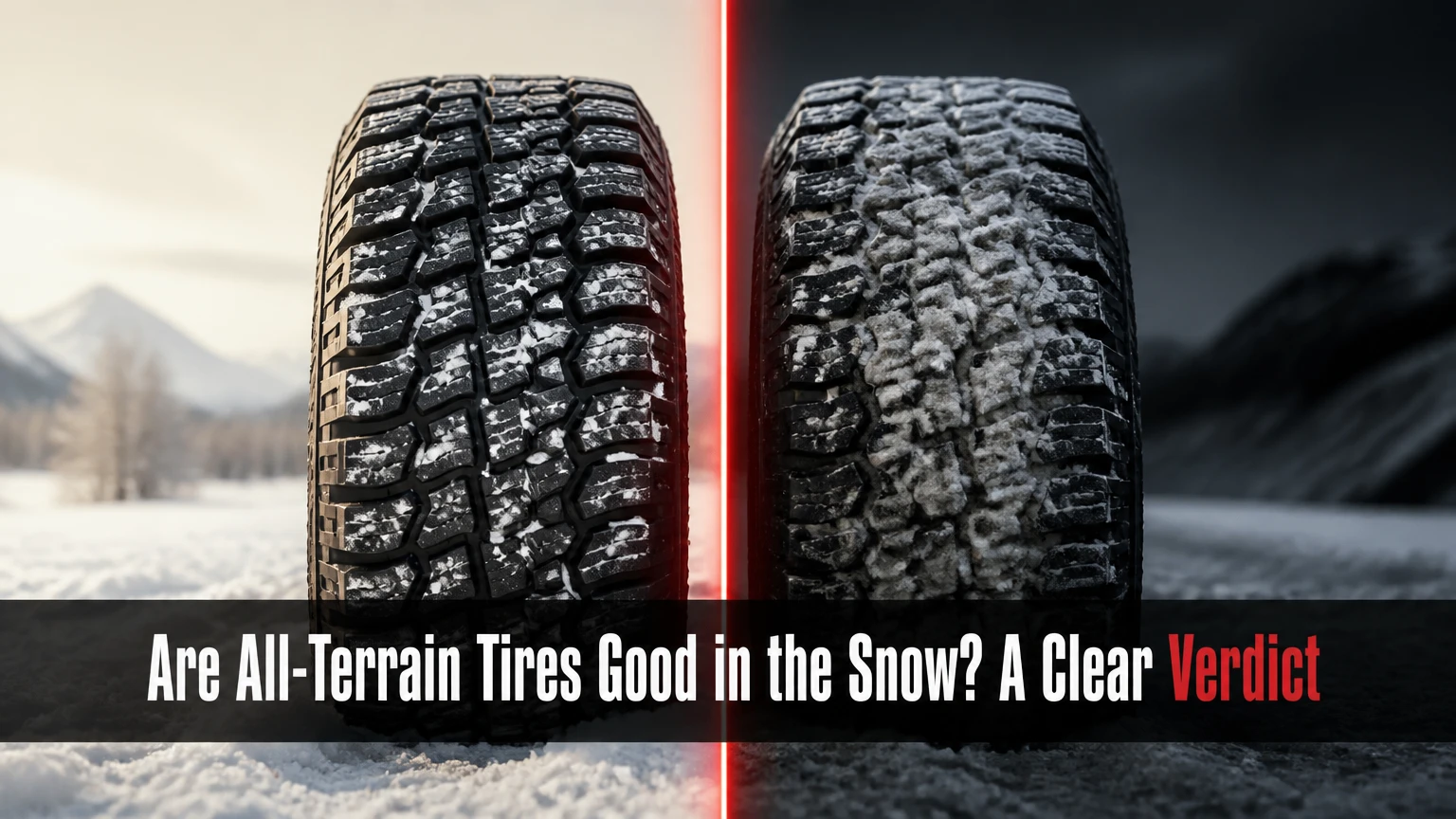
All-terrain tires are good in light to moderate snow and loose, unplowed conditions, especially when they carry the Three-Peak Mountain Snowflake, or 3PMSF, symbol. They are not equal to dedicated winter tires on ice, hard-packed snow, or consistently cold pavement because winter tires use softer compounds and more snow-focused siping.
Key Facts at a Glance
A 3PMSF-rated all-terrain tire is materially better for winter use than an A/T tire marked only M+S.
All-terrain tread can improve propulsion in loose snow through open voids, biting edges, and snow-to-snow contact.
Dedicated winter tires normally provide shorter braking distances and more predictable cornering on ice and packed snow.
The commonly cited 7°C, or 45°F, point is a useful winter-tire guideline, not an instant failure threshold for every all-terrain compound.
Winter capability declines substantially as tread approaches 5/32 inch, even though the legal replacement limit is often 2/32 inch.
AWD and 4WD help a vehicle accelerate through snow, but they do not create additional tire grip for braking or turning.
Are All-Terrain Tires Good in the Snow?
All-terrain tires are a reasonable year-round choice for drivers who encounter occasional snowfall, gravel roads, and moderate off-road use. A 3PMSF-rated model is the appropriate A/T category for regular snow because the marking requires a standardized packed-snow traction test, whereas M+S is primarily a tread-geometry designation.
The answer changes with the surface. Deep, loose snow rewards tread depth and open voids, while polished ice rewards flexible rubber, dense siping, and a large number of tread edges. A tire can pull well through an unplowed driveway and still slide during an emergency stop at an icy intersection.
The vehicle also matters. A heavy pickup with high torque can overwhelm a marginal tire more easily than a compact crossover, and an empty rear-wheel-drive truck can lose rear-axle stability even with capable A/T tires. Tire selection cannot compensate for excessive speed, poor pressure, worn tread, or an unsuitable drivetrain setup.
How Do All-Terrain Tires Gain Snow Traction?
All-terrain tires gain snow traction through tread geometry, tread depth, flexible edges, and the compound used at low temperatures. The tread blocks create forward and lateral edges, while grooves provide space for snow to enter and leave the contact patch.
Snow-to-snow friction explains an important part of the mechanism. When a tread groove packs with snow, the packed material can grip the snow on the road more effectively than smooth rubber can grip a loose surface. The effect is useful in fresh snow, but it does not replace the flexible compound and micro-edge density needed on ice.
Sipes are narrow cuts molded into tread blocks. Sipes open under load and create additional edges that can bite packed snow and disperse thin water films. More siping is not automatically better, because excessive block movement can reduce steering precision and accelerate wear; good winter designs balance edge density with block support.
A high void ratio helps an A/T tire clear loose snow, mud, and gravel. Very large voids can reduce the continuous rubber contact available for braking on wet pavement, so aggressive tread is not a universal winter advantage.
What Snow Conditions Suit A/T Tires?
Loose snow, moderate snowfall, and mixed pavement are the most suitable conditions for a 3PMSF all-terrain tire. Hard-packed snow, freezing rain, glare ice, and repeated sub-freezing highway travel favor a dedicated winter tire because those surfaces demand cold flexibility and controlled braking rather than only forward bite.
| Surface condition | Typical A/T result | Main design factor | Better alternative |
|---|---|---|---|
| 2-6 inches of fresh snow | Good propulsion | 10-12 mm new tread, open voids | 3PMSF A/T |
| 6-12 inches of unplowed snow | Good to very good flotation | Block spacing, vehicle clearance | 3PMSF A/T or winter SUV tire |
| Hard-packed snow | Moderate braking | Sipe density and compound flexibility | Dedicated winter tire |
| Glare ice | Poor to fair control | Soft compound, studs, severe siping | Studded or studless winter tire |
| Cold, wet pavement | Fair to good | Compound temperature range | Winter or all-weather tire |
| Slush at highway speed | Moderate hydroplaning resistance | Groove volume and tread depth | Newer 3PMSF A/T or winter tire |
What Do M+S and 3PMSF Mean?
M+S means Mud and Snow, but the marking does not prove that a tire passed a winter traction test. The 3PMSF symbol, a mountain with three peaks and a snowflake, indicates that the tire met a defined severe-snow traction requirement under standardized testing.
M+S classification generally relates to tread pattern geometry, including groove and block proportions. It does not establish a universal cold-temperature compound, an ice-braking distance, or a minimum performance level on frozen roads. Many conventional all-season and A/T tires carry M+S.
3PMSF testing is associated with ASTM F1805 snow traction procedures and compares the candidate tire with a standard reference tire on packed snow. The commonly cited threshold is at least 110% of the reference tire’s traction in the applicable test. That result makes the symbol meaningful, but it does not transform an A/T tire into a dedicated winter tire.
The symbol also does not certify every winter behavior. It says little about wet braking, black ice, cornering on polished snow, or performance after severe tread wear. Treat 3PMSF as a minimum snow-performance filter, not a complete ranking.
| Marking or tire category | What the marking establishes | What it does not establish | Practical winter meaning |
|---|---|---|---|
| M+S | Tread geometry meets a mud-and-snow description | No standardized severe-snow traction result | Occasional snow only |
| 3PMSF | At least 110% reference traction in the applicable snow test | No guarantee of ice superiority | Preferred A/T marking for regular snow |
| Studless winter | Winter compound and winter tread design | Summer usability and long warm-weather life | Strongest non-studded ice option |
| Studded winter | Metal studs permitted under local rules | Quiet operation and universal legality | Maximum ice bite where legal |
| All-weather | Product category varies by market and manufacturer | One universal regulatory definition | Check for 3PMSF and model testing |
Are 3PMSF All-Terrain Tires as Good as Winter Tires?
3PMSF all-terrain tires are not as good as dedicated winter tires on ice, packed snow, or cold asphalt, although they can be more capable in deep snow and more convenient for mixed road use. The difference comes from compound design, sipe density, block arrangement, and the priorities of the tire.
Winter tires use rubber that remains more flexible at low temperatures. Their tread blocks usually contain many fine sipes, and their contact pattern is optimized for snow, slush, and cold pavement rather than summer mileage, towing stability, or rock resistance. A 3PMSF A/T tire must balance winter traction with durability, gravel protection, dry-road handling, and off-road load requirements.
The trade-off is most visible during braking and cornering. A driver may feel an A/T tire pull confidently through a snowy trail, then discover that the same tire needs more distance to stop on a polished urban intersection. Tire tests vary by size and model, so no universal braking-distance number applies to every A/T and winter tire pairing.
AAA’s winter-driving guidance summarizes the drivetrain issue clearly: “AWD and 4WD vehicles can help you get going in snow, but they won’t help you stop or turn.” The same principle applies to aggressive A/T tread. Forward bite is only one part of winter control.
| Tire type | Fresh snow traction | Packed snow braking | Ice cornering | Cold-pavement grip | Typical use |
|---|---|---|---|---|---|
| M+S A/T | Moderate | Low | Low | Moderate | Mixed driving in mild winters |
| 3PMSF A/T | Good | Moderate | Fair | Good | Snowy roads plus off-road travel |
| Studless winter | Good | Very good | Very good | Very good | Frequent winter commuting |
| Studded winter | Very good | Excellent | Excellent on ice | Good | Severe ice and rural grades |
| M/T | Very good in deep loose snow | Low | Low | Low | Off-road use, not winter road control |
When Is an All-Terrain Tire the Better Choice?
A 3PMSF all-terrain tire is the better choice when one set must cover snow, dry pavement, gravel, mild trails, towing, and warm-weather driving. The choice is especially defensible where snow is intermittent, roads are plowed quickly, and ice is uncommon.
A standard M+S A/T can work in regions with occasional wet snow and temperatures that remain near freezing, but it provides less assurance when roads stay frozen for days. A driver who regularly crosses mountain passes, commutes before plows operate, or encounters black ice should give winter tires greater weight than off-road versatility.
The tire’s construction also matters. LT-metric A/T tires often carry higher load ranges and stronger sidewalls, but they may weigh more, ride more firmly, and require greater attention to pressure. A P-metric A/T can provide better ride comfort and wet-road behavior on a light SUV, while an LT tire may be appropriate for towing or cargo loads.
Which Drivers Should Choose 3PMSF A/T Tires?
| Driver situation | Annual snow pattern | Road mix | Recommended setup | Main compromise |
|---|---|---|---|---|
| Suburban SUV commuter | 5-15 snow days | 90% pavement, 10% gravel | 3PMSF A/T | More noise than touring tires |
| Rural pickup owner | 20-40 snow days | Plowed roads, gravel, farm lanes | 3PMSF A/T, correct load rating | Longer ice braking than winter tires |
| Mountain recreation driver | 15-30 snow days | Highway, pass, trail access | 3PMSF A/T plus chains where required | Winter tires may control better on passes |
| Severe-winter commuter | 50+ frozen days | Highway and packed city roads | Dedicated winter tires | Seasonal storage and second set |
| Warm-climate off-roader | 0-5 snow days | Pavement and dirt trails | M+S or 3PMSF based on trips | Winter rating may add cost |
Why Are Mud-Terrain Tires Not Automatically Better in Snow?
Mud-terrain tires are not automatically better in snow because large voids and widely spaced lugs can reduce packed-snow contact and lateral stability. Mud tires can dig through deep, loose snow, but they often perform poorly on hard-packed snow, ice, and wet pavement.
A mud-terrain block can flex under steering load, which delays response and reduces the tire’s ability to maintain a stable contact patch. Large voids also leave fewer rubber edges on the road during a stop. Some M/T models carry 3PMSF certification, but certification should be checked on the exact model rather than inferred from an aggressive appearance.
Mud tires make sense for specialized off-road use where self-cleaning and sidewall protection outweigh road manners. They are a poor default for a vehicle that spends most winter miles on paved roads.
How Much Do A/T Tires Cost to Own?
A typical set of four all-terrain tires costs about $600-$1,400 before installation, while mounting and balancing commonly add $80-$200 per set. Vehicle size, load rating, brand, wheel diameter, and 3PMSF certification drive the final price more than the A/T label alone.
A second winter wheel-and-tire set adds storage, seasonal installation, and sometimes TPMS sensor costs. That expense can still be reasonable when winter roads are frequent because improved control has greater value than avoiding two annual appointments.
Advertised tread warranties often reach 50,000-70,000 miles for highway-oriented A/T models, but severe use, misalignment, underinflation, towing, and gravel can shorten service life. Winter performance ends before the tire becomes legally worn.
| Ownership item | Typical range | Timing | Cost variable |
|---|---|---|---|
| 17-inch A/T tire | $150-$260 each | One purchase | Brand and 3PMSF rating |
| 20-inch LT A/T tire | $240-$400 each | One purchase | Load range and casing |
| Mount and balance | $20-$50 per tire | At installation | Local labor rate |
| Four-wheel alignment | $100-$200 | After uneven wear or suspension work | Vehicle and shop |
| Seasonal tire swap | $60-$160 per visit | Twice yearly | Mounted versus unmounted set |
| Indoor tire storage | $50-$150 per season | Each winter or summer | Region and storage service |
| Replacement at 5/32 inch | Model dependent | Before severe winter | Remaining legal tread is not the target |
What Maintenance Preserves Snow Performance?
Correct pressure, adequate tread, even wear, and reasonable tire age preserve snow performance. Check pressure at least monthly and before long winter trips, using the vehicle manufacturer’s cold-pressure specification on the door placard rather than the maximum pressure molded into the sidewall.
Pressure changes approximately 1 psi for each 10°F change in temperature, although the exact change varies with tire volume and atmospheric conditions. A tire that loses 10°F overnight can read about 1 psi lower the next morning, so seasonal checks prevent a gradual loss of contact quality.
Five-thirty-seconds of an inch is a practical replacement planning point for drivers who need snow traction, even though many jurisdictions use 2/32 inch as the legal wear limit. At low tread depth, grooves hold less snow and clear less slush. Measure across multiple points because shoulder wear can reduce winter capability before the center looks worn.
Rotate according to the vehicle and tire manufacturer’s schedule, often around 5,000-7,000 miles for severe-use A/T applications. Inspect for cupping, scalloping, cracks, puncture repairs, and age-related hardening. A tire can have attractive tread depth but poor winter behavior after prolonged ultraviolet exposure or storage in heat.
What Should You Check Before a Snow Trip?
- Set all four tires to the door-placard cold pressure.
- Measure tread depth at the center and both shoulders.
- Confirm that all four tires share the same size and similar wear.
- Inspect sidewalls for bulges, cuts, cracks, and exposed cords.
- Verify that chains or approved traction devices fit the vehicle.
- Test windshield washer fluid to at least the expected overnight temperature.
- Reduce speed before curves, intersections, downhill sections, and shaded ice.
What Problems Do A/T Tires Have in Winter?
The main winter problems are longer ice braking, vague cornering on packed snow, cold-weather stiffness, increased road noise, and uneven wear from incorrect pressure or alignment. Aggressive tread cannot overcome a frozen surface with almost no available friction.
Fishtailing during acceleration may indicate excessive throttle, rear-axle lightness, or inadequate rear traction rather than a simple tread failure. A pickup with an empty bed may benefit from properly secured ballast within the manufacturer’s limits, but adding weight does not replace suitable tires or safe speed.
Cupping creates alternating high and low tread spots that reduce contact consistency and produce noise. Correct the underlying alignment, suspension, balance, or pressure problem before replacing the tire, or the new set may develop the same defect.
Frozen slush can also pack into wheel wells and interfere with steering. After driving through deep snow, clear packed material from the tire, wheel, and suspension area when safe.
How Should You Choose A/T Tires for Your Winter?
Choose a 3PMSF-rated A/T tire with the correct size, load index, speed rating, and vehicle clearance when snow is regular but off-road and year-round use remain important. Choose a dedicated winter tire when ice, packed snow, cold pavement, or severe mountain travel dominates the risk.
Use this decision rule:
- Occasional light snow: An M+S A/T may be adequate if tread is healthy and roads are usually treated.
- Regular moderate snow: Select a 3PMSF A/T with at least 5/32 inch of usable tread before winter.
- Frequent ice or frozen commuting: Use dedicated winter tires, preferably on a second wheel set.
- Deep off-road snow: Compare 3PMSF A/T models by void design, sidewall strength, flotation, and vehicle clearance.
- Mandatory mountain chain routes: Carry the legally required chains even with 3PMSF tires.
The best model is not necessarily the one with the deepest-looking lugs. Review independent testing where available, confirm the exact tire size, and compare wet braking, noise, weight, warranty, and winter certification.
Frequently Asked Questions
Are all-terrain tires safe on the highway in winter?
3PMSF all-terrain tires can be safe on winter highways when tread depth, pressure, speed, and road conditions are appropriate. Standard M+S A/T tires provide less cold-weather assurance. On icy or continuously packed roads, dedicated winter tires offer more predictable braking and lane changes.
Are wide all-terrain tires worse in snow?
Wide tires are not automatically worse in snow, but a wide, low-profile tire can provide less ground pressure and may float on loose snow. Tire width, vehicle weight, tread design, inflation pressure, and snow depth interact, so use the vehicle manufacturer’s approved size rather than downsizing or upsizing solely for winter.
Can I use snow chains with all-terrain tires?
Snow chains can be used only when the vehicle manufacturer permits them and the chain size matches the tire and wheel well clearance. Check the owner’s manual for the required axle, maximum speed, and traction-device type. Chains add traction in severe conditions but do not make unsafe speeds acceptable.
Do I need winter tires if my SUV has AWD?
An AWD SUV still benefits from winter tires because AWD improves acceleration but does not materially improve tire friction during braking or cornering. If the vehicle regularly encounters ice, hard-packed snow, or steep untreated roads, winter tires provide the more important upgrade.
How old can an all-terrain tire be before winter use?
Replace an A/T tire when its tread, damage, age, or performance no longer meets the manufacturer’s guidance. Many tire manufacturers recommend inspection after six years and replacement around ten years from manufacture, regardless of tread, but the exact policy varies by brand and climate.
Is 3PMSF enough for severe winter driving?
3PMSF is a strong minimum requirement for an all-terrain tire used in snow, but it is not enough to guarantee top performance on ice. Drivers facing frequent freezing rain, steep untreated roads, or long periods of packed snow should choose dedicated winter tires and carry approved traction devices where required.
The Bottom Line
Are all-terrain tires good in the snow? Yes, when the snow is light to moderate, the tire has healthy tread, and the model carries the 3PMSF symbol. A/T tires offer useful versatility for trucks and SUVs that divide time between pavement, gravel, trails, and occasional snow.
They are not the best answer for every winter. Dedicated winter tires remain the safer choice for ice, hard-packed snow, repeated sub-freezing travel, and severe mountain conditions because their compounds and tread patterns prioritize low-temperature control. Choose the tire category according to the surface that determines your stopping risk, not the surface where the tire looks most aggressive.


