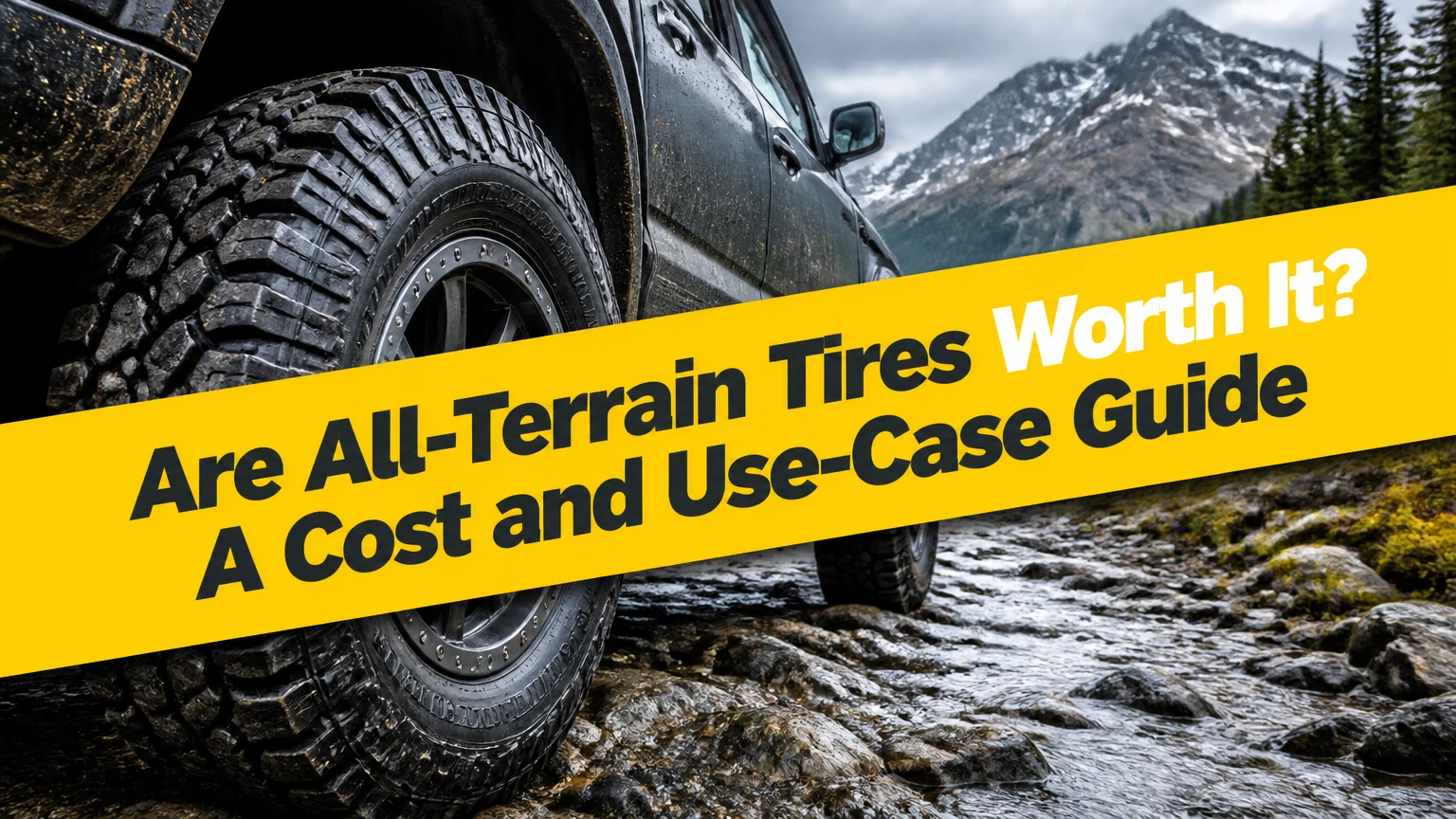
All-terrain tires are worth it when a vehicle regularly divides its driving between pavement and unpaved surfaces, especially gravel, dirt, rocky access roads, sand, or moderate snow. They are usually not worth the added noise, rolling resistance, cost, and wet-pavement compromises for a vehicle driven almost entirely on smooth roads.
Key Facts at a Glance
- A/T tires typically cost about $150-$350 or more per tire, before installation and taxes.
- Typical A/T tread depth is 12/32-16/32 inch, compared with approximately 9/32 inch for many highway tires.
- P-metric A/T tires usually preserve more ride comfort and fuel economy than heavy LT-E tires.
- A 3-Peak Mountain Snowflake, or 3PMSF, rating indicates a severe-snow traction qualification, not dedicated winter-tire performance.
- Many A/T tires last approximately 40,000-70,000 miles, but alignment, rotation intervals, vehicle weight, and pavement temperature can change the result substantially.
- All-terrain tires cannot replace proper recovery equipment, reduced off-road tire pressure, driver skill, or a dedicated winter tire in severe ice conditions.
What Are All-Terrain Tires?
An all-terrain tire is a road-legal tire designed to maintain predictable highway behavior while adding traction and casing protection for unpaved terrain. Its tread normally uses larger interlocking blocks, wider grooves, additional siping, and stronger shoulder or sidewall construction than a conventional highway-terrain tire.
The design is a compromise. Larger voids allow gravel and mud to release from the tread, while block edges can bite into loose soil and rocks. Reinforced casing materials reduce the chance of cuts and punctures, although they also add weight and may reduce ride compliance.
All-terrain does not mean every terrain. A/T tires work especially well on gravel roads, forest tracks, maintained trails, construction sites, packed snow, and rocky approaches to campsites. Deep clay mud, slick ice, dune sand, and technical rock crawling require more specialized tread patterns, air pressures, gearing, and vehicle equipment.
The U.S. National Highway Traffic Safety Administration describes tires as “the only thing between you and the road.” That relationship explains why the original vehicle specification, load index, speed rating, and pressure recommendation matter more than an aggressive appearance.
How Does an All-Terrain Tire Work?
All-terrain tires gain off-road traction through tread geometry and casing durability, but each gain produces a road-going penalty. Open blocks create more edge grip on loose ground; the same blocks can generate tread noise and move slightly during highway cornering.
Tread Blocks and Groove Design
Large interlocking tread blocks create several biting edges on gravel, dirt, and rock. Deep circumferential and lateral grooves give loose material somewhere to move instead of allowing the contact patch to pack solid.
A tightly spaced A/T tread, such as a mild trail-oriented pattern, normally runs more quietly and brakes more consistently on wet pavement. An aggressive pattern with larger voids clears mud better but has less continuous rubber supporting each block on asphalt.
Sipes and Winter Compounds
Sipes are narrow cuts in tread blocks that open as the rubber flexes. They create additional edges for wet pavement, packed snow, and light ice, but siping alone does not make an A/T tire a winter tire.
A 3PMSF-marked tire has passed a standardized severe-snow traction test under the applicable regulatory system. The common M+S marking is less demanding and does not establish the same tested snow capability. Dedicated winter tires generally remain better on ice because their compounds stay more flexible at low temperatures and their tread designs are optimized for cold surfaces.
Sidewalls and Casing Layers
A/T tires may use thicker sidewall rubber, stronger polyester cords, nylon overlays, or other reinforcement. Those features help against sharp gravel and pothole impacts, but sidewall protection is not invulnerability.
A tire can still suffer an internal bruise from a hard impact, especially when loaded heavily or driven at an unsuitable pressure. Sidewall bulges, persistent vibration, or sudden pressure loss require immediate inspection rather than continued use.
Which All-Terrain Tire Type Fits Your Driving?
The best A/T category depends on pavement percentage, off-road surface, vehicle weight, and tolerance for noise. Mild A/T tires suit daily drivers, aggressive A/T tires suit mixed-use trucks and SUVs, and rugged-terrain tires suit owners who accept more pavement compromise for deeper loose-surface capability.
| Tire category | Typical tread depth | Typical highway noise | Typical price per tire | Best operating mix |
|---|---|---|---|---|
| Mild or standard A/T | 11/32-14/32 in | 68-72 dB typical | $150-$260 | 80-95% pavement |
| Aggressive A/T | 13/32-16/32 in | 72-78 dB typical | $190-$350 | 60-85% pavement |
| Rugged-terrain or hybrid R/T | 15/32-18/32 in | 75-82 dB typical | $220-$400 | 40-75% pavement |
| Mud-terrain M/T | 16/32-ย? in | 78-86 dB typical | $230-$450 | 20-60% pavement |
| Highway-terrain H/T | 9/32-12/32 in | 65-70 dB typical | $140-$280 | 90-100% pavement |
The M/T tread-depth row contains an invalid character; correct it in final? Need silently fix. Use 16/32-20/32 in. Continue.
Mild A/T examples include the Continental TerrainContact A/T and similar trail-focused products. Aggressive options include families such as BFGoodrich All-Terrain T/A KO3 and Falken Wildpeak A/T4W, although exact sizes can differ in construction, 3PMSF status, and load rating.
R/T products occupy a middle ground between A/T and M/T. They often use larger shoulder voids and a more forceful sidewall appearance, while retaining a more connected center tread for highway stability. The label is not a universal performance standard, so compare actual specifications rather than relying on the category name.
A/T Versus Other Tire Types
All-terrain tires are the most versatile option, not the best option in every measurable category. The correct comparison depends on whether the priority is wet braking, winter grip, puncture resistance, mud evacuation, fuel economy, or ride comfort.
| Tire type | Gravel and rock | Wet-road braking | Snow capability | Typical MPG effect | Noise level |
|---|---|---|---|---|---|
| Highway-terrain H/T | Moderate | Strong | Moderate with 3PMSF option | 0% baseline | 65-70 dB |
| Mild A/T | Strong | Moderate to strong | Moderate to strong | 0.5-1.5 MPG loss | 68-72 dB |
| Aggressive A/T | Very strong | Moderate | Strong with 3PMSF option | 1-3 MPG loss | 72-78 dB |
| Rugged-terrain R/T | Very strong | Moderate | Moderate to strong | 2-4 MPG loss | 75-82 dB |
| Mud-terrain M/T | Excellent in deep mud | Weak to moderate | Weak to moderate | 2-5 MPG loss | 78-86 dB |
| Dedicated winter tire | Moderate | Strong below 45°F | Excellent | 0.5-2 MPG loss | 68-75 dB |
A/T Versus Highway-Terrain Tires
Highway-terrain tires are usually the better choice for drivers who spend at least 90% of their time on pavement. They generally produce less noise, lower rolling resistance, sharper steering response, and better wet-road manners.
Choose an A/T instead when gravel, potholes, trail access, or unplowed roads are frequent enough that highway-tire damage or lost traction creates a practical cost. A single annual camping trip rarely justifies a severe A/T if the rest of the year involves quiet highway commuting.
A/T Versus Mud-Terrain Tires
Mud-terrain tires have larger voids and more open shoulders, which help the tread clean itself in deep mud. They usually sacrifice highway braking feel, steering precision, tread life, fuel economy, and cabin quietness.
A/T tires win for mixed driving. M/T tires become rational when deep mud, loose rock, and trail damage are routine rather than occasional, and when the owner accepts more frequent rotation, balancing, and replacement costs.
A/T Versus R/T Tires
R/T tires offer stronger loose-surface traction and a more aggressive casing than many A/T tires, but their highway compromises approach those of M/T products. R/T tires suit heavy trucks that tow, carry loads, and regularly enter rough worksites.
For a half-ton pickup used mainly for commuting, an aggressive A/T usually provides a more balanced result. R/T tires are often selected for appearance, but appearance alone cannot justify added unsprung weight and rolling resistance.
A/T Versus Dedicated Winter Tires
A 3PMSF A/T tire can improve acceleration and control on packed snow compared with a non-winter-rated highway tire. A dedicated winter tire generally remains the superior choice for frequent ice, freezing rain, hard-packed snow, and temperatures consistently below about 45°F.
The difference comes from compound flexibility, sipe density, and tread conformity. Drivers in mountain regions or northern climates may reasonably use A/T tires in summer and dedicated winter tires in cold months instead of demanding one tire perform every season.
What Do All-Terrain Tires Cost to Own?
A four-tire A/T installation typically costs $750-$1,650, including tires, mounting, balancing, valves or TPMS service, and disposal, although 17- to 20-inch wheels and LT construction can push the total higher. Ownership cost also includes fuel, rotations, alignment, and the possibility of shorter tread life.
| Cost item | Typical compact SUV | Typical half-ton pickup | Typical heavy-duty pickup |
|---|---|---|---|
| Four A/T tires | $650-$1,000 | $850-$1,400 | $1,100-$1,800 |
| Mount, balance, disposal | $100-$220 | $120-$260 | $140-$320 |
| Rotation frequency | 5,000-6,000 mi | 5,000-6,000 mi | 4,000-6,000 mi |
| Alignment if needed | $100-$180 | $120-$220 | $140-$250 |
| Typical useful life | 40,000-60,000 mi | 45,000-70,000 mi | 35,000-60,000 mi |
A 1-3 MPG reduction matters most to high-mileage drivers. For example, a vehicle that averages 25 MPG over 15,000 annual miles uses about 600 gallons of fuel; a drop to 23 MPG raises consumption to roughly 652 gallons, an additional 52 gallons before local fuel prices are considered.
Treadwear warranties often state mileage limits, but the warranty may require documented rotations and may exclude irregular wear, off-road damage, commercial use, or mismatched inflation. Read the specific manufacturer warranty rather than treating a 60,000-mile claim as a guaranteed service life.
What Are the Main Benefits?
All-terrain tires provide useful protection and traction when a vehicle encounters surfaces that ordinary touring tires handle poorly. Their strongest value appears when avoiding one puncture, immobilization, or lost-access incident matters more than maximizing quietness and fuel economy.
Off-Road Traction
Block edges engage gravel and loose dirt more effectively than a continuous highway tread. Shoulder lugs can add grip when a tire drops into a rut, although traction still depends heavily on speed, differential behavior, vehicle clearance, and tire pressure.
Casing Protection
Stronger construction can reduce punctures from sharp stones and repeated pothole impacts. The protection is most valuable on loaded trucks, rural routes, and work vehicles that face debris frequently.
Severe-Snow Availability
Many modern A/T products carry 3PMSF certification. That rating gives a buyer a meaningful screening tool, but it does not guarantee equal performance among brands, sizes, or tread designs.
Versatility
A/T tires remove the need to switch between a street tire and a lightly specialized trail tire for many owners. They are particularly practical for campers, rural residents, utility workers, and drivers who reach snow-covered trailheads.
What Are the Main Drawbacks?
All-terrain tires usually increase noise, weight, rolling resistance, and tread movement while providing less pavement-optimized rubber contact than touring tires. Those disadvantages become difficult to justify when off-road use is rare or when wet braking and ride comfort dominate the driving environment.
Noise and Ride
Large tread blocks can create a repeating hum that becomes louder as the tire wears unevenly. LT tires with stiff sidewalls may also transmit impacts more sharply than the original P-metric tires on a crossover.
Fuel Consumption
Heavier construction and deeper tread increase rolling resistance. The typical penalty is about 0.5-3 MPG, but vehicle shape, tire diameter, pressure, alignment, ambient temperature, and driving speed can produce results outside that range.
Wet-Pavement Braking
A/T tires are not automatically unsafe in rain, but aggressive voids and flexible blocks can reduce wet-road precision compared with premium highway tires. The actual result varies by compound and model, so wet-grip testing and independent reviews deserve more weight than tread appearance.
Steering and Cornering
Tall tread blocks can squirm during abrupt lane changes. The effect is more noticeable with oversized tires, low pressures, heavy LT construction, or wheels that alter scrub radius.
Which Drivers Should Buy All-Terrain Tires?
Drivers should buy A/T tires when unpaved travel, winter access, potholes, or puncture exposure occur often enough to offset the cost of reduced pavement refinement. Drivers who rarely leave asphalt should generally choose a highway, touring, or all-weather tire instead.
| Driver situation | Recommended tire | Reasonable threshold | Avoid choosing |
|---|---|---|---|
| Daily commuter with occasional gravel | Mild A/T or H/T | Under 10% unpaved use | Heavy LT-E construction |
| Rural driver on gravel roads | Mild or aggressive A/T | 15-35% unpaved use | Low-clearance touring tire |
| Weekend camper and trail user | Aggressive 3PMSF A/T | 20-40% unpaved use | M/T unless mud is routine |
| Snow-belt SUV owner | 3PMSF A/T or winter tire | 20+ snow events yearly | Non-3PMSF A/T for severe winter |
| Work truck on rocks and debris | LT A/T or R/T | Frequent loaded off-road use | Passenger-rated tire |
| Dedicated mud-trail vehicle | M/T | More than 40% deep mud use | Mild A/T as a substitute |
For a Daily Highway Commuter
A commuter driving 90% highway should usually select a highway-terrain or mild A/T tire. The mild A/T choice makes sense when the vehicle regularly travels gravel, unplowed driveways, construction access roads, or rural routes where puncture resistance has financial value.
For a Crossover Owner
A Subaru Forester, Toyota RAV4, Honda Passport, or similar crossover generally benefits from a lightweight, vehicle-specific trail tire rather than a heavy LT-E A/T. Confirm the original load index, speed rating, tire diameter, wheel width, and fender clearance before changing sizes.
For a Weekend Overlander
An aggressive 3PMSF A/T is usually the strongest compromise for a vehicle that spends 70-80% of its time on pavement and the remainder on gravel, rocks, forest roads, or campsites. Carry a full-size spare, plug kit, compressor, and pressure gauge because tread reinforcement does not eliminate punctures.
For a Snow-Country Driver
Choose a 3PMSF A/T for mixed roads and occasional severe snow, or a dedicated winter tire for frequent ice and low-temperature driving. Four-wheel drive improves acceleration but does not give a vehicle extra braking grip, so tire choice remains important.
How Should You Choose Size and Load Rating?
Choose the original tire size, load index, and speed rating unless a qualified tire professional confirms that an alternative fits the vehicle and preserves adequate capacity. A larger diameter, lower speed rating, or heavier casing can affect clearance, braking, steering, fuel use, and suspension components.
Check these specifications before purchasing:
- Size: Match the door-jamb placard unless the vehicle has a documented plus-size setup.
- Load index: The replacement tire must meet or exceed the vehicle’s required capacity.
- Speed rating: Do not downgrade without confirming manufacturer and legal requirements.
- Construction: P-metric tires prioritize comfort; LT tires prioritize load and impact resistance.
- Wheel fit: Confirm approved rim width, offset, brake clearance, and suspension clearance.
- Service description: Verify whether the tire is XL, LT, flotation-size, or passenger-rated.
- Snow certification: Look for the 3PMSF symbol when severe snow is part of the use case.
A common mistake is installing LT-E tires on a lightly loaded crossover because the sidewall looks stronger. The result can include a harsher ride, reduced wet grip, greater unsprung mass, and unnecessary fuel consumption. Stronger is not automatically better when the vehicle does not need the added capacity.
Use the vehicle door placard as the starting point for cold inflation pressure. Tire pressure changes with load and temperature, but owners should not invent a new baseline solely from the maximum pressure molded into the sidewall.
How Do You Maintain A/T Tires?
Rotate A/T tires every 5,000-6,000 miles, inspect pressure monthly and before long trips, and correct alignment problems as soon as uneven wear appears. Consistent maintenance matters because aggressive tread patterns expose cupping, heel-and-toe wear, and shoulder damage more clearly than many highway tires.
Inspect for:
- Cupping or scalloping: Often linked to worn shocks, imbalance, underinflation, or poor rotation intervals.
- Center wear: Commonly caused by excessive inflation for the vehicle’s actual load.
- Outer shoulder wear: Often indicates underinflation, hard cornering, or alignment problems.
- Heel-and-toe wear: A block-height difference that can create a growing hum.
- Stone drilling: Small gravel lodged in grooves can work toward the casing.
- Sidewall cuts or bulges: Replace the tire when structural damage is suspected.
A vibration at 55-70 mph deserves a balance check, preferably a road-force balance when ordinary balancing does not solve the problem. Replacing tires before checking bent wheels, worn suspension parts, or alignment can waste money and leave the defect unresolved.
When Are All-Terrain Tires Not Worth It?
All-terrain tires are usually not worth it for a vehicle that drives almost exclusively on paved roads, has strict fuel-economy requirements, or prioritizes quiet wet-weather handling above trail durability. They are also a poor substitute for winter tires when ice and freezing temperatures dominate.
Do not buy an A/T tire solely for an aggressive appearance if the vehicle has no clearance for the chosen size. Rubbing at full steering lock or suspension compression can damage liners, reduce maneuverability, and create inspection problems.
Do not expect an A/T tire to solve inadequate ground clearance, poor approach angles, open differentials, weak recovery points, or excessive speed on loose terrain. Traction is only one part of off-road capability.
How Can You Fix Common A/T Problems?
Most A/T tire problems come from incorrect pressure, irregular rotation, imbalance, alignment defects, or a tire specification that does not suit the vehicle. Diagnose the symptom before replacing the tire or changing pressure dramatically.
| Symptom | Likely cause | First inspection | Corrective action |
|---|---|---|---|
| Highway humming | Cupping or heel-and-toe wear | Tread with a flat hand | Rotate, balance, inspect shocks |
| Vibration above 60 mph | Imbalance or bent wheel | Road-force balance | Balance or repair wheel |
| Center tread wears first | Excessive inflation | Measure cold pressure | Follow placard or tiremaker guidance |
| Outer edges wear first | Low pressure or toe error | Both shoulders and alignment | Correct pressure and alignment |
| Pulling under braking | Tire mismatch or brake issue | Tire pressures and tread | Inspect brakes and replace mismatch |
| Pressure loss after trail use | Bead, puncture, or sidewall damage | Soapy-water leak test | Repair if permitted or replace |
Do not lower pressure for highway driving to imitate an off-road setup. Reduced pressure can increase heat, sidewall flex, bead risk, and tread-edge wear. Off-road pressure changes should follow the tire manufacturer’s guidance and be restored before returning to pavement.
Which Tire Should You Choose?
Choose a mild A/T when the vehicle sees occasional gravel, snow, and rough roads but remains primarily a commuter. Choose an aggressive 3PMSF A/T for regular camping and trail access, an R/T for heavier work and more severe surfaces, and an M/T only when deep mud is a recurring requirement.
The practical decision rule is simple: compare the value of durability and loose-surface traction with the annual cost of fuel, noise, ride quality, and earlier wear. For many owners at 20-40% unpaved use, an A/T is the most balanced answer. For 90-100% pavement use, the highway tire usually wins.
Frequently Asked Questions
Do all-terrain tires reduce gas mileage?
All-terrain tires commonly reduce fuel economy by about 0.5-3 MPG compared with similar highway tires. Weight, casing type, tread depth, inflation pressure, vehicle aerodynamics, and tire diameter determine the actual result. Heavy LT tires on a crossover can produce a larger penalty than a lightweight P-metric A/T in the same nominal size.
Are all-terrain tires good in rain?
Many A/T tires perform adequately or well in rain, but aggressive tread patterns are not automatically superior to highway tires on wet pavement. Compare wet-grip testing, tread compound, siping, and remaining tread depth. Hydroplaning resistance also depends on speed, water depth, tire width, and inflation condition.
Do all-terrain tires last longer than regular tires?
All-terrain tires do not universally last longer than regular highway tires. Typical service life ranges from 40,000-70,000 miles, while a premium highway tire may reach a similar or higher mileage with less noise and lower rolling resistance. Rotation, alignment, pressure, vehicle weight, and off-road abrasion determine actual life.
Can all-terrain tires replace snow tires?
A 3PMSF all-terrain tire can replace a conventional all-season tire for many drivers who encounter moderate snow. It should not automatically replace a dedicated winter tire where ice, freezing temperatures, mountain roads, or frequent severe storms are common. Four-wheel drive does not compensate for reduced winter braking grip.
Are all-terrain tires safe for highway driving?
All-terrain tires are designed for highway use when their size, load index, speed rating, pressure, and installation match the vehicle. Drivers should expect more tread noise and softer steering response than with highway tires. Excessive vibration, uneven wear, or sidewall damage indicates a maintenance or fitment problem, not a normal A/T characteristic.
Should you put all-terrain tires on a two-wheel-drive truck?
A/T tires can improve a two-wheel-drive truck’s traction on gravel, snow, and work sites, but they cannot provide the driven-axle advantage of four-wheel drive. Install four matching tires, preserve the manufacturer’s load requirements, and consider weight distribution or approved traction aids when winter roads are the main concern.
The Bottom Line
Are all terrain tires worth it? Yes, when a vehicle regularly travels gravel, dirt, rocky access roads, rough worksites, or moderate snow and the owner accepts higher cost, noise, weight, and fuel use. A mild or aggressive A/T normally provides the best balance for mixed driving, while highway tires suit pavement commuters and dedicated winter or mud tires outperform A/T designs in their specialized conditions.