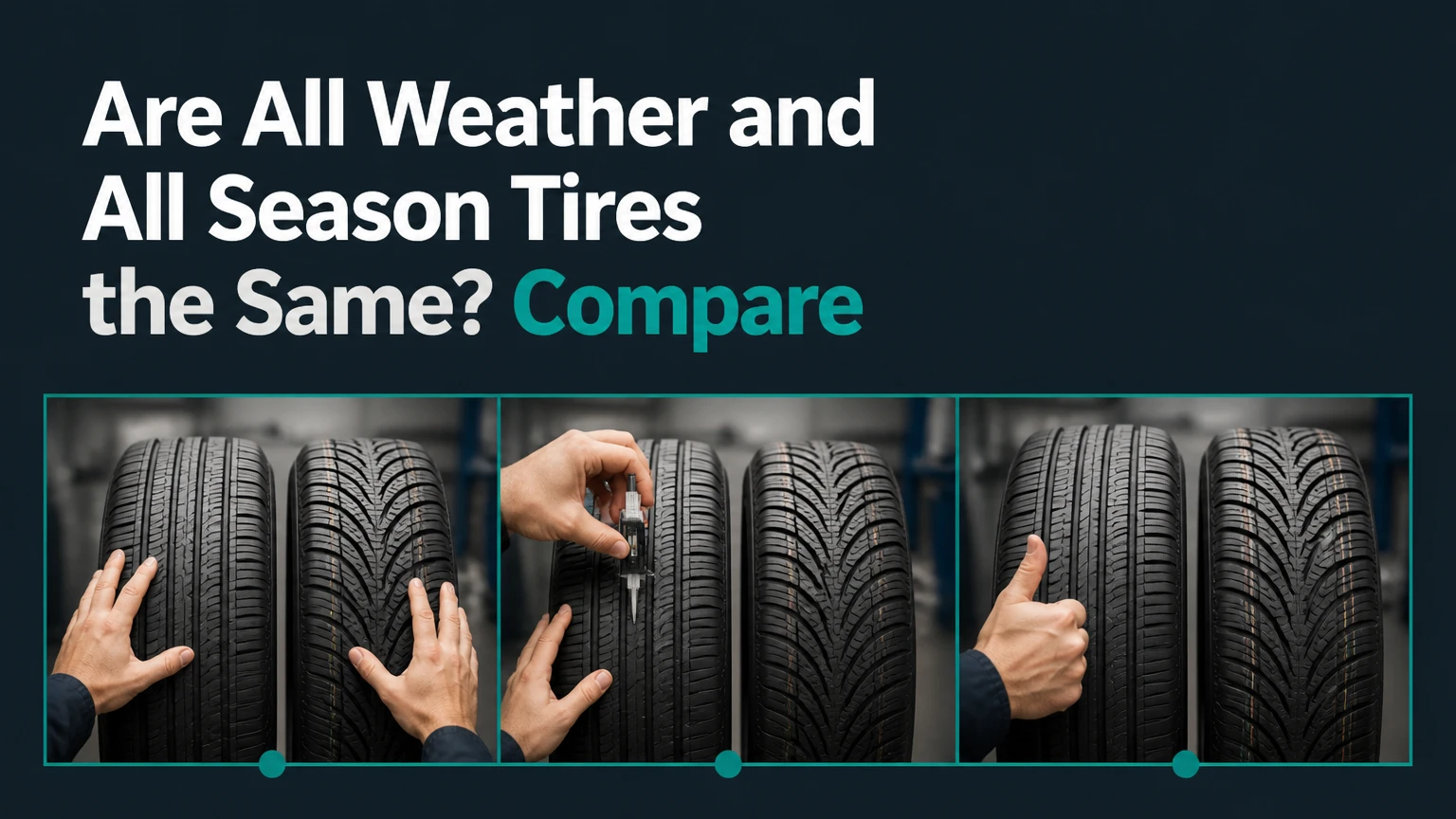
No, all-weather and all-season tires are not the same. All-season tires prioritize dry and wet-road performance, comfort, fuel economy, and tread life in moderate climates, while all-weather tires use a more winter-capable compound and tread design, usually with the 3PMSF severe-snow symbol. Neither category matches a dedicated winter tire on ice.
Key Facts at a Glance
All-season tires are generally the better choice for mild winters, warm summers, and occasional light snow.
All-weather tires are designed as a year-round compromise with stronger cold-weather and snow traction.
The 3PMSF symbol confirms a tire passed a severe-snow traction test; it does not certify strong braking on every type of ice.
M+S means Mud and Snow, but the marking alone does not prove winter-tested performance.
Dedicated winter tires remain the strongest option for frequent snow, packed ice, sub-freezing temperatures, or unplowed roads.
Tire model, tread depth, pressure, load rating, and vehicle alignment can matter as much as the category name.
What Is the Difference Between All-Season and All-Weather Tires?
All-season tires are optimized for moderate conditions, whereas all-weather tires shift more of the design toward cold-weather traction. The difference comes from the complete package: rubber formulation, tread voids, sipe density, tread-block shape, and certification.
The names are not perfectly standardized worldwide. Tire manufacturers and retailers commonly use “all-weather” for a year-round tire that carries the Three-Peak Mountain Snowflake symbol, but shoppers should verify the actual sidewall marking rather than rely on the product name.
A typical all-season tire has a relatively restrained tread pattern, solid circumferential ribs, moderate grooves, and fewer snow-biting edges. Those features can reduce noise and rolling resistance. A typical all-weather tire has deeper or more numerous grooves, additional sipes, and a compound that stays more flexible in cold conditions.
The trade-off is measurable in behavior. All-season tires usually deliver longer wear and a quieter ride, while all-weather tires usually provide more useful traction in slush and moderate snow but sacrifice some efficiency, summer precision, or tread life.
All-Season vs. All-Weather Tires: Master Comparison
The following ranges are typical retail-market characteristics, not guarantees for every brand or vehicle. A touring all-season tire and a high-performance all-season tire can behave very differently.
| Decision factor | Typical all-season tire | Typical all-weather tire | Dedicated winter tire |
|---|---|---|---|
| Primary design climate | Above about 7°C / 45°F | Year-round, including below 7°C / 45°F | Consistently below about 7°C / 45°F |
| Severe-snow marking | M+S often present | 3PMSF commonly present | 3PMSF normally present |
| Light-snow traction | Fair | Good | Very good |
| Packed-snow traction | Limited | Fair to good | Very good |
| Ice traction | Poor to limited | Limited to fair | Best of the three |
| Typical tread warranty | 45,000-90,000 miles | 40,000-70,000 miles | Often 0-50,000 miles |
| Typical replacement price | $80-$200 or more | $140-$260 or more | $120-$300 or more |
| Noise and rolling resistance | Lowest on touring models | Moderate | Highest on many models |
| Summer handling | Good to very good | Good | Acceptable, but not ideal |
| Seasonal storage required | No | No | Usually yes |
Which Tire Has Better Snow and Ice Traction?
All-weather tires have better snow traction than ordinary all-season tires, but dedicated winter tires have the strongest cold-weather performance. The advantage comes from a softer cold-weather compound, higher sipe density, and tread features that retain flexibility and create gripping edges below freezing.
The 3PMSF standard is useful because it requires a tire to meet a defined severe-snow traction performance threshold compared with a reference tire. It does not mean every 3PMSF tire performs identically, and it does not measure every braking or cornering condition.
Ice is the important limitation. A tire can pass a severe-snow test and still provide far less grip on polished ice than a dedicated studless winter tire. Studded tires may offer another advantage where studs are legal and roads permit their use, although stud performance depends on ice condition and local restrictions.
Winner: Dedicated winter tires for frequent snow and ice, all-weather tires for occasional or moderate winter conditions, and all-season tires for rare light snow.
Which Tire Works Better in Rain and Summer Heat?
All-season tires often provide the better overall summer compromise, especially touring models with continuous ribs and lower rolling resistance. All-weather tires can perform very well in rain because their larger grooves evacuate water and slush, but aggressive tread designs may create more noise and reduce steering sharpness.
Hydroplaning resistance depends on tread depth, water depth, speed, inflation pressure, and tire width. A worn all-season tire with 3/32 inch of tread can be less secure in rain than a newer all-weather tire with 9/32 inch, so category comparisons cannot replace inspection of actual condition.
Extreme summer heat also increases wear on softer compounds. That does not make all-weather tires unsuitable for summer; it means aggressive driving, high loads, poor alignment, and underinflation can consume their tread faster.
Winner: All-season tires for low noise, efficient highway travel, and long summer wear; all-weather tires when rain frequently connects with snow or freezing temperatures.
Do All-Weather Tires Last as Long as All-Season Tires?
All-season tires commonly last longer than all-weather tires when both are driven through hot summers and maintained correctly. Typical advertised tread-life ranges are about 45,000-90,000 miles for all-season tires and 40,000-70,000 miles for all-weather tires, but warranties are not mileage guarantees.
Actual service life depends on annual mileage, alignment, rotation, acceleration, road surface, climate, vehicle weight, and tread depth. Front-wheel-drive vehicles can wear their front tires substantially faster if the owner delays rotation. Electric vehicles may also increase wear because of higher curb weight and immediate torque.
Age matters even when tread remains. The U.S. Tire Manufacturers Association recommends regular inspection as tires age, and many manufacturers advise replacement around six years from service or earlier if cracking, damage, or abnormal wear appears. The DOT date code on the sidewall identifies the manufacturing week and year.
Winner: All-season tires for maximum expected tread life, provided winter traction is not the main requirement.
What Do M+S and 3PMSF Mean?
M+S identifies a Mud and Snow tread designation, while 3PMSF identifies a tire that passed a regulated severe-snow traction test. M+S is not equivalent to winter certification, and 3PMSF is not equivalent to dedicated-ice performance.
The M+S marking generally describes tread geometry with more open space than a basic highway pattern. It does not establish how flexible the rubber remains in cold weather or how effectively the tire brakes on snow. Many all-season tires carry M+S.
The 3PMSF symbol shows a mountain with three peaks and a snowflake. In North America, the marking is associated with a standardized severe-snow test under applicable regulatory frameworks. In Europe, the symbol is also used as a formal winter-performance designation, while local rules determine whether it satisfies a winter-equipment requirement.
A sidewall symbol cannot tell you the tire’s wet-braking distance, ice grip, noise level, or expected mileage. Compare independent tests, manufacturer specifications, load index, speed rating, and the actual conditions on your roads.
NHTSA summarizes the safety principle plainly: “Tires are the only thing separating your vehicle from the road.” That is why a category label should begin the evaluation, not end it.
| Sidewall marking | What it establishes | What it does not establish | Practical interpretation |
|---|---|---|---|
| M+S | Manufacturer-declared mud-and-snow tread geometry | Cold flexibility, ice braking, severe-snow test result | Common on all-season tires |
| 3PMSF | Passes a defined severe-snow traction test | Best ice grip, short stopping distance everywhere | Common on all-weather and winter tires |
| Stud designation | Tire is built to accept or use studs, depending on model | Legal permission in every jurisdiction | Check local road rules |
| DOT date code | Manufacturing week and year | Remaining safe life by itself | Use with inspection and age guidance |
| XL or Extra Load | Higher load capacity at specified pressure | Better winter traction | Match vehicle requirements |
Why Does 7°C Matter, and Is It a Hard Cutoff?
The 7°C or 45°F threshold is a useful engineering rule of thumb, not a switch that suddenly makes an all-season tire unsafe. Tire compounds lose flexibility progressively as temperatures fall, and road surface temperature, moisture, sunlight, and tire design influence the actual result.
Winter-oriented compounds are formulated to remain more pliable in cold conditions. All-season compounds typically balance cold flexibility against warm-weather wear, braking, and handling. The exact transition varies among tire models, so a premium all-season tire may outperform a weak all-weather tire in a particular test.
Drivers should treat repeated temperatures below about 45°F as a signal to evaluate winter traction, not as an automatic replacement deadline. If roads remain dry and snow is rare, all-season tires may remain appropriate. If temperatures stay below freezing and snow or ice is routine, the case for all-weather or winter tires becomes stronger.
A common expert mistake is treating the threshold as a legal or physical boundary. It is neither.
Are All-Weather Tires Worth the Extra Cost?
All-weather tires are often worth the premium when avoiding seasonal wheel changes matters and winter conditions are frequent but not severe. Typical prices run about $140-$260 or more per tire, compared with roughly $80-$200 or more for mainstream all-season tires, before installation and taxes.
A four-tire all-weather purchase may therefore cost $240-$320 more than a comparable all-season set. That premium can offset some costs associated with two tire sets, including mounting, balancing, storage, and twice-yearly appointments. However, a two-set system can provide better performance and may preserve each set because each tire is used for only part of the year.
| Ownership setup | Typical purchase cost | Typical seasonal service | Storage need | Winter capability |
|---|---|---|---|---|
| One all-season set | $320-$800 for four tires | $0 seasonal swaps | None | Light snow only |
| One all-weather set | $560-$1,040 for four tires | $0 seasonal swaps | None | Moderate snow |
| All-season plus winter sets | $1,000-$2,400 total | $60-$200 per year | Required | Strongest flexibility |
| Winter tires on spare wheels | $1,000-$2,400 total | $0-$100 per year | Required | Strong and convenient |
| Studded winter set | $1,100-$2,600 total | $0-$200 per year | Required | Strong ice performance where legal |
These are typical planning ranges, not quotes. Wheel size, tire brand, vehicle type, installation fees, and regional demand can change the total substantially.
How Much Does Tire Choice Affect Fuel Economy?
All-season touring tires generally have the lowest rolling resistance, while all-weather and winter tires often use deeper, more flexible tread that requires more energy to deform. The fuel difference varies by model, pressure, temperature, vehicle, speed, and driving route, so a universal percentage would be misleading.
The practical rule is simple: maintain the cold inflation pressure listed on the driver-door placard, not the maximum pressure molded into the sidewall. Check pressure at least monthly and before long trips. A common approximation is about 1 psi of pressure change for every 10°F change in air temperature, although tire construction and starting temperature alter the result.
Underinflation increases shoulder wear, heat buildup, rolling resistance, and stopping distance. Overinflation can reduce the contact patch and make impacts harsher. TPMS warns about substantial pressure loss, but it does not replace a gauge.
Which Tire Should You Choose?
The right choice depends on winter severity, road-clearing speed, driving schedule, storage access, and the vehicle manufacturer’s specifications. A driver who sees one brief snowfall each year has a different risk profile from a rural commuter traveling before roads are plowed.
Mild-Climate Urban Commuter
Choose all-season tires when winter temperatures usually remain moderate, snow is rare, and roads are cleared quickly. Touring all-season tires generally provide the quietest ride, lowest rolling resistance, and longest tread warranty for highway commuting.
Do not choose this setup if you must drive during every storm or regularly cross roads that remain icy overnight. Occasional snow is manageable only when the driver can reduce speed or postpone travel.
Snow-Belt Driver Without Storage Space
Choose all-weather tires when snow occurs regularly but dedicated winter storage, wheel changes, or seasonal appointments are impractical. Verify the 3PMSF symbol and select a model with the correct load index and speed rating.
All-weather tires simplify ownership, but they remain a compromise. They do not create the same margin on glare ice as dedicated winter tires, particularly on hills, rural roads, and intersections with polished snow.
Mountain, Rural, or Unplowed-Road Driver
Choose dedicated winter tires when roads are frequently unplowed, steep, deeply snow-covered, or icy. All-weather tires can be a reasonable minimum for occasional mountain travel, but 3PMSF status does not guarantee that a tire satisfies every chain-control or winter-equipment rule.
Check the transport authority for the route and jurisdiction. Legal requirements can specify approved symbols, chains, studs, or traction devices, and the rules can change by road segment.
Performance Driver
Choose a high-performance all-season tire for dry-road response in a moderate climate, or use dedicated summer and winter sets when handling matters in both seasons. All-weather tires usually prioritize winter versatility over the rigid shoulder response and steering precision preferred for aggressive cornering.
Never install a tire with a lower speed rating or load index than the vehicle requires. The owner’s manual, door placard, and replacement-tire documentation control that decision.
Electric Vehicle or Heavy SUV Owner
Choose by load capacity first, then by climate capability. Heavy SUVs, pickup trucks, and electric vehicles can generate faster wear and greater heat because of their mass, so an all-weather tire must have an appropriate load index and, where required, an XL or reinforced construction.
Do not assume a larger or more aggressive tire is automatically safer. Additional tread weight can increase rolling resistance, while incorrect diameter can affect speedometer accuracy, driver-assistance systems, and clearance.
Can All-Weather Tires Replace Winter Tires?
All-weather tires can replace winter tires for some drivers, but not for every winter environment. They are suitable when snow is occasional to moderate, roads receive timely treatment, and the driver accepts less ice traction than a dedicated winter set provides.
Dedicated winter tires remain preferable when temperatures stay below freezing, snow remains packed for long periods, black ice is common, or stopping on steep roads is unavoidable. Their compound and tread are optimized around cold-weather use rather than year-round compromise.
All-weather tires also cannot overcome unsafe speed, poor visibility, worn tread, or inadequate following distance. Traction control, stability control, and all-wheel drive help manage acceleration and vehicle motion, but they do not eliminate the laws of braking. AWD can help a vehicle start moving; it cannot make a tire stop faster on ice.
What Problems Do Drivers Commonly Miss?
Several maintenance and buying mistakes can erase the advantage of the chosen tire category.
- Confusing M+S with winter certification: M+S does not demonstrate severe-snow traction. Look for 3PMSF when winter performance is a purchase requirement.
- Ignoring tread depth: Snow performance declines before the legal minimum. Many technicians recommend replacing winter-oriented tires around 5/32 inch when snow traction matters, even though local legal limits may be lower.
- Cross-rotating directional tires: Directional tread must maintain its rolling direction. Rotation is normally front-to-back on the same side unless the tire is removed and remounted.
- Mixing incompatible categories: Installing two winter-capable tires on one axle and ordinary all-season tires on the other can create uneven handling. Follow the vehicle manufacturer’s replacement guidance.
- Using the wrong pressure reference: The sidewall maximum is not the vehicle’s recommended operating pressure. Use the placard or manual.
- Ignoring alignment wear: Feathering, inner-edge wear, or steering pull can destroy a new set quickly. Correct alignment before judging tread life.
- Treating the tire name as a test result: “All-weather,” “four-season,” and similar marketing terms vary. Confirm symbols, specifications, independent testing, and warranty details.
A tire with excellent design cannot perform properly when it is underinflated, badly worn, overloaded, or fitted to a vehicle with incorrect alignment.
When Should You Buy All-Season, All-Weather, or Winter Tires?
Buy all-season tires when dry and wet pavement dominate, winter snow is uncommon, and comfort or mileage is the priority. Buy all-weather tires when one set must handle warm summers plus recurring snow, slush, and freezing temperatures.
Buy dedicated winter tires when severe winter conditions affect your route often enough that a missed trip or emergency stop carries meaningful risk. The extra wheels, storage, and seasonal service are ownership costs, but they purchase a larger cold-weather performance margin.
Before ordering, record the tire size, load index, speed rating, vehicle type, annual mileage, winter temperature pattern, and local legal requirements. Compare the same attributes across models rather than comparing category names alone.
FAQ
Can I Use All-Season Tires in Light Snow?
You can use all-season tires in light snow when tread depth is healthy, pressure is correct, speeds are reduced, and roads are not heavily packed or icy. All-season tires are not a reliable substitute for winter tires when snow is frequent, temperatures remain below freezing, or stopping distances are safety-critical.
Are All-Weather Tires Noisier Than All-Season Tires?
All-weather tires are often somewhat noisier because deeper grooves, larger tread voids, and more flexible blocks can create additional tread pattern sound. The difference varies by model and vehicle insulation, so a touring all-weather tire may be quieter than an aggressive all-season SUV tire.
Do All-Wheel-Drive Vehicles Need Winter Tires?
All-wheel-drive vehicles do not automatically need winter tires, but AWD does not improve tire grip during braking. Drivers facing frequent snow, ice, hills, or unplowed roads gain more winter safety from dedicated winter tires than from relying on AWD with ordinary all-season tires.
How Often Should I Rotate All-Weather Tires?
Rotate all-weather tires according to the vehicle and tire manufacturer’s schedule, commonly every 5,000-8,000 miles. Directional tires usually move front-to-back on the same side, while asymmetric non-directional tires may allow a different pattern. Inspect for uneven wear at every service.
When Should I Replace a Tire Even If It Has Tread?
Replace a tire for sidewall cracking, bulges, puncture damage outside a repairable area, severe uneven wear, vibration that cannot be corrected, or excessive age. Check the DOT date code and follow the tire manufacturer’s age guidance, because rubber degradation can reduce safety before tread reaches the legal limit.
The Bottom Line
Are all weather and all season tires the same? No. All-season tires are usually the better-value choice for moderate climates and mostly dry or wet pavement, while all-weather tires provide stronger year-round snow capability and commonly carry the 3PMSF symbol. Drivers facing frequent ice, deep snow, or prolonged freezing conditions should choose dedicated winter tires instead.