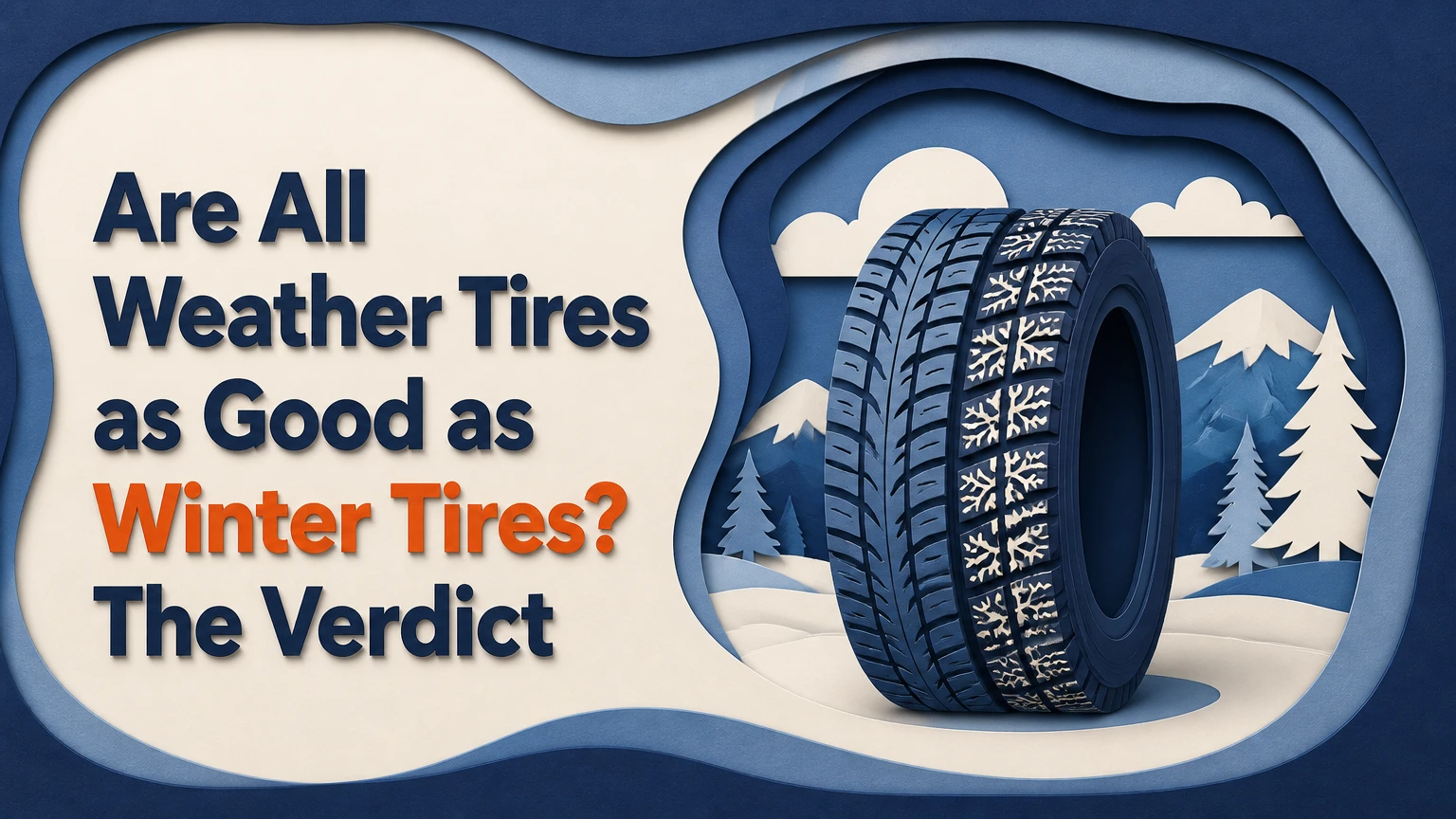
No, all-weather tires are not as good as dedicated winter tires in severe cold, packed snow, or icy conditions. All-weather tires are a strong year-round compromise with the 3PMSF severe-snow symbol, while winter tires retain softer cold-weather compounds and more specialized tread for shorter stops and better control when temperatures stay below freezing.
Key Facts at a Glance
- Dedicated winter tires usually provide the greatest traction on ice, packed snow, and unplowed roads below freezing.
- All-weather tires carry the Three-Peak Mountain Snowflake, or 3PMSF, symbol and are tested against a defined severe-snow traction standard.
- The 3PMSF symbol does not mean an all-weather tire performs identically to a winter tire on ice.
- AWD improves acceleration on slippery roads, but it does not provide additional tire grip while braking or cornering.
- All-weather tires eliminate seasonal tire changes, but they usually sacrifice some winter grip and summer tread life.
- Drivers who regularly encounter ice, deep snow, steep hills, or prolonged sub-freezing temperatures benefit most from four dedicated winter tires.
What Is the Difference Between All-Weather and Winter Tires?
All-weather tires are designed to cover a wider temperature and road-surface range, whereas winter tires concentrate their design around cold pavement, snow, and ice. The categories overlap in winter capability, but they do not have the same performance target.
A dedicated winter tire normally uses a cold-flexible compound, dense sipe arrangement, and tread blocks that remain pliable when the road is well below freezing. An all-weather tire uses a more temperature-stable compound and a tread pattern that must also tolerate warm pavement, summer rain, and long highway drives.
The practical distinction is specialization. Winter tires give up some warm-weather precision to maximize cold-weather grip. All-weather tires give up some peak snow and ice performance to remain suitable for year-round use.
Are All-Weather Tires the Same as All-Season Tires?
All-weather tires and all-season tires are different categories. A qualifying all-weather tire has the 3PMSF symbol, while a conventional all-season tire may carry only the M+S marking, which does not represent the same standardized severe-snow test.
| Tire category | Severe-snow marking | Typical design range | Best use |
|---|---|---|---|
| Dedicated winter | 3PMSF | Below 45°F, including sub-freezing roads | Ice, packed snow, deep snow |
| All-weather | 3PMSF | Roughly 20-80°F | Year-round use with regular snow |
| All-season | Often M+S only | Roughly 40-100°F | Mild climates and occasional light snow |
| Summer | Usually no winter marking | Above roughly 45°F | Warm, dry, and wet pavement |
The 45°F figure is a useful rule of thumb, not a legal cutoff or a sudden chemical switch. Tire stiffness changes progressively with temperature, and the road surface, compound, inflation pressure, and tire design all affect the result.
How Do the Compounds and Tread Patterns Change Grip?
Winter tires improve cold-weather traction through two connected systems: rubber flexibility and tread mechanics. The compound must remain compliant enough to contact microscopic road texture, while the tread must create edges that engage snow and remove water from the contact patch.
Winter compounds generally contain a higher proportion of silica and other cold-weather ingredients than conventional all-season designs. The softer material can conform to uneven ice and cold asphalt, but that same softness creates faster wear, more tread movement, and less precise steering on warm pavement.
All-weather compounds occupy the middle ground. Engineers tune them to resist hardening in cold conditions without making the tread excessively soft during summer driving. That compromise explains why a premium all-weather tire can outperform an ordinary all-season tire in snow while still falling behind a dedicated winter tire on glare ice.
Tread architecture creates the second difference. Winter tires commonly use many narrow sipes, flexible blocks, and grooves that retain snow. Snow-on-snow friction can be stronger than rubber-on-snow friction, so the tread must capture and compact snow without becoming packed solid.
All-weather tires also use substantial siping and often employ directional V-shaped channels for slush and standing water. Their larger, more stable blocks improve dry-road handling, but those blocks generally provide fewer flexible biting edges than a severe-winter design.
What Does the 3PMSF Symbol Actually Prove?
The 3PMSF symbol proves that a tire met a regulated severe-snow traction threshold under a standardized test. The symbol confirms a minimum capability, not a ranking against every winter tire or a guarantee of safe performance on ice.
A tire with 3PMSF certification is a more credible snow choice than an M+S-only tire. However, certification does not measure every condition a driver faces. It does not make an all-weather tire equal to a Nordic winter tire on polished ice, nor does it specify stopping distance on every vehicle.
Check the sidewall rather than relying on product names. “All-weather,” “snow,” and “winter-rated” can be used differently by manufacturers and retailers, but the mountain-and-snowflake icon gives the clearest severe-snow signal.
Which Tire Stops Shorter on Snow and Ice?
Dedicated winter tires generally stop shorter and accelerate faster on packed snow and ice than all-weather tires, although the size of the difference depends on the tire models, vehicle, temperature, surface, and test procedure. Published comparisons should therefore be treated as model-specific evidence, not universal category guarantees.
A Tire Rack comparison of premium tires reported approximately 58-63 feet for a winter tire stopping from 25 mph on packed snow, compared with 72.4 feet for a Michelin CrossClimate2 all-weather tire in the cited test. The same comparison reported ice braking from 12 mph at 38.7 feet for the winter tire and 53.0 feet for the all-weather tire.
Those figures represent a large safety difference, but they should not be converted into a promise that every winter tire stops 20-30 percent shorter than every all-weather tire. Tire Rack’s results apply to the tested products and conditions.
| Test condition | Premium winter example | Premium all-weather example | Practical meaning |
|---|---|---|---|
| Packed-snow braking, 25-0 mph | 58-63 feet | 72.4 feet | Winter tire has more snow traction |
| Ice braking, 12-0 mph | 38.7 feet | 53.0 feet | Winter tire has a stronger ice margin |
| Snow acceleration, 0-12 mph | 2.3-2.5 seconds | About 3.0 seconds | Winter tire reaches traffic speed sooner |
| Warm dry braking | Less precise response | Stronger stability | All-weather tire usually favors dry pavement |
| Slush evacuation | High | High to very high | Tread design matters more than label alone |
The most important point is not the exact number. A vehicle traveling only a few miles per hour faster can require substantially more stopping distance, so a modest tire difference can determine whether the vehicle stops before an intersection, pedestrian crossing, or stopped car.
How Do They Perform on Dry Roads, Rain, and Warm Pavement?
All-weather tires generally perform better than winter tires on warm dry roads and often feel more controlled during cold rain. Their stiffer tread blocks, broader operating range, and more stable construction reduce squirm during lane changes and braking.
Winter tires can still perform safely in rain, but warm conditions accelerate tread wear and can make steering feel less precise. A winter tire is not automatically the best choice for every cold-weather road because cold rain on bare pavement is different from compacted snow or ice.
Hydroplaning resistance depends on groove volume, tread depth, speed, water depth, and inflation pressure. A directional all-weather tire may channel standing water very effectively, while a winter tire with deep, open grooves can perform strongly in slush. The label alone cannot settle the wet-road comparison.
| Road condition | Likely advantage | Reason | Main limitation |
|---|---|---|---|
| Glare ice below 32°F | Dedicated winter | Softer compound and dense siping | Weak warm-weather precision |
| Packed snow | Dedicated winter | Flexible blocks and snow retention | Faster wear above 45°F |
| Deep unplowed snow | Dedicated winter | Greater voids and tread depth | Higher purchase and storage burden |
| Cold rain at 35-45°F | All-weather, often | Stable blocks and flexible compound | Less ice grip than winter |
| Dry pavement at 60-80°F | All-weather | Stiffer tread and temperature stability | Reduced peak winter traction |
| Hot summer highway | All-season or summer | Heat-resistant compound | Neither winter nor all-weather is ideal for maximum performance |
Is an All-Weather Tire Good Enough for Your Winter?
An all-weather tire is often sufficient when winter driving consists of occasional snow, maintained urban roads, cold rain, and short trips where the driver can stay home during severe storms. The tire provides a meaningful improvement over an M+S-only all-season tire without requiring a second wheel set.
A dedicated winter setup is the safer choice when driving cannot be postponed. Rural roads, mountain routes, early-morning commutes, steep driveways, frequent black ice, and snow that remains packed for days all increase the value of maximum cold-weather traction.
Which Drivers Should Choose All-Weather Tires?
All-weather tires fit drivers who value convenience and encounter variable conditions throughout the year. They are particularly practical for:
- Mid-Atlantic and Pacific Northwest drivers who see cold rain, slush, and occasional snow.
- Urban drivers whose streets are plowed quickly.
- Remote workers who can avoid driving during major storms.
- Households without storage space for a second tire set.
- Drivers who travel through winter areas but spend most mileage on bare pavement.
An all-weather tire is not a license to drive normally during a blizzard. It provides more reserve than a conventional all-season tire, but speed reduction, following distance, and route selection remain necessary.
Which Drivers Need Dedicated Winter Tires?
Winter tires make more sense for drivers who face sustained temperatures below freezing or frequent snow and ice. They are appropriate for:
- Northern New England, the Upper Midwest, interior Canada, and mountain regions.
- Healthcare, utility, emergency, and shift workers who drive regardless of forecasts.
- Rural drivers on untreated or unplowed roads.
- Vehicles that regularly climb steep snowy grades.
- Drivers transporting children or valuable equipment in severe conditions.
A front-wheel-drive car with winter tires can outperform an AWD vehicle on ordinary all-season tires during braking and cornering. The tire contact patches create the available grip; drivetrain layout cannot replace that friction.
Do AWD and 4WD Replace Winter Tires?
AWD and 4WD do not replace winter tires. All-wheel drive can distribute engine torque to tires with available traction, which helps a vehicle accelerate, but AWD does not shorten the basic friction-limited braking distance on ice.
Electronic stability control and traction control can reduce wheelspin and help the driver maintain the intended path. Those systems work more effectively when the tires can generate usable grip, but they cannot create traction where the road and tire interface provides almost none.
The common mistake is judging winter capability by launch performance. An AWD crossover may pull away quickly on snow and still slide through a stop sign because all four tires have insufficient braking grip.
What Does the Two-Set Tire Strategy Cost?
A single premium all-weather set typically costs about $140-$260 per tire, while a dedicated winter tire set commonly costs about $110-$240 per tire before mounting, wheels, taxes, and installation. Actual prices vary by tire size, load rating, speed rating, vehicle, and local supply.
The two-set strategy has higher initial costs but spreads tread use across two sets. If each set is stored correctly and replaced based on age, tread depth, and condition, the winter and summer mileage can reduce the annual wear rate of each individual set.
| Ownership item | One all-weather set | Winter plus summer or all-season sets |
|---|---|---|
| Tire purchase | $560-$1,040 | $1,000-$2,000 |
| Second wheel set | $0 | $400-$1,200 |
| Seasonal installation | $0-$200 annually | $120-$300 annually |
| Storage | $0 | $50-$150 per season |
| Typical usable period | 3-5 years | 4-6 years per set |
| Main financial risk | Faster summer wear | Higher upfront investment |
The cheapest option is not always the lowest-risk option. A collision, missed work, deductible, or vehicle repair can exceed several years of seasonal service costs, while a second set is poor value for a driver who rarely encounters snow.
How Long Do All-Weather and Winter Tires Last?
All-weather tires often carry treadwear warranties in the 50,000-60,000-mile range, although severe winter use and hot summers can reduce actual life. Winter tires commonly last about four to five seasons, or approximately 20,000-30,000 miles, when drivers store them indoors and remove them during warm weather.
Replace either tire type when tread reaches the manufacturer’s limit, cracking appears, studs are damaged, vibration develops, or the tire becomes too old for its condition. Measure tread depth across the tire because uneven wear can leave one shoulder unsafe even when the center grooves look acceptable.
How Should You Install and Maintain Winter-Capable Tires?
Install four matching tires of the same category, size, construction, and closely matched tread depth. Putting winter or all-weather tires on only one axle can create a traction imbalance that causes oversteer or understeer during braking and cornering.
Use the vehicle manufacturer’s recommended cold inflation pressure, not the maximum pressure molded into the sidewall. Check pressure monthly and after major temperature changes because cold air reduces measured pressure and underinflation increases heat, wear, and steering delay.
Rotate tires according to the vehicle and tire manufacturer’s schedule, commonly every 5,000-8,000 miles. Confirm that directional tires are mounted in the correct rolling direction, and reset or relearn the TPMS system after installation when the vehicle requires it.
Store removed tires clean, dry, shaded, and away from ozone-producing equipment. Bagging tires can reduce exposure to moisture and contaminants, but storage bags do not make an overheated garage suitable for long-term storage.
What Mistakes Reduce Winter Tire Safety?
- Using an M+S tire as proof of severe-winter capability: Look for the 3PMSF mark when regular snow is expected.
- Keeping winter tires on through summer: Warm pavement increases wear and reduces steering precision.
- Mixing winter and all-season tires: Install a complete matched set rather than changing only the drive axle.
- Ignoring tire age: Rubber properties decline even when tread remains deep.
- Relying on tread depth alone: A tire can have usable grooves but hardened, cracked, or damaged rubber.
- Driving at summer speeds on snow: No tire eliminates the need for lower speed and longer gaps.
One counterintuitive rule matters most: a new all-weather tire is usually safer than an old winter tire with hardened rubber. Category matters, but condition and maintenance determine whether the designed performance remains available.
Which Tire Should You Choose?
Choose all-weather tires if you need one year-round set, drive mostly on cleared roads, experience mixed rain and snow, and can avoid the worst storms. Choose dedicated winter tires if ice, packed snow, deep snow, or prolonged sub-freezing driving is a routine part of your transportation.
| Driver profile | Recommended setup | Reason | Reconsider if |
|---|---|---|---|
| Urban commuter, occasional snow | Premium all-weather | No seasonal swap and 3PMSF snow rating | Daily roads remain icy |
| Rural northern commuter | Dedicated winter | Better braking and traction on untreated roads | Winter conditions are rare |
| AWD SUV owner | Four winter tires | AWD does not improve braking grip | Vehicle stays in a warm climate |
| Mild coastal driver | All-weather | Stronger balance for rain and occasional snow | Frequent mountain travel |
| Performance-car owner | Winter plus warm-season set | Better control across both temperature ranges | Storage and wheel cost are prohibitive |
A tire retailer should verify the exact tire size, load index, speed rating, wheel fitment, and local winter-tire requirements before purchase. The best category cannot compensate for an incorrect specification.
FAQ
Are all-weather tires safe on black ice?
All-weather tires are safer than conventional all-season tires on cold roads, but dedicated winter tires generally provide better black-ice traction. Black ice can overwhelm any non-studded tire, so speed, braking distance, road temperature, and tire condition remain decisive.
Can I use all-weather tires in Canada?
Yes, all-weather tires can be used in Canada where the tire meets vehicle requirements and local regulations. Some provinces, including Quebec, specify winter-tire periods and requirements, so verify the current provincial rule before selecting a tire based only on its marketing name.
Are studded tires better than studless winter tires?
Studded tires can provide greater traction on persistent glare ice, especially on untreated rural roads, while studless winter tires usually offer quieter operation and better flexibility on mixed pavement. Stud restrictions, seasonal dates, and road wear rules vary by jurisdiction.
Should I buy winter tires for an electric vehicle?
Electric vehicles can use winter tires, but the tires must meet the vehicle’s load index and speed requirements. EV weight, instant motor torque, regenerative braking, and range loss in cold weather make traction, pressure checks, and correct fitment especially important.
Is a 3PMSF all-weather tire enough for mountain trips?
A 3PMSF all-weather tire may be adequate for occasional trips on cleared mountain roads, but dedicated winter tires provide a larger safety margin when routes include ice, steep grades, chain-control areas, or roads that remain packed with snow.
When should I switch from all-weather tires to winter tires?
Switch to winter tires before regular temperatures stay below about 45°F, rather than waiting for the first snowfall. Remove them when sustained warm weather returns, commonly near spring temperatures of 45-50°F, to limit accelerated wear and handling loss.
The Bottom Line
Are all weather tires as good as winter tires? No. Dedicated winter tires remain the better choice for ice, packed snow, deep snow, and frequent sub-freezing driving because their compounds and tread patterns are optimized for those conditions.
All-weather tires are the better compromise for drivers who want one 3PMSF-rated set, spend most time on cleared pavement, and encounter mixed rain, slush, and occasional snow. Choose according to the roads you must drive, not merely the roads you hope to avoid.