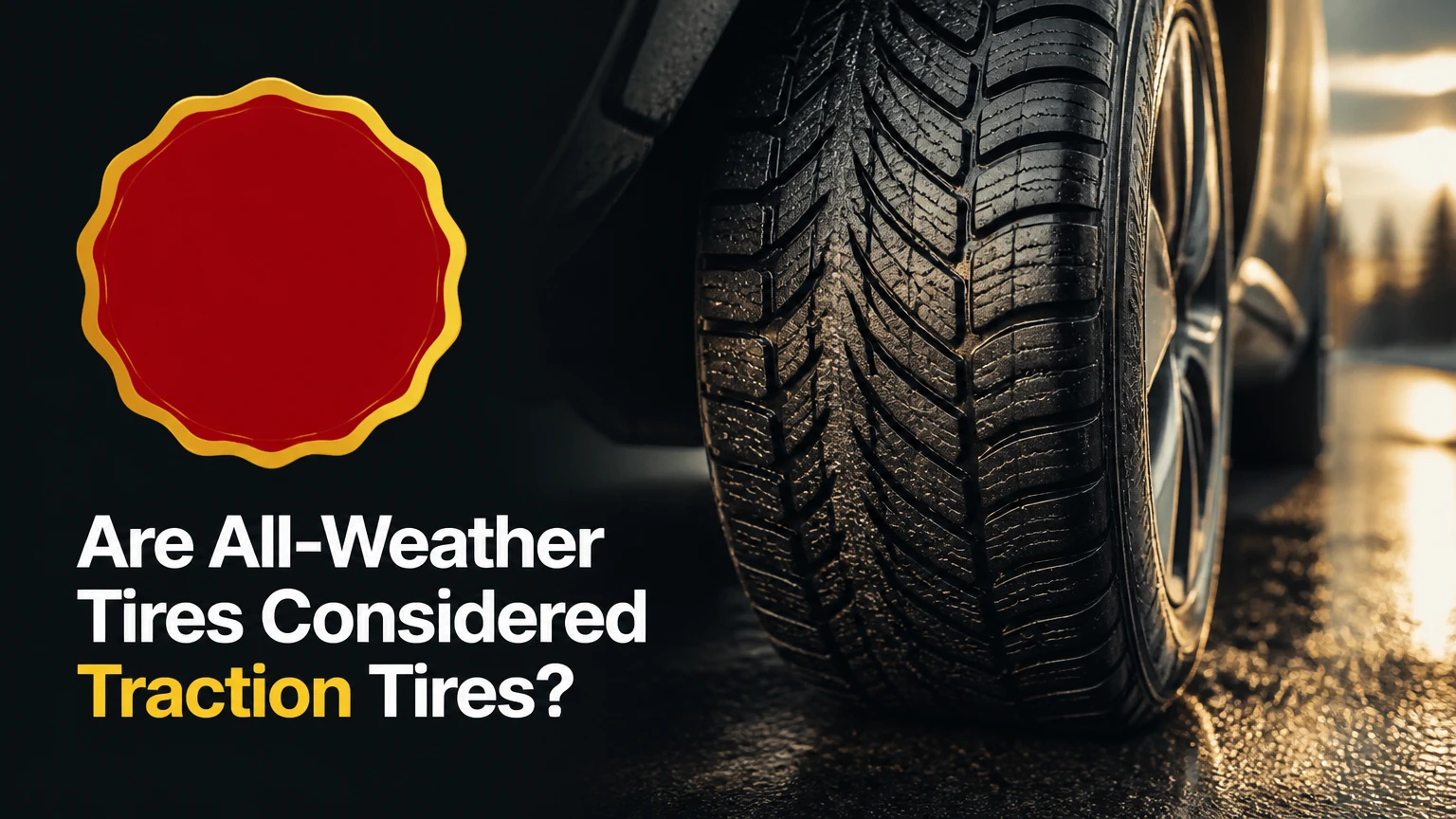
All-weather tires are generally recognized as traction tires when they carry the Three-Peak Mountain Snowflake, or 3PMSF, symbol and meet the applicable local definition. The designation does not create one nationwide legal rule: state and provincial transportation authorities may impose different tread-depth, chain, axle, or route requirements, especially during severe pass conditions.
Key facts at a glance
A 3PMSF-marked all-weather tire has passed a standardized severe-snow traction test.
The 3PMSF symbol is different from the M+S marking found on many conventional all-season tires.
A tire can qualify as a traction tire while still providing less ice and deep-snow grip than a dedicated winter tire.
AWD and 4WD improve propulsion but do not automatically satisfy chain-control requirements.
A 4/32-inch tread rule applies in some winter-travel programs, not as a universal North American legal standard.
The tire sidewall, vehicle load rating, and local transportation authority determine whether a setup is suitable and permitted.
Are All-Weather Tires Considered Traction Tires Under the Law?
All-weather tires are usually accepted as traction tires when their sidewalls display the 3PMSF symbol, but the legal answer depends on the road authority controlling the route. Oregon, Washington, Utah, British Columbia, and other jurisdictions publish their own definitions for traction tires, chains, tread depth, and vehicle exemptions.
The word “traction” has two meanings in practice. Tire manufacturers use it to describe winter-capable design and certification, while transportation agencies use it in enforceable travel restrictions. Those meanings overlap, but they are not identical.
For example, an agency may accept a 3PMSF tire as a traction tire during an ordinary “traction tires required” advisory, then require chains during a higher-level closure or severe-weather condition. A highway sign can therefore impose a stricter rule than the tire’s certification status.
The safest legal test is:
- Read the route’s current notice from the relevant Department of Transportation.
- Confirm that every tire has the required sidewall marking.
- Check the agency’s minimum tread-depth rule.
- Carry the specified chains or cables when the route requires them.
- Follow axle, trailer, and vehicle-class instructions separately.
A 3PMSF symbol is strong evidence that an all-weather tire is winter certified. It is not a blanket exemption from every traction law.
What Does the 3PMSF Symbol Actually Prove?
The 3PMSF symbol proves that the tire met a defined severe-snow traction performance threshold under an industry-standard test; it does not prove maximum performance on ice, packed snow, slush, or every mountain road. The symbol shows a mountain with three peaks surrounding a snowflake.
The test associated with the marking is ASTM F1805, a standardized procedure that evaluates tire traction on medium-packed snow. The test measures longitudinal acceleration performance under specified conditions. It does not replicate braking on glare ice, cornering on a wet descent, or driving through deep unplowed snow.
The U.S. Tire Manufacturers Association describes the marking as identifying tires that “meet the required performance criteria in snow testing.” That wording matters because the symbol represents a threshold, not a ranking. Two 3PMSF tires can have noticeably different braking distances, steering response, noise levels, and wear rates.
3PMSF, M+S, and winter labeling
| Sidewall marking | What it indicates | Typical legal significance | Main limitation |
|---|---|---|---|
| 3PMSF | Certified severe-snow performance | Often accepted as a traction tire | Does not guarantee ice or chain exemption |
| M+S | Manufacturer-declared mud-and-snow tread design | Accepted in some older rules | Does not require the same severe-snow test |
| Stud symbol or studded designation | Tire contains approved metal studs | May trigger seasonal dates and restrictions | Stud use is regulated by location |
| No winter marking | No stated winter certification | May fail a traction-tire rule | Tread pattern alone is not proof of compliance |
A tire can carry both M+S and 3PMSF markings. Most modern all-weather tires intended for winter regions do. Many traditional all-season tires carry M+S but not 3PMSF.
How Do All-Weather Tires Differ From All-Season Tires?
All-weather tires use a winter-capable compound and tread design while retaining year-round road manners; conventional all-season tires prioritize quiet, efficient performance across mild conditions and may lack severe-snow certification. The names are marketing categories, so the sidewall symbol and manufacturer specifications matter more than the category name.
The common claim that all-season tires become unsuitable below 45°F is too broad. All-season tires vary by compound and model, and many remain usable in cold rain or occasional light snow. The practical distinction is that a conventional all-season tire is not engineered or certified to the same severe-snow threshold as a 3PMSF tire.
| Attribute | Conventional all-season | All-weather | Dedicated winter |
|---|---|---|---|
| Typical severe-snow marking | M+S, sometimes 3PMSF | Usually 3PMSF | 3PMSF |
| New tread depth | 9/32-11/32 inch | 10/32-12/32 inch | 10/32-13/32 inch |
| Summer use | Strongest of the three | Acceptable year-round | Not recommended for warm months |
| Ice performance | Low to moderate | Moderate | Highest of the three |
| Road noise | Usually lowest | Moderate | Moderate to high |
| Seasonal tire swaps | None | None | Usually two per year |
| Typical warranty range | 60,000-80,000 miles | 50,000-60,000 miles | Often no mileage warranty |
| Typical use | Mild climates | Mixed rain, cold, and snow | Frequent snow and ice |
The categories overlap. A high-performance all-season tire can outperform a low-cost all-weather model in dry braking, while the all-weather model can provide substantially better snow launch and packed-snow control.
Which Features Give All-Weather Tires Winter Traction?
All-weather tires gain winter traction from flexible cold-weather compounds, dense siping, open grooves, and block geometry that maintains contact on snow. Their design is a compromise: the tread remains usable in summer, but it cannot match the soft compound and heavily articulated tread of a dedicated winter tire on ice.
Cold-weather compound
Rubber compounds stiffen as temperatures fall. All-weather compounds use a higher silica content and other formulation changes to retain flexibility in cold conditions, although exact recipes are proprietary. Flexibility helps the tread conform to irregular snow and pavement surfaces.
The same compound must tolerate hot pavement. That requirement limits how soft the tire can be, which explains why dedicated winter tires generally grip ice better and wear faster in warm weather.
Sipes and biting edges
Sipes are narrow cuts in tread blocks. When a block contacts snow, the sipes open and create additional edges that help the tread grip and evacuate water. Siping also lets blocks flex, so excessive or poorly controlled siping can reduce dry-road steering precision.
A practical inspection rule is to compare the center tread blocks with the shoulder blocks. If the fine grooves have nearly disappeared, the tire may retain legal tread while losing much of its original snow behavior.
Grooves and tread direction
Many all-weather models use directional, V-shaped grooves that move water and slush away from the contact patch. The tread must point in the rotation direction molded into the sidewall. Mounting a directional tire backward can reduce wet-weather evacuation.
Not every all-weather tire is directional. Check the sidewall for “rotation” arrows or the manufacturer’s mounting diagram rather than assuming a pattern from its appearance.
How Much Do All-Weather Traction Tires Cost?
A typical all-weather tire costs about $130-$300 per tire, or $520-$1,200 for four tires before mounting, balancing, taxes, and disposal fees. Price changes with wheel diameter, load rating, speed rating, vehicle size, brand, and local inventory.
| Ownership item | Typical passenger car | Typical SUV or crossover | Typical pickup or van |
|---|---|---|---|
| Tire price per unit | $130-$220 | $160-$280 | $180-$320 |
| Mount and balance, four tires | $80-$160 | $100-$180 | $120-$220 |
| Four-tire installed total | $600-$1,050 | $740-$1,300 | $840-$1,500 |
| Mileage warranty | 50,000-60,000 miles | 50,000-60,000 miles | 40,000-60,000 miles |
| Seasonal storage avoided | $60-$150 per year | $60-$180 per year | $80-$200 per year |
| Seasonal swap avoided | $80-$180 per year | $100-$220 per year | $120-$260 per year |
These are typical retail ranges, not guarantees. Dedicated winter tires require a second set of wheels in many households, and that extra purchase can exceed $400 before seasonal mounting. All-weather tires can reduce ownership complexity, but their purchase price is commonly higher than a basic all-season tire.
A mileage warranty is also not a predicted service life. Alignment, inflation, rotation frequency, driving temperature, vehicle weight, and summer pavement can shorten actual mileage.
Are All-Weather Tires Good on Ice and Deep Snow?
All-weather tires are adequate for occasional snow and cold wet roads, but dedicated winter tires provide better control on glare ice, hard-packed snow, and prolonged subfreezing roads. The difference becomes most important during braking and cornering, where AWD cannot compensate for limited tire-road friction.
All-weather tires are a reasonable fit for drivers who encounter:
- Several snow events each winter
- Slush and freezing rain
- Plowed roads with intermittent packed snow
- Mountain travel that permits certified traction tires
- Temperatures below freezing without months of continuous ice
Dedicated winter tires are the safer choice when roads remain icy for weeks, snowfall is frequent, or travel continues on unplowed rural routes. Studless winter tires use very soft compounds and specialized microchannels; studded tires can add ice grip where local law permits them.
The limitation is simple: 3PMSF certification confirms severe-snow capability, not equal winter performance. A symbol answers the legal and baseline-performance question. It does not identify the shortest-stopping tire in every condition.
Do AWD Vehicles Still Need Chains With 3PMSF Tires?
AWD and 4WD vehicles can still need chains when a transportation authority raises the restriction level or explicitly requires them. Drivetrain traction helps a vehicle accelerate, while chains may be required to provide additional braking, steering, or roadway protection.
Chain rules differ by route. Washington State Department of Transportation, Oregon Department of Transportation, and Utah transportation agencies publish separate pass requirements, and those requirements can change with weather and vehicle configuration.
A traction-tire exemption may apply only when:
- The vehicle has AWD or 4WD.
- The vehicle has approved traction tires on specified axles.
- The vehicle carries chains.
- The vehicle is below a stated gross weight.
- The vehicle is not towing a trailer.
Those conditions are not interchangeable. A driver with a 3PMSF tire should keep properly sized chains or cables in the vehicle, practice fitting them before winter, and confirm whether cable devices are accepted on the intended route.
What Tread Depth Makes an All-Weather Tire Safe?
There is no universal North American tread-depth threshold that makes every tire a legal traction tire. Some jurisdictions and commercial travel programs specify 4/32 inch for winter traction, while ordinary tire replacement guidance often uses 2/32 inch as the federal wear-bar limit for passenger tires in the United States.
Legal minimums and practical winter limits differ. A tire at 4/32 inch may satisfy a local rule yet deliver less snow performance than a new tire because the grooves are shallower and the siping is less effective.
| Tread depth | Practical meaning | Recommended action |
|---|---|---|
| 10/32-12/32 inch | Typical new all-weather depth | Record depth and maintain pressure |
| 7/32-9/32 inch | Good remaining winter capacity | Rotate and inspect for uneven wear |
| 5/32-6/32 inch | Reduced snow evacuation | Plan replacement before severe winter |
| 4/32 inch | Common winter advisory threshold | Verify local law and avoid assuming full grip |
| 2/32-3/32 inch | Near or at wear-bar limit | Replace promptly |
| Below 2/32 inch | Unsafe and generally illegal | Do not continue normal use |
Measure all four tires at several points. Uneven wear can leave one shoulder below the apparent average, and mismatched tread depths can affect handling on AWD vehicles.
How Do You Verify That a Tire Qualifies?
Verify the sidewall marking, tire size, tread condition, vehicle fitment, and current route rule before treating an all-weather tire as a traction tire. A retailer’s category label is useful for shopping, but the sidewall and transportation authority provide the stronger compliance evidence.
Use this five-point check:
- Find the symbol. Look for the mountain-and-snowflake 3PMSF marking on each tire.
- Record the full tire specification. Confirm size, load index, speed rating, and manufacturer fitment.
- Measure tread depth. Use a tread gauge rather than estimating from the groove appearance.
- Check vehicle matching. Replace tires in the configuration required by the vehicle maker, especially for AWD systems.
- Read the route notice. Confirm chain, cable, trailer, and axle requirements from the local DOT.
An all-weather tire with 3PMSF may be accepted for a normal traction advisory while failing a rule requiring chains, studs, or a particular tread depth. Compliance is a route-specific decision.
Which All-Weather Tire Type Fits Your Vehicle?
Touring all-weather tires suit sedans and crossovers, performance all-weather tires suit drivers who value steering response, and light-truck versions suit heavier vehicles that need higher load capacity. Tire type must match the vehicle placard, not merely the wheel diameter.
| Tire type | Common vehicle | Typical load or speed focus | Strength | Limitation |
|---|---|---|---|---|
| Touring all-weather | Sedan, compact SUV | H-V speed ratings | Quiet highway ride | Less suited to heavy towing |
| Performance all-weather | Sport sedan, coupe | W-Y speed ratings | Sharper dry handling | Often reduced snow bias |
| Crossover all-weather | CUV, EV | XL or standard load | Balanced range and comfort | Higher replacement cost |
| LT all-weather | Pickup, work van | Load Range C-E | Payload and durability | Heavier, noisier, less efficient |
| SUV all-weather | Three-row SUV | XL or LT fitment | Stable under vehicle weight | Check actual axle loads |
EV owners should verify the tire’s load index and rolling-resistance characteristics. Electric vehicles can be heavier and deliver immediate torque, which may increase wear if the tire is under-rated or frequently driven aggressively.
Towing adds another constraint. A 3PMSF tire does not increase the vehicle’s legal payload or braking capacity, and a trailer can have separate chain requirements.
When Should You Choose All-Weather Tires Instead of Winter Tires?
Choose all-weather tires when winter is intermittent, roads are usually plowed, and avoiding seasonal storage matters more than maximum ice performance. Choose dedicated winter tires when snow and ice are persistent, braking margins are limited, or travel continues before roads are cleared.
Choose all-weather tires if
- Your area receives occasional snow rather than continuous snow cover.
- Temperatures move between freezing and mild conditions.
- You drive mostly treated highways and urban roads.
- You need one year-round set.
- Your route accepts 3PMSF tires during ordinary traction advisories.
Choose dedicated winter tires if
- Packed snow or ice remains on the road for long periods.
- You regularly drive steep, unplowed roads.
- Your vehicle is rear-wheel drive and heavily dependent on tire grip.
- You prioritize winter braking over summer handling.
- You can store and change a second set.
Choose conventional all-season tires if
- Snow is rare and road temperatures are usually mild.
- Your route has no severe-snow requirement.
- You prioritize low noise and long tread life.
- You will avoid driving during winter storms.
The wrong choice is often caused by the calendar rather than the road. A driver in a low-snow climate who frequently crosses an icy mountain pass may need more winter capability than a driver in a snowy city whose roads are plowed within hours.
Common Problems With All-Weather Traction Tires
All-weather tires can lose winter capability through wear, mismatched installation, low inflation, or incorrect assumptions about legal exemptions. Most failures occur because the driver treats certification as a substitute for inspection and route planning.
Directional tires installed incorrectly
A directional tire mounted backward can move water and slush less effectively. Ask the installer to confirm the rotation arrow on every tire, particularly after a puncture repair or tire replacement.
Uneven wear from alignment problems
A worn inner shoulder can reduce traction while the center tread appears healthy. Measure inside, center, and outside grooves, then correct alignment before installing replacement tires.
Low pressure in cold weather
Tire pressure typically falls about 1 pound per square inch for each 10°F temperature decrease, although the exact change varies with tire volume and ambient conditions. Set pressure when the tires are cold, using the vehicle placard rather than the maximum pressure molded into the sidewall.
Mixed tires on an AWD vehicle
Different tread depths, models, or rolling circumferences can stress AWD components and alter handling. Follow the vehicle manufacturer’s replacement policy, which may require four tires or a tightly matched circumference.
Assuming 3PMSF means ice-rated
The snowflake symbol does not certify a tire for every winter surface. Slow down before curves, increase following distance, and select dedicated winter tires if ice is the dominant hazard.
What Are the Most Important Expert Rules?
Three rules prevent most misunderstandings: inspect the symbol rather than the marketing name, treat tread depth as a performance variable rather than a legal checkbox, and read the active route order before departure. These rules remain useful when weather changes faster than tire conditions.
- Never equate “all-season” with “all-weather.” Confirm 3PMSF on the sidewall.
- Do not replace winter planning with AWD. AWD helps launch; it does not shorten every stop.
- Keep chains even when they are not currently installed. A route can change from traction-tire use to chain control during one storm.
- Replace before the legal minimum if winter grip matters. The 4/32-inch point is a common practical threshold, not a guarantee of performance.
- Match all four tires on AWD vehicles. Small circumference differences can create mechanical and handling problems.
- Inspect after summer use. Heat, heavy loads, and long highway trips can consume the tread needed for the next winter.
Frequently Asked Questions
Are all-season tires considered traction tires?
Some all-season tires may satisfy a local traction rule if they carry an accepted marking and meet the agency’s tread requirements, but many only carry M+S and lack 3PMSF certification. Drivers should check the route authority rather than assume that the phrase all-season qualifies the tire for severe-snow travel.
Can I use all-weather tires in summer?
All-weather tires are designed for year-round use, including summer pavement, and do not require seasonal removal. They may produce more noise and wear faster in hot conditions than a touring all-season tire, while dedicated winter tires should generally be removed when sustained temperatures become mild.
Are all-weather tires legal on mountain passes?
All-weather tires with the 3PMSF symbol are often accepted for ordinary traction-tire requirements on mountain passes. A pass authority can still require chains, restrict trailers, specify approved axles, or close the route, so drivers must check the current notice before traveling.
Do all-weather tires improve braking on snow?
All-weather tires generally improve snow traction and braking compared with non-certified all-season tires, but the result depends on tire model, tread depth, temperature, vehicle weight, and road surface. Dedicated winter tires normally provide the strongest braking on ice and hard-packed snow.
Should all four tires be 3PMSF rated?
All four tires should normally provide comparable winter capability, especially on AWD and 4WD vehicles. Installing only two winter-capable tires can create uneven axle grip and unpredictable handling, even if the vehicle can accelerate adequately.
How often should all-weather tires be rotated?
Rotate all-weather tires according to the vehicle and tire manufacturer’s schedule, commonly every 5,000-8,000 miles. Directional tires must remain on the same side unless a technician dismounts and remounts them to preserve the forward rotation direction.
The Bottom Line
Are all weather tires considered traction tires? Usually, yes, when the tires carry the 3PMSF severe-snow symbol and satisfy the local authority’s tread and equipment rules. The certification supports winter use, but it does not guarantee maximum ice grip or eliminate chain requirements. Verify the sidewall, measure the tread, match the tires to the vehicle, and check the active route rule before driving.