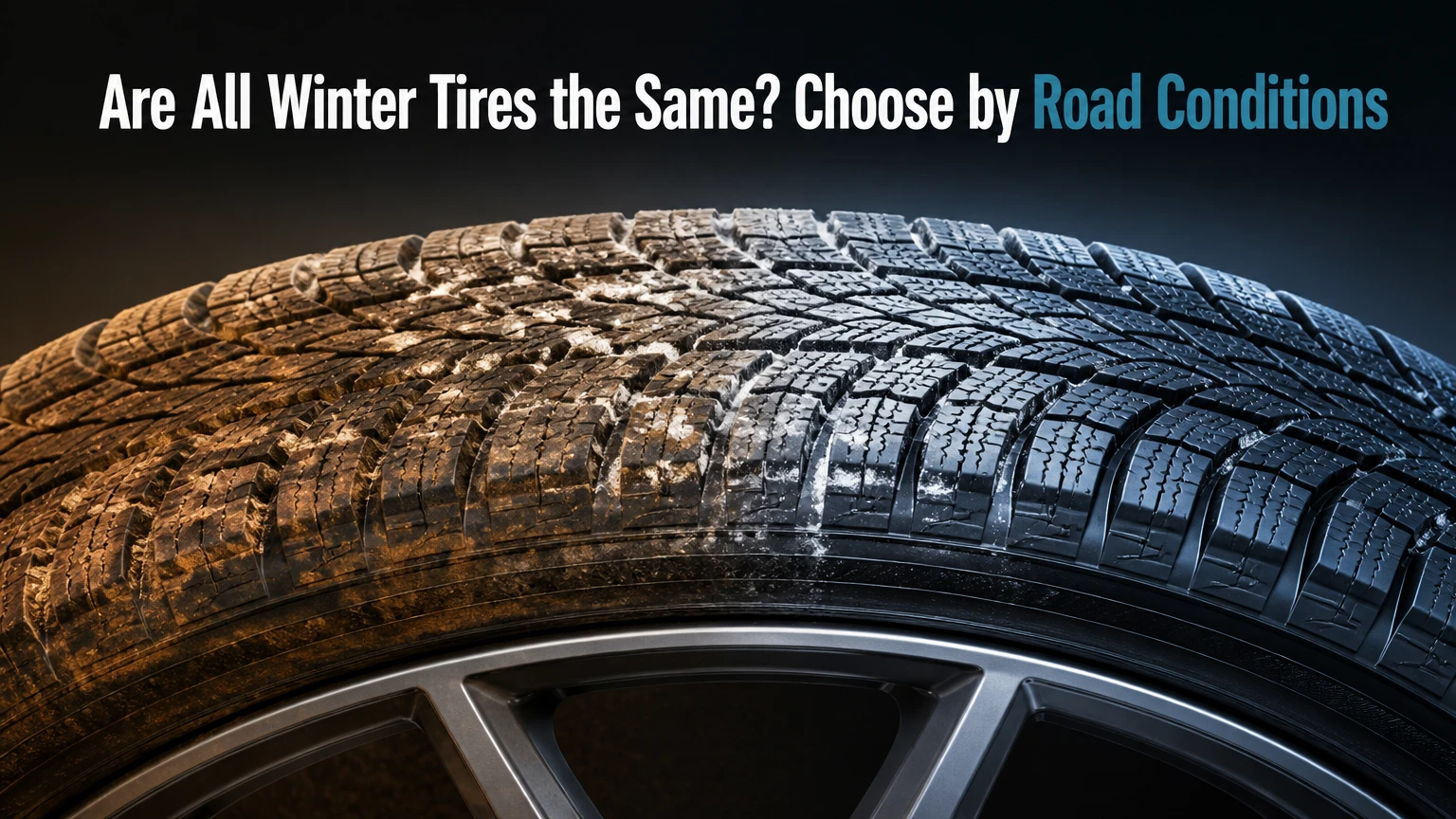
No, winter tires are not all the same. They differ in rubber compound, sipe density, tread pattern, stud design, temperature range, dry-road handling, ice traction, noise, price, and expected wear. The best winter tire depends on whether you mainly drive on glare ice, packed snow, slush, wet pavement, or cleared highways.
Key facts at a glance
A dedicated winter tire remains more flexible than many all-season compounds in cold weather, often below about 7°C (45°F).
Studless Nordic tires prioritize cold ice and packed snow, while performance winter tires prioritize wet and dry pavement.
Studded tires usually provide the strongest grip on glare ice but create more noise and may be restricted by local law.
Winter tires should normally be installed as a complete set of four, not only on the driven axle.
AWD improves acceleration on slippery surfaces, but winter tires still determine much of the available braking and cornering grip.
The legal minimum tread depth is commonly 2/32 inch, but winter traction can become inadequate well before that point.
What Makes a Winter Tire Different?
A winter tire is engineered for cold-weather flexibility and traction rather than year-round compromise. Its tread compound, internal construction, grooves, and sipes are designed to keep working when temperatures fall below the range where ordinary all-season rubber becomes less compliant.
The familiar 7°C threshold is a useful rule of thumb, not a chemical cliff. Tire compounds change gradually with temperature, and performance also depends on road moisture, sunlight, vehicle weight, tire age, and driving speed. A tire can remain legal below 7°C while still being poorly suited to ice.
The U.S. Tire Manufacturers Association explains that winter tires use specialized tread compounds and patterns for snow and ice. A tire marked with the Three-Peak Mountain Snowflake symbol has passed a standardized severe-snow traction test, but that symbol does not tell you whether the tire is optimized for glare ice or dry winter highways.
How do winter compounds create grip?
Winter compounds use polymers, silica, plasticizers, and other formulation choices to preserve flexibility in low temperatures. Flexible rubber can conform to small road irregularities, while the tread edges and sipes create mechanical grip on snow and ice.
Compound flexibility has a trade-off. A very soft compound generally improves cold-surface traction but can wear faster, feel less precise on warm pavement, and respond less sharply during dry-road cornering. A firmer winter compound may sacrifice some ice performance to improve steering stability and tread life.
Winter tread also uses small slits called sipes. Sipes open as the tread block contacts the road, creating additional edges that can grip packed snow and help break through thin water films. Sipes do not eliminate hydroplaning, however. Speed, water depth, inflation, tread wear, and road shape remain major factors.
Why does snow sometimes improve snow traction?
Snow can adhere to compacted snow within a tread groove more effectively than rubber adheres to loose snow. That snow-on-snow interaction helps a tire climb through moderate snow, provided the grooves remain open and the tread blocks can flex.
The principle has limits. Wet, heavy snow can pack into grooves and reduce evacuation. Deep snow can also overwhelm a passenger-car tire regardless of brand. Ground clearance, vehicle weight, wheel speed, and throttle control matter alongside tread design.
What Types of Winter Tires Exist?
The four practical categories are studless Nordic, performance winter, studded, and studdable tires. The categories overlap in marketing language, so the tire’s test results, severe-snow marking, speed rating, and intended market matter more than the label alone.
| Tire category | Primary design target | Typical strongest surface | Main compromise |
|---|---|---|---|
| Studless Nordic | Cold ice and packed snow | Glare ice below freezing | Less precise on warm, dry pavement |
| Performance winter | Cold wet and dry-road handling | Cleared asphalt and slush | Less ice and deep-snow grip than Nordic tires |
| Studded | Mechanical ice penetration | Glare ice and frozen hardpack | Noise, road wear, legal restrictions |
| Studdable | Flexible stud installation choice | Snow, with optional ice studs | Usually compromises both modes somewhat |
What are studless Nordic winter tires?
Studless Nordic tires use very flexible compounds, dense siping, and tread patterns intended for prolonged sub-freezing conditions. Representative models include the Bridgestone Blizzak WS90, Michelin X-Ice Snow, and Nokian Hakkapeliitta R5, although performance varies by size and vehicle.
These tires suit drivers who regularly encounter packed snow, cold polished ice, and unplowed residential roads. They are often quieter than studded tires and avoid stud restrictions. Their softer tread can feel less stable during a warm-weather highway trip, especially on a heavy SUV or performance sedan.
What are performance winter tires?
Performance winter tires use a somewhat firmer construction and more stable tread blocks. Michelin Pilot Alpin models, Continental WinterContact performance lines, and Pirelli winter performance products target drivers who spend most of winter on cleared roads.
A performance winter tire can offer better steering response and dry or wet pavement behavior than a Nordic tire. It remains a winter tire, not a summer tire. On glare ice or deep packed snow, a Nordic design usually offers a larger traction margin.
When are studded tires worthwhile?
Studded tires are most worthwhile when glare ice, freezing rain, or polished hardpack is a routine hazard and local law permits their use. Metal studs press through the surface film and provide mechanical bite that rubber alone cannot consistently match.
Studs do not improve every winter attribute. On bare asphalt they can increase noise, reduce smoothness, contribute to pavement wear, and sometimes lengthen stopping distances compared with a high-quality studless tire. Studded-tire seasons vary by jurisdiction, so check state, provincial, or national regulations before purchase.
What are studdable tires?
Studdable tires leave the factory with molded holes for optional installation of studs. A tire shop can install approved studs if regulations and the manufacturer permit it.
A studdable tire is not automatically equivalent to a factory-studded tire. Stud retention depends on casing design, rubber hardness, stud type, installation quality, and break-in procedure. Ask whether the tire is intended to be driven unstudded, studded, or both before treating it as a universal solution.
How Do Winter Tires Compare on Different Roads?
No single tire type wins every surface. A driver on salted city streets needs different priorities from a rural driver who faces frozen ruts before sunrise.
| Driving surface | Usually strongest choice | Why it works | Limitation to expect |
|---|---|---|---|
| Glare ice | Studded or Nordic studless | Studs penetrate ice; Nordic compounds maximize rubber friction | Studded tires are noisy; Nordic tires need careful speed control |
| Cold packed snow | Nordic studless or studded | Dense sipes and flexible blocks create many edges | Steering can feel soft on clear asphalt |
| Deep loose snow | Nordic or studdable winter tire | Open grooves and snow packing support forward motion | Clearance may limit the vehicle first |
| Wet slush | Performance winter or high-quality Nordic | Grooves evacuate water and slush | Slush can still cause hydroplaning |
| Cold dry highway | Performance winter | Firmer blocks improve steering stability | Ice grip is usually below Nordic designs |
| Warm bare pavement | All-season or summer tire | Harder compounds resist heat and wear | These tires lose cold-weather traction |
How do winter tires behave on clear pavement?
Winter tires remain usable on clear pavement, but their performance priorities differ from summer or all-season tires. A Nordic tire may produce softer steering, longer dry stopping distances, and faster wear when the pavement is warm.
Performance winter tires generally handle cleared roads better because their tread blocks deform less under lateral load. Even so, every winter tire should be removed when sustained spring temperatures make the compound unnecessarily soft. Occasional warm days are not the same as a full hot season.
Do premium winter tires always outperform budget tires?
Price does not guarantee the best result for every driver. A premium Nordic tire can outperform a cheaper tire on ice, while a mid-priced performance winter tire may be the better choice for a commuter who rarely sees snow.
Independent testing from organizations such as Tire Rack and Canada’s Automobile Protection Association commonly evaluates braking, acceleration, handling, noise, and rolling resistance separately. A tire can rank highly in one category and poorly in another. Compare tests conducted in your tire size and climate rather than relying on brand reputation.
Which Winter Tire Fits Your Driving Conditions?
The correct choice depends on the dominant surface, not the most dramatic storm you might encounter once each year. Match the tire to the roads you actually drive, then add a safety margin for your most consequential conditions.
| Driver situation | Recommended category | Useful specification focus | Typical reason |
|---|---|---|---|
| Plowed urban commuter | Nordic studless | Severe-snow marking, low noise, ice braking | Freeze-thaw cycles create black ice |
| Rural snowbelt driver | Nordic or studded | Open grooves, deep tread, legal stud period | Packed snow and unplowed roads recur |
| Mountain-pass traveler | Studded or Nordic studless | Ice traction, load rating, chain compatibility | Frozen grades punish small traction losses |
| Dry-road highway commuter | Performance winter | Speed rating, steering stability, wet braking | Most miles occur on cleared asphalt |
| Mild coastal winter | Performance winter or all-weather | Wet grip, hydroplaning resistance, 3PMSF marking | Rain and cold pavement dominate |
| Light-use second vehicle | Properly stored winter set | Tire age, tread depth, storage history | Low mileage does not stop rubber aging |
What should city and highway drivers buy?
Urban drivers who face salted streets, wet slush, and occasional black ice usually benefit from a quality studless winter tire. A Nordic model offers more ice reserve, while a performance winter model feels more composed if roads are cleared quickly.
Highway commuters should examine speed rating and wet-road test performance rather than choosing solely by advertised snow traction. A tire that feels vague during repeated lane changes can create fatigue even when it performs well in a snow test.
What should mountain and rural drivers buy?
Drivers on unplowed roads, steep grades, and repeated freezing rain should prioritize ice and packed-snow traction. Studded tires can be justified where ice is frequent and legal, while Nordic studless tires are the quieter choice when road wear or regulations rule out studs.
Check the vehicle’s load requirements carefully. A compact crossover carrying passengers and cargo may need a higher load index than the same tire size on a small sedan. Never reduce the load index merely to obtain a lower price.
Why Do Four Matching Winter Tires Matter?
Four winter tires preserve balanced braking, steering, and cornering behavior. Installing winter tires only on the driven axle can create a major grip mismatch, because one axle responds differently during braking or a sudden lane change.
Front-wheel drive with winter tires only at the front may accelerate effectively but allow the rear to rotate during braking. Rear-wheel drive with winter tires only at the rear can leave the front axle unable to steer or stop effectively. Tire manufacturers and vehicle makers generally recommend four matching tires.
The tires should ideally match in model, size, construction, and tread depth. On an AWD vehicle, circumference differences can also stress the drivetrain or trigger control-system warnings. Follow the owner’s manual for permitted tread-depth differences and replacement procedures.
Does AWD Make Winter Tires Unnecessary?
AWD does not replace winter tires. All-wheel drive can distribute engine torque to available wheels and improve acceleration, but it cannot create friction during braking or cornering on ice.
The National Highway Traffic Safety Administration states, “Tires are the only thing between your vehicle and the road.” That practical limitation applies to AWD, 4WD, traction control, and electronic stability control. Driving aids manage available grip; they do not manufacture it.
A useful real-world distinction is getting moving versus stopping. An AWD crossover may climb a snowy driveway more easily than a two-wheel-drive sedan, yet both vehicles still depend on tire-road friction when approaching a frozen intersection.
How Much Do Winter Tires Cost to Own?
A typical passenger-car winter tire costs approximately $90-$250 per tire, while larger SUV, truck, run-flat, and premium sizes can exceed that range. A complete seasonal setup also includes mounting, balancing, storage, wheels, and eventual replacement.
| Ownership item | Typical range | Main cost variable |
|---|---|---|
| Budget passenger tire | $90-$130 each | Size and retailer |
| Premium passenger tire | $150-$250 each | Brand, compound, speed rating |
| Seasonal mount and balance | $60-$120 per visit | Wheel size and service region |
| Dedicated steel wheels | $80-$180 each | Diameter, finish, TPMS requirements |
| Seasonal storage | $50-$150 per season | Storage provider and location |
| Four-tire replacement | $360-$1,000 before service | Category and vehicle size |
A dedicated wheel set can reduce repeated mounting costs and protect tire beads from seasonal handling, but its purchase price may take several seasons to recover. Direct TPMS sensors add cost on vehicles that require them.
Does price predict winter performance?
Price is an imperfect proxy for performance. Premium tires often invest more in compound development, casing construction, testing, and warranty support, but a cheaper tire matched to the correct surface can be safer than an expensive tire designed for a different climate.
Compare braking and handling evidence in the tire’s intended size. Also examine warranty terms carefully. Some winter tires have mileage warranties, but winter use, mixed tire sizes, commercial use, and uneven wear can affect eligibility.
When Should Winter Tires Be Replaced?
Replace winter tires when tread, age, damage, or compound condition removes a reasonable traction margin. The common legal limit of 2/32 inch is not a winter-performance target; many technicians recommend replacing winter tires around 4/32 inch when snow traction has noticeably declined.
New winter tires often begin near 11/32-13/32 inch, but starting depth varies by model and size. Measure the main grooves with a tread-depth gauge rather than judging by appearance. Check the wear bars, but do not wait for them if winter performance is already poor.
Typical service life is four to five winter seasons, but calendar age and storage conditions matter as much as mileage. The U.S. Tire Manufacturers Association recommends that consumers inspect tires regularly and consult a professional when tires show aging, cracking, or damage. Follow the vehicle and tire manufacturer’s age guidance.
Inspect for:
- Cracks between tread blocks or along the sidewall.
- Bulges, punctures, exposed cords, or separated tread.
- Uneven shoulder wear from alignment or inflation problems.
- A DOT date code indicating an unexpectedly old tire.
- Missing studs or excessive stud rounding on studded tires.
When Should You Install and Remove Them?
Install winter tires before sustained cold weather and remove them when spring temperatures remain consistently warm. Many drivers use about 7°C (45°F) as a seasonal reminder, but local weather patterns matter more than one afternoon’s temperature.
Leaving winter tires on through a hot summer can accelerate tread wear and soften steering response. Removing them during a brief warm spell is unnecessary, but driving them for months on hot pavement wastes usable tread and can distort handling.
Store tires clean, dry, cool, and away from direct sunlight, ozone-producing equipment, solvents, and electric motors. Bag loose tires, keep mounted assemblies inflated, and store them according to the manufacturer’s orientation guidance.
What Tire Specifications Must Match?
The correct winter tire must fit the vehicle, wheel, load, braking system, and operating conditions. Tire size alone is insufficient.
Check the driver-door placard and owner’s manual for:
- Tire size, such as 225/60R17.
- Load index, such as 99 or 103.
- Speed rating, such as H, V, or T.
- Recommended cold inflation pressure.
- Wheel width and diameter.
- Run-flat, XL, or reinforced construction requirements.
- TPMS sensor compatibility.
- Approved winter-tire size and chain clearance.
A narrower tire is not automatically better in snow. It may cut through loose snow in some situations, but the vehicle manufacturer’s approved size, load rating, wheel clearance, and braking calibration take priority.
Winter Tire Troubleshooting
Winter tire problems often come from pressure, packed snow, alignment, or incorrect expectations rather than a defective tire. Diagnose the symptom before replacing a set.
| Symptom | Likely cause | First corrective action |
|---|---|---|
| Highway vibration | Snow packed inside a wheel | Clear the wheel barrel, then rebalance if needed |
| Pressure warning in cold weather | Temperature-related pressure loss | Check pressure cold against the door placard |
| Metallic clicking | Studded tread on bare pavement | Confirm studs are legal and inspect for damage |
| Pulling to one side | Uneven pressure or alignment | Equalize pressures and request an alignment check |
| Poor ice braking | Wrong tire category, wear, or speed | Check tread depth, age, and Nordic or studded suitability |
| Rapid shoulder wear | Underinflation or alignment error | Inspect pressure history and suspension geometry |
A common rule of thumb is that pressure changes by roughly 1 psi for each 10°F (5.5°C) temperature change, although the exact result depends on tire volume and atmospheric conditions. Use the vehicle placard pressure, not the maximum pressure molded into the sidewall.
Snow packed inside a wheel can create severe vibration at highway speed after a storm. Clear the wheel safely before assuming the tire has lost a belt or requires replacement. Persistent vibration on clean roads requires professional inspection.
Winter Tires Versus All-Weather Tires
All-weather tires are a compromise between all-season convenience and winter certification. Many carry the Three-Peak Mountain Snowflake symbol, but their compound and tread usually provide less severe-ice traction than dedicated Nordic or studded winter tires.
| Attribute | Dedicated Nordic winter | Performance winter | All-weather tire |
|---|---|---|---|
| Cold ice grip | Highest among studless options | Moderate | Moderate to low |
| Deep-snow traction | High | Moderate | Moderate |
| Warm-weather usability | Low | Moderate | High |
| Seasonal tire changes | Required | Required | Usually unnecessary |
| Summer wear risk | High | Moderate | Lower |
| Best climate | Long, severe winter | Milder winter | Moderate winter with mixed seasons |
Choose all-weather tires when convenience and year-round use outweigh maximum ice performance. Choose dedicated winter tires when stopping and cornering on recurring ice or packed snow are the primary safety concerns.
Common Mistakes That Reduce Winter-Tire Safety
Several purchasing and installation mistakes undermine the advantage of winter rubber.
- Buying only two tires. A two-tire setup creates an axle grip imbalance during braking and cornering.
- Ignoring tire age. Unused tires still age in storage, particularly in heat, sunlight, and ozone.
- Choosing by snowflake symbol alone. Severe-snow certification does not reveal noise, ice braking, or dry-road behavior.
- Using the wrong pressure. Cold-weather pressure loss changes handling and increases wear.
- Assuming narrower is always superior. Approved fitment and load capacity matter more than a simplistic width rule.
- Leaving studs on restricted roads. Local laws can limit dates, roads, vehicle types, or stud dimensions.
- Expecting electronics to overcome ice. ABS and stability control work within the friction available at the tire contact patch.
FAQ
Are winter tires worth it for occasional snow?
Winter tires can be worthwhile even with occasional snow when your routes include freezing rain, shaded bridges, hills, or early-morning black ice. If winter conditions are rare and roads are rapidly cleared, certified all-weather tires may provide a practical compromise, but they usually offer less ice margin than dedicated winter tires.
Can I mix different winter tire brands?
Mixing brands is generally less desirable than using four matching tires because tread stiffness, circumference, traction, and handling balance can differ. If replacement is unavoidable, follow the vehicle manufacturer’s axle-pair and AWD requirements, and place the tires with greater remaining tread on the rear axle when appropriate.
Are used winter tires safe to buy?
Used winter tires can be safe when their age, tread depth, storage history, damage, and repair condition are verified. Avoid tires with sidewall cracking, uneven wear, exposed cords, missing chunks, unknown storage conditions, or less than roughly 4/32 inch of usable winter tread.
Do winter tires increase fuel consumption?
Winter tires can increase fuel consumption modestly because soft compounds, deeper tread, lower temperatures, and heavier wheels increase rolling resistance. The actual change depends on tire model, pressure, temperature, vehicle, and driving speed, so a precise percentage cannot be applied to every vehicle.
Are winter tires noisier than all-season tires?
Winter tires may be noisier because their open grooves and flexible tread blocks generate more pattern movement. Studded tires are usually the loudest on bare pavement. Performance winter tires often produce less noise than aggressive Nordic or studded designs, but road surface and vehicle insulation strongly affect cabin sound.
How should I choose between studded and studless tires?
Choose studded tires when legal roads regularly produce glare ice or frozen hardpack and maximum ice traction outweighs noise and pavement concerns. Choose studless Nordic tires when you need strong ice and snow performance without restrictions, or when your winter driving includes substantial bare pavement and quiet operation.
Conclusion: Are All Winter Tires the Same?
Winter tires are not all the same, and the differences matter most at the surface where your vehicle must stop. Choose Nordic studless tires for cold ice and packed snow, performance winter tires for cleared wet and dry roads, and studded tires for frequent glare ice where regulations allow them. Buy four correctly fitted tires, maintain their pressure, and replace them before winter tread becomes marginal. The right answer to “are all winter tires the same” is no, because climate, road surface, vehicle fit, and tire design determine the safety margin.


