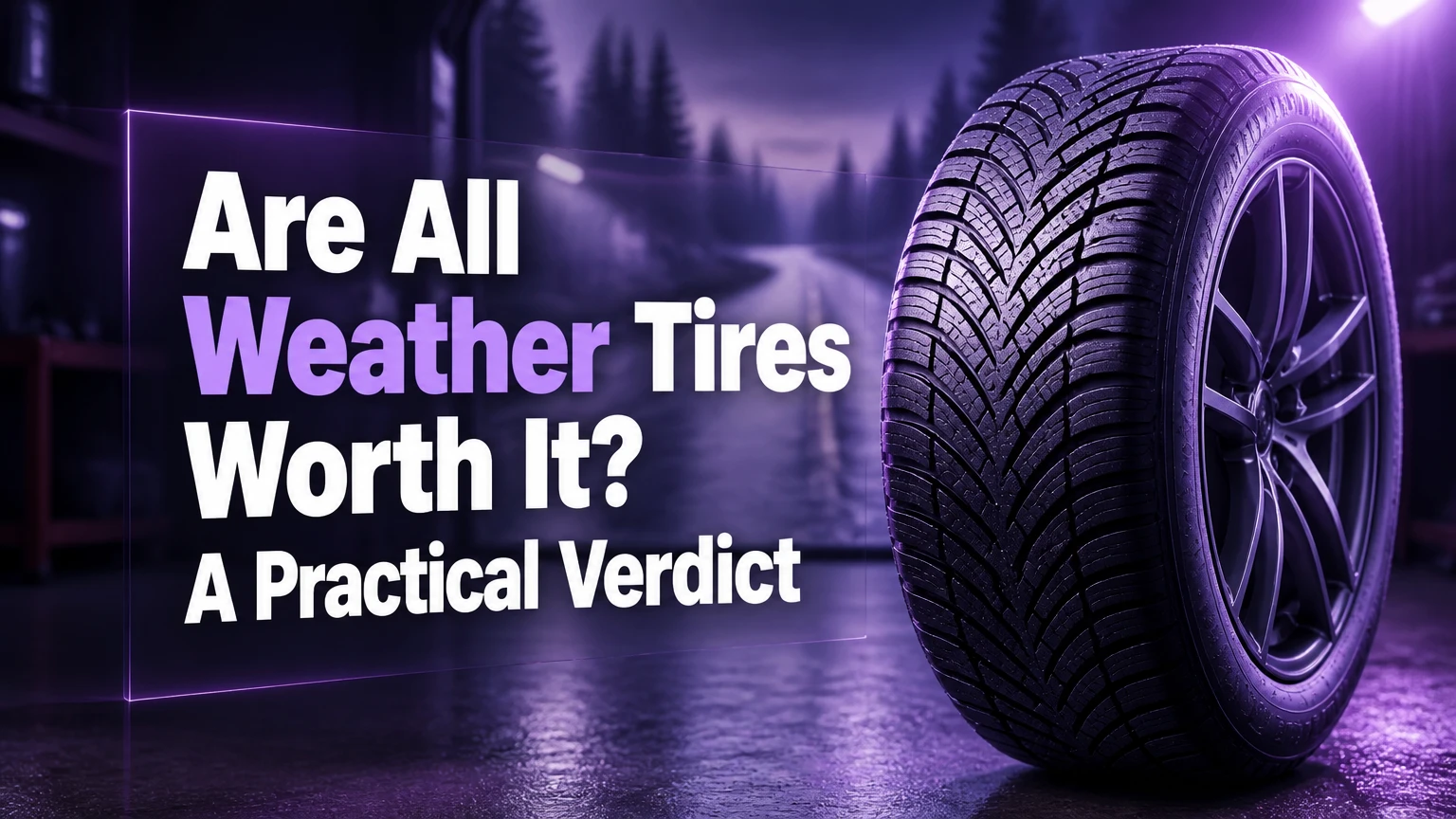
All-weather tires are worth it for drivers who face occasional or moderate snow, mostly cleared roads, and changing temperatures, but do not want two tire sets. They provide substantially better snow traction than typical all-season tires through a 3PMSF severe-snow rating, yet remain usable in summer. Dedicated winter tires remain safer for frequent ice, deep snow, steep roads, or prolonged severe cold.
Key facts at a glance
All-weather tires carry the Three-Peak Mountain Snowflake, or 3PMSF, symbol; ordinary all-season tires may not.
All-weather tires usually cost about 10%-15% more than comparable touring all-season tires.
A typical second-set swap and storage arrangement can cost approximately $160-$420 per year.
All-weather tires improve snow traction but do not equal dedicated winter tires on ice or unplowed roads.
A 3PMSF mark identifies a tested snow-performance threshold, not a guarantee of short braking distances in every winter condition.
Correct inflation, four matching tires, rotation, alignment, and remaining tread determine real-world safety more than the label alone.
What Are All-Weather Tires?
All-weather tires are year-round tires designed between conventional all-season tires and dedicated winter tires. Their tread usually has more snow-biting edges, deeper grooves, and a cold-flexible compound than an all-season touring tire, while the casing and tread blocks remain stable enough for warm-weather highway driving.
The category is easy to misunderstand because “all-weather” is not a perfectly standardized global marketing class. In North America, the decisive physical marking is usually 3PMSF, not the words printed in the product name. A tire can be advertised as all-season and still carry 3PMSF, while some products marketed as all-weather may have different regional naming conventions.
The best definition is therefore functional: an all-weather tire is a year-round tire with certified severe-snow capability and a stronger warm-weather compromise than a winter tire. It is not a winter tire with no summer penalty, and it is not automatically superior to every all-season tire in rain or dry braking.
What Does the 3PMSF Symbol Prove?
The 3PMSF symbol proves that a tire passed a standardized severe-snow traction test relative to a reference tire. The symbol is represented by a mountain with three peaks and a snowflake inside it, and it is stronger evidence of snow capability than the words “all-season” or “mud and snow.”
The symbol does not prove that the tire:
- Matches a dedicated winter tire on ice.
- Stops equally well in every snow depth.
- Remains safe after its winter-oriented tread has worn down.
- Meets every jurisdiction’s chain, stud, or winter-equipment law.
- Performs identically to another 3PMSF tire.
Transport Canada and tire manufacturers distinguish severe-snow certification from the broader category of winter suitability. Local laws also differ. Before crossing mountain passes or driving in regions such as British Columbia, Colorado, Quebec, or the European Alps, check the road authority’s current requirements rather than assuming that 3PMSF automatically satisfies them.
NHTSA describes tires as “the only part of your vehicle that makes contact with the road.” That basic fact explains why electronic stability control and all-wheel drive cannot compensate for a tire with inadequate cold-weather grip.
How Do All-Weather Tires Work?
All-weather tires combine a cold-capable tread compound with a road-oriented structure that limits tread movement in warm conditions. Engineers tune the compound, void ratio, siping, tread shape, casing, and sidewall to cover a wider temperature range than either a traditional all-season or a winter tire optimized for cold.
Which features create the winter advantage?
The winter advantage comes from several interacting features:
- Sipes: Small slits create additional biting edges and help tread blocks conform to compacted snow.
- Open grooves: Longitudinal and lateral channels evacuate slush and water.
- Directional or asymmetric patterns: V-shaped or split tread layouts can improve snow evacuation and wet-road stability, depending on the model.
- Silica-enhanced compounds: Silica is commonly used to preserve flexibility and wet grip at lower temperatures. The claim that all-weather tires rely on “sulfide-rich rubber” is misleading; sulfide is not the defining compound technology.
- Rigid outer blocks: More stable shoulder blocks reduce the soft, delayed steering response associated with a full winter tread.
The familiar 7°C, or 45°F, threshold is a useful seasonal rule, not a chemical switch. All-season tires do not suddenly become unsafe at 7°C, and all-weather tires do not become winter tires below it. Rubber stiffness, road temperature, tread depth, vehicle weight, speed, and precipitation all affect grip.
How Do All-Weather Tires Compare?
All-weather tires are the strongest one-set choice for mixed climates, while dedicated winter tires provide the highest cold-weather margin and conventional all-season tires usually deliver the quietest, longest-wearing warm-weather operation.
| Decision factor | Touring all-season | All-weather | Dedicated winter |
|---|---|---|---|
| 3PMSF marking | Often absent | Usually present | Present |
| Snow traction | Fair to moderate | Moderate to strong | Strongest |
| Polished-ice grip | Weak | Better than all-season, limited | Strongest among non-studded options |
| Dry summer steering | Crisp | Moderately crisp | Softest |
| Typical purchase price | $120-$260 each | $140-$280 each | $130-$300 each |
| Typical tread warranty | 65,000-95,000 km | 55,000-80,000 km | Often 0-50,000 km |
| Second set required | No | No | Yes |
| Warm-weather noise | Lowest | Low to moderate | Highest when overheated |
| Best operating role | Mild climates | Mixed seasons | Repeated severe winter |
Prices are typical North American retail ranges for common passenger-car and crossover sizes, not quotes for every vehicle. Run-flat construction, large SUV dimensions, EV load ratings, and premium performance sizes can exceed these ranges substantially.
What is the winter difference?
All-weather tires are materially better than non-3PMSF all-season tires on light snow, packed snow, slush, and cold wet pavement. The difference comes from the winter-capable compound and extra siping, which preserve traction when a hard all-season tread loses flexibility.
A dedicated winter tire remains better when the road is icy, deeply snow-covered, steep, poorly cleared, or consistently below freezing. Winter tires generally use a softer compound and more flexible tread that can feel less precise on dry pavement, but that trade-off creates more cold-weather grip.
A useful practitioner rule is to judge the route, not the annual snowfall total. A city receiving 30 centimeters of snow may be manageable if roads are cleared within hours. A rural driver facing one steep, unplowed hill each morning may need winter tires even with fewer total snow days.
Winner: All-weather tires win for mixed, cleared-road winter use; dedicated winter tires win for maximum snow and ice traction.
How do they handle summer heat?
All-weather tires handle normal summer heat safely when they have the vehicle’s required load index, speed rating, and inflation pressure. Their trade-off is usually slightly higher tread movement, noise, or wear than a hard touring all-season tire, especially during sustained high-speed driving in hot climates.
The difference is not that all-weather tires are unsuitable for summer. The relevant question is whether the driver values winter readiness more than maximum dry steering precision, lowest noise, and longest warm-weather tread life.
A summer-biased all-weather design, such as the Michelin CrossClimate 2 category, tends to emphasize dry and wet braking with a rigid directional tread. A winter-biased product, such as the Goodyear Assurance WeatherReady category, tends to emphasize snow evacuation and cold-weather flexibility. Product behavior still varies by size and vehicle.
Winner: A touring all-season tire wins for hot, snow-free climates; an all-weather tire wins where winter interruptions are common.
Are they better in rain?
All-weather tires can perform very well in rain, but wet performance depends on tread design, compound, inflation, and wear. A tire with large grooves and strong water evacuation may resist hydroplaning well, while a worn tire with shallow channels can lose wet traction regardless of its original rating.
Consumer Reports has repeatedly advised drivers to replace tires before legal minimum tread is exhausted when wet-weather performance matters. The practical limit is earlier for winter-oriented tires because snow performance declines sharply as specialized grooves and sipes wear.
Do not assume a directional tread always prevents hydroplaning. Speed, standing-water depth, tire width, inflation, and road drainage remain decisive.
Winner: The best tire is model-specific, but all-weather tires generally offer a better rain-and-snow compromise than ordinary all-seasons.
What Do All-Weather Tires Cost?
A four-tire all-weather purchase typically costs $560-$1,120 before installation, with many mainstream passenger vehicles falling near $700-$900. The premium over an equivalent all-season set is commonly 10%-15%, although wheel size, load rating, brand, and seasonal promotions can change the comparison.
| Ownership item | Typical range | When it applies | Four-year example |
|---|---|---|---|
| All-weather tire set | $560-$1,120 | One purchase | $560-$1,120 |
| All-season tire set | $480-$1,040 | Lower initial price | $480-$1,040 |
| Mount and balance | $80-$180 per event | Each seasonal swap | $640-$1,440 for 8 events |
| Tire storage | $50-$120 per year | Shop-stored second set | $200-$480 |
| Rotation | $0-$80 per visit | Every 8,000-10,000 km | $0-$320 |
| Typical installation fees | $100-$220 | Tire purchase appointment | $100-$220 |
The one-set financial case is strongest when a shop charges for mounting, balancing, and storage twice annually. Over four years, avoiding eight swap appointments and paid storage can offset the all-weather premium. A second set mounted on inexpensive wheels can reduce future labor costs, so the calculation should compare complete ownership systems rather than tire prices alone.
A second set can still be cheaper for high-mileage drivers. If dedicated winter tires and all-season tires each last four seasons, the driver receives two specialized tread designs and may preserve more warm-weather tread. The cost advantage depends on mileage, storage, wheel purchase, and whether both sets age out before wearing out.
Who Should Buy All-Weather Tires?
All-weather tires are most worthwhile for urban and suburban drivers who encounter snow several times each winter, use mostly maintained roads, and want one set that remains installed year-round. They are particularly practical for apartment residents, moderate-mileage households, and drivers whose weather changes faster than their tire-swapping schedule.
Urban commuter
A city commuter covering 12,000-18,000 kilometers annually on plowed roads is a strong candidate. All-weather tires provide a safety margin when a morning storm arrives before municipal clearing, without requiring an April and November appointment.
Apartment or condo resident
A driver without a dry storage area can avoid storing four loose tires or paying roughly $50-$120 annually for shop storage. The convenience has practical safety value because drivers are less likely to delay a seasonal change or leave winter tires installed into hot weather.
Mixed-climate highway driver
A highway driver who travels between warm and snowy regions benefits from a tire that remains stable in rain and heat but carries 3PMSF certification. The driver should still check destination laws, mountain-pass rules, and weather forecasts.
Who Should Avoid All-Weather Tires?
Drivers who regularly encounter unplowed roads, glare ice, steep mountain grades, prolonged sub-zero temperatures, or demanding performance driving should usually buy dedicated tires. The all-weather compromise becomes less attractive as winter severity or summer performance expectations increase.
| Driver situation | Better choice | Reason |
|---|---|---|
| Flat city roads cleared within 12 hours | All-weather | One-set convenience with certified snow traction |
| Rural route cleared after 24-48 hours | Dedicated winter | More margin in packed and deep snow |
| Frequent freezing rain and polished ice | Studless winter | Softer cold compound and ice-focused tread |
| Track days or aggressive summer driving | Summer performance | Sharper steering and higher dry grip |
| Desert or coastal climate with no snow | Touring all-season | Lower noise and stronger warm-weather value |
| Heavy EV used in cold conditions | Load-rated all-weather or winter | Extra vehicle mass increases tire demands |
| Mountain route with chain-control rules | Winter plus approved equipment | 3PMSF may not satisfy every local requirement |
All-weather tires are not a substitute for safe speed, adequate following distance, snow removal, or emergency equipment. All-wheel drive helps a vehicle accelerate, but it does not create extra tire-road friction during braking or cornering.
What Are the Main Drawbacks?
The main drawbacks are reduced peak performance at both extremes, potentially faster warm-weather wear, and less ice traction than a dedicated winter tire. Drivers should accept those limitations before treating all-weather tires as a universal replacement for specialized sets.
Common trade-offs include:
- Dry steering: Softer, more heavily siped tread can feel less immediate than a summer or touring tire.
- Summer wear: Hot pavement and high annual mileage can consume tread faster than a hard all-season compound.
- Noise: Open grooves and block edges may produce a mild hum at highway speed.
- Ice performance: 3PMSF snow certification does not equal dedicated ice traction.
- Replacement timing: Winter performance can deteriorate before the tire appears completely worn.
- Vehicle fit: A tire with the wrong load index or speed rating can compromise handling, towing, or warranty compliance.
An all-weather tire also cannot correct poor alignment. Toe misalignment can destroy an expensive set through feathering long before the tread compound reaches its expected mileage.
How Long Do All-Weather Tires Last?
All-weather tires commonly last 55,000-80,000 kilometers, or about four to six years for a driver covering 12,000-15,000 kilometers annually. High temperatures, heavy vehicles, aggressive acceleration, low pressure, poor alignment, and frequent highway mileage can shorten that range.
| Condition | Inspection interval | Typical consequence |
|---|---|---|
| Tire rotation | Every 8,000-10,000 km | More even tread wear |
| Pressure check | Monthly and before long trips | Prevents underinflation wear |
| Alignment inspection | At installation and after impacts | Limits feathering and pull |
| Tread-depth check | Every 5,000-8,000 km | Reveals winter-performance decline |
| Age inspection | At 5 years, then annually | Rubber aging and cracking |
| Replacement planning | Around 4/32 inch for winter use | Preserves snow and wet margin |
The legal minimum tread depth in many North American jurisdictions is 2/32 inch, but that is not a winter-performance target. At approximately 4/32 inch, snow evacuation and siping effectiveness can be substantially reduced, so a tire may remain technically legal while providing a poor winter margin.
Check the vehicle door placard for cold inflation pressure. Do not lower pressure to increase the contact patch in snow. Underinflation increases heat, shoulder wear, steering delay, and fuel or energy consumption.
How Do You Protect Their Performance?
Use four identical tires with matching size, construction, load index, speed rating, and comparable tread depth. Never install all-weather tires on only one axle while leaving ordinary all-seasons or winter tires on the other axle, because the mismatch can alter braking, cornering, and stability-control behavior.
Follow these maintenance rules:
- Rotate according to the tire manufacturer’s pattern and the vehicle manual.
- Inspect for cuts, bulges, punctures, and irregular wear after pothole impacts.
- Keep pressures at the manufacturer’s cold specification, not the maximum printed on the sidewall.
- Confirm directional arrows point forward after installation.
- Replace tires in axle pairs when possible, and place deeper tread on the rear axle unless the vehicle maker specifies another arrangement.
- Avoid mixing different models across one axle.
- Recheck pressure when temperatures change sharply, because pressure changes by roughly 1 psi for each 10°F temperature change as a practical approximation.
Tire age matters even when tread remains. The Department of Transportation identification code on the sidewall reveals the production week and year, allowing buyers of older inventory or used tires to screen for age-related risk.
When Are Dedicated Winter Tires Still Better?
Dedicated winter tires are better when winter traction is the primary safety requirement rather than one factor among several. Their flexible low-temperature compound and dense siping provide additional grip on packed snow, ice, and cold pavement, particularly below freezing.
Choose winter tires if the vehicle regularly travels:
- Roads that remain snow-covered for days.
- Steep grades where stopping or starting is difficult.
- Areas with frequent freezing rain or black ice.
- Remote routes where assistance is delayed.
- Mountain passes with mandatory winter equipment.
- Long stretches below approximately -10°C, depending on the tire and road conditions.
Studded winter tires can add ice traction where permitted, but they create road wear, noise, and legal restrictions. Studless winter tires are more broadly usable, while all-weather tires remain more convenient during warm interludes.
How Should You Decide?
Use the following decision sequence before buying:
- Count severe-weather trips, not snow days. One dangerous mountain commute each week matters more than a low annual snowfall average.
- Check the road-clearing interval. Cleared urban roads favor all-weather tires; delayed rural clearing favors winter tires.
- Confirm the sidewall mark. Look for 3PMSF, then verify size, load index, and speed rating.
- Calculate four-year ownership cost. Include tires, wheels, mounting, balancing, storage, rotations, and replacement timing.
- Compare driving priorities. Dry steering and quiet operation favor touring all-seasons; snow margin favors all-weather or winter tires.
- Check local rules. Confirm whether 3PMSF satisfies regional winter-tire or chain requirements.
- Inspect the vehicle system. AWD, traction control, TPMS, vehicle weight, and suspension alignment all influence the result.
A driver who answers “moderate snow, cleared roads, no storage, normal speeds” should usually choose all-weather tires. A driver who answers “ice, hills, deep snow, delayed clearing” should choose dedicated winter tires.
Frequently Asked Questions
Are all-weather tires safe for highway driving?
All-weather tires are safe for highway driving when they meet the vehicle’s required size, load index, speed rating, and inflation specification. They may produce more tread noise and slightly softer steering than touring or summer tires, while maintaining useful wet and dry stability at normal legal speeds.
Can all-weather tires replace snow tires?
All-weather tires can replace snow tires for many urban drivers facing moderate, intermittent snow on maintained roads. They should not replace dedicated winter tires for frequent ice, deep snow, steep unplowed roads, prolonged sub-zero conditions, or routes governed by specific winter-equipment laws.
Are all-weather tires better for AWD vehicles?
All-weather tires can improve an AWD vehicle’s snow traction, but AWD does not eliminate the need for appropriate tires. AWD mainly assists acceleration; all four tires still determine braking and cornering grip. Use four matching tires and follow the vehicle manufacturer’s replacement and tread-depth guidance.
Can you drive all-weather tires in hot climates?
You can drive all-weather tires in hot climates if the tires have the correct rating and pressure. A touring all-season or summer tire may offer lower noise, longer tread life, and sharper dry handling where snow never occurs, making an all-weather purchase unnecessary for that climate.
Should all-weather tires be rotated?
All-weather tires should generally be rotated every 8,000-10,000 kilometers, unless the vehicle or tire manufacturer specifies a different interval. Directional tires require front-to-back rotation on the same side, while asymmetric tires must retain their correct outside and inside orientation.
The Bottom Line
Are all weather tires worth it? For a driver with moderate winter weather, mostly cleared roads, ordinary annual mileage, and no desire to store or swap two sets, yes. The 3PMSF rating provides a meaningful snow-traction advantage over conventional all-season tires, while one set reduces appointments and storage costs.
All-weather tires are not the highest-performing option in every condition. Dedicated winter tires remain the better choice for ice, deep snow, steep terrain, and prolonged cold, while summer or touring all-season tires remain better for maximum warm-weather precision and low operating cost in snow-free climates. Choose according to the worst road you regularly drive, not the average weather outside your driveway.