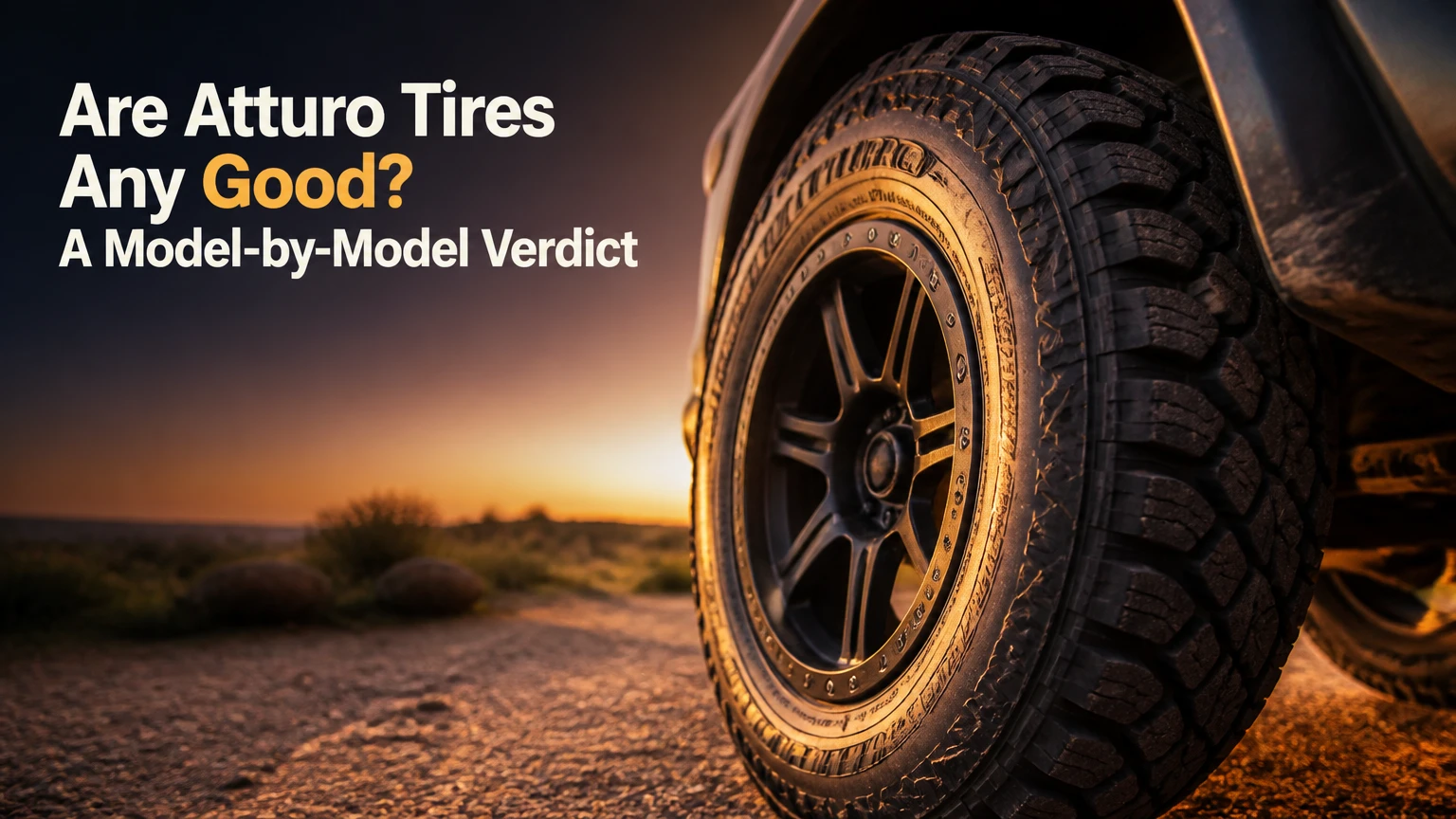
Atturo tires are good value-oriented tires when the model matches the vehicle and driving surface. Trail Blade tires offer competitive off-road traction and aggressive styling, while AZ tires can deliver strong dry-road performance at lower prices than premium alternatives. Buyers generally trade some refinement, wet-weather reserve, and long-term consistency for the lower purchase price.
Key Facts at a Glance
- Atturo is a specialized value tire brand, not a single tire design with uniform performance.
- Trail Blade A/T, X/T, M/T, and BOSS tires suit progressively more aggressive off-road use.
- AZ850 is a summer ultra-high-performance tire, while AZ850DR is intended for drag-oriented applications.
- A 3PMSF symbol indicates severe-snow testing, not safe ice performance.
- Aggressive tread patterns usually create more highway noise and uneven-wear risk than touring tires.
- Warranty mileage, load range, speed rating, and construction vary by model and size.
Are Atturo Tires Any Good Overall?
Atturo tires are a sensible purchase for drivers who prioritize price, dry grip, visual appearance, or trail traction over the quietest ride and highest wet-weather margin. The strongest value appears in specialized sizes, lifted-truck applications, and performance fitments where premium replacement tires can cost substantially more.
Atturo should not be judged as a single performance tier. A Trail Blade M/T has a completely different job from an AZ600 touring tire, so comparing the brand without naming the model can produce the wrong recommendation. The useful question is whether a particular Atturo tire fits the vehicle, climate, speed, payload, and road mix.
Retail listings and independent reviews commonly place Atturo below premium brands such as Michelin, Continental, and Bridgestone in refinement and consistency, but above anonymous import tires in brand identity and application specialization. That does not guarantee every model will perform better than every competitor. Tire size, manufacturing date, inflation, alignment, and retailer storage all affect the result.
What does the lower price actually buy?
The lower price usually reflects product positioning, manufacturing economics, distribution, and a narrower testing and marketing budget than tier-one competitors. It does not automatically mean the tire is unsafe, and it does not mean the tire offers premium-level braking, noise control, or wear.
A typical UHP comparison can look like this:
| Category | Atturo AZ850 | Mid-tier UHP tire | Premium UHP tire |
|---|---|---|---|
| Typical 18-inch purchase price | $140-$190 | $180-$240 | $240-$330 |
| Dry steering response | High | High | Very high |
| Wet braking reserve | Moderate to high when new | High | Very high |
| Treadwear warranty | Often none | 30,000-45,000 miles | 30,000-40,000 miles |
| Best operating season | Warm weather | Warm to mild weather | Warm to mild weather |
Those ranges are typical retail ranges, not fixed prices. Wheel diameter, load rating, size scarcity, promotions, shipping, mounting, and disposal fees can change the final invoice by hundreds of dollars.
How Do Atturo Tires Differ by Construction?
Atturo tires differ through tread pattern, compound, sidewall construction, load rating, and intended surface. A passenger touring tire needs low rolling resistance and stable water evacuation, while a mud tire needs self-cleaning voids and sidewall protection, even though those features increase noise and rolling resistance.
Some Atturo LT-metric off-road sizes use reinforced sidewall constructions, including configurations marketed with multiple sidewall plies. Buyers must verify the exact specification because ply count, load range, maximum pressure, and maximum load are size-dependent. A three-ply claim should never be assumed across an entire product family.
The same caution applies to silica content and asymmetric tread layouts. Performance tires often use compounds and tread arrangements designed to balance dry grip, wet evacuation, heat behavior, and rolling resistance, but a retailer description cannot substitute for the tire’s official specification sheet.
Which specifications matter most?
| Specification | Why it matters | Buyer check |
|---|---|---|
| Load index | Sets the maximum rated load per tire | Match or exceed the vehicle placard |
| Speed rating | Defines tested speed capability under conditions | Match the manufacturer requirement |
| Load range | Indicates casing and pressure category on LT tires | Confirm towing and payload needs |
| 3PMSF marking | Indicates severe-snow service testing | Look for the mountain-and-snowflake symbol |
| UTQG treadwear | Relative rating within regulatory testing | Compare only within similar tire categories |
| DOT date code | Identifies week and year of manufacture | Avoid old, poorly stored inventory |
The vehicle placard and owner’s manual control fitment decisions. A larger tire with a lower load index can create a serious payload problem even when the tire physically fits the wheel well.
Which Atturo Model Should You Choose?
The best Atturo model depends on the proportion of pavement, gravel, mud, snow, and performance driving. Trail Blade A/T is the broadest truck-oriented choice, X/T suits drivers wanting a more aggressive hybrid tread, M/T and BOSS favor difficult terrain, and AZ models target paved-road performance.
| Atturo model | Primary surface | Highway behavior | Snow or winter note | Warranty position |
|---|---|---|---|---|
| Trail Blade A/T | Pavement, gravel, light trails | Quieter than M/T designs | Some sizes carry 3PMSF | Verify size-specific terms |
| Trail Blade X/T | Pavement, rocks, sand, mixed trails | Noticeable hum at speed | Not a substitute for an ice tire | Verify size-specific terms |
| Trail Blade M/T | Mud, clay, rocks | Loud and less efficient | Weak choice for packed ice | Commonly no mileage warranty |
| Trail Blade BOSS | Rock crawling and severe terrain | Very loud, heavy, slower steering | Poor ice application | Verify current warranty |
| AZ600 or AZ810 | Commuting and touring | Most road-focused | Depends on exact marking | Verify current mileage warranty |
| AZ850 | Warm-weather performance | Firm, responsive, potentially loud | Not a winter tire | Usually no mileage warranty |
| AZ850DR | Drag-strip launches | Specialized road use | Not suitable for winter | Verify competition-use limitations |
Atturo’s official website and warranty document should be checked before purchase because product names, sizes, markings, and coverage can change. Retail pages sometimes combine specifications from several sizes or model revisions.
Is the Trail Blade A/T good for daily driving?
Trail Blade A/T is the most defensible Atturo choice for a truck or SUV that spends most of its time on pavement but regularly uses gravel roads, campsites, and light trails. Its tighter tread arrangement should produce better manners than an M/T, although a highway tire will remain quieter and more efficient.
A/T suitability depends on the exact size and marking. Some A/T sizes carry 3PMSF certification, while others may carry only an M+S designation. M+S is not equivalent to the severe-snow symbol, and neither marking makes a tire an ice-specialist product.
Is the Trail Blade X/T good for highway driving?
Trail Blade X/T can work on highways when aggressive appearance and mixed-terrain traction matter more than silence, fuel economy, and soft ride quality. The open shoulder and hybrid tread typically create more hum than a conventional A/T or H/T, especially as the tread develops heel-and-toe wear.
The X/T is a compromise tire. It is usually a better match for a lifted truck used on pavement, construction access roads, and trails than for a quiet family crossover that sees almost no unpaved surface.
Are Trail Blade M/T and BOSS tires worth buying?
Trail Blade M/T and BOSS tires are worth buying for drivers who actually use mud, deep ruts, rock, or steep loose terrain. They are poor value for a commuter who wants the appearance of an off-road tire, because heavy tread can reduce fuel economy, increase noise, lengthen wet-road stopping distances as it wears, and require more frequent balancing and rotation.
Large lugs do not automatically produce better traction everywhere. Mud tires can clean themselves in soft ground, but their limited sipe density and stiff tread blocks can feel poor on wet pavement, packed snow, and polished ice.
Are AZ850 tires good for performance cars?
AZ850 is a reasonable budget summer tire for a driver seeking dry grip and responsive steering in a performance car or SUV. Its soft performance orientation can provide useful traction in warm conditions, but the tire is not an all-season solution and should not be chosen for freezing temperatures or regular snow.
The AZ850DR is more specialized. Drag-oriented construction can favor straight-line launches, but flexible sidewalls and limited rain-oriented tread may reduce everyday road confidence. Drivers should follow the manufacturer’s street-use, pressure, and speed guidance rather than treating a drag radial as a normal touring tire.
How Long Do Atturo Tires Last?
Atturo tire life commonly ranges from about 25,000 miles for heavily used soft UHP or mud-terrain applications to 50,000-60,000 miles for suitable touring or highway use. Actual life depends more on alignment, inflation, rotation, load, road temperature, and driving style than on the brand name alone.
| Application | Typical usable range | Main wear driver | Replacement warning |
|---|---|---|---|
| AZ850 summer performance | 20,000-35,000 miles | Heat, acceleration, camber | Inner shoulder or shallow tread |
| Trail Blade M/T | 25,000-40,000 miles | Rocks, pavement, lug wear | Cracking, chunking, irregular wear |
| Trail Blade X/T | 30,000-45,000 miles | Highway mileage and rotation | Cupping or heel-and-toe wear |
| Trail Blade A/T | 40,000-55,000 miles | Mixed surfaces and alignment | Uneven shoulder wear |
| AZ600, AZ810, or H/T | 45,000-60,000 miles | Inflation and highway use | Age, hardening, or low tread |
These are practical planning ranges, not guarantees. A performance tire can become unsuitable before the legal tread limit because wet braking falls as grooves become shallower. The manufacturer’s warranty document controls any mileage claim, and warranty eligibility normally requires proof of rotation, maintenance, and original installation.
Why do Atturo tires sometimes wear unevenly?
Atturo tires can wear unevenly when aggressive tread blocks interact with incorrect toe, excessive camber, low pressure, worn suspension components, or infrequent rotation. Cupping produces repeating high and low spots, while heel-and-toe wear makes one side of each tread block feel sharper than the other.
A useful maintenance schedule is to inspect pressure monthly and rotate at roughly 5,000-7,500 miles, or earlier for aggressive LT patterns and vehicles with unusual wear. A 3,000-5,000-mile interval can be sensible for severe off-road use, but the vehicle manufacturer’s rotation guidance and the tire warranty should take priority.
Are Atturo Tires Safe in Rain and Snow?
Atturo tires can be safe in rain when correctly sized, inflated, and new enough, but wet performance varies sharply by model and tread condition. Touring and A/T designs generally provide more predictable road behavior than M/T and drag-focused tires, while worn open tread can lose hydroplaning resistance faster than a premium road tire.
Rain safety depends on water depth, speed, tread depth, tire pressure, and suspension condition. A tire with aggressive voids may clear mud effectively yet provide less continuous rubber on wet asphalt. Drivers should reduce speed in standing water rather than relying on the tread appearance.
Snow capability requires the correct marking and realistic expectations. The 3PMSF symbol identifies a tire that met a severe-snow performance test; it does not certify braking on glare ice, and an M/T tire without dense siping is usually a poor winter choice.
| Condition | More suitable Atturo direction | Avoid | Reason |
|---|---|---|---|
| Wet highway commuting | AZ600, AZ810, or road-oriented A/T | M/T and AZ850DR | More predictable water evacuation |
| Light snow and gravel | 3PMSF-marked Trail Blade A/T | Unmarked summer tires | Better tested snow traction |
| Deep mud | Trail Blade M/T | Touring AZ models | Mud-clearing void geometry |
| Packed snow | Dedicated winter tire | Most M/T designs | Sipes and cold-weather compound matter |
| Glare ice | Dedicated studless or studded winter tire | Any aggressive summer tire | Ice requires specialized compound and edges |
What Installation and Maintenance Do Atturo Tires Need?
Atturo tires need accurate fitment, correct inflation, careful balancing, and regular inspection. Road-force balancing is useful when a tire-wheel assembly requires unusually high weights, produces a speed-related vibration, or remains unsettled after conventional balancing.
Road-force equipment measures loaded tire and wheel variation, so it can identify a tire that should be rotated relative to the wheel or moved to another axle position. It cannot repair a bent wheel, worn hub bearing, damaged suspension component, or defective tire.
Use the following installation process:
- Confirm the fitment. Match size, load index, speed rating, wheel width, and clearance to the vehicle specification.
- Inspect the DOT date code. Check all four tires for age and consistent inventory before mounting.
- Check the wheels and valve stems. Repair bends and replace damaged rubber valves or TPMS service parts.
- Balance the assembly. Request road-force balancing when vibration risk or a large tire diameter justifies the additional service.
- Set cold pressure. Use the door-jamb placard, not the maximum pressure molded into the sidewall.
- Align the vehicle. Obtain a printout when the vehicle has adjustable camber, a lift kit, lowered suspension, or uneven wear.
- Recheck after installation. Inspect torque, pressure, vibration, and TPMS operation after the first 25-50 miles.
One practitioner rule is especially important for staggered sports-car fitments: tire rotation may be impossible front to rear, so alignment and side-to-side wear checks become more important than a generic rotation reminder. Excessive negative camber can destroy the inner shoulder of a soft performance tire long before the center tread looks worn.
How Do Atturo Tires Compare With Alternatives?
Atturo generally wins on purchase price and aggressive fitment availability, while premium alternatives usually win on wet braking, noise control, ride quality, and test documentation. The right comparison is category-specific, such as Trail Blade A/T versus BFGoodrich All-Terrain T/A KO2, or AZ850 versus Nitto NT555 G2.
| Buyer priority | Atturo direction | Mid-tier alternative | Premium alternative |
|---|---|---|---|
| Lowest replacement cost | Trail Blade A/T or AZ600 | General Grabber or Cooper | Michelin Defender or Bridgestone Dueler |
| Aggressive mixed-terrain look | Trail Blade X/T | Cooper Discoverer STT Pro | BFGoodrich KO2 or Toyo Open Country |
| Deep mud use | Trail Blade M/T | Mastercraft or Cooper M/T | Toyo Open Country M/T |
| Warm-weather street performance | AZ850 | Nitto NT555 G2 | Continental ExtremeContact Sport 02 |
| Long highway commuting | AZ600 or AZ810 | General Altimax or Cooper Endeavor | Michelin Defender2 |
| Severe winter driving | Choose a dedicated winter tire | General Altimax Arctic | Michelin X-Ice or Bridgestone Blizzak |
The price gap should be evaluated against the ownership period. Saving $400 at installation may be sensible if the vehicle is lightly used and the driver accepts more noise, but the saving is less attractive if rapid wear causes an earlier replacement or if poor wet performance changes daily driving habits.
Premium tires also do not guarantee perfect outcomes. Incorrect pressure, worn shocks, poor alignment, and old inventory can ruin an expensive tire. Atturo’s lower price is most defensible when the buyer maintains the vehicle and selects a model for its real operating environment.
Who Should Buy Atturo Tires?
Atturo tires suit four specific buyer profiles: budget-conscious truck owners, drivers who need unusual aggressive sizes, warm-weather performance enthusiasts, and motorists who accept more noise for lower purchase cost. Atturo is a weaker choice for drivers who prioritize quiet commuting, severe winter safety, maximum wet braking, or predictable long-term tread life.
Choose Atturo if you drive a modified truck
A lifted truck used on pavement, gravel, and occasional trails can benefit from Trail Blade A/T or X/T tires when the load index and wheel clearance are correct. X/T is more appearance- and terrain-oriented; A/T is the calmer daily-use choice.
Choose AZ tires if dry performance matters most
AZ850 may suit a warm-climate performance driver who wants responsive steering without a premium price. The driver must accept seasonal limitations, monitor pressure, and budget for faster wear than a touring tire.
Skip Atturo if winter ice is routine
Drivers in regions with frequent freezing rain, packed snow, or ice should choose a dedicated winter tire, regardless of brand. A 3PMSF-marked A/T can help in light snow, but it cannot replicate the cold-weather compound and dense siping of a true winter tire.
Skip aggressive tread for a quiet family vehicle
A highway tire is usually the better decision for a crossover that spends 95% of its time on asphalt. The apparent savings from an M/T can disappear through higher fuel use, more cabin noise, and premature irregular wear.
What Are the Most Common Atturo Buying Mistakes?
The most common mistakes are choosing a tire by appearance, treating a brand warranty as universal, ignoring load index, and assuming a 3PMSF mark makes any surface safe. Each error can create a poor result even when the tire itself is functioning normally.
- Choosing M/T tires for commuting: Select A/T or H/T tread when pavement dominates.
- Ignoring the load index: Compare the tire sidewall and vehicle placard before ordering.
- Skipping alignment after suspension changes: Obtain alignment readings after lifts, lowering springs, or steering repairs.
- Using maximum sidewall pressure: Set cold pressure according to the vehicle manufacturer unless a qualified specialist provides a documented reason to change it.
- Buying old or poorly stored inventory: Check the DOT date and inspect for cracking before installation.
- Expecting drag radials to behave like touring tires: Reserve AZ850DR-type products for applications consistent with their construction.
- Rotating only when vibration appears: Follow a schedule before heel-and-toe wear becomes permanent.
A counterintuitive point is that more aggressive tread is not automatically safer in rain. Wider voids can help remove loose mud, but less continuous rubber and fewer sipes can reduce wet-road confidence.
Frequently Asked Questions
Who makes Atturo tires?
Atturo is a tire brand headquartered in the United States that develops and sells application-specific tires manufactured through overseas production facilities. The country of manufacture varies by tire and size, so buyers should inspect the sidewall and DOT information on the exact product rather than generalizing from the brand.
Are Atturo tires good for towing?
Atturo tires can work for towing when the selected size has sufficient load index, the vehicle axle ratings are respected, and cold inflation is set correctly. LT construction may suit heavier trucks, but a rugged tread pattern does not increase the vehicle’s legal payload or compensate for overloaded axles.
Are Atturo tires suitable for electric vehicles?
Some AZ-series sizes can fit performance SUVs and electric vehicles, but fitment must account for the EV’s higher curb weight, instant torque, range sensitivity, and noise expectations. Confirm load capacity, speed rating, rim width, and manufacturer approval before installing an Atturo tire on an EV.
How can I tell whether an Atturo tire is too old?
Read the final four digits of the DOT code. The first two digits identify the production week and the final two identify the year, so a code ending in 2324 indicates production during week 23 of 2024. Inspect older inventory for cracking and verify retailer storage conditions.
Should I buy four Atturo tires at once?
Buy four matching tires when the vehicle uses all-wheel drive, has similar tread requirements at every corner, or has substantial existing wear differences. Replacing only two can be acceptable on some two-wheel-drive vehicles, but the newest tires are commonly installed on the rear axle to reduce oversteer risk, subject to the vehicle maker’s guidance.
What is the final verdict on Atturo tires?
Atturo tires are good when low cost, aggressive appearance, dry grip, or off-road traction outweigh the refinement advantages of premium tires. They are not the best universal choice. Match the model to the surface, verify load and winter markings, check the production date, and maintain alignment, pressure, balancing, and rotation.
The Bottom Line
Are Atturo tires any good? Yes, for the right application. Trail Blade A/T and X/T models can deliver useful truck and trail capability, while AZ-series tires offer affordable warm-weather performance. Buyers seeking the quietest ride, strongest wet-weather reserve, or dependable ice traction should spend more on a category-leading tire or choose a dedicated winter product instead.