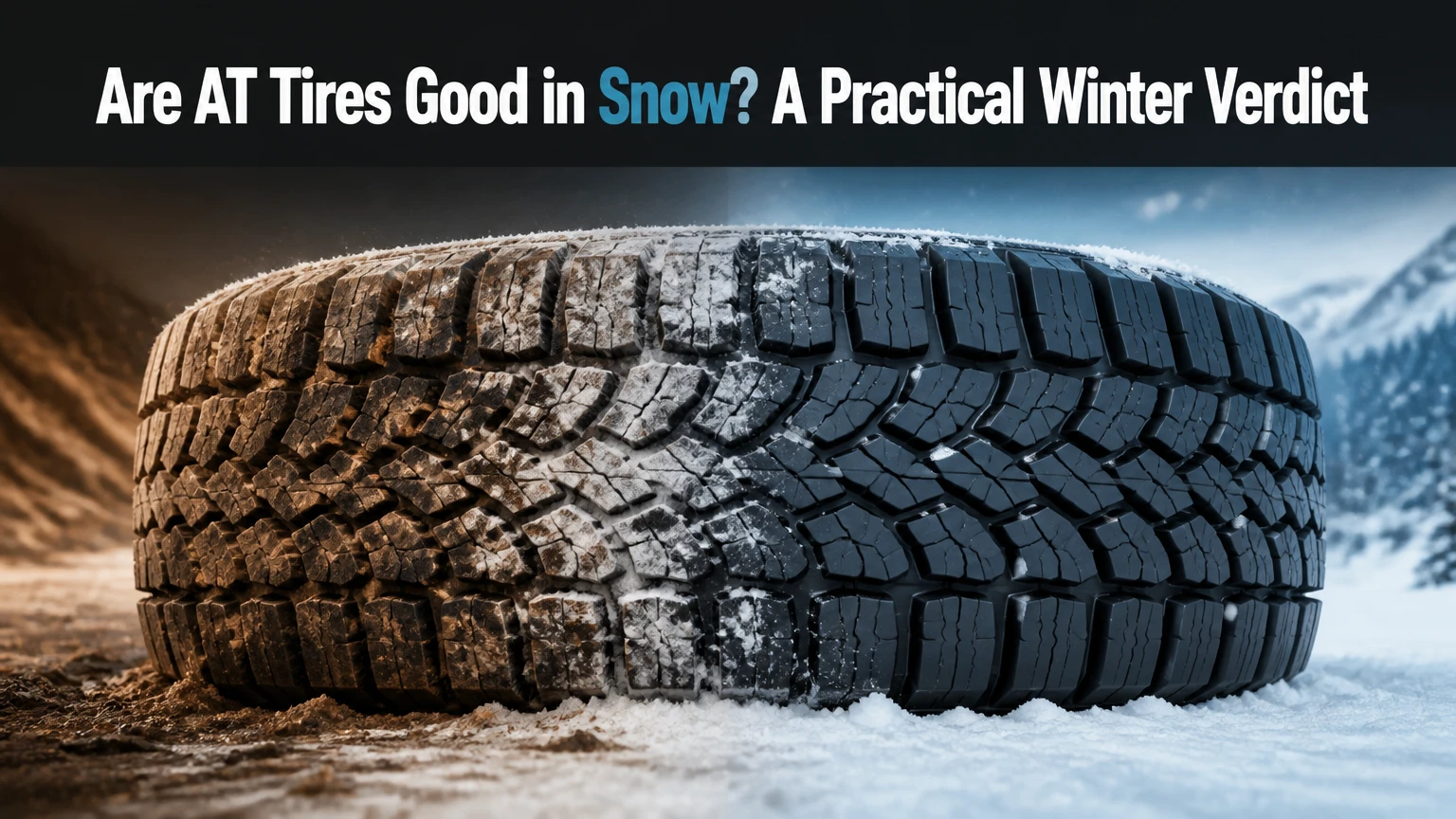
All-terrain (A/T) tires are generally good in light to moderate snow, especially when they have the Three-Peak Mountain Snowflake (3PMSF) symbol and substantial tread depth. A/T tires are less effective than dedicated winter tires on ice, packed snow, and temperatures consistently below freezing because their compounds and tread patterns prioritize year-round durability and off-road balance.
Are A/T Tires Good in Snow?
A/T tires work well for occasional snowfall, unplowed roads, gravel routes, and moderate winter conditions, but dedicated winter tires remain safer for repeated ice, steep hills, and persistent snowpack. The deciding factors are the 3PMSF marking, tread depth, temperature, vehicle weight, road surface, and whether braking safety matters more than off-road versatility.
Key Facts at a Glance
- A/T tires with the 3PMSF symbol meet a severe-snow acceleration performance requirement; M+S alone does not provide the same assurance.
- A/T tires usually outperform highway-terrain tires in loose snow because their grooves and voids evacuate snow more effectively.
- Dedicated winter tires generally provide shorter braking distances on ice and cold pavement than A/T tires.
- All-wheel drive improves acceleration in snow, but it does not provide additional tire grip during braking.
- A practical winter inspection point is 6/32 inch of tread, although local laws and manufacturer guidance may differ.
- Typical A/T pricing ranges from $180 to $350 or more per tire, while load range, size, brand, and construction can move the price substantially.
How Do A/T Tires Create Snow Traction?
A/T tires create snow traction through open grooves, tread depth, biting edges, and snow packing inside the tread. Snow packed into a tread void can generate snow-on-snow friction, while sipes and block edges provide additional grip during acceleration, cornering, and braking.
Loose snow behaves differently from ice. A tire can press into powder or packed snow and develop mechanical interlock, but a smooth ice surface offers little material for a large tread block to engage. That difference explains why an aggressive A/T tire may climb a snowy trail confidently yet slide during an emergency stop on glazed pavement.
Tread depth also matters. Typical new A/T tires have approximately 13/32 to 17/32 inch of tread, although exact depth varies by model and size. Deeper grooves provide more room for snow retention and evacuation, while broad shoulder blocks help maintain propulsion when the vehicle enters ruts.
Sipes cut small edges across tread blocks. Sipes can improve grip on wet or snowy surfaces, but more siping is not automatically better for every use. Excessive block movement can reduce dry-road stability and accelerate irregular wear, so tire engineers balance sipe density with block rigidity.
What Do M+S and 3PMSF Mean?
M+S means Mud and Snow and identifies a tread pattern that meets a geometric design criterion, while 3PMSF identifies a tire that passed a standardized severe-snow traction test. M+S does not test braking on ice, cornering, cold flexibility, or actual stopping distance.
The 3PMSF symbol shows a mountain with three peaks and a snowflake. The U.S. Tire Manufacturers Association explains that the severe-snow symbol is associated with a tire’s performance in a defined packed-snow acceleration test. The test threshold is commonly described as at least 10% greater traction than a reference tire under that test condition.
That certification has a defined scope. It does not certify winter braking, emergency cornering, black-ice control, or performance on every type of snow. A 3PMSF A/T tire is therefore a stronger winter choice than an M+S-only A/T tire, but it is not automatically equivalent to a studless winter tire.
The 7°C, or 45°F, guideline also needs precision. Winter compounds generally retain flexibility below that temperature more effectively than all-season or many A/T compounds, but 7°C is not a universal point at which every A/T tire becomes unsafe. Compound design, pavement temperature, speed, moisture, and tire age all affect grip.
Which A/T Features Matter Most in Winter?
The most useful winter features in an A/T tire are the 3PMSF certification, high sipe density, flexible cold-weather compound, adequate tread depth, and a tread width suited to the vehicle and road. Large voids help in deep powder, but they cannot replace winter rubber on ice.
| Feature | Typical A/T specification | Winter benefit | Limitation |
|---|---|---|---|
| New tread depth | 13/32-17/32 inch | Holds and clears loose snow | Does not guarantee ice grip |
| 3PMSF marking | Severe-snow certified | Better packed-snow acceleration than reference tire | No ice-braking certification |
| M+S marking | Often present on A/T tires | Indicates open tread geometry | No required snow or cold test |
| Siping | Model-specific, often dense on 3PMSF tires | Adds biting edges on snow and wet pavement | Can reduce block rigidity if excessive |
| Load range | SL, XL, C, D, or E | Supports vehicle weight and towing needs | Heavy casing can reduce comfort and efficiency |
| Section width | Vehicle-specific, often 235-285 mm | Narrower sizing can cut through slush | Too narrow can reduce flotation in deep powder |
A tire’s load range deserves special attention on pickups. An E-load-range tire may carry substantial weight, but its stiff casing can transmit more impact and provide less compliant contact on a lightly loaded truck. Choosing the correct load rating from the vehicle manufacturer’s specification is safer than automatically selecting the heaviest construction.
Are 3PMSF A/T Tires Equal to Winter Tires?
3PMSF A/T tires are not equal to dedicated winter tires in severe winter conditions. A 3PMSF A/T tire is the better single-tire compromise for drivers who need off-road durability and year-round use, while a winter tire is usually the better choice for cold pavement, ice, repeated snow, and maximum braking control.
| Tire category | Typical snow use | Ice and cold-pavement behavior | Best application |
|---|---|---|---|
| M+S A/T | 1-3 inches of occasional snow | Harder feel below freezing; limited siping | Mild winter and dirt-road driving |
| 3PMSF A/T | Packed snow, moderate powder, winter highways | Better cold traction than M+S-only A/T; below winter-tire performance on ice | Mixed road and trail use |
| R/T | Deep powder, rutted snow, off-road routes | Highly model-dependent; large voids can reduce ice contact | Aggressive mixed terrain |
| Studless winter tire | Packed snow, ice, freezing rain, cold asphalt | Flexible compound and dense siping improve braking and cornering | Mountain and persistent-winter driving |
| Studded winter tire | Ice, glare ice, hard-packed snow | Strongest ice bite where legal | Severe ice conditions and permitted regions |
| Highway-terrain tire | Plowed pavement and mild rain | Usually less effective in deep snow than A/T designs | Quiet highway use with occasional snow |
Winter tires use compounds formulated to remain pliable at lower temperatures, plus dense siping and block designs that target cold-road braking. Their shallow-looking tread pattern can outperform a deeper A/T tread on ice because chemical grip and edge density matter more than void size on a smooth surface.
Are R/T Tires Better Than A/T Tires in Deep Snow?
Rugged-terrain (R/T) tires can outperform many A/T tires in deep, unplowed snow, but R/T construction does not guarantee better winter control. Large voids and stiff blocks clear powder effectively, while limited siping or heavy casing design can reduce braking and lateral grip on polished ice.
R/T tires occupy the space between A/T and mud-terrain designs. Their aggressive shoulders and open tread can prevent the tire from filling with wet snow when a vehicle travels through deep drifts. That advantage matters on remote roads where maintaining forward motion is the main problem.
R/T tires are a poor default for urban winter driving when their tread has few sipes. Deep snow and ice are separate problems. A tire designed to dig through a 12-inch drift may feel less secure during a 35 mph turn on wet, frozen pavement.
How Much Snow Can A/T Tires Handle?
A 3PMSF A/T tire can typically handle light to moderate snowfall, packed residential roads, and many unplowed access roads when the tread is healthy. No universal inch limit applies because snow density, road grade, vehicle clearance, tire size, speed, and underlying ice determine whether the vehicle remains controllable.
| Driving condition | A/T suitability | Main risk | Preferred tire choice |
|---|---|---|---|
| 1-3 inches on treated pavement | High for 3PMSF A/T | Slush and sudden refreeze | 3PMSF A/T or winter tire |
| 4-8 inches of loose snow | Moderate to high | High-centering and packed tread | 3PMSF A/T with good clearance |
| Snow-covered mountain pass | Moderate | Ice beneath packed snow | Dedicated winter tire |
| Freezing rain or black ice | Low | Long braking and lateral sliding | Studless or studded winter tire |
| Deep trail snow | High for aggressive A/T or R/T | Buried chassis and recovery difficulty | R/T or specialized winter-capable setup |
| Plowed, cold highway | Moderate | Cold braking and lane changes | Winter tire for frequent severe use |
Ground clearance is often confused with tire traction. A truck can have adequate tread but become immobilized when snow reaches the differential, running boards, or underbody. Tire selection cannot correct a high-centered vehicle.
Vehicle weight also has a mixed effect. More weight can increase normal force and help a tire bite, but it increases stopping energy and does not overcome an inadequate compound. A heavy SUV on worn A/T tires can take longer to stop than a lighter vehicle on quality winter tires.
What Is the Difference Between A/T and All-Season Tires?
A/T tires generally provide deeper, more open tread and stronger off-road traction than passenger all-season tires, while all-season tires usually offer quieter highway behavior and more predictable dry-road handling. In snow, the comparison depends on the exact model, because some modern 3PMSF all-season or all-weather tires outperform older M+S A/T designs.
The word “all-season” describes a broad market category rather than one technical performance level. Some all-season tires carry only M+S, while all-weather tires commonly carry 3PMSF and use a more cold-capable compound. A/T buyers should inspect the sidewall marking and manufacturer specifications instead of relying on the category name.
| Decision factor | M+S A/T | 3PMSF A/T | 3PMSF all-weather | Dedicated winter |
|---|---|---|---|---|
| Typical tread depth | 13/32-17/32 in | 14/32-18/32 in | 10/32-12/32 in | 10/32-13/32 in |
| Off-road durability | High | High | Low to moderate | Low |
| Highway noise | Moderate to high | Moderate to high | Low to moderate | Low to moderate |
| Ice braking | Low | Moderate | Moderate to high | High |
| Severe-snow certification | Usually no | Yes | Yes | Yes |
| Seasonal operating range | Year-round | Year-round | Year-round | Approximately below 45°F |
| Typical price per tire | $150-$280 | $180-$350 | $160-$300 | $140-$300 |
The table uses typical market ranges, not guaranteed retail prices. Tire size, regional taxes, installation, rebates, and load rating can change the final bill.
Which A/T Tires Are Best for Winter Use?
The best A/T winter choice is a 3PMSF model with dense siping, a cold-weather compound, a correct load rating, and a size approved for the vehicle. Recognized examples include BFGoodrich All-Terrain T/A KO3, Falken Wildpeak A/T4W, and Goodyear Wrangler DuraTrac RT, but model-year specifications and available sizes should be verified before purchase.
A named model is not a universal recommendation. Tread design can change between sizes, and an LT version may behave differently from a passenger-load version because casing stiffness, weight, and inflation requirements differ.
Use these criteria when comparing candidates:
- Confirm the 3PMSF symbol on the actual sidewall or manufacturer specification page.
- Check the vehicle placard for approved tire size, speed rating, and load capacity.
- Compare the tire’s published tread depth and sipe layout.
- Read independent tests for snow braking and handling, not only owner comments about deep powder.
- Check whether the tire is unusually heavy for the vehicle’s normal payload.
- Confirm that four matching tires can be installed, especially on AWD and 4WD vehicles.
The best A/T tread for a work truck may be a poor choice for a family crossover. A tire that carries an E-load rating and resists trail damage can add unsprung mass, steering effort, noise, and fuel consumption to a vehicle that spends almost every mile on pavement.
Does AWD Make A/T Tires Safe on Ice?
AWD and 4WD help A/T tires accelerate by distributing engine torque across multiple wheels, but neither drivetrain shortens the tire’s braking distance on ice. The tire’s compound, tread edges, speed, road temperature, and available friction determine stopping performance.
This is one of the most persistent winter-driving mistakes. Drivers often test AWD by accelerating from a stop and conclude that the tires work well, yet emergency braking uses the contact patches and anti-lock braking system rather than engine torque.
AWD can also encourage excessive speed because the vehicle feels composed during launch. A/T tires on an AWD vehicle still need longer following distances, gentle steering inputs, and early braking on frozen surfaces.
How Should You Prepare A/T Tires for Winter?
Prepare A/T tires by checking cold inflation pressure, tread depth, sidewall condition, balance, alignment, and the 3PMSF marking before the first major storm. Use the pressure listed on the vehicle door placard, not the maximum pressure molded into the tire sidewall.
Cold air reduces tire pressure by approximately 1 psi for every 10°F temperature decrease as a practical rule of thumb. The exact change varies with tire volume and atmospheric conditions, so the correct procedure is to measure pressure when the vehicle has been parked for several hours.
Inspect all four tires for:
- Tread at or above 6/32 inch for stronger winter performance.
- Even wear across the tread width.
- Cracks, bulges, punctures, or exposed cords.
- Working TPMS sensors and matching pressure readings.
- Adequate tread depth in the center and shoulder grooves.
- A manufacturing date that does not indicate excessive age.
A tire can remain legally usable below 6/32 inch while losing useful snow performance. The 2/32-inch replacement benchmark concerns minimum tread depth in many jurisdictions, not the point at which winter traction remains strong.
Alignment is another overlooked factor. Excessive toe or camber wear can remove the outer tread edges that provide lateral grip, even when the center tread still appears deep. Rotate tires according to the vehicle and tire manufacturer’s schedule, commonly every 5,000-8,000 miles.
How Much Do Snow-Capable A/T Tires Cost?
Snow-capable A/T tires typically cost $180-$350 or more each, producing a four-tire purchase of approximately $720-$1,400 before mounting, balancing, taxes, and disposal fees. LT construction, large wheels, high load ranges, premium brands, and uncommon sizes usually raise the total.
| Purchase item | Typical quantity | Typical price | Common timeframe |
|---|---|---|---|
| 3PMSF A/T tire, 16-18 inch | 4 tires | $720-$1,200 | 50,000-65,000-mile warranty range on some models |
| 3PMSF A/T tire, 20 inch or LT E-load | 4 tires | $1,000-$1,600 | Installation often scheduled within 1-2 hours |
| Mounting and balancing | 4 wheels | $80-$180 | Usually 45-90 minutes |
| Seasonal winter tire swap | 1 service | $80-$160 | Commonly repeated twice yearly |
| Dedicated winter tire set | 4 tires | $560-$1,200 | Often used for 3-5 winter seasons |
| Storage service | 1 season | $50-$150 | Approximately 5-7 months |
Typical service prices vary by region and whether tires remain on the same wheels. A second wheel set can reduce repeated mounting labor and protect tire beads, but it adds the cost of wheels, sensors, and storage.
A 50,000-65,000-mile warranty does not mean an A/T tire will last that long in every winter application. Frequent wheelspin, gravel, underinflation, misalignment, heavy towing, and hot summer pavement can shorten service life. Replace tires for age, damage, or inadequate traction before the mileage warranty ends.
What Problems Do A/T Tires Develop in Snow?
The main A/T winter problems are wheelspin, lateral sliding, slush wandering, packed tread, and long braking distances. Each problem points to a different cause, so adding throttle or lowering pressure is not a universal fix.
Wheelspin in Light Snow
Wheelspin often results from worn tread, abrupt throttle, incorrect pressure, or a surface with ice beneath the snow. Check tread depth, use smooth throttle input, and allow traction control to work unless the vehicle is stuck and the owner’s manual specifies a temporary alternate setting.
Sliding on Turns
Lateral sliding indicates limited side grip, excessive speed, compacted ice, or insufficient siping. Reduce speed before the turn rather than braking sharply in the curve. Mechanical remedies include replacing worn tires or switching to a tire with greater cold-weather and lateral-siping performance.
Floating in Slush
Wide tires can ride on deep slush instead of cutting through it, especially at highway speeds. Do not change size outside the manufacturer-approved range without checking wheel clearance, load capacity, speedometer effects, and winter chain compatibility.
Tread Packed With Wet Snow
Tread packing occurs when snow fills the grooves faster than the tire can eject it. A 3PMSF tire with appropriate void spacing can reduce the problem, but very wet snow, low speed, and insufficient tread depth can still overwhelm the pattern.
Which Tire Type Should You Choose?
Choose a 3PMSF A/T tire when one set must handle snow, highways, gravel, towing, and moderate off-road use. Choose dedicated winter tires when the vehicle regularly encounters ice, mountain passes, persistent snowpack, freezing temperatures, or high-consequence braking situations.
Mountain Commuter
A mountain commuter should use dedicated studless winter tires, such as the Bridgestone Blizzak or Michelin X-Ice families, when winter roads remain cold and snow-covered for weeks. A/T tires may be acceptable for trail access, but highway braking and cornering deserve priority.
Mixed-Use Truck Owner
A truck owner who drives plowed roads during the week and unplowed access roads on weekends should consider a 3PMSF A/T tire. Falken Wildpeak A/T4W and similar severe-snow-rated designs provide a practical balance, provided the size and load rating suit the truck.
Mild-Climate Driver
A driver who sees one to three inches of snow that melts within 48 hours can use a quality M+S A/T tire, although 3PMSF adds a stronger margin. Correct pressure, fresh tread, and conservative speed matter more than an aggressive sidewall when most roads are treated pavement.
Ice-Focused Driver
A driver whose main concern is freezing rain or black ice should skip A/T tires as the primary winter solution. Studless winter tires offer the more appropriate compound and sipe design, while studded tires may provide additional ice traction where local law permits them.
What Should You Avoid When Buying A/T Tires?
Avoid treating M+S as proof of winter performance, selecting an oversized tire without checking vehicle specifications, and assuming aggressive tread automatically improves ice control. Avoid mixing tire models or substantially different tread depths on AWD vehicles unless the vehicle manufacturer explicitly permits that arrangement.
Three expert rules prevent many expensive mistakes:
- Do not select by void ratio alone. Deep grooves help a tire move through powder, but dense siping and cold flexibility matter more on ice.
- Do not test winter safety with acceleration. A vehicle can launch effectively with AWD while still requiring a much longer distance to stop.
- Do not inflate by the sidewall maximum. The vehicle placard specifies the pressure used to engineer the suspension and contact patch.
A/T tires are also a poor substitute for tire chains where authorities require chains during severe storms. Chains can supply additional bite in deep snow, but they require compatible clearance and correct installation; consult the vehicle manual before fitting them.
FAQ
Are A/T Tires Better Than All-Season Tires in Snow?
A/T tires are usually better than basic all-season tires in loose or deep snow because they have deeper tread and larger evacuation grooves. A 3PMSF all-season or all-weather tire can outperform an M+S-only A/T tire on cold pavement, so the sidewall symbol and independent testing matter more than the category label.
Can You Drive A/T Tires Year-Round?
You can drive A/T tires year-round when the manufacturer permits it and the vehicle receives the correct size, pressure, and load rating. Year-round use is practical for drivers who need off-road durability, but aggressive A/T tires may produce more noise, lower fuel economy, and faster warm-weather wear than highway tires.
Are 3PMSF Tires Good on Black Ice?
3PMSF tires are better suited to severe snow than tires without the marking, but the symbol does not certify black-ice braking. Dedicated winter tires generally provide more grip because their compounds remain flexible in cold conditions and their tread contains more edges designed for ice and packed snow.
Should A/T Tires Be Narrower for Winter?
A slightly narrower approved tire can cut through slush and reach firmer pavement, while a wider tire can provide flotation in deep, loose powder. Never change width solely for winter without verifying wheel fitment, load capacity, clearance, speedometer accuracy, and local chain requirements.
How Long Do A/T Tires Last?
Premium A/T tires commonly last approximately 50,000-65,000 miles under favorable conditions, but winter wheelspin, towing, gravel, heat, underinflation, and alignment problems can reduce that figure. Replace an A/T tire when tread, damage, age, or winter traction no longer meets the vehicle’s needs.
Do Trucks Need Winter Tires if They Have A/T Tires?
Trucks do not automatically need winter tires when quality 3PMSF A/T tires provide adequate performance for the local climate and driving conditions. Trucks that regularly encounter ice, steep grades, mountain passes, or prolonged subfreezing pavement gain a meaningful safety advantage from dedicated winter tires.
The Bottom Line
Are A/T tires good in snow? Yes, a 3PMSF A/T tire is a strong year-round compromise for light to moderate snow, gravel, unplowed access roads, and mixed-use trucks. A dedicated winter tire remains the better choice for ice, repeated freezing temperatures, mountain driving, and maximum braking performance. Choose based on the surface you must stop on, not the depth of tread you can see.