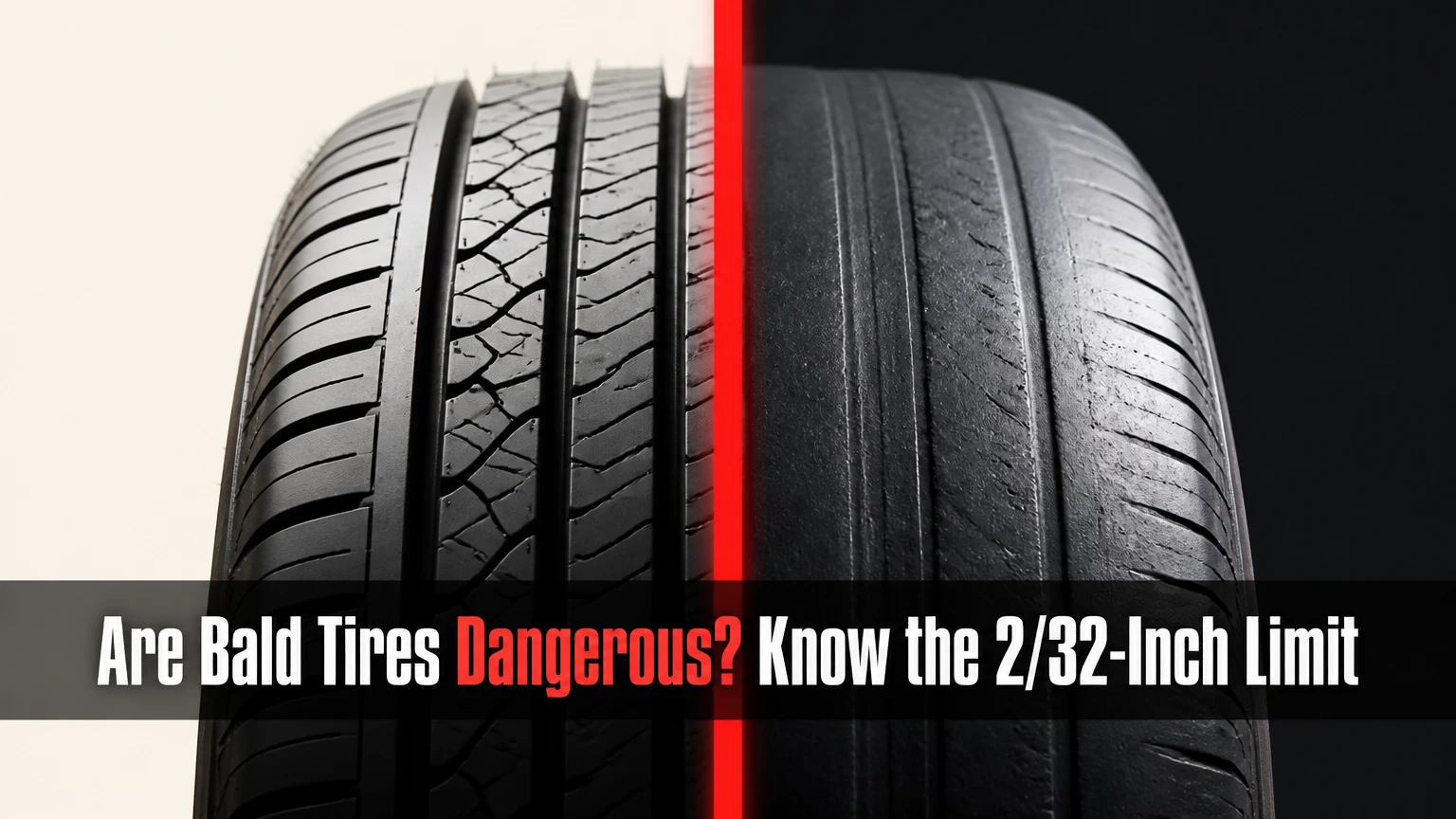
Are bald tires dangerous? Yes. A bald or severely worn street tire has reduced wet traction, a greater risk of hydroplaning, and less protection against impact or structural damage. Replace a tire at or below 2/32 inch of tread, and consider replacement around 4/32 inch when frequent rain, snow, highway driving, or heavy loads make wet grip especially important.
Key Facts at a Glance
A tire at 2/32 inch, or 1.6 mm, has reached the commonly used US replacement threshold.
A tire can become unsuitable for heavy rain or snow before it reaches 2/32 inch.
Tread wear bars become level with the surrounding tread at approximately 2/32 inch.
Correct inflation cannot restore tread that has worn away.
Uneven wear often indicates incorrect pressure, poor alignment, worn suspension, or missed rotations.
A tire with exposed cords, a sidewall bulge, deep cracking, or sudden pressure loss should not be driven.
How Dangerous Are Bald Tires?
Bald tires are unsafe on public roads because worn tread reduces water evacuation and leaves less rubber between road hazards and the tire’s internal structure. The risk rises sharply during rain, standing water, cold weather, emergency braking, high-speed travel, and turns, although a dry road does not make a severely worn tire safe.
The US National Highway Traffic Safety Administration, or NHTSA, describes tires as “the only part of your vehicle that makes contact with the road.” That small contact area controls acceleration, braking, and steering. When tread channels disappear, the tire may retain some dry-road grip while losing a large margin of wet-weather control.
A tire does not need to show steel belts to be dangerous. The loss of grooves alone can materially reduce resistance to hydroplaning, and a tire with uneven shoulders may have dangerously little usable tread even if the center looks acceptable.
What is the legal tread limit?
The commonly used US legal minimum is 2/32 inch, or 1.6 mm, measured in the principal grooves, but laws and inspection rules differ by state and country. Legal compliance is a floor, not a promise that the tire will perform well in rain, snow, or an emergency maneuver.
Tire manufacturers mold raised tread-wear indicators into the main grooves. When the surrounding tread reaches the same height as those bars, the tire is approximately at 2/32 inch and should be replaced. A tread-depth gauge gives a more reliable measurement than visual inspection.
The 4/32-inch recommendation needs precision. Many tire retailers, vehicle manufacturers, and safety professionals use 4/32 inch as a planning point for wet-weather replacement, while winter-tire specialists commonly recommend replacing winter tires at 5/32 or 6/32 inch because snow traction depends on deeper grooves. These are performance guidelines, not one universal legal definition.
Why Does Tread Depth Matter in Rain?
Tire tread matters in rain because grooves provide channels for water to leave the contact patch. A worn tire has less void space and fewer effective channel edges, so water can build between the rubber and pavement, reducing steering and braking control.
Hydroplaning does not require a completely smooth tire. Speed, water depth, inflation pressure, vehicle weight, tread design, pavement texture, and tire condition all affect the event. A deep puddle can overwhelm even a new tire, while a worn tire may lose grip in a relatively shallow layer of water.
When hydroplaning begins, the driver may feel light steering, a sudden change in engine speed, or the vehicle drifting across a lane. Braking and steering inputs become less effective because the tire is no longer gripping the pavement normally. The correct response is to ease off the accelerator, hold the steering wheel steadily, and avoid abrupt braking or steering until contact returns.
NHTSA reported that wet-weather crashes account for a substantial share of weather-related collisions, but no single stopping-distance figure applies to every bald tire. Claims that all bald tires add 90-100 feet at 60 mph are too broad without specifying the tire, water depth, pavement, temperature, vehicle, and test method.
Which Tread Depth Requires Replacement?
Replace a passenger tire at 2/32 inch or less, and schedule replacement before that point when measurements approach 4/32 inch in a rainy climate. Replace a winter tire earlier if its tread no longer provides the depth required by the manufacturer or if snow traction is a primary need.
| Measured tread depth | Approximate condition | Recommended action | Main concern |
|---|---|---|---|
| 10/32-12/32 inch | Typical new all-season tire | Inspect monthly and rotate according to the vehicle schedule | Break-in and pressure maintenance |
| 6/32-8/32 inch | Moderate wear | Continue service with regular measurements | Uneven wear can shorten life |
| 4/32-5/32 inch | Reduced wet-weather reserve | Budget for replacement, especially before rainy season | Longer wet braking and less hydroplaning margin |
| 3/32 inch | Poor margin in rain and snow | Arrange replacement promptly | Water and snow evacuation decline |
| 2/32 inch | Common legal replacement threshold | Replace the tire | Wear bars are usually flush |
| Below 2/32 inch | Severely worn | Do not use for normal road driving | Very low wet traction and limited rubber reserve |
| Exposed cords or belts | Structural failure condition | Stop driving and arrange a tow | Blowout or rapid air loss |
A single measurement can hide a problem. Measure the inner, center, and outer grooves at several points around the tire, because camber or toe misalignment may wear one shoulder below the legal threshold while the center still appears serviceable.
Is the penny test reliable?
The US penny test is a quick screening method, not a substitute for a tread-depth gauge. Insert a penny with Lincoln’s head facing downward into a main groove; if the top of his head is fully visible, the tread may be at or below approximately 2/32 inch.
The test has important limits. It cannot identify 3/32 or 4/32 inch accurately, cannot reveal internal separation, and can miss a bald inner shoulder. A digital or manual tread gauge costs little, measures in 1/32-inch increments, and is the better tool for maintenance decisions.
Can You Drive Bald Tires in Dry Weather?
Dry weather reduces hydroplaning exposure but does not make bald tires safe. Worn tread can still reduce braking reserve, lose grip on dusty or polished pavement, and provide less protection from potholes, glass, nails, and sharp road debris.
Summer heat also does not repair worn rubber. High pavement temperatures increase tire temperature, especially when the tire is underinflated, overloaded, or traveling at highway speed. Heat-related failure depends on casing condition, pressure, load, speed, age, and damage, not tread depth alone.
A tire with visible cords, a sidewall bulge, deep sidewall cracking, a puncture outside the repairable area, or a sudden pressure loss should not be driven even to a nearby tire shop. Use roadside assistance or a tow service. If the tire is merely near its planned replacement depth and has no damage, a short, slow trip to a professional tire facility may be reasonable, but rain and highway speeds should be avoided.
How Do You Inspect a Tire at Home?
Inspect tire tread, pressure, age, sidewalls, and wear distribution in about 10-15 minutes for all four tires. A tread-depth gauge, an accurate pressure gauge, a flashlight, and the vehicle owner’s manual provide a more useful inspection than looking only for a smooth center rib.
- Check cold inflation pressure. Compare each tire with the pressure on the driver-door placard, not the maximum pressure molded into the sidewall. The placard value is the vehicle manufacturer’s cold-pressure specification.
- Measure three tread areas. Record the inner, center, and outer groove readings on each tire. Repeat at two or three points around the circumference.
- Inspect the wear bars. Confirm whether the tread surface has reached the molded indicators in the major grooves.
- Read the DOT date code. The final four digits identify the production week and year, such as 2421 for the 24th week of 2021. Age guidance varies by manufacturer, so follow the tire maker’s recommendation and inspect older tires for cracking.
- Examine the sidewall. Look for bulges, cuts, cracking, abrasion, and damage from curbs or potholes. Sidewall damage is not corrected by adding air.
- Check the spare. Verify its pressure, age, cracking, and tool kit. A spare can deteriorate while unused.
- Record TPMS warnings. The tire-pressure monitoring system can warn about low pressure, but it does not measure tread depth or detect every structural defect.
You will know the inspection is useful when every tire has recorded inner, center, and outer measurements, a pressure comparison, an age code, and a visible-damage result. The common mistake is checking only the easiest-to-see outside shoulder.
What Do Uneven Wear Patterns Mean?
Uneven tire wear usually points to a maintenance or chassis problem rather than ordinary tread aging. Correct the cause before installing replacement tires, or the new tires may develop the same defect within a few thousand miles.
| Wear pattern | Typical measurement or appearance | Likely cause | Required follow-up |
|---|---|---|---|
| Center wear | Center reads 2/32 inch, shoulders read 5/32 inch | Chronic overinflation | Set cold pressure to the door-placard value |
| Both shoulders worn | Inner and outer edges read 2/32 inch, center reads 5/32 inch | Underinflation or overloading | Check pressure, load, and slow leaks |
| One shoulder worn | Inner edge reads 2/32 inch, center reads 6/32 inch | Camber or toe misalignment | Alignment inspection and suspension check |
| Cupping or scalloping | Repeating dips every 2-4 inches around tread | Worn shocks, imbalance, or loose components | Suspension, balance, and wheel inspection |
| Feathered tread blocks | One edge of each block feels sharper | Incorrect toe setting | Alignment measurement |
| Diagonal wear | Slanted bands across the tread | Rotation, alignment, or suspension issue | Professional diagnosis before replacement |
The practitioner rule is simple: if one tread region is at 2/32 inch and another is at 6/32 inch, treat the tire as a 2/32-inch tire. The highest reading does not make the lowest section safe.
A second expert distinction matters. Wheel alignment changes the direction a tire travels, while wheel balancing corrects rotational weight distribution. Balancing will not repair a toe or camber problem, and alignment will not cure a bent wheel or failed shock absorber.
Should You Replace One Tire, Two, or Four?
Replace tires in axle pairs when practical, and replace all four when the vehicle manufacturer requires closely matched rolling circumferences, especially on many AWD systems. Replacing one tire can be acceptable in limited cases if a professional confirms that the new tire’s model, size, construction, and circumference are compatible with the remaining tires.
| Replacement situation | Typical action | Reason | Verification needed |
|---|---|---|---|
| One tire punctured, three tires nearly new | Replace one matching tire | Small tread difference may be acceptable | Match model and measure tread |
| One tire at 4/32, partner at 2/32 | Replace both axle tires | Balanced braking and cornering | Confirm correct rotation position |
| Front-wheel-drive car, all four at 3/32 | Replace four | Uniform wet performance | Alignment and rotation review |
| AWD vehicle with mixed tread depths | Follow manufacturer limit | Differing rolling circumference can stress driveline parts | Dealer or tire specialist measurement |
| Staggered performance setup | Replace by axle or manufacturer specification | Front and rear sizes may differ | Preserve approved size and speed rating |
| Run-flat tire with sidewall damage | Replace the damaged tire | Run-flat capability does not make damage safe | Inspect wheel and TPMS |
For many vehicles, the safest pair of new tires goes on the rear axle, even on front-wheel-drive cars, because stronger rear wet grip helps reduce oversteer and loss of control. Follow the tire manufacturer’s and vehicle manufacturer’s instructions when they differ from a retailer’s default practice.
Replacement tires must match the original size, load index, speed rating, construction, and seasonal category. A cheaper tire with the wrong load rating is not an equivalent bargain.
How Much Do New Tires Cost and How Long Do They Take?
Typical US consumer pricing is about $100-$300 for one passenger-car tire and $180-$550 or more for one truck, SUV, specialty, or run-flat tire. A four-tire installation commonly takes 45-90 minutes, while adding alignment, diagnosis, or difficult TPMS service can extend the appointment to 1.5-2.5 hours.
| Service or purchase | Typical US range | Typical time | What changes the price |
|---|---|---|---|
| Economy passenger tire | $100-$160 each | 10-20 minutes mounting | Size, retailer, warranty |
| Midrange passenger tire | $150-$240 each | 10-20 minutes mounting | Wet rating, mileage warranty |
| Premium or run-flat tire | $220-$400 each | 15-25 minutes mounting | Reinforced sidewall and specialty size |
| Truck or SUV tire | $180-$550 each | 15-30 minutes mounting | Load range, diameter, off-road design |
| Mounting and balancing | $20-$45 per tire | 30-60 minutes for four | Local labor and wheel size |
| Alignment | $80-$150 | 30-90 minutes | Adjustable suspension and seized hardware |
| Disposal fee | $5-$25 per tire | Included in visit | Local recycling charge |
A four-tire purchase often totals $500-$1,200 for a sedan and $900-$1,800 or more for a large truck, before unusual wheels, specialty tires, taxes, or repairs. Ask for an itemized quote covering tires, mounting, balancing, valve stems, TPMS service, disposal, taxes, and alignment.
Used tires reduce the initial bill but require careful inspection. Reject a used tire with an unknown age, repairs near the sidewall, uneven wear, cracking, bulges, missing identification, or less than the tread depth your climate requires.
Are Racing Slicks Safer Than Street Tires?
Engineered racing slicks can provide more dry-track grip than grooved street tires, but they are unsuitable for ordinary public-road driving and may be illegal on the street. Slicks depend on a controlled, dry, warm track surface; water has nowhere to escape from a smooth tread.
| Tire type | Groove design | Best surface | Public-road suitability | Main limitation |
|---|---|---|---|---|
| All-season street tire | Multiple grooves and sipes | Dry, wet, and mild cold roads | Designed for road use | Less dry-track grip than a slick |
| Summer performance tire | Fewer, larger grooves | Warm dry and wet pavement | Designed for road use | Reduced cold-weather performance |
| Winter tire | Deep grooves and many sipes | Snow, ice, and cold pavement | Designed for seasonal road use | Faster wear in hot conditions |
| Track slick | Smooth tread surface | Dry, warm race circuit | Usually unsuitable or unlawful | Severe loss of wet traction |
| Semi-slick competition tire | Limited grooves | Dry track with restricted wet use | Depends on approval and markings | Narrow operating temperature range |
The important comparison is not smooth versus grooved rubber alone. Racing slicks use compounds, casings, temperatures, pressures, and operating conditions engineered for a closed course. A worn street tire lacks those controlled properties and cannot reproduce slick-tire performance.
What Are the Most Common Mistakes?
The most dangerous mistake is treating the legal minimum as the ideal replacement point. A 2/32-inch tire may pass a narrow legal measurement while providing poor rain performance, particularly when wear is uneven or the tire is old.
Other frequent errors include:
- Checking only the outer shoulder: The inner shoulder may be bald because of toe or camber wear.
- Using the sidewall maximum pressure: Inflate to the door-placard specification when cold, unless a qualified professional gives a vehicle-specific instruction.
- Replacing tires without diagnosing wear: New rubber will not correct a failed shock, bent wheel, or alignment fault.
- Trusting TPMS as a safety inspection: TPMS reports pressure changes, not tread depth, tire age, or belt separation.
- Ignoring manufacturing age: Rubber can crack and harden even when a vehicle has traveled few miles.
- Mixing tire categories: Combining winter and all-season tires or mismatched load and speed ratings can change handling.
- Driving through a warning sign: A bulge, exposed cord, repeated pressure loss, or vibration requires immediate inspection.
An honest limitation is worth stating: tread depth cannot predict every tire failure. A newer tire can fail after impact damage, manufacturing damage, severe underinflation, or prolonged aging, while a worn tire may appear intact until a wet corner exposes its limited grip.
What Should You Do If You Discover a Bald Tire?
Do not continue normal driving on a tire at or below 2/32 inch, with exposed cords, a bulge, deep cracking, or sudden air loss. Replace the tire or arrange professional inspection, and use a tow when the defect is structural or the route requires highway speed, heavy rain, or snow.
For a tire that is merely near its replacement depth, drive only the shortest practical distance to a tire shop at moderate speed, avoid standing water, increase following distance, and avoid hard braking or sharp turns. Do not rely on a temporary spare beyond its speed and distance limits.
If a blowout occurs, hold the steering wheel firmly, release the accelerator gradually, avoid stamping on the brake, allow the vehicle to slow, and move to a safe location. Turn on hazard lights and call roadside assistance rather than attempting a roadside repair in moving traffic.
Frequently Asked Questions
Can a tire be dangerous before it looks bald?
Yes. A tire can become unsafe before the tread appears smooth because the inner shoulder may be worn, the rubber may be aged, or the casing may have impact damage. Measure multiple grooves and inspect the sidewall. A tire at 3/32 or 4/32 inch may still be legal but have inadequate wet-weather reserve for local conditions.
Does rotating tires prevent bald tires?
Regular rotation can reduce uneven wear when the vehicle manufacturer permits it, but rotation cannot fix misalignment, incorrect pressure, worn suspension, or an overloaded vehicle. Follow the rotation pattern and interval in the owner’s manual. Stop rotating a damaged tire and have a technician identify the failure cause.
Are bald tires worse on front-wheel-drive vehicles?
Bald tires are dangerous on every drivetrain. Front-wheel-drive vehicles place steering, braking, and engine torque demands on the front tires, while rear-tire grip remains important for stability. A front-drive car can still oversteer if its rear tires lose wet traction first, so all four tires require measurement.
Are all-season tires safe in snow at 4/32 inch?
No. All-season tires at 4/32 inch may have limited snow performance, and the actual result depends on compound, temperature, vehicle, and snow depth. Dedicated winter tires use deeper tread, flexible cold-weather compounds, and dense siping. Drivers in regular snow should follow the winter-tire manufacturer’s replacement guidance rather than rely on one number.
Can I replace bald tires with a different brand?
Usually, a different brand can be used if the replacement has the correct size, load index, speed rating, construction, and approved application. Handling may change when tire models differ substantially. Replace tires in pairs where possible, and follow the vehicle maker’s rules for AWD systems and staggered wheel setups.
How often should tire tread be checked?
Check tire pressure monthly and inspect tread at least monthly, before long trips, and before seasons with heavy rain or snow. Measure whenever the vehicle develops vibration, pulling, noise, repeated pressure loss, or uneven steering. A professional inspection is appropriate when readings differ by more than 2/32 inch across one tire or axle.
The Bottom Line
Are bald tires dangerous? Yes, and the danger begins before a tire becomes visibly smooth. Replace tires at or below 2/32 inch, plan earlier replacement near 4/32 inch when wet-weather traction matters, and never drive on a tire with exposed cords, a bulge, severe cracking, or rapid air loss. Measure every groove, inspect the DOT age code, correct the cause of uneven wear, and match replacement tires to the vehicle’s size, load, speed, and AWD requirements.