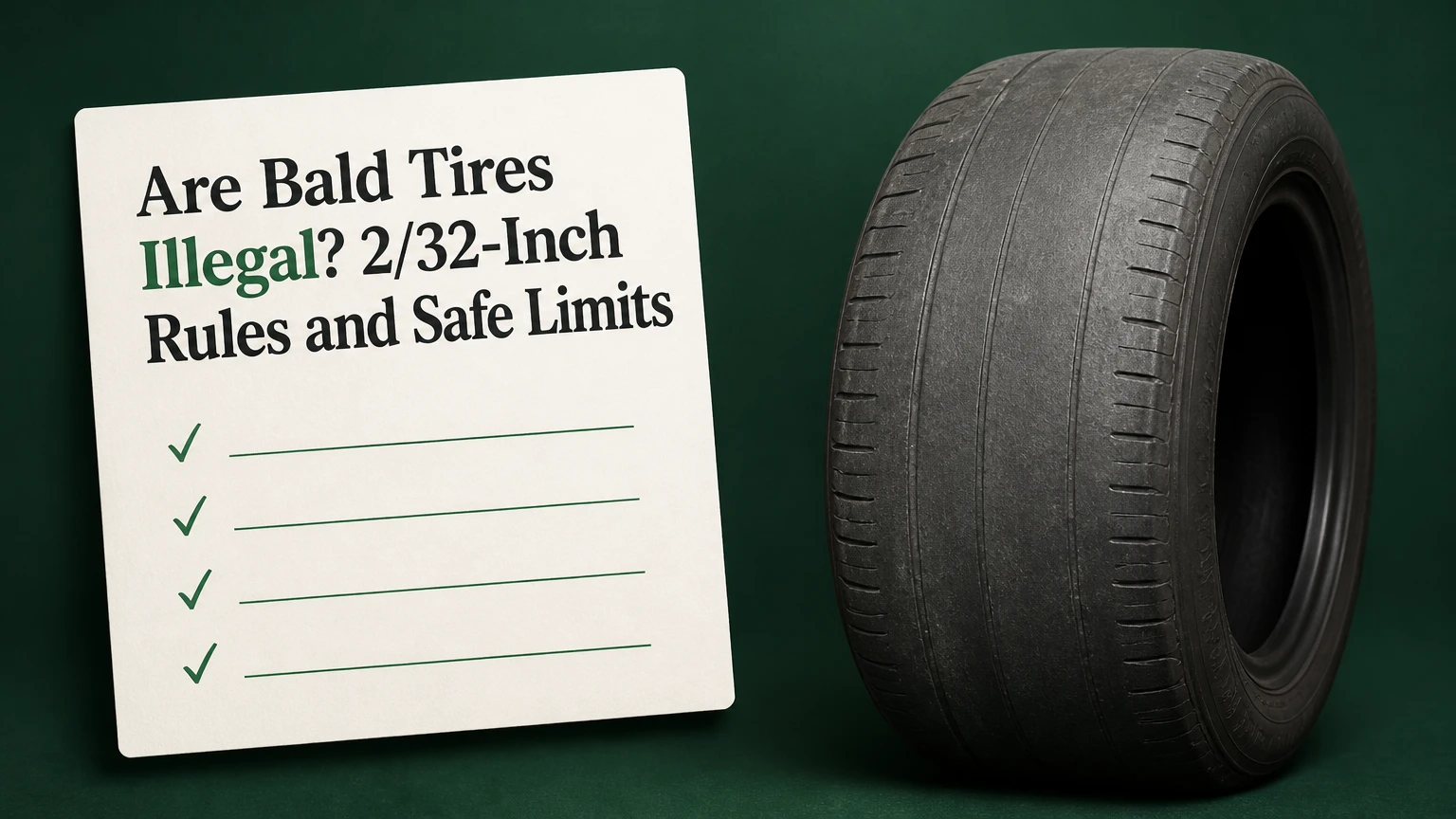
Bald tires are illegal to drive on public roads when their tread reaches the applicable legal minimum, commonly 2/32 inch, or when they have exposed cords, dangerous damage, or another safety defect. In the United States, passenger-tire rules are primarily state-based rather than one universal federal standard, so the exact enforcement rule depends on location and vehicle type.
Key facts at a glance
A passenger tire at or below 2/32 inch, or 1.6 mm, is commonly treated as legally worn out in the United States.
The United States has no single federal tread-depth rule covering every passenger vehicle; state statutes and inspections control.
FMCSA rules require at least 4/32 inch on commercial motor vehicle steer tires and 2/32 inch on most other applicable tires.
A tire can be illegal before reaching 2/32 inch if cords show, a belt is exposed, a bulge exists, or a serious cut compromises the structure.
Tire manufacturers and safety organizations commonly recommend replacement before the legal limit, especially at 4/32 inch for wet driving.
A penny test is a screening method; a tread-depth gauge gives a more reliable measurement across the tire.
What tread depth makes a tire legally bald?
A passenger tire is generally legally bald at 2/32 inch, or approximately 1.6 mm, in a major groove, but the precise legal test varies by jurisdiction. Many states also prohibit tires with exposed ply or belt material, tread separation, hazardous cuts, punctures, bulges, or localized wear even when another part of the tread measures above 2/32 inch.
The 2/32-inch figure is a legal floor, not a guarantee of safe braking. Tread depth is measured from the bottom of a principal groove to the top of the tread, not from the bottom of a sipe or a decorative channel. Factory-molded tread-wear indicators sit at approximately 2/32 inch. When surrounding tread becomes level with those bars, replacement is due.
The National Highway Traffic Safety Administration, or NHTSA, states that “Tires are the only part of your vehicle that makes contact with the road.” That small contact area must transmit steering, braking, acceleration, and cornering forces through water, dust, snow, and temperature changes.
Is the 2/32-inch rule federal in the United States?
The 2/32-inch passenger-tire threshold is widely used, but it is not a single federal rule that automatically governs every privately owned car nationwide. State vehicle codes, inspection regulations, and unsafe-equipment statutes determine whether a worn tire can produce a citation or inspection failure.
The frequently repeated claim that exactly 42 states mandate an identical 2/32-inch rule should not be treated as a substitute for checking the local statute. States differ in wording, measurement location, inspection practice, and treatment of visible damage. A state with no simple numeric threshold can still prohibit an unsafe tire.
For a definitive answer, check the state department of motor vehicles, highway patrol, vehicle-inspection manual, or legislative code. A tire shop’s opinion can identify a safety problem, but it cannot replace the governing law.
How do bald tires affect grip and stopping?
Bald tires retain some rubber contact on dry pavement, but their missing grooves cannot evacuate water effectively. In wet conditions, shallow tread increases the chance that water will form a layer between the tire and asphalt, reducing steering response and lengthening braking distance.
Tread grooves provide channels for water to escape from the footprint. Sipes create additional edges and small drainage paths, particularly on all-season and winter tires. As the grooves become shallow, the tire has less volume available to move water, and the vehicle becomes more sensitive to speed, rainfall depth, road texture, tire pressure, and vehicle weight.
Hydroplaning is not an on-off event at one universal speed. A worn tire can lose meaningful wet-road control at a lower speed than a new tire, while a new tire can also hydroplane in deep standing water. The driver may feel a light steering wheel, delayed response, or a sudden engine-speed change before complete loss of contact.
Bald tires also have less rubber protecting internal components from road debris and heat. A tire with exposed steel, fabric, or belt material requires immediate removal from service.
Why is 4/32 inch important if the tire remains legal?
Four thirty-seconds of an inch is a practical wet-weather planning threshold, not the universal legal limit for passenger vehicles. Tire manufacturers and automotive service organizations commonly advise replacing or closely planning replacement around 4/32 inch because rain performance has less safety margin well before the legal wear bar.
The exact stopping-distance change depends on tire model, road surface, temperature, speed, vehicle, and water depth. Claims that every tire’s wet stopping distance increases by exactly 40 percent at 4/32 inch are too broad to apply reliably. Treat 4/32 inch as a decision point, not a universal laboratory result.
For a driver in a dry climate, 3/32 inch may remain legally usable while replacement is scheduled. For a driver facing frequent rain, snow, mountain travel, or highway speeds, 4/32 inch deserves earlier replacement consideration. Winter tires need more tread depth to preserve their grooves and sipes in snow.
How do you check tread depth at home?
Measure the shallowest tread area in the inner, center, and outer portions of each tire, then compare the readings with the legal limit and the tire’s wear indicators. A complete four-tire inspection usually takes 10-15 minutes and requires a flashlight, a tread-depth gauge, and the vehicle owner’s manual or door-jamb pressure label.
Step 1: Inspect the tire safely
Park on level ground, switch off the vehicle, apply the parking brake, and turn the steering wheel to expose the front tires. For rear tires, move around the vehicle rather than reaching into an unsafe gap.
Look for missing tread blocks, nails, cuts, bubbles, exposed cords, and tread that is flush with the wear bars. Never place hands near a tire that is being moved, lifted, or serviced.
Step 2: Use a tread-depth gauge
Press the gauge’s base flat against the tread and place the probe in a major groove. Take at least three readings across the tread width and repeat the process at several points around the circumference.
Record the lowest number. A tire measuring 5/32 inch in the center but 1/32 inch on an inside shoulder has a serious wear problem, even though the average appearance may look acceptable.
Step 3: Check the wear bars
Find the raised rubber bars inside the longitudinal grooves. If the tread surface is level with a bar, that groove is approximately at the 2/32-inch replacement limit.
Wear bars do not reveal every defect. They may miss a localized bald patch between inspection points, and they do not measure sidewall damage, age cracking, or internal belt separation.
Step 4: Perform a coin test
Insert a U.S. penny into a major groove with Abraham Lincoln’s head facing downward. If the top of Lincoln’s head is visible, the tread is approximately 2/32 inch or less.
A quarter test provides an earlier warning. Insert George Washington’s head downward; if the top of Washington’s head is visible, the tire is approximately 4/32 inch or less. Coin tests are affected by viewing angle, groove shape, coin wear, and uneven tread, so use a gauge for a purchase or legal dispute.
What do different tread readings mean?
The following ranges distinguish legal status from practical risk. Local law, tire damage, weather, and vehicle category can change the outcome.
| Tread depth | Approximate metric value | Typical passenger-car decision | Practical meaning |
|---|---|---|---|
| 10/32-12/32 in | 7.9-9.5 mm | Normal service | New-tire tread and full groove volume |
| 6/32-8/32 in | 4.8-6.3 mm | Continue monitoring | Common mid-life range |
| 5/32 in | 4.0 mm | Usually serviceable | Reduced margin in heavy rain or snow |
| 4/32 in | 3.2 mm | Plan replacement | Wet-weather reserve is declining |
| 3/32 in | 2.4 mm | Inspect frequently | Legal in many locations, but limited rain margin |
| 2/32 in or less | 1.6 mm or less | Replace immediately | Common legal limit and wear-bar level |
A legal tread reading does not make a damaged tire safe. The lowest measurement and the most serious defect govern the decision.
How do U.S. tire laws work?
U.S. tire legality depends on the state, vehicle category, tire position, inspection rules, and condition of the tire. A law-enforcement officer or inspector may cite a tire under a numeric tread rule, an unsafe-equipment statute, or a defect provision even where the statute does not present a simple 2/32-inch table.
Typical consequences include a citation, repair order, failed safety inspection, prohibition on continued operation, or increased responsibility after a crash. Impoundment is possible in some circumstances, but it is not an automatic consequence for every worn passenger tire.
Insurance does not convert an illegal tire into a legal one. After a collision, photographs, inspection records, maintenance invoices, and tire measurements can become relevant to fault and claims. A bald tire does not automatically prove that its driver caused a crash, but knowingly operating unsafe equipment can worsen the legal position.
Can a state allow less than 2/32 inch?
Some state-law summaries report thresholds below 2/32 inch or rely on general unsafe-vehicle language, but those summaries can omit exceptions, vehicle classes, or inspection standards. California law, for example, should be checked directly rather than assumed from a national chart because its statute addresses tread and exposed material in specific terms.
Idaho and other states also require direct verification before relying on a claimed 1/32-inch allowance. The legally relevant question is not merely what a tire retailer or online chart says. It is which statute and inspection rule applies to that vehicle on that road.
Do commercial trucks have different limits?
Commercial motor vehicles covered by the Federal Motor Carrier Safety Regulations have stricter position-specific requirements. Under 49 CFR § 393.75, a commercial vehicle tire generally needs at least 4/32 inch in a major groove on steering axles and at least 2/32 inch in a major groove on other positions, subject to the regulation’s detailed wording and exceptions.
| Vehicle or tire position | Federal reference | Minimum tread depth | Operational implication |
|---|---|---|---|
| CMV steering axle | 49 CFR § 393.75 | 4/32 in | Affects out-of-service exposure and steering control |
| CMV other axle positions | 49 CFR § 393.75 | 2/32 in | Legal floor under the applicable federal rule |
| Passenger vehicle | State law | Commonly 2/32 in | Verify local statute and inspection standard |
| Winter tire in snow service | Manufacturer and local law | Often replace at 4/32-5/32 in | Legal minimum may be inadequate for snow traction |
Commercial operators also face roadside inspections, maintenance-record requirements, and potential out-of-service determinations. Fleet policies commonly remove steer tires before the federal minimum because a roadside failure can cost more than planned replacement.
What if only one section of the tire is bald?
A localized bald area can make a tire unsafe even when the rest of the tread is deep. Inner-shoulder wear, center wear, cupping, and diagonal wear often indicate incorrect inflation, poor alignment, worn suspension components, wheel imbalance, or a bent wheel.
| Wear pattern | Likely cause | Immediate check | Typical correction |
|---|---|---|---|
| Center strip worn | Overinflation or wrong tire pressure | Compare cold pressure with door label | Correct pressure, assess tire damage |
| Both shoulders worn | Underinflation or overload | Inspect pressure and load rating | Inflate correctly, inspect casing |
| One inner edge worn | Alignment or suspension fault | Measure camber and toe | Alignment or suspension repair |
| Scalloped patches | Imbalance, shock, or rotation issue | Check wheel balance and dampers | Balance, repair, rotate if permitted |
| One circumferential bald patch | Locked-wheel braking or severe defect | Inspect casing and brake system | Replace tire and diagnose vehicle |
Do not “fix” uneven wear by adjusting pressure beyond the manufacturer’s specification. Correct the underlying mechanical cause before fitting replacement tires, or the new tire may develop the same defect within a few thousand miles.
Can a tire be unsafe without being bald?
A tire can be illegal or unsafe without low tread depth because age, impact damage, separation, and air-loss defects are independent failure modes. A tire with 7/32 inch of tread still needs removal if it has exposed cords, a sidewall bulge, severe cracking, a puncture in a nonrepairable area, or visible tread separation.
Check the DOT Tire Identification Number on the sidewall. The final four digits identify the production week and year, so “2422” means the 24th week of 2022. Age recommendations differ by manufacturer, but many tire companies advise professional inspection after five years in service and replacement around six to ten years, regardless of remaining tread.
There is no single federal passenger-tire expiration date that automatically makes every tire illegal. Rubber compounds, storage, climate, ultraviolet exposure, inflation history, and service load affect aging. A tire shop should inspect deep circumferential cracks, sidewall weather checking, and deformation.
How do rules differ outside the United States?
The United Kingdom generally requires at least 1.6 mm of tread across the central three-quarters of the tread around the complete circumference for cars, light goods vehicles, and trailers, with additional requirements for the remaining tread area. Driving below the limit can lead to fines and penalty points for each defective tire.
Australia commonly uses a 1.5 mm minimum tread-depth requirement for road tires, although state and territory rules and vehicle categories must be checked. European requirements are not one universal rule for every country and vehicle, even though 1.6 mm is a widely recognized passenger-car benchmark.
| Location or system | Common stated minimum | Measurement qualification | Important caution |
|---|---|---|---|
| United States passenger cars | 2/32 in, 1.6 mm | State-specific major-groove rules | No universal passenger-car federal rule |
| United States CMV steer axle | 4/32 in, 3.2 mm | Major groove under FMCSA rules | Position-specific requirement |
| United States CMV other positions | 2/32 in, 1.6 mm | Major groove under FMCSA rules | Exceptions and vehicle details matter |
| United Kingdom | 1.6 mm | Central three-quarters around circumference | Remaining tread and damage rules also apply |
| Australia | Commonly 1.5 mm | State or territory road rules | Confirm local vehicle category |
| European countries | Often 1.6 mm | National implementation varies | Check the country’s inspection authority |
When should you replace a legal tire?
Replace a passenger tire before the legal minimum when its lowest reading reaches 4/32 inch in frequent rain, 5/32 inch for demanding snow use, or the tire shows age or structural damage. Legal operation and prudent replacement are separate decisions.
A typical U.S. replacement set costs approximately $400-$1,000 for four passenger tires, including a broad range of vehicle sizes and brands but excluding unusual performance tires, taxes, alignment, and disposal charges. Mounting, balancing, and alignment can add roughly $80-$200 depending on location and vehicle.
| Situation | Replace or service at | Typical action |
|---|---|---|
| Dry climate, even wear | 3/32-4/32 in | Schedule replacement and avoid postponing inspections |
| Frequent heavy rain | 4/32 in | Replace before the legal floor removes wet-weather margin |
| Snow and ice | 5/32-6/32 in | Preserve winter groove and sipe performance |
| Exposed cords or belt | Immediately | Do not drive on the tire |
| Sidewall bulge or major cut | Immediately | Use a spare or roadside service |
| Slow leak or repeated pressure loss | Same day | Inspect for puncture, valve, wheel, or internal damage |
Can you drive to a tire shop on bald tires?
If the tire is at or below the legal limit but has no exposed cords, bulge, rapid leak, or separation, the safest choice is a mobile tire service or towing. If driving a short distance is unavoidable, avoid highways, rain, standing water, heavy loads, and abrupt steering, and confirm that the tire is inflated correctly.
Do not drive a visibly damaged tire to a shop. A spare tire, roadside-assistance call, or tow is safer than relying on a coin test and hoping the tire survives the trip.
How can you prevent premature tread loss?
Check cold tire pressure monthly and before long trips, using the pressure on the driver-door label rather than the maximum pressure molded into the sidewall. Rotate tires according to the vehicle and tire manufacturer’s schedule, commonly every 5,000-8,000 miles when the vehicle permits rotation.
Have alignment checked after a pothole impact, suspension repair, steering symptom, or persistent one-edge wear. Keep tread readings and invoices when a vehicle is used heavily, because maintenance records reveal whether pressure, rotation, and alignment were managed consistently.
A practical inspection routine includes four actions:
- Check pressure when the tires are cold.
- Measure three tread positions on each tire.
- Inspect the entire circumference for damage and separation.
- Record the lowest reading and the DOT date code.
The most common measurement error is checking only the outside shoulder. Modern vehicles can wear the inside edge rapidly while the outward-facing tread still appears acceptable.
Frequently Asked Questions
Are bald tires illegal if I drive only in dry weather?
Usually, yes, when the tire is below the applicable legal minimum or has a prohibited defect. Dry pavement does not remove the legal requirement, and it does not eliminate blowout risk, debris exposure, or reduced emergency braking control. Weather changes during a trip can also turn a marginal tire into an immediate hydroplaning hazard.
Does tire pressure change the legal tread-depth reading?
Tire pressure can change the contact patch and accelerate uneven wear, but it does not legitimately restore missing tread. Measure a normally inflated tire and correct pressure using the door-jamb specification. Overinflation tends to wear the center, while underinflation commonly wears both shoulders and increases heat buildup.
Can I replace only one bald tire?
Replacing one tire can be acceptable on some two-wheel-drive vehicles when the replacement matches the existing tire closely, but axle-pair and all-wheel-drive requirements may require two or four tires. The vehicle manufacturer’s instructions determine acceptable tread-depth differences, especially for AWD systems.
Are worn tread bars enough to prove a tire is illegal?
Worn tread bars strongly indicate that the tire is near 2/32 inch, but they are not the only legal test. Inspectors can also consider exposed cords, cuts, bulges, tread separation, and localized bald spots. Measure multiple grooves and consult the applicable inspection standard when a citation or inspection decision is disputed.
Does a tire with good tread need replacement after six years?
Age alone does not create one universal passenger-tire expiration rule, but six years is a common point for professional evaluation and many manufacturers recommend replacement by approximately six to ten years. Cracking, hardening, storage damage, heat exposure, and repeated pressure loss can require earlier replacement.
What is the safest response to a tire at 2/32 inch?
Replace the tire before normal driving, particularly before highway travel or rain. A tire at 2/32 inch is at the common legal floor, not a reserve target. If cords, a bulge, separation, or a fast leak is present, do not drive to the shop; use a spare, mobile service, or a tow.
The Bottom Line
Are bald tires illegal? In most cases, yes. A passenger tire at or below 2/32 inch is commonly beyond the legal tread limit, while commercial steering tires generally face a 4/32-inch federal minimum under FMCSA rules. State and national rules differ, and damage can make a tire illegal before tread reaches the limit.
Measure the lowest tread point, inspect all three tread zones and the sidewalls, verify the local statute, and replace tires before the wear bars when rain or snow is common. The legal minimum is the last boundary, not the point at which a driver gains a safe margin.