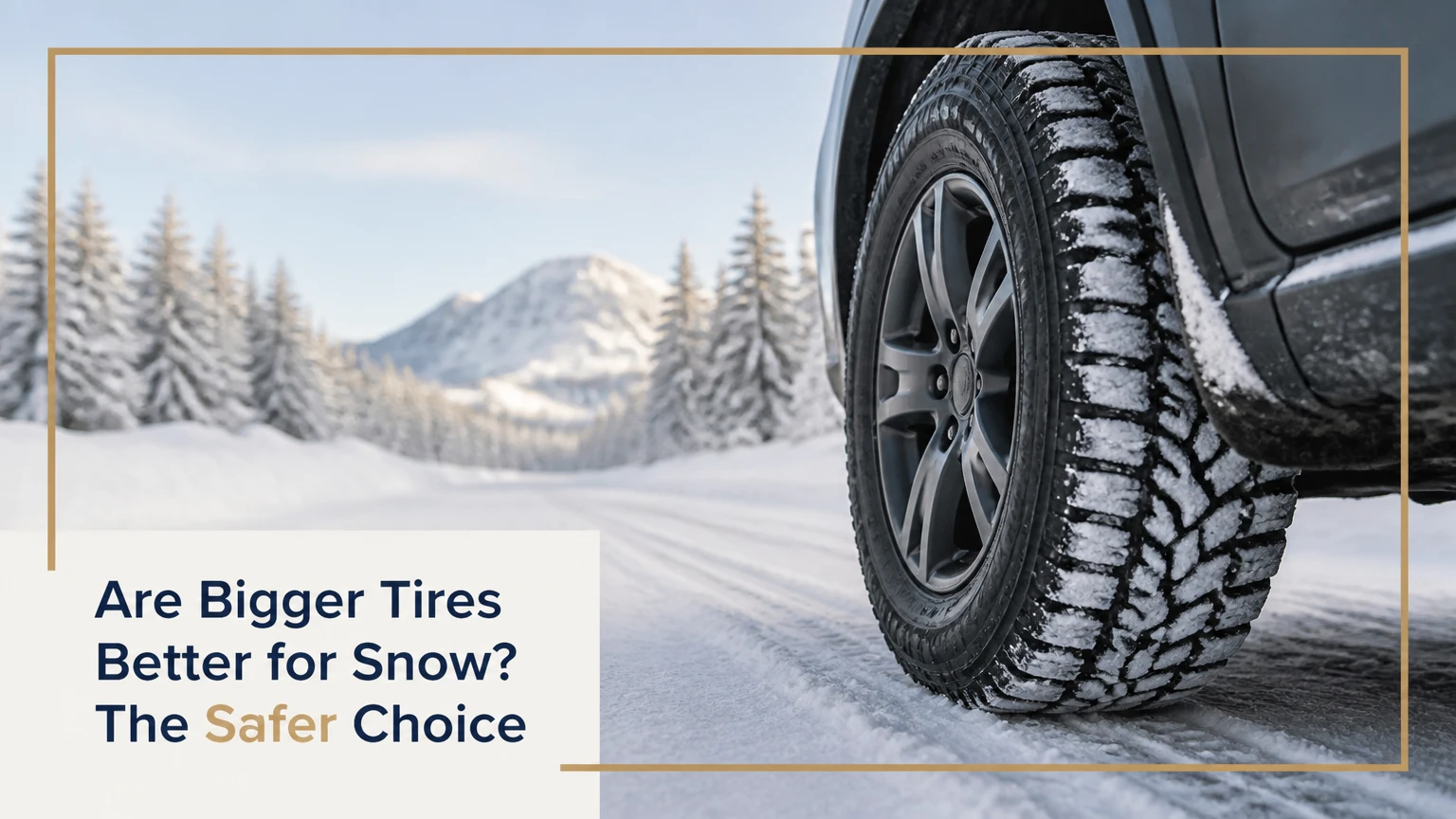
No, bigger tires are not automatically better for snow. If “bigger” means wider, a factory-width or slightly narrower winter tire usually cuts through packed snow and slush more effectively, while a wider tire may float and lose directional grip. If “bigger” means taller overall diameter, the main effects are ground clearance, gearing, speedometer accuracy, and fitment rather than a guaranteed increase in traction.
Key Facts at a Glance
Tire width affects how the tread interacts with snow; overall diameter mainly affects clearance and rolling circumference.
A factory-approved winter tire size is the safest default for most passenger cars and SUVs.
A narrower tire can help in deep snow and slush, but tire compound, tread design, inflation pressure, and vehicle weight also determine grip.
A winter tire with the Three-Peak Mountain Snowflake symbol meets a regulated severe-snow traction standard; an ordinary M+S marking does not provide the same assurance.
Winter tires remain more flexible than many all-season tires below approximately 7°C, or 45°F.
Never downsize without confirming load index, speed rating, brake clearance, wheel width, rolling diameter, and TPMS compatibility.
What Does “Bigger Tire” Mean?
“Bigger tire” can mean greater width, a larger wheel diameter, a taller sidewall, or a larger overall rolling diameter. Those changes produce different snow-driving results, so comparing only a number such as 18 inches or 245 millimeters can lead to the wrong conclusion.
A tire size such as 225/55R17 contains four useful measurements:
- 225: nominal section width in millimeters.
- 55: sidewall height as 55% of the section width.
- R: radial construction.
- 17: wheel diameter in inches.
Changing from 225/55R17 to a wider 245/50R17 increases width while keeping the same wheel diameter. Changing to 225/55R18 increases wheel diameter and usually requires a lower-profile tire to preserve rolling diameter. The second change does not automatically create more snow traction.
Width, Wheel Diameter, and Overall Diameter
| Change | What physically changes | Main winter consequence | Typical risk |
|---|---|---|---|
| 225 to 245 mm width | Tread and casing become wider | More flotation, potentially less cutting in slush | Hydroplaning, rubbing, tramlining |
| 17 to 18 inch wheel | More wheel, less sidewall at equal diameter | Sharper steering, less cushion over ice heaves | Wheel damage, reduced compliance |
| 55% to 60% aspect ratio | Sidewall becomes taller | More flex and pothole protection | Slower steering response |
| 26.7 to 27.5 inch diameter | Tire sits higher from the ground | More clearance under packed snow | Speedometer and gearing changes |
For winter use, “plus-sizing” usually means adding wheel diameter and reducing sidewall height. “Minus-sizing” usually means fitting a smaller wheel with a taller sidewall, while keeping the tire’s overall diameter close to the original specification.
Are Bigger Tires Better for Snow?
Wider tires are usually less advantageous in moderately deep snow, packed snow, and slush, but they are not universally worse. Narrower tires concentrate the tread into a smaller track and can reach firmer material sooner; wider tires spread the load and can remain afloat in loose, bottomless snow where sinking does not create useful traction.
The familiar “pizza cutter versus snowshoe” explanation is useful but incomplete. A vehicle’s tire load and inflation pressure largely determine the size of its contact patch, while tread width changes the patch’s shape and how the tread enters snow. A wider tire does not simply lose all grip because its total contact area becomes larger.
On a plowed road with a thin layer of snow, a high-quality narrow tire may offer a measurable practical advantage because its tread blocks encounter firmer pavement or compacted snow. On a trail covered by very loose powder, flotation can prevent the vehicle from digging down to the chassis. In that environment, a wider tire at an appropriate pressure may keep the vehicle moving.
The better rule is condition-specific: choose narrow or factory width for ordinary winter roads, and choose width based on flotation requirements only for specialized off-road use.
Which Tire Width Works Best in Common Conditions?
| Driving surface | Preferred width approach | More important tire features | Reason |
|---|---|---|---|
| Plowed pavement | Factory width or 10 mm narrower | Flexible compound, dense siping | Preserves contact with pavement and compacted snow |
| 10-20 cm of packed snow | Factory width or slightly narrow | 8-10 mm usable tread, open grooves | Limits snow packing and maintains steering |
| Wet slush at 80-110 km/h | Factory width or slightly narrow | Circumferential grooves, wet braking | Reduces the tendency to ride on slush |
| Bottomless powder off-road | Vehicle-specific wider setup | Low-pressure capability, flotation casing | Keeps the chassis from digging into snow |
| Glare ice | Factory width | Studs or severe-winter compound, many sipes | Width is secondary to ice-biting design |
| Cleared dry winter roads | Factory width or approved wide size | Cold-weather wet and dry braking | Avoids unnecessary fitment compromises |
Why Do Narrow Tires Often Work Better in Snow?
Narrow winter tires often work better because their tread enters a smaller track and can penetrate soft snow to reach denser snow or pavement. The advantage is strongest when the road has several centimeters of snow, slush, or ruts, and the vehicle needs forward and lateral control rather than maximum dry-road cornering.
Tread geometry also matters. Narrow tires can produce a longer, narrower contact patch when load and pressure remain comparable, which may help the tread maintain a continuous path through ruts. However, the result depends on the tire model, axle load, inflation pressure, and snow density.
The “higher ground pressure” claim should not be treated as a universal law. Contact-patch pressure is influenced by vertical tire load and inflation pressure, and a tire’s carcass stiffness changes how that load is distributed. Narrowness helps the tread shape and penetration in many road conditions, but it cannot rescue a worn all-season tire with a hardened compound.
What Tire Features Matter More Than Width?
A winter tire’s rubber compound remains flexible at low temperatures, allowing tread blocks and sipes to conform to irregular ice and compacted snow. Michelin identifies approximately 7°C, or 45°F, as the temperature around which winter tires begin to retain an advantage over many all-season tires.
The 3PMSF symbol indicates that a tire passed a standardized severe-snow traction test under the applicable tire regulations. The M+S marking is less demanding and may appear on tires that have no winter-specific compound or testing for severe snow.
Look for these attributes:
- 3PMSF certification: Useful for recurring snow and cold conditions.
- Deep, usable tread: Many manufacturers recommend replacement near 4/32 inch for winter performance, even where the legal minimum is lower.
- Sipes: Small slits create additional biting edges and help tread blocks flex.
- Open grooves: Longitudinal and lateral channels evacuate slush and loose snow.
- Cold-weather compound: Preserves flexibility below freezing.
- Stud capability: Metal studs can improve ice traction where local laws permit them.
Winter tire performance is a system. Width is only one variable.
Should You Use Narrower Winter Tires?
Use a narrower winter tire when the approved fitment reduces width by approximately 10-20 mm, preserves the required load capacity, and keeps overall diameter close to the vehicle’s original specification. Minus-sizing is most useful for drivers who regularly encounter unplowed roads, deep ruts, slush, and potholes.
Minus-sizing does not mean choosing the smallest tire that physically fits. The replacement must be approved for the vehicle and wheel, and the wheel must clear the brake caliper, suspension, and steering components throughout their movement.
A practical example is changing from 225/45R18 to an approved 215/55R17 winter package. The smaller wheel provides room for a taller sidewall, while the increased aspect ratio helps preserve overall diameter. The exact pairing must be confirmed through the vehicle manufacturer, tire manufacturer, or a qualified fitment database.
How Do You Downsize Winter Tires Safely?
- Read the door placard. Record the original size, recommended cold inflation pressure, and axle load information.
- Check the owner’s manual. Some vehicles list separate winter sizes and wheel diameters.
- Choose an approved width. A reduction of 10-20 mm is a typical starting range, not a universal rule.
- Match rolling diameter. Keep the replacement near the factory circumference; approximately 3% is a common practical limit, but the manufacturer’s specification controls.
- Confirm load index. The new tire must support at least the required front and rear axle loads.
- Confirm speed rating. Do not assume a winter tire with a lower rating is acceptable without checking local rules and the vehicle manual.
- Verify brake clearance. A 16-inch wheel may not clear brakes designed for a 17-inch minimum wheel.
- Check wheel width and offset. The rim must fall within the tire maker’s approved range and avoid suspension or fender contact.
- Plan TPMS. Install compatible sensors or follow the vehicle’s relearn procedure.
- Use four matching winter tires. Do not install winter tires only on the driven axle.
You will know the fitment is correct when the tire clears at full steering lock, the vehicle has no rubbing over compression, the TPMS system recognizes all wheels, and the speedometer remains close to actual speed.
Does Tire Diameter Matter for Snow?
Tire diameter matters mainly through ground clearance, sidewall height, gearing, and electronic-system compatibility. A taller tire can help a vehicle pass over deeper snow, but the larger diameter itself does not create more friction between tread and road.
A taller sidewall is often useful in winter because it absorbs sharp pothole edges, frozen ruts, and uneven road surfaces. A smaller wheel with a taller sidewall also costs less to damage than a large low-profile wheel in many winter environments.
Increasing overall diameter can cause the speedometer to read lower than the vehicle’s actual speed, reduce effective engine torque at the contact patch, and create rubbing. Some modern vehicles also use tire circumference in ABS, stability-control, and all-wheel-drive calculations.
| Tire setup | Sidewall example | Ground-clearance effect | Winter trade-off |
|---|---|---|---|
| 225/45R18 | 101 mm nominal | Factory reference | Precise steering, vulnerable rim |
| 215/55R17 | 118 mm nominal | Similar overall diameter | More cushioning, approved fitment required |
| 225/55R17 | 124 mm nominal | Similar overall diameter | Comfortable, common winter profile |
| 235/60R17 | 141 mm nominal | Noticeably taller | Clearance gain, possible rubbing and gearing change |
The three-percent guideline is not permission to alter any vehicle by 3%. It is a commonly used fitment threshold for keeping rolling circumference near stock. Vehicle-specific approval takes priority.
Which Winter Tire Type Is Best?
Studless winter tires are the best general choice for drivers who face cold pavement, packed snow, and occasional ice, while studded tires are stronger on repeated glare ice where local law permits them. 3PMSF-rated all-weather tires suit moderate winters, and ordinary all-season tires suit regions that rarely remain below freezing.
| Tire type | Temperature behavior | Best surface | Typical service pattern | Main limitation |
|---|---|---|---|---|
| Studless winter | Flexible below 7°C | Packed snow, cold pavement, mixed ice | Install when temperatures stay near 7°C | Faster warm-weather wear |
| Studded winter | Metal ice pins plus winter compound | Glare ice and hard-packed snow | Seasonal use where legal | Road noise, dry-road wear, restrictions |
| 3PMSF all-weather | Better cold flexibility than all-season | Mild to moderate snow and rain | Year-round use in moderate climates | Less severe-winter grip |
| M+S all-season | Broad temperature range, less winter-focused | Rain and occasional light snow | Year-round use | Harder compound and weaker ice grip |
The Three-Peak Mountain Snowflake symbol does not mean a tire stops a vehicle quickly on every icy surface. It confirms a defined severe-snow traction performance level, not immunity from physics.
Is a Wider Tire Better on Ice or Slush?
A wider tire is not generally better on ice or highway slush. Ice traction depends primarily on the compound, sipe design, tread temperature, and available surface texture, while slush performance depends on groove capacity, speed, pressure, and the tire’s ability to displace water and snow.
On wet winter pavement, a wide performance tire can provide strong dry-road cornering and braking when the road is clear. That advantage can disappear when slush fills the grooves or when the tire’s broad tread rides across ruts instead of following them.
Tire pressure also matters. Inflate every tire to the vehicle placard’s cold specification, measured before driving; do not lower pressure on public roads to imitate off-road snow practice. Underinflation can increase heat, shoulder wear, steering delay, and slush instability.
What Is the Best Width for an SUV or Truck?
An SUV or truck should normally retain its factory winter width unless the manufacturer lists an approved narrower package. Vehicle mass and ground clearance help a truck move through snow, but they do not eliminate the need for four suitable winter tires.
Off-road trucks are different from daily road vehicles. Low-pressure flotation setups, aggressive casings, bead-lock wheels, and oversized tires may work on private trails, yet they can compromise braking, steering, fuel economy, bearing loads, fender clearance, and stability on public roads.
For a road-going SUV, the most reliable winter configuration is usually a factory-approved wheel and tire package with a 3PMSF winter or all-weather tire, correct load index, and equal tires on all four corners.
What Does a Winter Tire Setup Cost?
A complete winter setup typically costs $720-$1,440 for four winter tires, plus approximately $240-$600 for four basic wheels, before taxes, mounting, storage, and TPMS components. Actual prices vary by tire size, vehicle class, brand, local labor rates, and whether the tires are studded.
| Item | Typical quantity | Typical unit price | Typical total |
|---|---|---|---|
| Passenger winter tire | 4 tires | $120-$250 | $480-$1,000 |
| SUV or truck winter tire | 4 tires | $180-$350 | $720-$1,400 |
| Steel winter wheel | 4 wheels | $60-$110 | $240-$440 |
| TPMS sensor | 4 sensors | $35-$80 | $140-$320 |
| Seasonal tire change | 2 visits | $60-$150 | $120-$300 |
A dedicated wheel set reduces repeated tire mounting and can make seasonal changes faster. Many shops complete a complete wheel swap in approximately 45-60 minutes, while tire dismounting and remounting may take longer.
Winter tires commonly last four to five seasons when drivers remove them promptly in spring, maintain correct pressure, rotate according to the manufacturer’s schedule, and retire them before the tread becomes too shallow for snow.
What Winter Tire Mistakes Reduce Snow Grip?
The most damaging mistakes are mixing winter and non-winter tires, selecting an incompatible size, ignoring pressure, and driving on worn or warm-weather-damaged rubber. These errors can outweigh the traction difference between a factory-width tire and a slightly narrower approved tire.
Installing Winter Tires on Only Two Wheels
Install four winter tires, including on front-wheel-drive and all-wheel-drive vehicles. Two winter tires can improve acceleration on the driven axle while leaving the other axle with less lateral grip, increasing the risk of oversteer or understeer during braking and cornering.
Assuming AWD Replaces Winter Tires
All-wheel drive helps a vehicle accelerate by distributing engine torque, but it does not create extra tire-road friction during braking. A front-wheel-drive vehicle with four quality winter tires can stop and turn more predictably than an AWD vehicle on four ordinary all-season tires.
Lowering Pressure for Public Roads
Use the placard pressure when the tires are cold. Winter temperatures reduce measured pressure, so check pressure regularly rather than compensating with an arbitrary adjustment; the placard already specifies the correct cold target for the vehicle.
Ignoring Tread Age
A tire can have legal tread remaining and still perform poorly if its compound has hardened from age, heat, or prolonged ultraviolet exposure. Check the DOT date code, inspect for cracks, and replace tires according to the manufacturer’s age guidance.
Choosing Appearance Over Fitment
Wide, aggressive tires can look appropriate on a truck yet perform poorly in highway slush if the tread design and compound are not winter-focused. Clearance, load rating, braking behavior, and severe-snow certification should outrank visual size.
Which Setup Should Different Drivers Choose?
The best winter setup depends on road surface, temperature, annual snowfall, and vehicle fitment rather than a universal preference for narrow tires. Factory width is the low-risk answer for most drivers, while minus-sizing makes sense when the vehicle manufacturer approves it and deep snow or potholes are routine.
Daily Commuter
Use the factory-approved size with a premium studless winter tire if temperatures regularly fall below 7°C and snow or ice is common. A dedicated wheel set is practical when seasonal tire changes occur twice each year.
Mountain or Rural Driver
Use an approved winter package that is factory width or 10-20 mm narrower, with a taller sidewall when available. Prioritize deep tread, open grooves, 3PMSF certification, and a compound designed for frequent packed snow and sub-freezing pavement.
Mild-Winter Urban Driver
Choose a 3PMSF all-weather tire in the factory size when snow is occasional and temperatures fluctuate above and below freezing. This option avoids seasonal storage, but it usually cannot match a dedicated winter tire on glare ice or repeated heavy snowfall.
Performance-Car Owner
Avoid widening the winter setup for appearance. Retain the factory width or use an approved narrower package with the required speed rating, because steering clearance, stability-control compatibility, and cold wet braking matter more than dry-weather cornering width.
Off-Road Snow User
Choose width and pressure around flotation, tire casing strength, and trail conditions only when the vehicle is used off public roads. Do not transfer an oversized off-road setup to highway driving without confirming braking, load, gearing, clearance, and legal compliance.
How Can You Check Your Winter Tires?
Check winter tires before the first cold-weather trip and repeat pressure and tread inspections monthly. A five-minute inspection can identify a pressure loss, damaged sidewall, missing stud, irregular wear pattern, or tread depth too low for snow.
Use this checklist:
- Read all four cold pressures against the door placard.
- Measure tread depth across the inner, center, and outer grooves.
- Inspect for cracks, bulges, punctures, and exposed cords.
- Confirm the DOT date code and tire model.
- Verify that all four tires share the required size and load rating.
- Relearn TPMS sensors after installing a second wheel set.
- Torque wheel nuts to the vehicle manufacturer’s specification.
- Recheck torque after approximately 80-160 kilometers if the wheel maker recommends it.
- Remove packed snow and ice from wheel barrels if highway-speed vibration appears.
- Replace tires that show uneven wear, because alignment problems reduce winter contact.
A vibration that begins after driving through wet snow often comes from frozen snow inside a wheel, not from tire width. Remove it safely with warm water, never boiling water, and inspect the wheel if vibration remains.
Frequently Asked Questions
Are 18-inch Tires Worse Than 17-Inch Tires in Snow?
Not automatically. An 18-inch tire may perform as well as a 17-inch tire if both use the same winter compound, tread design, load rating, and similar overall diameter. The 17-inch package usually offers a taller sidewall, more pothole protection, and lower replacement cost, which makes it a practical winter choice.
Should I Buy Winter Tires in the Same Size as My Current Tires?
Use the same size when it is the vehicle’s approved winter fitment and you want the simplest installation. A different size can work when the manufacturer approves it and the replacement preserves load capacity, speed rating, clearance, wheel width, TPMS operation, and near-stock rolling circumference.
Are All-Season Tires Safe in Snow?
All-season tires can manage light, occasional snow when temperatures are moderate, but many harden in sustained cold and provide less ice and packed-snow traction than winter tires. A 3PMSF all-weather tire is a stronger year-round choice for mild snow climates than a basic M+S all-season tire.
Do Snow Tires Improve Braking on Ice?
Dedicated winter tires can improve braking on cold, icy, and packed-snow surfaces because their compounds remain flexible and their tread includes winter-oriented siping. Studded tires can add ice traction where legal, but no tire eliminates the need for lower speed, greater following distance, and smooth inputs.
Can I Use a Narrower Tire Without Changing Wheels?
Sometimes, but only if the existing wheel width falls within the narrower tire manufacturer’s approved range and the tire clears the vehicle. A 10-20 mm width reduction may require a different aspect ratio or wheel, so a qualified tire shop should verify the complete fitment.
When Should I Remove Winter Tires?
Remove dedicated winter tires when temperatures consistently remain above approximately 7°C, or 45°F, and winter conditions have ended. Warm pavement accelerates wear in soft winter compounds, reduces handling precision, and can make seasonal tires less economical to operate through spring and summer.
The Bottom Line
Are bigger tires better for snow? Usually not when “bigger” means wider. For public-road winter driving, choose a factory-approved size or an approved 10-20 mm narrower package, pair it with four 3PMSF-rated winter tires, maintain placard pressure, and use a taller sidewall when the vehicle allows it. Width can help specialized off-road flotation, but compound, tread, fitment, and driving conditions determine safe winter performance.