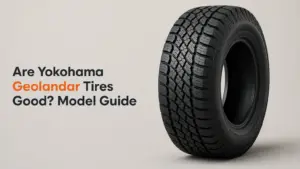
Some car tires are directional, but car tires are not universally directional. A directional tire must rotate in one specified direction, shown by a sidewall arrow or “Rotation” marking; symmetric tires have no required rolling direction, while asymmetric tires must be mounted with their “Inside” and “Outside” sides correctly positioned.
Key Facts at a Glance
- A directional tire has a specified rolling direction marked by an arrow or the word “Rotation.”
- Directional tread usually uses V-shaped or sweeping grooves to move water toward the shoulders.
- “Outside” and “Inside” markings identify an asymmetric tire’s mounting position, not necessarily its rolling direction.
- A directional tire can usually move from front to rear on the same side, but not from left to right without remounting.
- Tread pattern alone cannot determine wet or snow performance because compound, tread depth, inflation, and vehicle setup also matter.
- The vehicle owner’s manual and the tire sidewall markings take priority over generic rotation advice.
Are Car Tires Directional?
Yes, some car tires are directional, but many are not. The decisive test is the sidewall marking, not simply whether the tread resembles an arrow: a directional tire displays a rotation arrow or equivalent instruction that must point toward the front of the vehicle when the tire is rolling forward.
Directional tires, asymmetric tires, and symmetric tires are the three broad tread-pattern categories encountered on passenger vehicles. A tire can also combine characteristics, such as a tread that looks directional while carrying separate inside and outside mounting instructions, so visual inspection should confirm the manufacturer’s marking.
The distinction affects installation, rotation, noise, wet handling, and replacement decisions. A tire shop should never infer direction from appearance alone when the sidewall is available.
What does a rotation arrow mean?
A rotation arrow identifies the tire’s required forward rolling direction. When the vehicle moves forward, the arrow should point in the direction of travel at the top of the tire, or toward the front of the vehicle when viewed from the side.
The arrow does not identify the vehicle’s left or right side. The same directional tire design can fit either side, provided its arrow points forward. A left-side tire and a right-side tire may therefore have mirror-image-looking tread positions while still using the same tire model.
A tire marked only “Outside” and “Inside” has a mounting orientation. That marking means the labeled outside side must face away from the vehicle, but it does not by itself prove that the tire has a required rotation direction.
How Do Directional Tires Work?
Directional tires use angled grooves and tread blocks to channel water, slush, or loose material from the contact patch toward the shoulders. The design can improve straight-line wet traction and steering response in specific conditions, but it cannot eliminate hydroplaning because speed, water depth, inflation pressure, tread depth, and road surface remain decisive.
When a tire enters standing water, the tread must displace enough water for rubber to maintain contact with the pavement. A V-shaped pattern can create a preferred path for water movement, while broad grooves provide empty volume for fluid storage and evacuation.
Directional designs also commonly use continuous center ribs or interlocking blocks. Those features can sharpen steering response, although actual cornering performance depends on the tire’s rubber compound, casing, belt package, alignment, and operating temperature.
What directional tires are not good at
Directional tread is not automatically the quietest, longest-lasting, or safest choice. Some directional performance tires use soft compounds that wear faster than touring tires, and a limited rotation pattern can make front-to-rear wear differences more difficult to manage.
A directional winter tire is not necessarily a severe-snow tire. Look for the Three-Peak Mountain Snowflake symbol when severe-snow certification matters; the symbol reflects a standardized performance requirement, while a V-shaped tread alone does not.
What Are the Three Tread-Pattern Types?
Directional tires have a required rolling direction, asymmetric tires have a required inner and outer mounting position, and symmetric tires generally have no tread-side or rolling-direction requirement. These classifications describe installation geometry, not a complete ranking of tire quality.
| Tread pattern | Sidewall instruction | Typical rotation freedom | Common design purpose |
|---|---|---|---|
| Directional | “Rotation” plus arrow | Same-side front-to-rear | Water evacuation and responsive handling |
| Asymmetric | “Outside” and “Inside” | Vehicle-specific; often cross-rotatable if no arrow | Outer-cornering grip with inner wet traction |
| Symmetric | Usually no orientation instruction | Front-to-rear or cross pattern | Quiet touring, even wear, and low cost |
| Directional asymmetric | Arrow plus “Outside” and “Inside” | Same-side only unless remounted | Combined wet-channel and cornering design |
Directional versus asymmetric tires
A directional tire is defined by rolling direction. An asymmetric tire is defined by which half of the tread faces inward or outward. Some tires are both directional and asymmetric, which is why “Outside” alone cannot be treated as proof that a tire may roll in either direction.
For example, an asymmetric, non-directional tire may be moved from the left side to the right side if the tire remains mounted with “Outside” facing outward. A directional asymmetric tire cannot make that left-to-right move without removing the tire from the wheel and remounting it.
Symmetric tires
Symmetric tires repeat the same tread design across the tread width. Unless the sidewall adds a directional instruction, a symmetric tire can generally be mounted in either rolling direction, though the vehicle still imposes requirements for size, load index, speed rating, and approved wheel position.
Symmetric patterns commonly appear on commuter cars and touring tires because they support flexible rotation patterns. Flexibility can reduce uneven wear, but symmetric construction does not guarantee long tread life or low noise.
How Can You Identify Your Tire Type?
Inspect the tire’s sidewalls first, then compare the markings with the tread. A visible arrow labeled “Rotation” identifies a directional tire, while “Outside” and “Inside” identify mounting orientation; if neither instruction appears, confirm the model in the manufacturer’s fitment documentation before assuming the tire is unrestricted.
Use this inspection sequence:
- Turn the steering wheel or move the vehicle so the outer sidewall is visible.
- Search both sidewalls for an arrow, “Rotation,” “Direction,” “Outside,” or “Inside.”
- Photograph the marking if it is partly hidden behind a suspension component.
- Check every tire, because a vehicle may contain mixed models or a wrongly mounted replacement.
- Compare the sidewall instruction with the tread and tire model listed on the invoice.
- Ask a tire professional to verify the installation if the marking is illegible.
A V-shaped tread is a useful clue, but it is not conclusive. Directional arrows can be subtle, and some non-directional tires have sweeping grooves that look like arrows.
| Sidewall marking | Meaning | Correct installation test | Common error |
|---|---|---|---|
| Arrow plus “Rotation” | Required rolling direction | Arrow points forward on both sides | Treating left and right as interchangeable |
| “Outside” | Labeled side faces outward | “Outside” is visible after fitting | Mounting the tire inside-out |
| “Inside” | Labeled side faces inward | “Inside” faces suspension | Assuming the tire has no direction |
| No orientation marking | Usually unrestricted orientation | Confirm tire model documentation | Assuming every tire with no visible mark is symmetric |
Where Does Each Tread Pattern Work Best?
Directional tires suit drivers who prioritize wet-road evacuation or responsive steering, asymmetric tires suit drivers seeking a balance of wet braking and cornering, and symmetric tires suit ordinary touring use where quiet operation, flexible rotation, and purchase price matter more than specialized response.
| Driving situation | Usually suitable pattern | Why it can fit | Important limitation |
|---|---|---|---|
| Urban commuting | Symmetric touring | Flexible rotations and commonly lower cost | Does not guarantee maximum wet braking |
| Frequent heavy rain | Directional or asymmetric | Angled grooves can move water efficiently | Speed and tread depth still control hydroplaning risk |
| Dry performance driving | Asymmetric performance | Larger outer blocks can support cornering | Soft compounds may wear faster |
| Dedicated winter use | Certified winter tire | Cold-weather compound remains flexible | Tread direction alone does not establish snow rating |
| Mixed highway and touring | Symmetric or asymmetric touring | Noise and wear may be balanced | Confirm manufacturer rotation instructions |
| Staggered sports-car wheels | Directional or asymmetric, vehicle dependent | Matches front and rear size strategy | Rotation may be impossible without remounting |
The tire model matters more than the category label. A premium asymmetric touring tire may outperform a budget directional tire in wet braking, while a certified winter tire may outperform either in cold snow because its compound remains flexible below typical all-season operating temperatures.
Tire industry guidance consistently treats tread depth and inflation as safety variables. The National Highway Traffic Safety Administration states that “Tires are the only thing that connects your vehicle to the road,” a concise reason to assess the complete tire specification instead of selecting by tread shape alone.
How Should Directional Tires Be Rotated?
Directional tires should normally be rotated front-to-rear on the same side, following the vehicle manufacturer’s schedule. A left-front directional tire moves to left-rear, and a right-front tire moves to right-rear; crossing them to the opposite side reverses their rolling direction.
Before rotating, check the owner’s manual because front-wheel-drive, rear-wheel-drive, all-wheel-drive, and staggered vehicles can have different requirements. Many manufacturers specify inspection or rotation around 5,000-8,000 miles, but the manual and the tire condition take priority over a generic interval.
What changes with a staggered setup?
A staggered setup uses different front and rear tire widths or sizes. If the front and rear tires differ, they cannot be moved between axles, so directional tires may have no practical rotation path at all.
A professional tire shop can sometimes remount a tire on the opposite wheel to preserve its rolling direction, but that is not a normal at-home rotation. The shop must confirm wheel width, tire size, bead compatibility, load capacity, and the vehicle manufacturer’s instructions before changing positions.
What about AWD and four-wheel-drive vehicles?
AWD vehicles can be sensitive to tire circumference differences. Replacing only one tire or allowing substantial tread-depth differences may increase driveline stress on some systems, so the vehicle manufacturer’s replacement policy should be checked before mixing tires.
Typical tire-shop rotation service takes about 15-30 minutes and may cost approximately $20-$60 when not included with purchase. After wheel installation, lug nuts require the vehicle manufacturer’s torque specification, and tire pressure should be set from the vehicle placard rather than the maximum pressure molded into the sidewall.
What Happens When a Directional Tire Is Mounted Backward?
A backward-mounted directional tire may evacuate water less effectively and can produce unusual noise or handling, especially on wet roads. The tire is not automatically destroyed, but the wheel should be returned to a qualified tire shop so the tire can be removed and remounted with the arrow pointing forward.
Do not correct the problem by swapping the complete wheel to the opposite side. That may make the arrow point forward on one position while creating another incorrect installation elsewhere, depending on which tire is affected.
A tire mounted backward can still contact the road, which makes the error easy to miss in dry weather. Wet-road braking is the more relevant test, and a driver should not deliberately test the limit on public roads.
What Problems and Edge Cases Matter?
Directional-tire problems usually arise from incorrect mounting, restricted rotation, underinflation, alignment faults, or mixed replacement tires. The tread arrow is only one diagnostic clue, so vibration or noise should not be attributed to direction before checking balance, wheel damage, inflation, and suspension condition.
| Symptom | Likely causes | First inspection | Appropriate response |
|---|---|---|---|
| Roaring noise | Tread wear, cupping, bearing fault, aggressive pattern | Inspect tread and listen for speed-related changes | Check tires, balance, bearings, and suspension |
| Steering vibration | Imbalance, bent wheel, tire separation | Balance and inspect wheel runout | Stop driving if a bulge or separation appears |
| Scalloped tread | Worn shocks, imbalance, alignment, inflation | Run a hand over tread blocks | Correct the underlying fault before replacing tires |
| One shoulder worn | Incorrect alignment or pressure | Compare inner and outer shoulders | Obtain alignment and verify cold pressure |
| Arrow points backward | Incorrect mounting | Read every sidewall | Have the tire professionally remounted |
| Different tread depths | Uneven wear or partial replacement | Measure each tire | Follow AWD and axle-pair replacement guidance |
Can a directional tire be repaired?
A directional tire may be repairable if the puncture is within the repairable tread area, the damage is small, the tire has not been driven severely underinflated, and a professional inspection finds no internal damage. Directional status does not make a tire automatically unrepairable.
The U.S. Tire Manufacturers Association recommends that puncture repairs involve removing the tire for internal inspection and using a combination plug-and-patch repair, rather than inserting a plug from the outside alone. Sidewall and shoulder damage commonly requires replacement.
Can you mix directional and non-directional tires?
Mixing tire types is generally discouraged unless the vehicle and tire manufacturers permit it. Tires on the same axle should normally match in size, construction, load index, speed rating, and model specification, while AWD systems may require all four tires to remain closely matched in circumference.
A temporary spare is an exception with limited use. Follow its speed and distance restrictions, and do not treat a compact spare as a permanent replacement for a directional tire.
What Do Directional Tires Cost and How Long Do They Last?
Typical passenger-car directional tires cost about $100-$350 per tire, while ordinary symmetric touring tires often cost about $70-$180 and asymmetric performance tires commonly cost about $110-$300. Actual pricing depends on size, brand, speed rating, load index, seasonal compound, and local installation charges.
| Tire category | Typical tire-only price | Typical usable mileage | Rotation constraint |
|---|---|---|---|
| Symmetric touring | $70-$180 | 50,000-80,000 miles | Usually flexible |
| Asymmetric touring | $110-$240 | 40,000-70,000 miles | Check arrow and side markings |
| Directional performance | $100-$350 | 25,000-50,000 miles | Usually same-side only |
| Directional winter | $120-$300 | 20,000-40,000 seasonal miles | Same-side rotation is common |
These are typical planning ranges, not warranties. A performance tire used on a heavy SUV, driven aggressively, or operated with incorrect pressure can wear far sooner than a touring tire with the same nominal tread warranty.
Treadwear warranties, when offered, often exclude irregular wear caused by poor alignment, missed rotations, underinflation, suspension defects, or improper maintenance. Keep rotation and alignment records if warranty coverage matters.
Which Tire Pattern Should You Choose?
Choose a tread pattern based on climate, vehicle geometry, driving priorities, and maintenance flexibility. A symmetric touring tire is usually the practical choice for quiet commuting, an asymmetric tire fits drivers who value cornering and wet-road balance, and a directional tire fits a specific wet-performance or appearance preference when same-side rotation is acceptable.
Daily commuter
Select a symmetric or touring-focused asymmetric tire when low noise, predictable wear, and flexible rotation matter most. Check the wet-braking test results and treadwear warranty instead of assuming a visually aggressive pattern is safer.
Frequent heavy-rain driver
A directional or asymmetric design can be appropriate, especially when the tire also has strong wet-grip testing and adequate groove depth. Replace tires before the legal or manufacturer wear limit becomes the only remaining margin, because shallow grooves evacuate less water.
Performance-car owner
An asymmetric performance tire may offer stronger dry cornering because its outer tread shoulder can use larger, more rigid blocks. A directional performance tire can also work well, but the owner must accept same-side rotation and potentially faster wear.
Snow-belt driver
Choose a winter tire with the Three-Peak Mountain Snowflake designation when sustained cold, packed snow, or ice is common. Directional geometry can help slush management, but compound temperature range, siping, stud rules, and braking performance matter more than the arrow.
Staggered or AWD vehicle owner
Prioritize the vehicle manufacturer’s approved tire sizes and circumference limits. The best tread pattern is the one that meets those constraints while matching the required load index, speed rating, seasonal designation, and axle-pair replacement policy.
What Compatibility Rules Should You Check?
Confirm tire size, load index, speed rating, construction, seasonal category, wheel width, and orientation markings before purchase. A tread pattern that fits the wheel physically can still be unsuitable if its load capacity, diameter, speed rating, or rolling circumference conflicts with the vehicle.
Check these items on the sidewall and vehicle placard:
- Tire size: Match the approved width, aspect ratio, and wheel diameter.
- Load index: Meet or exceed the vehicle’s specified carrying capacity.
- Speed rating: Meet the vehicle manufacturer’s minimum rating.
- Seasonal type: Distinguish summer, all-season, all-weather, and winter designs.
- Orientation: Follow “Rotation,” “Outside,” and “Inside” instructions together.
- Age: Read the DOT date code and inspect for cracking, bulges, or deformation.
- Axle matching: Follow the manufacturer’s rules for replacing two or four tires.
- Pressure: Use the placard pressure, then inspect pressure when tires are cold.
A tire’s maximum molded pressure is not the recommended pressure for the vehicle. The placard, commonly found on the driver’s door jamb or fuel-door area, provides the vehicle-specific cold inflation value.
Frequently Asked Questions
Are all four tires on a car usually directional?
No. A vehicle may use four directional tires, four non-directional tires, or a mixture created by prior replacement. Inspect every tire individually because one incorrectly mounted tire can exist alongside three correctly installed tires.
Can directional tires go on either side of the car?
Yes, directional tires can usually go on either side when mounted correctly. The arrow must point forward on the left and right sides, so the tire may need to be mounted in a mirrored tread position relative to the vehicle.
Are asymmetric tires always directional?
No. Asymmetric tires require correct inside-outside mounting, but many asymmetric tires do not require a rolling direction. A tire marked with both “Outside” and a rotation arrow is directional asymmetric and must satisfy both instructions.
Do directional tires last longer?
Usually not as a category rule. Directional performance tires often use softer compounds and may last 25,000-50,000 miles, while touring tires can reach 50,000-80,000 miles under suitable conditions, but model, driving, pressure, alignment, and load determine actual life.
Should new directional tires go on the front or rear?
When only two tires are replaced, many tire-industry safety recommendations place the tires with greater wet traction on the rear axle to reduce oversteer risk. Confirm the vehicle manufacturer’s instructions, maintain matching axle sizes, and fit both directional tires with arrows pointing forward.
The Bottom Line
Are car tires directional? Some are, and the sidewall marking provides the reliable answer. A rotation arrow means same-side rolling direction, “Outside” means mounting orientation, and no orientation marking usually indicates a non-directional design after model verification.
Directional tires can provide useful wet-road and steering characteristics, but they are not automatically superior to asymmetric or symmetric alternatives. Choose by tire specification, climate, vehicle drivetrain, wheel layout, tread depth, and maintenance requirements, then rotate and replace the tires according to the vehicle and tire manufacturers’ instructions.