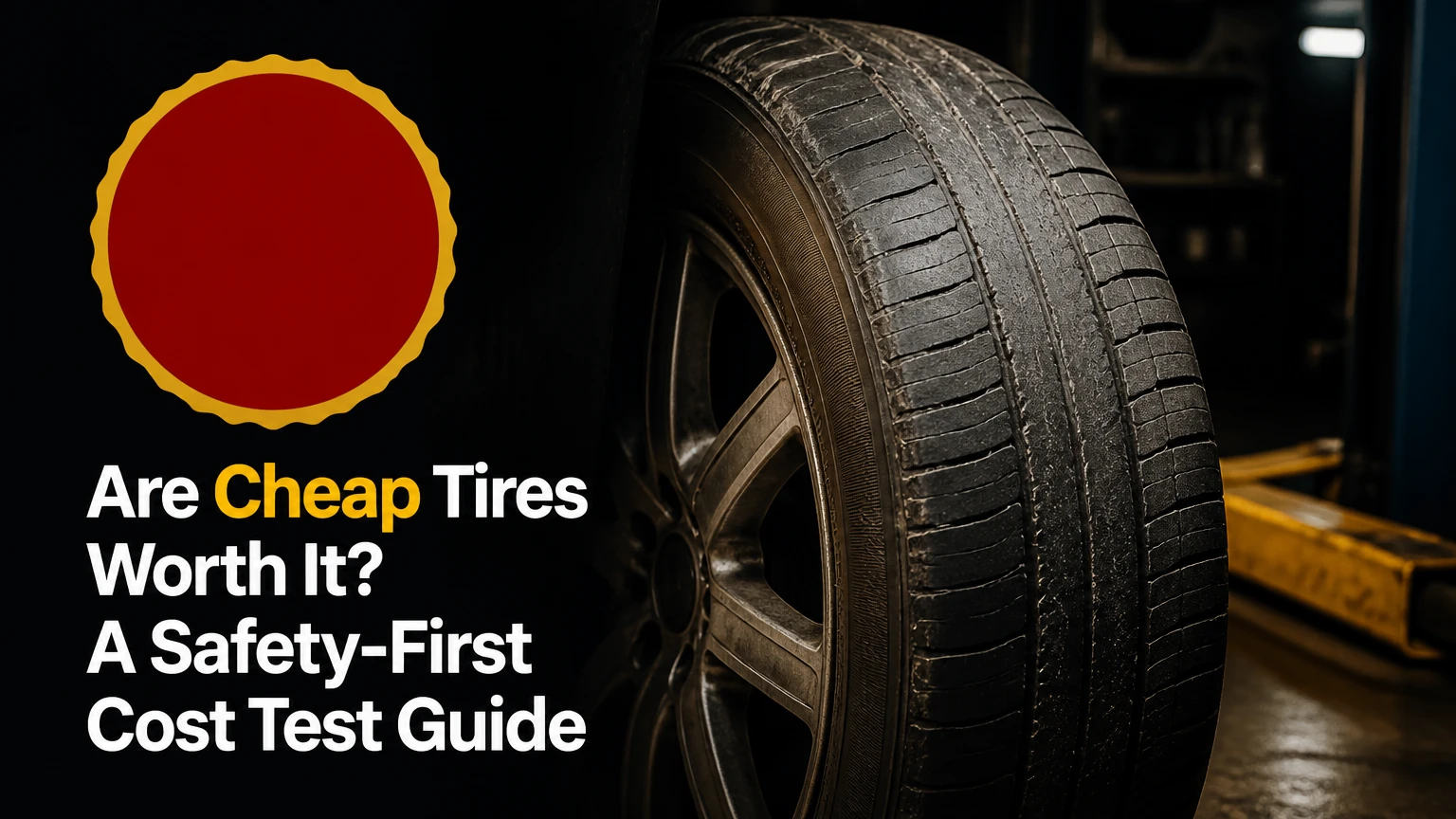
Cheap tires are worth buying only when the vehicle has modest demands, the tires correctly match the vehicle, and the lower purchase price is a genuine financial necessity. For frequent highway travel, heavy rain, snow, towing, or emergency handling, a reputable mid-tier tire usually delivers better wet grip, casing quality, and cost per mile than an ultra-budget tire.
Key Facts
“Cheap tire” is a price description, not a regulated performance category or safety rating.
A new budget tire is generally safer than a bald, cracked, or damaged tire, regardless of brand.
Tire age, load index, speed rating, inflation pressure, and wet traction matter more than the logo alone.
Typical mounting, balancing, disposal, tax, and alignment charges can add $25-$50 per tire.
UTQG treadwear numbers compare tires only within limited testing conditions and are not mileage guarantees.
Replacing only two tires requires careful axle placement; on most vehicles, the tires with deeper tread belong on the rear axle.
What does “cheap tire” actually mean?
A cheap tire is usually an entry-level model sold below the price of premium or specialized tires, often with fewer performance features, shorter warranties, or less extensive independent testing. The category includes legitimate private-label products, major-brand value lines, clearance inventory, and unfamiliar imported brands, so price alone cannot establish quality.
“Tire tier” labels are informal. A parent-company relationship also does not guarantee that every model shares the parent brand’s newest compound, tread design, or manufacturing controls.
Some examples frequently associated with value segments include General, Uniroyal, Laufenn, Kumho, Nexen, Cooper, and Toyo. Those names do not belong in one universal quality ranking. Cooper became part of Goodyear in 2021, General is associated with Continental, and individual models can differ substantially within the same company.
How are budget tires made less expensively?
Budget tires reduce cost through some combination of compound formulation, tread design, casing construction, production scale, warranty coverage, and product development investment. A simplified tread mold may use fewer design features, while a less specialized compound may prioritize wear resistance over low-temperature or wet-road grip.
Tire grip comes from chemical adhesion between rubber and pavement plus mechanical interlocking as the tread deforms into road texture. Silica, polymers, plasticizers, carbon black, tread depth, grooves, and siping affect how that contact behaves across temperature and water conditions.
A harder compound is not automatically unsafe. It can resist abrasion and deliver long tread life, but a tire optimized mainly for wear may produce less wet grip as temperatures fall or tread depth declines. The meaningful question is the model’s tested braking and handling performance, not whether its rubber is simply “hard.”
Are cheap tires safe?
Cheap tires can be safe when they are new, undamaged, correctly sized, properly inflated, and certified for the vehicle’s required load and speed. Safety standards establish a legal performance floor, but they do not make every compliant tire equal during wet braking, cornering, heat buildup, noise, or emergency maneuvers.
The National Highway Traffic Safety Administration advises drivers to inspect tire condition, pressure, tread, and age because tire failure can cause a loss of vehicle control. NHTSA’s consumer guidance describes tires as “the only thing between your vehicle and the road.” That contact area is small, which makes compound and construction meaningful.
A budget tire becomes a poor safety choice when it is the wrong size, overloaded, several years old, visibly cracked, poorly balanced, or selected for a climate it cannot handle. Electronic stability control and anti-lock brakes cannot create traction that the tire does not have.
Legal compliance is not the same as equal performance
A tire can meet the applicable Federal Motor Vehicle Safety Standards and still require more distance to stop in rain than a better-performing competitor. Generic claims such as “premium tires stop 25-30% shorter” should not be applied to every model, vehicle, speed, temperature, or road surface.
Independent comparison tests are more useful when they identify the exact tire models, vehicle, test speed, pavement, temperature, and remaining tread. A tire’s wet performance often changes significantly after wear, especially when its grooves no longer evacuate water effectively.
What is the real cost of cheap tires?
The real cost includes the purchase price, installation, taxes, disposal, alignment, premature replacement, fuel effects, and the consequence of reduced grip. Typical United States installed prices vary by wheel diameter, location, vehicle, and service package, but fixed labor can erase much of the apparent saving.
| Cost component | Typical budget tire | Typical premium tire | Why it matters |
|---|---|---|---|
| Tire price per unit | $50-$100 | $150-$300+ | Wheel size and vehicle type change the range |
| Mount and balance | $20-$40 | $20-$40 | Usually charged per tire |
| Disposal and shop fees | $3-$10 | $3-$10 | Often excluded from online tire prices |
| Four-tire installation | $90-$200 | $90-$200 | Paid again whenever replacement occurs |
| Four-tire total before alignment | $290-$600 | $690-$1,400+ | Typical retail range, not a quote |
| Alignment if needed | $80-$180 | $80-$180 | Prevents rapid, uneven wear |
A simple cost-per-mile calculation can reverse the sticker-price conclusion. Four $75 tires that last 30,000 miles cost about $0.010 per tire-set mile before installation. Four $190 tires that last 65,000 miles cost about $0.012 per tire-set mile. The premium set costs more overall, but the difference may be smaller than the original checkout price suggests.
Mileage is not guaranteed. Alignment, inflation, driving style, climate, vehicle weight, rotation frequency, and treadwear compound determine actual life.
How long do budget tires last?
Typical ultra-budget tires may deliver roughly 20,000-40,000 miles, while reputable value models may reach 40,000-65,000 miles under suitable conditions. Calendar age can end their useful life first for low-mileage drivers because rubber hardens and develops weather cracking even when tread remains.
| Tire category | Typical purchase price | Typical tread life | Common ownership outcome |
|---|---|---|---|
| Ultra-budget import | $50-$100 | 20,000-40,000 miles | Lowest entry price, frequent replacement |
| Established value model | $90-$150 | 40,000-65,000 miles | Balanced purchase and operating cost |
| Premium touring model | $150-$300+ | 55,000-85,000 miles | Higher initial cost, longer service interval |
| Performance or specialty tire | $140-$350+ | 20,000-50,000 miles | Grip or capability prioritized over longevity |
Treadwear warranties provide a useful comparison, but exclusions matter. Uneven wear, underinflation, poor alignment, commercial use, and failure to rotate can void coverage or reduce the adjustment.
Which tire specifications must match?
The replacement tire must meet or exceed the vehicle manufacturer’s required size, load index, speed rating, construction, and, where applicable, run-flat or extra-load specification. The door-jamb placard and owner’s manual take priority over a generic online size chart.
| Specification | Example | Minimum decision rule | Consequence of getting it wrong |
|---|---|---|---|
| Tire size | 225/65R17 | Match approved vehicle size | Clearance, gearing, or speedometer problems |
| Load index | 102, 850 kg per tire | Meet or exceed placard value | Overheating or overload risk |
| Speed rating | H, 130 mph | Meet vehicle requirement | Reduced heat and handling margin |
| Construction | Radial, R | Match the approved design | Incorrect fitment or handling |
| XL designation | Extra Load | Use when vehicle requires it | Lower load capacity than specified |
| 3PMSF marking | Mountain and snowflake | Required for severe snow service | All-season tire may lack winter capability |
| UTQG traction | AA, A, B | Compare model data cautiously | Wet-grip information is limited |
| DOT date code | 4024 | Check manufacturing week and year | Older inventory may have less usable life |
UTQG treadwear, traction, and temperature grades apply mainly to United States passenger tires. Treadwear numbers are comparative, not promises that a 600-rated tire will last twice as long as a 300-rated tire. Brand-to-brand comparisons are especially unreliable.
How do cheap tires compare with premium tires?
Cheap tires usually win on purchase price, while premium tires generally offer stronger wet braking, quieter operation, more consistent behavior near the wear bars, and broader engineering for temperature and road conditions. Mid-tier tires often provide the most defensible compromise for ordinary commuting.
| Decision criterion | Ultra-budget | Mid-tier value | Premium touring |
|---|---|---|---|
| Typical price per tire | $50-$100 | $90-$150 | $150-$300+ |
| Typical mileage range | 20,000-40,000 | 40,000-65,000 | 55,000-85,000 |
| Wet-road consistency | Model-dependent, often weaker near wear | Usually moderate | Usually strongest |
| Highway noise | Frequently higher | Moderate | Frequently lower |
| Warranty availability | Limited or short | Common, model-specific | Common, often longer |
| Winter capability | Rarely specialized | Some 3PMSF options | More specialized options |
| Best fit | Low-mileage, low-speed use | Daily commuting | High mileage and demanding conditions |
Premium does not mean invulnerable. A premium summer tire can be a worse winter choice than a less expensive severe-snow-rated tire. Correct category selection beats brand prestige.
Which option offers the best value?
For most drivers, a reputable mid-tier tire with the correct rating, current date code, and an adequate mileage warranty offers the best value. Ultra-budget tires make sense when cash flow is the binding constraint or the vehicle is driven very little; premium tires make more sense when wet-road exposure, annual mileage, or vehicle performance justify the extra cost.
How do cheap tires perform in rain and snow?
Cheap tires can perform acceptably in light rain when they have adequate tread depth and the correct pressure, but wet braking and hydroplaning resistance vary widely by model and usually deteriorate as grooves wear. Snow requires a separate assessment because ordinary all-season tread cannot provide the cold-weather flexibility and siping of a winter tire.
A driver in Phoenix making short, low-speed trips faces different demands from a driver in Seattle commuting on wet highways or a driver in Buffalo crossing packed snow. Temperature, water depth, tread depth, and speed can matter more than the retail tier.
For snow, look for the Three-Peak Mountain Snowflake symbol, not merely the words “all-season” or “mud and snow.” Dedicated winter tires remain the stronger choice for repeated subfreezing conditions, packed snow, and ice.
What changes as a tire wears?
Water evacuation becomes less effective as tread depth falls. The legal replacement threshold in the United States is commonly 2/32 inch, but wet-weather performance may decline well before that point, particularly if the tread design has narrow grooves or uneven wear.
Reduce speed in standing water and increase following distance during rain. A longer gap improves reaction time, but it cannot compensate for a severely worn or defective tire.
Who should avoid ultra-budget tires?
Drivers should avoid ultra-budget tires for frequent high-speed highway travel, heavy rain, severe winter conditions, towing, loaded SUVs, performance cars, and vehicles with sensitive all-wheel-drive systems unless the exact model has strong evidence for that use. The risk is greatest when a tire’s low price encourages a mismatch with the vehicle or environment.
High-mileage highway commuters
Choose a mid-tier or premium touring tire when annual driving exceeds roughly 15,000 miles or includes long highway stretches. Lower noise, longer tread life, stronger wet performance, and fewer replacement appointments can offset the initial difference.
Drivers who tow or carry heavy loads
Use the load index and inflation requirements specified for the vehicle and trailer combination. A tire designed for ordinary passenger use may not provide the heat, load, or sidewall margin required for towing.
AWD and performance vehicles
Replace tires in the pattern required by the vehicle manufacturer. Some AWD systems permit only a small circumference difference between tires, so installing two new tires beside two heavily worn tires can stress driveline components or trigger control-system faults.
Low-mileage city drivers
A budget tire can be reasonable for a car driven under about 5,000 miles annually at urban speeds, provided the driver checks age and cracking. Calendar replacement may arrive before tread exhaustion, making a 70,000-mile premium warranty economically irrelevant.
Can you mix budget and premium tires?
Mixing budget and premium tires is usually avoidable and can change handling balance because tread compounds, stiffness, traction, and wear levels differ. If only two tires are replaced, many tire-industry safety recommendations place the deeper-tread pair on the rear axle to reduce the chance of rear hydroplaning and oversteer.
Do not mix different sizes, construction types, or incompatible speed and load ratings. Follow the vehicle manufacturer’s instructions for directional tires, staggered fitments, run-flat systems, and AWD tolerances.
If a temporary replacement is unavoidable, use the same size and required rating, drive cautiously, and arrange a matched set as soon as practical. Never treat four mismatched tires as equivalent to four tires engineered as one set.
How do you buy budget tires safely?
Buy budget tires safely by verifying fitment, age, certification, retailer support, warranty terms, and installation quality before comparing prices. A low price from an established installer with current inventory can be better than a lower online price with uncertain storage, return, or defect handling.
- Read the door-jamb placard. Record the approved size, load index, speed rating, and cold inflation pressure.
- Check the DOT date code. The final four digits identify the production week and year, such as 4024 for week 40 of 2024.
- Confirm the exact model. Search independent tests and owner reports for wet braking, noise, snow, and wear rather than relying on the brand tier.
- Price the complete job. Include mounting, balancing, valve stems, TPMS service, disposal, taxes, shipping, and alignment.
- Inspect delivered tires. Reject visible cracks, bulges, bead damage, contamination, or unexpectedly old inventory.
- Request proper installation. Confirm torque to vehicle specification, dynamic balancing, valve condition, and TPMS relearning.
- Plan the first inspection. Check pressure after the first temperature change and inspect tread wear within 1,000 miles.
A new tire should not vibrate, pull, leak, or produce a persistent thumping sound after installation. Those symptoms require an immediate inspection, not a period of “breaking in.”
What are common budget-tire problems?
Common problems include rapid shoulder wear, cupping, vibration, wet-road instability, excessive noise, and premature cracking. Each symptom can also result from alignment, suspension, inflation, wheel damage, or incorrect balancing, so replacing the tire without diagnosis can waste money.
| Symptom | Likely tire-related cause | Other likely cause | First action |
|---|---|---|---|
| Steering-wheel vibration at 55-75 mph | Force variation or imbalance | Bent wheel or worn suspension | Request road-force balance and wheel inspection |
| Cupped, scalloped tread | Irregular casing or tread wear | Weak shock absorber or misalignment | Inspect suspension and alignment |
| Pulling to one side | Conicity or unequal pressure | Alignment or brake drag | Set pressures, then test alignment |
| Loud rhythmic roar | Aggressive tread or heel-toe wear | Bearing fault or cupping | Rotate, inspect, and compare sound by speed |
| Sliding in rain | Low wet traction or worn grooves | Excessive speed or standing water | Measure tread, reduce speed, replace if needed |
| Repeated pressure loss | Bead or valve leak | Wheel corrosion or puncture | Perform a leak test, including TPMS valve |
Expert rule: vibration is not normal
A slight change in steering feel is possible between models, but persistent vibration after installation is not an acceptable budget-tire trade-off. Ask the shop to measure radial force, inspect the wheel, and verify lug torque before blaming the compound.
Expert rule: alignment comes before mileage claims
A tire with a 60,000-mile warranty can be destroyed quickly by toe misalignment. Have alignment checked when the steering wheel is off-center, the vehicle pulls, or tread develops inner-edge wear; rotating a damaged tire only spreads the problem.
What are the alternatives to ultra-budget tires?
The main alternatives are clearance tires from a reputable retailer, established mid-tier models, used tires, retreads, and delaying purchase only when the existing tires remain safe. Mid-tier or clearance new tires are usually the most sensible alternatives because they preserve known fitment and warranty support.
| Alternative | Typical price position | Main advantage | Main risk |
|---|---|---|---|
| Clearance new tire | 10%-35% below current price | New casing and possible warranty | Older date code or discontinued model |
| Mid-tier value tire | 15%-45% above ultra-budget | Better balance of grip and life | Fewer specialized performance features |
| Used tire | $25-$80 each | Lowest immediate spending | Unknown repairs, age, and internal damage |
| Retread passenger tire | Uncommon for cars | Reuses casing material | Limited availability and model choice |
| Premium tire sale | 10%-25% discount | Better design at reduced price | Sale inventory may be size-limited |
Used tires deserve particular caution. A tire can have visible tread but hidden belt separation, a puncture repair near the sidewall, sun damage, or an unknown overload history. Never buy a used tire without inspecting the interior, sidewalls, repairs, date code, and uniformity.
Which drivers should choose cheap tires?
The right decision depends on weather exposure, annual mileage, vehicle requirements, and whether the purchase is a temporary financial solution. The following situations provide a more reliable answer than a universal yes or no.
| Driver situation | Recommended choice | Reason |
|---|---|---|
| Under 5,000 miles yearly, urban errands | Reputable budget or value tire | Low mileage limits the benefit of long warranties |
| 15,000+ highway miles yearly | Mid-tier or premium touring | Noise, wet grip, and replacement frequency matter |
| Frequent heavy rain | Mid-tier with strong wet-test results | Tread design and compound affect water evacuation |
| Regular snow and ice | 3PMSF all-weather or winter tire | Seasonal traction matters more than low price |
| Lease return with safe short-term use | Current, correctly rated budget tire | Meets the immediate replacement need |
| Emergency cash shortage | New budget tire from a traceable seller | Safer than bald, cracked, or damaged tires |
| Towing or heavy SUV loads | Load-appropriate value or premium tire | Heat and load capacity require margin |
| Sport sedan or high-speed driving | Performance tire with tested handling | Steering and emergency grip outweigh price |
FAQ
Are cheap tires good for a daily driver?
Cheap tires can work for a daily driver when the car travels short urban routes in moderate weather and the tires match the manufacturer’s specifications. Daily highway mileage, frequent rain, heavy loads, or cold winters justify moving to a reputable mid-tier tire with stronger wet performance and a longer tread warranty.
Should I buy cheap tires for a second car?
Cheap tires may suit a second car driven only occasionally, but infrequent use increases the importance of tire age, storage, and visual inspection. Check pressure monthly, inspect for sidewall cracks, and replace tires based on condition and age rather than waiting for tread to disappear.
Is a cheap new tire better than an expensive used tire?
A new, correctly rated budget tire is generally a safer purchase than an expensive used tire with unknown age, repairs, storage, or impact history. Used tires can be acceptable only when a qualified technician verifies the casing, repair location, date code, and absence of internal or sidewall damage.
Do cheap tires affect gas mileage?
Cheap tires can affect fuel economy through rolling resistance, weight, inflation stability, and tread design, but the result varies by model. Correct inflation usually has a larger immediate effect than brand price. Use the vehicle’s placard pressure, not the maximum pressure molded into the sidewall.
How often should budget tires be rotated?
Rotate budget tires at the vehicle manufacturer’s interval, commonly every 5,000-8,000 miles, unless the tire maker specifies differently. Inspect earlier when the vehicle has aggressive alignment settings, uneven wear, directional tread, or a history of cupping.
How old is too old for a budget tire?
Age limits depend on the manufacturer and tire condition, but many tire organizations recommend close inspection after five years and replacement around ten years from manufacture regardless of remaining tread. Heat, sunlight, ozone, underinflation, and long storage can shorten that interval.
The Bottom Line
Are cheap tires worth it? Yes, when the tire is new, correctly rated, current enough, professionally installed, and used on a low-mileage vehicle in moderate conditions. No, when the lower price substitutes for wet-weather capability, winter traction, load capacity, or long-distance reliability.
The safest value decision is usually a reputable mid-tier model, not the absolute cheapest listing. Buy the best tire that fits the vehicle and climate, calculate the installed cost per mile, and treat tread depth, tire age, inflation, and wet-road performance as safety requirements rather than optional upgrades.


