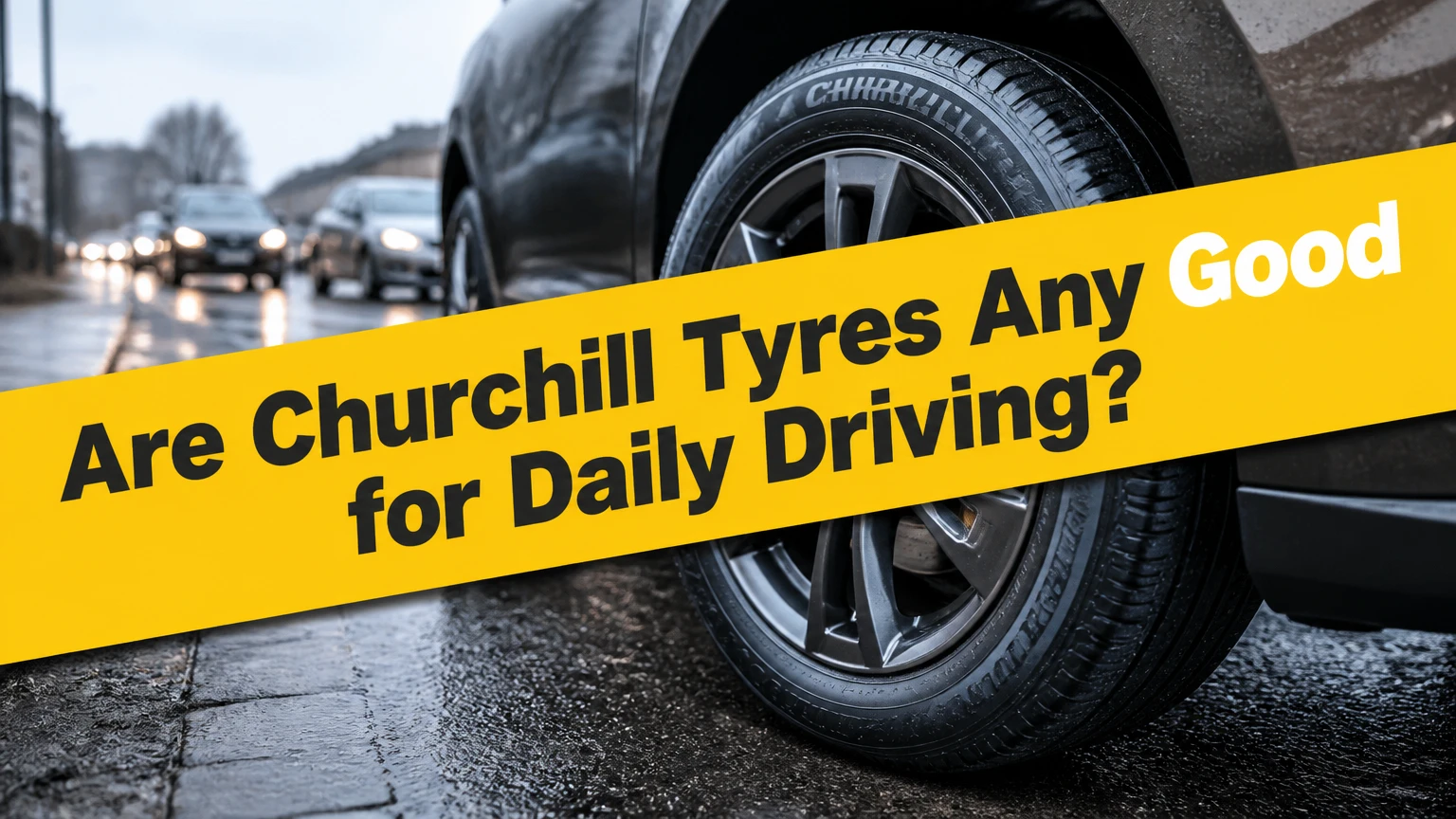
Churchill tyres are a reasonable mid-range choice for daily driving when the exact model has the correct size, load rating, speed rating, and a suitable EU label. They generally offer more support and warranty protection than unknown budget imports, but Michelin, Continental, Goodyear, and comparable premium tyres usually provide better wet braking, refinement, wear consistency, and handling at a higher price.
Key Facts at a Glance
- Churchill tyres are a UK-market private-label brand associated with Bond International and distributed through partner tyre dealers.
- Churchill models are commonly manufactured in China or Vietnam, with patterns developed for British road conditions according to distributor and retailer information.
- Current model specifications vary substantially, with wet-grip labels reported from A to C, fuel-efficiency labels commonly C or D, and external noise figures around 70-73 dB.
- A typical fitted price is approximately £60-£70 for a 205/55 R16, £75-£85 for a 225/45 R17, and £100 or more for larger SUV sizes.
- The Churchill lifetime guarantee is generally a pro-rata accidental-damage benefit, not an unlimited free-replacement promise.
- Churchill tyres suit ordinary hatchbacks, saloons, urban commuting, and older vehicles better than high-performance cars, demanding motorway use, or drivers who prioritise maximum wet-weather grip.
What Kind of Tyre Brand Is Churchill?
Churchill is a private-label tyre brand positioned between premium manufacturers and the cheapest unbranded imports. Bond International is identified in UK trade and dealer material as the brand owner or distributor, while Sailun Group is named in retailer and industry descriptions as a manufacturing partner.
Manufacturing location does not by itself prove that a tyre is safe or unsafe. A tyre made in China or Vietnam can comply with the same UK and European approval requirements as one made elsewhere, while quality still varies between compounds, casings, factories, sizes, and production batches. The useful questions are the tyre’s tested label, certification, manufacturing date, construction, dealer support, and performance for the intended vehicle.
Retail descriptions state that Churchill tread patterns are developed in the UK for British roads and use materials sourced from several countries, including natural rubber and reinforcement materials. Treat those statements as supply-chain information, not as proof that every Churchill model performs like a premium tyre. The model and size remain more important than the flag on the sidewall.
Are Churchill Tyres Safe Enough?
Churchill tyres are generally suitable for normal road use when they carry the required approval marks and match the vehicle manufacturer’s specification. Safety depends on the individual tyre’s wet-grip rating, condition, pressure, fitting quality, axle pairing, and the driver’s speed, so a blanket brand-wide safety rating would be misleading.
Check for the E-mark on the sidewall, the correct dimensions, the required load index, and a speed rating equal to or above the vehicle requirement. A Churchill tyre that is correctly approved and maintained is not automatically unsafe because it is made in Asia. However, a lower-cost tyre usually offers less performance reserve when braking hard in standing water or changing direction suddenly.
The UK legal minimum tread depth for cars is 1.6 mm across the central three-quarters of the tread and around the full circumference. TyreSafe states that drivers should replace tyres before reaching that legal limit because wet performance can deteriorate significantly as tread wears. A practical replacement threshold is often 3 mm for drivers who regularly face heavy rain, although that is advice rather than the legal minimum.
How Do Churchill Models Differ?
Churchill model names indicate different intended applications, but the size-specific product listing is the final authority. An RCB010 in one size may have a different label, load construction, or manufacturer detail from an apparently similar size, so buyers should inspect the actual tyre label before ordering.
| Churchill model | Typical application | Reported size range | Notable buying consideration |
|---|---|---|---|
| RCB008 | Family hatchbacks and everyday cars | 15-18 inches | Balanced cost and comfort for standard driving |
| RCB009 | Saloons, sporty hatchbacks, and larger cars | 16-22 inches | Check wet label and speed rating in the exact size |
| RCB010 | Performance-oriented cars | 16-20 inches | Some sizes carry an A wet-grip label |
| CSB007 | SUVs and crossovers | Varies by listing | Confirm XL or reinforced construction and load index |
The RCB008 is the conventional daily-driver option. It may suit a Ford Focus, Volkswagen Golf, Honda Civic, or similar car used for local journeys, school runs, and moderate annual mileage.
The RCB009 and RCB010 should not be treated as interchangeable. A sporty tread pattern does not turn an entry-level tyre into a track or high-performance product. Drivers of powerful rear-wheel-drive cars should examine the rear-axle load, traction needs, and wet-grip label particularly carefully.
SUV owners need more than a matching diameter. A heavier vehicle requires the correct load index, and some applications require XL, reinforced, or manufacturer-approved construction. A Churchill tyre with the wrong load rating can be unsuitable even when its width and rim size appear correct.
How Good Are Churchill Tyres in Wet Conditions?
Churchill wet performance ranges from acceptable to strong on paper, depending on the model and size. Reported EU labels range from C on some older or lower-positioned products to A on newer RCB010 sizes, but an A label does not mean identical wet braking to every premium A-rated tyre.
The EU tyre label grades wet grip from A to E, with A representing the shortest tested wet braking performance within the label system and lower letters representing progressively longer stopping distances. The label is useful for comparing tyres of the same size, but it does not cover aquaplaning resistance, cornering balance, cold-weather grip, steering feedback, or worn performance.
| Label or feature | Churchill range or example | What the driver can infer | What it does not prove |
|---|---|---|---|
| Wet grip | A-C, depending on model and size | Relative certified wet-braking class | Exact stopping distance on every road |
| Rolling resistance | C-D, commonly reported | Relative fuel-efficiency class | Actual litres per 100 km in one car |
| External noise | 70-73 dB in listed examples | Certified pass-by noise level | Cabin noise on coarse UK tarmac |
| Starting tread | Approximately 7 mm in some reports | Approximate new tread depth | Expected mileage without wear data |
A rainy urban commuter may find an A- or B-rated Churchill entirely adequate at normal speeds. A motorway driver who frequently brakes from high speed in heavy rain has more reason to pay for a tyre with independent test strength, stable handling, and predictable behaviour as the tread wears.
Tyre pressure has a larger immediate effect than many buyers expect. Underinflation increases heat generation, rolling resistance, shoulder wear, and steering delay; overinflation reduces the contact patch and can make the car less settled on uneven wet roads. Use the vehicle manufacturer’s pressure placard, not the maximum pressure moulded into the sidewall.
How Much Should Churchill Tyres Cost?
Churchill tyres typically cost about £60-£70 fitted in a common 205/55 R16 size, £75-£85 fitted in a 225/45 R17 size, and £100 or more for large SUV or 19-inch applications. The final invoice depends on location, stock, casing construction, disposal charges, valves, TPMS service, balancing, and alignment.
| Example size and vehicle type | Typical price per tyre fitted | Two-tyre axle total | Common cost variables |
|---|---|---|---|
| 205/55 R16 family hatchback | £60-£70 | £120-£140 | Valve, disposal, and alignment charges |
| 225/45 R17 medium saloon | £75-£85 | £150-£170 | XL construction and speed rating |
| 225/50 R18 performance car | £90-£120 | £180-£240 | RCB010 availability and TPMS |
| 235/55 R19 SUV | £100-£150+ | £200-£300+ | Load index, reinforced casing, and dealer stock |
A low headline price is incomplete if fitting excludes balancing or a new valve. Ask for the complete price before authorising work, including VAT, disposal, balancing, valves, TPMS servicing, and any alignment correction.
Churchill’s warranty can change the value calculation. A £70 tyre with a useful accidental-damage guarantee may be more attractive than a £60 tyre with no meaningful aftercare, but the guarantee has conditions and may require registration through the selling dealer.
What Does the Churchill Lifetime Guarantee Cover?
The Churchill lifetime guarantee is generally a pro-rata benefit for accidental damage, such as punctures or kerb impact, rather than a free replacement for the entire life of the tyre. A tyre with approximately half its usable tread remaining may provide a discount toward a replacement, subject to the policy wording and dealer process.
Warranty terms can change, and dealers may describe the benefit differently. Obtain the current written terms and confirm whether the following are included:
- Registration after purchase, and the deadline for completing it.
- Accidental puncture, kerb damage, and impact damage.
- Manufacturing defects and the evidence required for a claim.
- Pro-rata calculation based on remaining tread depth.
- Exclusions for incorrect inflation, racing, overloading, vandalism, and poor maintenance.
- Whether the guarantee applies to one tyre, an axle pair, or the original vehicle.
- Whether fitting, balancing, disposal, and delivery are included in the replacement.
The pro-rata calculation is the most commonly misunderstood part. If the policy values the tyre at £70 and determines that 50% of the eligible tread remains, the benefit may be around £35 toward a replacement, not a free £70 tyre. The dealer’s inspection and the exact policy formula control the result.
How Do Churchill Tyres Compare With Alternatives?
Churchill tyres are usually a sensible middle ground between anonymous budget products and premium tyres. The best alternative depends on whether the buyer values lower purchase cost, quieter motorway travel, independent test performance, longer wear, or warranty protection.
| Decision factor | Churchill | Premium brands | Reputable mid-range brands | Unknown budget imports |
|---|---|---|---|---|
| Typical 16-inch fitted price | £60-£70 | £90-£130 | £70-£100 | £45-£65 |
| Wet-label range | A-C by model and size | A-B commonly | A-C by model | C-E frequently seen |
| External noise examples | 70-73 dB | 68-71 dB commonly | 69-72 dB | 70-75 dB or unlisted |
| Typical service life | 20,000-30,000 miles, variable | 30,000-40,000+ miles, variable | 25,000-35,000 miles, variable | 10,000-25,000 miles, variable |
| Accidental-damage cover | Available through lifetime guarantee terms | Usually not standard | Dealer-dependent | Rare |
| Best use | Urban and ordinary mixed driving | High mileage and demanding driving | Balanced everyday use | Lowest initial cost |
Premium tyres can justify their price when a car covers 20,000 or more motorway miles annually, carries passengers regularly, or has strong braking and handling performance. A tyre that lasts longer and reduces noise may also lower the whole-life cost, even when its purchase price is higher.
Falken, Hankook, Kumho, and selected Uniroyal products are common alternatives for buyers seeking a recognised mid-range brand. Michelin, Continental, Goodyear, and Bridgestone usually occupy the premium tier. Compare exact sizes and independent tests rather than assuming every model within a brand performs identically.
Unknown imports may be cheaper, but purchase price hides the cost of poor wet braking, uneven wear, early replacement, and weak after-sales support. Churchill is normally the more defensible choice when the price difference is modest and the guarantee is documented.
Which Drivers Should Choose Churchill Tyres?
Churchill tyres are best for drivers who prioritise a controlled purchase price and ordinary road performance over maximum refinement. The decision changes with annual mileage, road type, vehicle power, climate, and the consequence of a long stopping distance.
City and Suburban Commuters
A commuter covering 6,000-12,000 miles a year in a small hatchback can reasonably choose a Churchill RCB008 or a similarly specified model. The purchase cost remains predictable, and the lifetime guarantee may help drivers who regularly encounter potholes and kerbs.
Choose the exact size and wet label carefully. Frequent short trips do not eliminate safety requirements because cold, wet tyres still need predictable braking.
High-Mileage Motorway Drivers
A driver covering 20,000-30,000 motorway miles each year should compare Churchill against premium and upper-mid-range alternatives. Lower noise, stronger high-speed stability, better wear consistency, and reduced rolling resistance can matter more than saving £25 per tyre.
A Churchill tyre is not automatically unsuitable for motorway use. The issue is value and performance reserve over many hours at speed, especially on wet roads with a heavily loaded vehicle.
Performance-Car Owners
Owners of high-powered BMW, Mercedes-AMG, Audi S, Porsche, or similar vehicles should normally choose a premium performance tyre or a thoroughly tested upper-mid-range alternative. RCB010 may be the most appropriate Churchill option where available, but model branding cannot compensate for limited steering feedback or traction reserve.
Do not fit a lower-rated tyre because it is cheaper. Match the vehicle’s speed and load requirements, and never mix a touring tyre with a fundamentally different performance tyre across the same axle.
Older Cars and Low-Value Vehicles
Churchill tyres can make economic sense on an older vehicle whose market value does not justify premium replacement costs. The safety conditions remain unchanged: the car still needs correct pressures, sound suspension, proper alignment, and tyres without age-related cracking.
A cheap tyre on worn shock absorbers is not a cheap safety solution. Mechanical condition determines how much of the tyre’s available grip reaches the road.
How Long Do Churchill Tyres Last?
Churchill tyres may last approximately 20,000-30,000 miles in ordinary use, but mileage is a typical practitioner range rather than a guaranteed product specification. Front-wheel-drive cars, aggressive cornering, incorrect alignment, underinflation, heavy loads, and frequent urban braking can reduce that figure substantially.
Measure wear across the inner, centre, and outer tread rather than checking only the visible shoulder. Inner-edge wear often indicates toe or camber problems, while scalloping or cupping can indicate worn dampers, imbalance, or suspension play.
Replace a tyre when it reaches the legal limit, develops bulges or cracks, suffers structural damage, repeatedly loses pressure, or becomes unsuitable for the vehicle’s season and use. Tyre age also matters. The Department for Transport and tyre-safety organisations recommend regular inspection of older tyres; check the four-digit date code on the sidewall, where the first two digits identify the production week and the last two identify the year.
Rotation can help equalise wear where the vehicle manufacturer permits it. A typical inspection interval is every 5,000-7,000 miles, but directional tyres, staggered sizes, and manufacturer-specific rotation rules may prevent front-to-rear movement.
Why Do Churchill Tyres Become Noisy?
Churchill tyre noise usually comes from tread pattern resonance, coarse road surfaces, or irregular wear rather than a dangerous defect. A droning sound that rises with road speed can also indicate a wheel bearing, so noise should not be dismissed as a normal budget-tyre characteristic.
Use this diagnostic sequence:
- Swap from smooth asphalt to a different surface and note whether the sound changes.
- Run a hand over the tread in both directions to detect saw-tooth or heel-and-toe wear.
- Check pressures against the vehicle placard.
- Inspect for uneven inner-edge wear.
- Ask a technician to check wheel bearings, balancing, alignment, and suspension joints.
A V-shaped or directional tread can produce more road roar on coarse asphalt than a comfort-focused premium pattern. Rotation may slow irregular wear, but it will not correct an alignment fault that caused the wear. Noise that appears suddenly, becomes louder while cornering, or is accompanied by vibration requires mechanical inspection.
How Should You Buy and Fit Churchill Tyres?
Buy Churchill tyres by verifying the vehicle specification, the exact model and label, the date code, and the complete fitted price before payment. Correct fitting determines whether the tyre’s certified performance is available on the road.
- Read the current tyre size. A marking such as 205/55 R16 91V identifies width, aspect ratio, radial construction, rim diameter, load index, and speed rating.
- Check the vehicle placard. Use the door pillar, fuel flap, handbook, or manufacturer data for approved sizes and pressures.
- Compare the exact model. Check wet grip, rolling resistance, noise, XL status, run-flat status, and speed rating for the listed size.
- Inspect the date code. Reject stock that is damaged, cracked, or unusually old, and ask the dealer how stored inventory is managed.
- Confirm the quote. Include VAT, fitting, balancing, valves, disposal, TPMS service, and alignment if required.
- Replace in axle pairs where possible. Fit the better or newer pair to the rear unless the vehicle manufacturer or tyre specialist gives a different instruction.
- Check the finished installation. Confirm pressures, torque, valve condition, bead seating, and the absence of vibration on the test drive.
- Register the guarantee. Keep the invoice, policy details, and registration confirmation in the vehicle records.
Never choose a tyre solely because the numerical size matches. Load index and speed rating are safety specifications, while XL construction may be necessary for a heavy SUV or loaded estate car.
What Are Churchill Tyres Not Good For?
Churchill tyres are not the strongest choice for drivers seeking the shortest possible wet stopping distances, premium motorway silence, precise steering feedback, or repeatable grip during enthusiastic driving. They are also a poor solution when the vehicle has worn suspension, incorrect geometry, or a tyre specification that the selected Churchill model cannot meet.
Churchill tyres may still work on an ordinary family car used within legal speeds and maintained correctly. The limitation is performance margin, not an automatic failure of basic road use. Premium tyres can give more warning before losing grip and may recover more predictably during an emergency manoeuvre.
Winter conditions deserve separate consideration. A standard summer Churchill tyre can remain legal in cold weather, but dedicated winter or all-season tyres may provide better cold-weather grip, snow traction, and braking below approximately 7°C. UK weather varies by region, so drivers in rural Scotland, upland Wales, or areas with regular snow should assess seasonal needs rather than rely on the brand’s price.
The Bottom Line
Churchill tyres are any good for daily driving? Usually yes, provided the chosen model has the correct specification, a credible wet-grip rating, fresh stock, and professional fitting. Churchill offers a practical value proposition for urban drivers, older cars, and moderate annual mileage, particularly when the written lifetime guarantee is included.
Churchill tyres are not equivalent to Michelin or Continental in every performance category. Drivers who cover high motorway mileage, demand low cabin noise, drive a powerful sports car, tow frequently, or prioritise maximum wet-weather reserve should compare premium or well-tested mid-range alternatives.
The sensible buying decision is model-specific: compare the exact size, label, load index, speed rating, fitted price, warranty terms, and independent performance evidence. A correctly maintained Churchill tyre is a defensible mid-range purchase, while an unknown import is rarely worth choosing solely to save a small amount.
Frequently Asked Questions
Are Churchill tyres made by Michelin?
No. Churchill tyres are a separate private-label brand associated with Bond International and reported by UK tyre retailers and trade sources as being manufactured by Sailun Group partners. Churchill and Michelin therefore have different ownership, product development, testing programmes, manufacturing arrangements, and dealer networks.
Can Churchill tyres pass an MOT?
Churchill tyres can pass an MOT when they meet the vehicle’s size and construction requirements and have at least 1.6 mm tread across the required central tread area, with no dangerous damage, exposed cords, bulges, or serious defects. An MOT pass does not prove that a tyre offers premium wet braking or long-term value.
Should Churchill tyres be replaced in pairs?
Replace Churchill tyres in axle pairs when practical, particularly if the remaining tyre has significantly different tread depth or performance. Fitment should follow the vehicle manufacturer’s instructions, and many specialists prefer the tyres with greater wet grip and tread depth on the rear to reduce oversteer risk.
Are Churchill tyres suitable for SUVs?
Churchill tyres can suit SUVs when the selected product has the required load index, speed rating, size, and reinforced or XL construction. SUV weight increases casing and braking demands, so a passenger-car version with the same diameter is not automatically appropriate for a crossover or large 4×4.
Is the Churchill lifetime warranty transferable?
Transferability depends on the current guarantee wording and the dealer that supplied the tyres. Do not assume the benefit follows the vehicle or a later owner. Keep the original invoice, registration record, and policy terms, then ask the authorised dealer whether a change of ownership affects eligibility.
Which is better, Churchill or a premium tyre?
A premium tyre is usually better for wet braking reserve, steering response, noise control, high-mileage wear, and performance consistency. Churchill is usually better for initial affordability and may offer stronger accidental-damage support through its pro-rata guarantee. For ordinary commuting, Churchill can be sufficient; for demanding driving, premium is the safer investment.